
The 90-Day Technology Strategy Plan for a New CEO, COO, or Board Chair
Your 90 Day Technology Strategy starts with pressure, not tools. Find real exposure, name owners, and force clear decisions before risk outruns governance.


Use your first 90 days to find the real exposure, name the owners, and stop technology from outrunning governance.
A new CEO, COO, or board chair inherits pressure fast. Growth is moving, reporting is lagging, and everyone wants answers before the next meeting. Buying another tool or asking for another dashboard will not fix a strategy problem.
Your first 90 days are about finding what is exposed, who owns each major decision, and where technology is helping or slowing the business. You do not need to solve everything. You do need to make the biggest risks visible and the next decisions defensible.
TL;DR
A 90 Day Technology Strategy is a leadership plan, not a shopping list for tools.
Start with three questions, what is exposed, who decides, and what changes first.
In the first 30 days, cut through the noise and find the few issues that could hit revenue, trust, operations, or compliance.
In days 31 to 60, turn each major issue into a choice, accept risk, fund mitigation, require a contract change, or plan an exit.
In days 61 to 90, set the cadence, metrics, and accountability so risk does not drift back into the shadows.
What a 90-Day Technology Strategy is, and what it is not
A good first 90-day plan is about risk posture, governance, and execution. That's the whole game.
Risk posture tells you what could break and where the business is exposed.
Governance tells you who owns the call, who funds the fix, and who escalates.
Execution tells you what gets done in the next 90 days, and how you prove it happened.
The point is simple, if you do not define the real problem early, you inherit noise instead of control.
The difference between a strategy and a status update
A status update tells you what is happening. A strategy tells you what matters, what to do first, and who decides.
A status update tells you what is happening. A strategy tells you what matters, what gets done first, and who makes the call.
That difference matters. You can sit through ten polished meetings and still not know whether the business is exposed, whether the right person owns the fix, or whether the board needs to act.
How to tell if you are looking at noise instead of real risk
Noise is easy to spot once you know the signs. You see vanity metrics, scattered priorities, unresolved risk acceptance, and reports that celebrate activity without showing change.
If the dashboard says "green" but no one can explain what got safer, you are not looking at control. You are looking at comfort. And comfort is not governance.
Your first 30 days: find the pressure points fast
The first month is a diagnostic sprint. You are not fixing everything. You are finding the few points where a failure could hit revenue, trust, operations, or compliance.
Ask for the shortest list of risks that could hurt the business most
Forget the long risk register for a minute. Ask management for the five to seven issues that could hurt the business now.
You want plain-English answers. Which systems matter most? Which customer or employee data is most exposed? Which vendor could slow the business, leak data, or break a promise? If AI is already in the mix, ask where it is used, who approved it, and what controls sit around it, then use the AI governance question pack to keep the discussion at board level.
Check whether reporting shows change, not just activity
Useful reporting answers three things. What changed? Why does it matter? What decision is needed?
Weak reporting shows tickets closed, scans run, or meetings held. That is motion, not insight. You want to know whether the exposure is shrinking, whether deadlines are slipping, and whether the business needs to fund, accept, or re-sequence a risk.
Map who owns the decisions that matter
This is where many first 90-day plans stall. The work is being done, but nobody owns the decisions.
You need to know who can accept risk, who can fund fixes, who can pause a project, and who escalates to the board. The accountable owner should be a business leader, not just security or IT. If you cannot name the owner, you do not have ownership.
Your second 30 days: turn what you found into decisions
By day 31, the job changes. You have enough signal to make choices. Now each major issue needs a lane, a cost, a timing view, and one accountable owner.
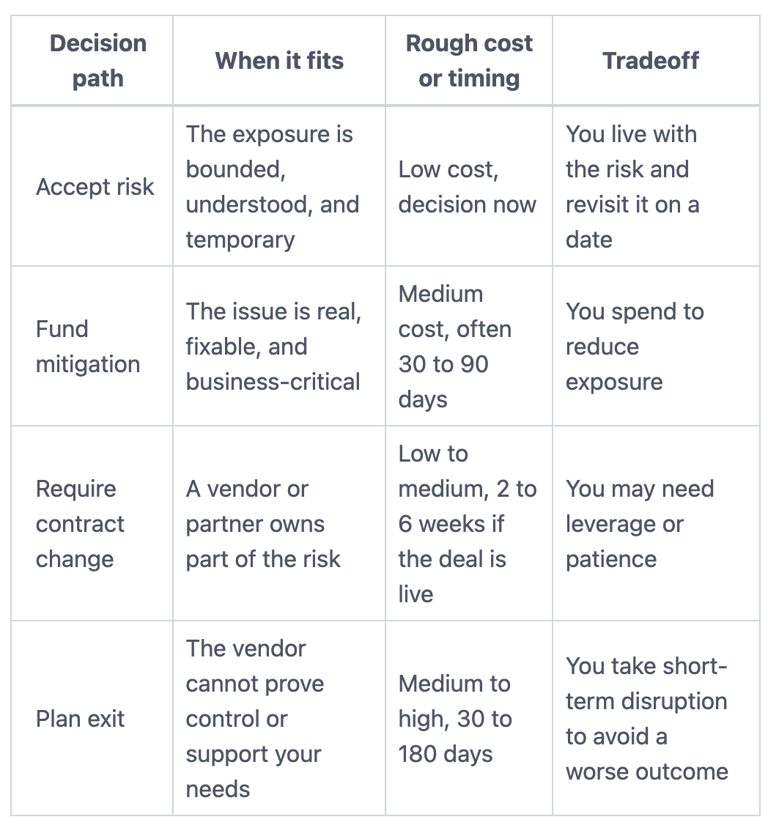
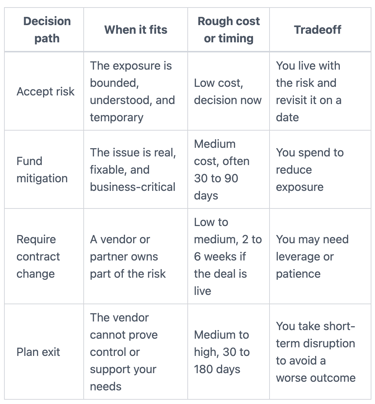
Use this table as a starting point, not a script. The important part is that you choose. "We are looking into it" is not a decision.
Do not let weak vendor evidence become a false comfort
Third-party risk is where a lot of leaders get lulled into false safety. If the vendor says it is covered, ask for the proof.
Look at subcontractor clauses, data deletion terms, and exit support. If the vendor's evidence is thin, say so. Then validate with sampled controls testing, limited access, segmented systems, and compensating monitoring. Trust matters, but verification matters more.
Assign one owner and one date for each open item
Open items drift when ownership is fuzzy. So every item needs one business owner, one due date, and one reporting date back to leadership or the board.
You also need a small set of milestones. Confirm scope by one date, mitigation plan by another, and closure evidence after that. That is how you stop the work from turning into "we'll look into it."
Your final 30 days: lock in the operating rhythm
By day 61, the work should feel less like a project and more like a habit. If it only lives in one memo, it will fade.
Set the meeting rhythm that keeps risk from drifting
Keep the cadence simple. A weekly leadership check-in, a biweekly issue review, and a monthly board-ready summary is enough for most teams.
Add a clear escalation path for major incidents or missed deadlines. If the issue is severe, the CEO, board chair, or audit lead should not hear about it late. They should hear about it on time, with the next decision already framed.
Define the metrics that matter to the board
The board does not need a flood of data. It needs proof that risk is moving in the right direction.
Focus on a small set of measures, time to fix critical issues, recovery readiness, vendor coverage, unresolved exceptions, and evidence that controls were tested, not just listed. That is the difference between busy reporting and board-ready reporting.
Make sure compensation and performance support the plan
If leaders are measured only on speed or output, risk work gets pushed aside. That happens fast.
Tie senior performance goals to outcomes that matter, fewer critical exceptions, better recovery results, cleaner vendor coverage, and shorter closure times. If you want the plan to stick, your scorecards have to match it.
The mistakes that make the first 90 days fail
The biggest mistake is starting with technology before the business problem is clear. The second is letting vague ownership survive the first meeting.
You also want to avoid these traps:
You treat activity as progress.
You accept reports that do not show change.
You let the loudest voice decide the risk.
You keep open issues alive without a decision.
You tell yourself the vendor evidence is good enough when it is not.
If you do not define decision rights early, you get a busy room and a slow business.
A simple 90-day checklist you can use right away
If you want a quick read on whether your oversight is real or ceremonial, See Where Your Board Actually Stands is a useful place to start.
Use this checklist in your next leadership or board conversation:
Name the top business technology risks in plain English.
Confirm one accountable owner for each risk.
Review the most critical vendors, subcontractors, and exit terms.
Check incident readiness, escalation paths, and who calls whom.
Decide what gets accepted, funded, fixed, or exited.
Set the next reporting date and the one metric that proves progress.
That list is short on purpose. Short lists get used.
Conclusion
Your first 90 days are not about proving you know every system. They are about turning technology from a source of noise into a source of better leadership decisions.
You do not need perfection. You need the biggest risks named, real owners assigned, and a rhythm that keeps follow-up visible.
If you want help pressure-testing what you are seeing and building a defensible path forward, Get Board-Ready on AI and Cyber Risk.
Tyson Martin is the executive public and pre-IPO companies in financial services, AI/data, SaaS, and cloud hire to make trust a measurable asset, one accountable answer to Is it secure? Is it resilient? Is the AI governed?
© 2026. All rights reserved.
Navigation
Free Resources
Contact


Stay ahead of your next board agenda
Sign up for Reports & Learnings From the Boardroom. Plain-English AI and cyber governance insights, biweekly. No pitch.
No spam. Unsubscribe anytime. · Or download the Director's AI Question Pack — 25 questions free