AI Decision Rights: What the Board Owns, What Management Owns, and What Must Be Escalated
Board AI decision rights management gets clear here: who approves, who escalates, and how you keep AI risk, vendors, and oversight defensible.


A plain-English model for approvals, escalation, and defensible oversight.
AI approvals are landing on your desk faster than your board calendar can absorb them. You are being asked to sign off on new tools, new use cases, new vendors, and new risk calls, while the business wants speed and the board wants proof that someone is in charge.
That is why AI decision rights are a strategy problem, not a policy problem. When ownership is fuzzy, approvals slow down, risky work slips through, and nobody has a clean answer when the question gets harder.
If your board is also trying to tighten cyber and AI oversight together, pair this with the AI boardroom question pack. It gives you a sharper starting point before the next committee meeting.
TLDR
The board sets the boundaries, risk appetite, and major exceptions.
Management owns the program, the controls, and the routine calls inside approved guardrails.
Escalation should be driven by business impact, not technical drama.
If the AI touches sensitive data, customer decisions, or legal exposure, the board needs visibility.
A short decision record beats a long memo that nobody can use.
The real problem is not AI, it is unclear decision rights
The real issue in AI decision rights board management is not whether you should use AI. It is who gets to decide what. If you do not name that clearly, every approval turns into a small negotiation, and every negotiation takes time.
This is not a tool list. It is not a policy binder. It is the map that tells you who can approve a model, who can accept risk, who can change the data source, and who must escalate the call.
When the map is weak, people start working around it. They get quiet sign-offs. They chase the loudest executive. They launch first and document later. That is how you end up with decisions that are hard to defend when a customer, regulator, or director asks what happened.
Harvard Law School's board guidance on AI and directors' roles gets to the same point. The board needs enough visibility to govern material risk, not enough detail to run the work.
What happens when everyone can say yes, but no one can own no
Shared responsibility sounds safe until something goes wrong. Then it turns into shadow approvals, rushed launches, and a lot of finger-pointing.
You see it when a business leader says yes, security raises a concern, procurement pushes the vendor through, and nobody owns the final no. The project ships anyway. The problem shows up later, when everyone wants to know who approved the shortcut.
Why the board needs clarity before the first incident
You do not want to learn the ownership map during a customer complaint, a model failure, or a disclosure issue. By then, the confusion is part of the record.
Clear decision rights make escalation faster. They also make board oversight easier to explain later, because the line between management authority and board authority was drawn before pressure hit.
What the board owns, what management owns, and where the line sits
A clean split keeps you out of two bad habits. The first is board micromanagement. The second is management hiding behind "we'll handle it."
Here is the simple model.
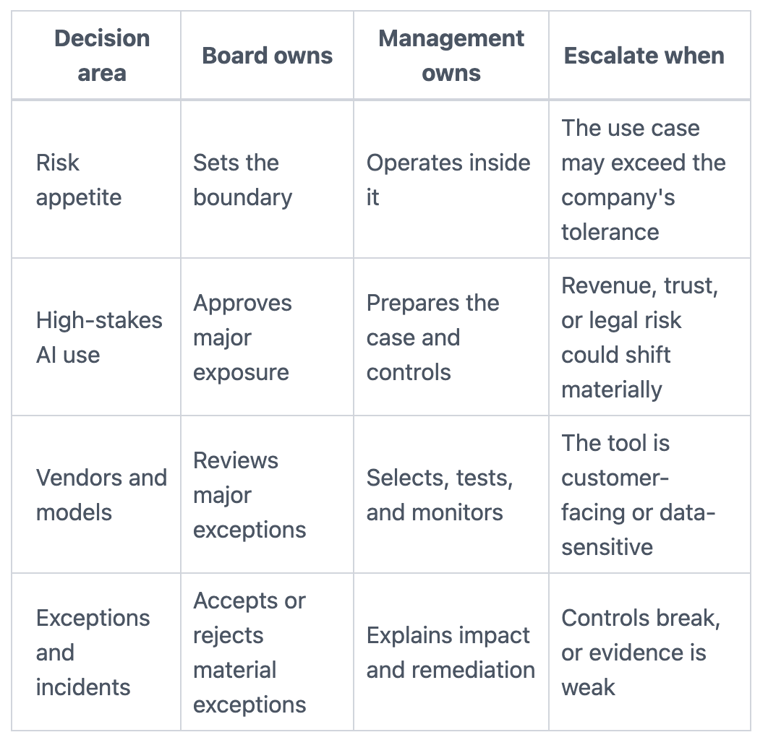
The takeaway is simple, the board sets the line, management works inside it, and escalation happens when the line might move.
The board owns appetite, boundaries, and material risk calls
The board should decide how much AI risk the company is willing to carry. That includes what kinds of use are off limits, what needs formal approval, and which exceptions need a director-level look.
If the AI use case creates legal exposure, reputational damage, or a major policy exception, it belongs in the board lane. Directors do not need to inspect every feature. They do need to know which decisions can change the shape of the business.
Management owns design, controls, and daily operating decisions
Management should run the program. That means choosing vendors, building controls, testing outputs, monitoring drift, and handling routine approvals inside the guardrails the board already set.
You do not help anyone by sending every small question upstairs. If the use case is low risk and fits the approved policy, management should move it. That is the point of having a management team.
The line shifts when the risk becomes material
The line moves when the decision can change revenue, trust, legal exposure, regulated data use, or safety. It also moves when the AI touches customers, employees, or other decisions that people will ask you to defend later.
If the use case is internal, low stakes, and reversible, management can usually own it. If it is public, irreversible, or tied to regulated outcomes, the board needs visibility before it ships.
Use simple escalation triggers so the right issues rise fast
Escalation works when it is based on business impact. It fails when it is based on technical noise.
A practical trigger list looks like this:
The AI uses sensitive or regulated data.
The AI affects customers, hiring, pricing, lending, or advice.
The company depends on a vendor, model, or cloud service it does not control.
Testing is thin, undocumented, or not repeatable.
The use case creates legal, disclosure, or contract risk.
The same control break keeps showing up.
If you want a quick benchmark, the board oversight scorecard shows where your board has real visibility and where it only has confidence.
Escalate when the decision changes the business, not just the workflow
An AI tool that drafts emails is one thing. An AI tool that touches customer data, influences hiring, or changes how advice is given to clients is another.
Those decisions are board-relevant because the business consequence is larger than the workflow change. A clean interface does not make a low-risk choice.
Escalate when the evidence is thin or the controls are not proven
Vendor claims are not proof. Demos are not proof. A polished deck is not proof.
If management cannot show how the control works, how it was tested, and what happens when it fails, the issue belongs in escalation.
If you cannot see the control, you should not assume it exists.
That matters even more when cyber and AI depend on the same vendors, data paths, and cloud services. A weak third-party review can turn an AI issue into a broader business risk fast.
Make the decision model easy to use in meetings, not just in policy language
The best AI governance model is short enough to use in a meeting. It names the owner, the approval path, and the decision needed today.
You are trying to avoid the board packet that reads like a museum exhibit. The board does not need every detail. It needs enough to approve, defer, fund, fix, or stop.
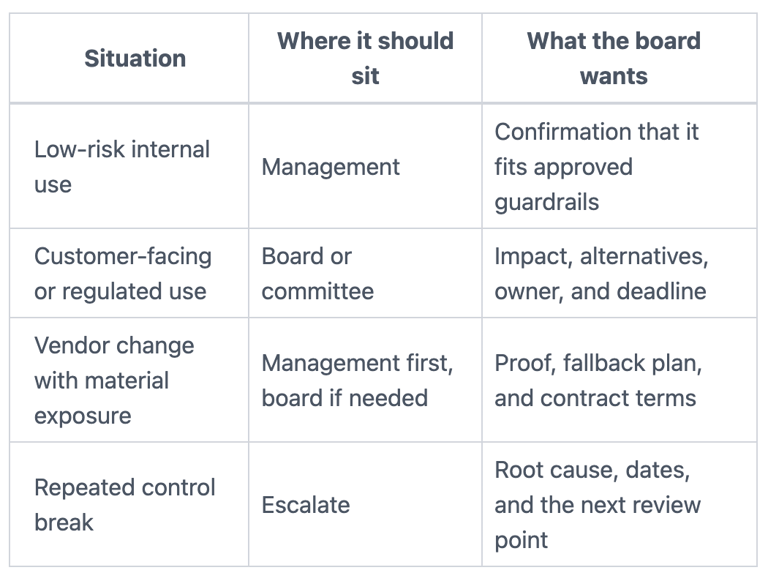
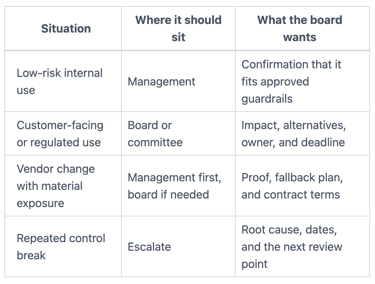
That table is the whole game. If the use case fits the first row, management should own it. If it fits the third or fourth row, it needs more than a status update.
Use one approval path for low-risk use and another for high-risk use
Not every AI project deserves board time. Low-risk work can stay with management if it sits inside pre-approved guardrails.
High-risk work needs a different path. It should come with a short business case, a named owner, and a clear answer to the question, "What happens if this goes wrong?"
Keep the questions short, specific, and tied to business impact
When something does reach the board, the questions should be plain:
Who benefits if this works?
What could go wrong?
What would it cost?
Who owns the call?
When do we need to hear about this again?
If a question does not change the decision, it does not belong in the meeting.
Frequently asked questions about AI decision rights
Who should own AI approval, the board or management?
Management should own most AI approvals inside approved guardrails. The board owns the boundaries, major exceptions, and anything that creates material exposure.
What AI decisions need escalation?
Escalate when the use case touches sensitive data, customer decisions, legal exposure, regulated activity, or a third-party dependency you cannot see clearly.
How often should the board review AI decision rights?
Review them whenever the company changes its AI footprint, enters a new market, adopts a new vendor, or hits a control issue. A standing review cadence is better than waiting for a problem.
What if a vendor says the model is safe but shows little evidence?
Treat that as an issue, not reassurance. The board should not accept confidence without proof, especially when the vendor sits inside a customer-facing or regulated workflow.
For a director-level reference point, the NACD's AI and board governance guidance keeps the focus where it belongs, on oversight, risk, and accountability.
Related reading
If you want to keep going, look at the AI boardroom question pack, the board oversight scorecard, and the decision-clarity call page. Those three give you a practical way to pressure-test where the board owns the call and where management should move on its own.
Conclusion
You do not need the board to run AI, but you do need the board to set the boundaries, question the hard risks, and know when a decision has crossed into their lane. Management should move fast inside those boundaries and be ready to explain the tradeoffs.
Before the next AI purchase, pilot, or vendor review, pressure-test your current model. If the ownership map is fuzzy, the fix is not more noise.
Tyson Martin is the executive public and pre-IPO companies in financial services, AI/data, SaaS, and cloud hire to make trust a measurable asset, one accountable answer to Is it secure? Is it resilient? Is the AI governed?
© 2026. All rights reserved.
Navigation
Free Resources
Contact
Stay ahead of your next board agenda
Sign up for Reports & Learnings From the Boardroom. Plain-English AI and cyber governance insights, biweekly. No pitch.
No spam. Unsubscribe anytime. · Or download the Director's AI Question Pack — 25 questions free