
Board of Directors AI Liability and Oversight in 2026
You're under boardroom pressure as AI moves into decisions, and you need clear ownership, tighter oversight, and proof that holds up later.


Clear board guidance for directors and executive teams who need fewer surprises, better decisions, and a record that holds up later.
You are already under pressure in the boardroom. AI is moving into growth plans, vendor pitches, and operating decisions, while you still have to protect customers, data, and trust. Buying another tool or approving another policy will not fix weak ownership.
This is not a technical problem first. It is a governance problem. You need to know where liability can show up, what the board owns, what management should run, and what evidence you will need if someone asks hard questions later.
The goal is simple. Make AI decisions visible, accountable, and easier to defend.
TLDR
Board oversight means setting boundaries, asking for proof, and challenging risk, not managing prompts or tuning models.
Liability often shows up when the board gets vague reporting, misses obvious questions, or lets risky use spread without clear decision rights.
AI is no longer a side experiment. It now sits inside customer work, pricing, hiring, fraud, and vendor workflows.
Good reporting should show what changed, why it matters, and what decision you need to make.
Your first move is to map every important AI use case, assign ownership, and set the board's risk appetite.
What board of directors AI liability and oversight really mean in 2026
Board oversight is not the same as running AI projects. You are not there to approve every model choice, review every prompt, or tune every workflow. You are there to govern the risk the business is taking.
That means you need to know three things fast: where AI is used, who owns each use case, and what could go wrong if it fails. Liability shows up when the board cannot answer those questions, gets comfort instead of facts, or lets high-risk use spread without clear limits.
What you are responsible for, and what management should handle
A clean split keeps the line clear.
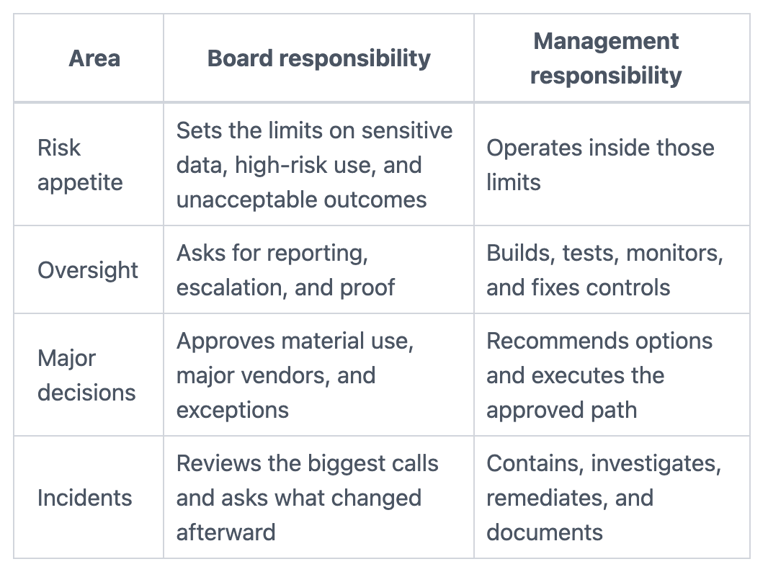
If the board starts managing the machinery, it loses altitude. If management starts making the boardroom calls, you get sloppy accountability.
Why the distinction matters when something goes wrong
When a bad output hits a customer, a vendor mishandles data, or a bias issue surfaces in a hiring or pricing workflow, the first question is not technical. It is governance.
Who knew what, when did they know it, and what did they do next?
If nobody can explain the last hard call in plain English, you are relying on memory, not governance.
That is where a board can get exposed. A hidden AI tool in a customer workflow, a vendor that changes its model without warning, or a privacy issue tied to training data can all become board questions fast. If your records are thin, the defense is thin too.
Why this issue matters more now than it did last year
AI adoption is moving faster than most oversight models. Vendors are pushing new features into tools you already use. Business teams are slipping AI into daily work before the board has seen the full picture. That is how liability grows.
This is why a board-level view matters now. The risk is not only that a model fails. The bigger problem is that the company moved ahead without clear approval paths, reporting, or controls.
AI is moving into core business decisions
AI is no longer limited to pilots and lab work. It now affects hiring, customer service, content, pricing, fraud, operations, and risk scoring.
That changes the board's job. You are not asking whether the technology is interesting. You are asking whether it changes revenue, cost, compliance, trust, or control. If it does, it belongs in the board's oversight lane.
Regulators and plaintiffs expect a paper trail
Good intentions are not enough. If you are public, or if your business lives under heavy scrutiny, you need records that show policies, review cycles, decision logs, escalation paths, and ownership.
The NIST AI Risk Management Framework is one useful reference point. So is your own evidence. If the file shows no approval, no review, and no follow-through, a later defense will look weak no matter how polished the slide deck was.
If you need a tighter set of director prompts, Download the AI Boardroom Question Pack and use it before the next committee meeting.
Vendor use can create hidden liability fast
A lot of AI risk enters through third parties. The vendor trains on sensitive data, changes its model, pushes a new feature, or returns a bad output, and your company still owns the business fallout.
That means your board should care about contract terms, data deletion, subcontractors, monitoring, and exit support. Third-party AI risk is still your risk when the customer is yours.
The board questions that separate real oversight from symbolic reporting
A strong board asks for business answers, not technical trivia. It wants to know where AI is used, what could break, and what decision is needed now.
If you want a fast read on whether your current oversight is real or just polished, See Where Your Board Actually Stands is a useful pressure test.
Where is AI being used today, and who owns each use case?
You cannot oversee what you cannot see. Management should be able to name each important use case, the business owner, the data involved, the vendor or system used, and the decision it supports.
If they cannot answer that quickly, oversight is already weak. A board does not need a model inventory that reads like a lab report. It needs a business map with names on it.
Use this as a simple check:
What is the use case?
Who owns it?
What data does it touch?
Which customer, employee, or business decision does it influence?
What would make it unacceptable?
What could go wrong, and how would we know early?
Ask for harm, not hype. You want to hear about customer damage, employee issues, legal exposure, revenue loss, operational slowdown, and trust erosion.
Good reporting shows thresholds and early warning signals. It tells you when a risk is rising, who is watching it, and when escalation starts. A list of tools does none of that.
What decisions need board approval versus management approval?
This is where decision rights matter. The board should set the boundaries for sensitive data, major vendors, customer-facing use, and any outcome that is not acceptable under the company's risk appetite.
Management should run inside those boundaries and bring back the exceptions. If the line is blurry, everything becomes a committee vote, and nothing moves cleanly.
How to build AI oversight that actually holds up under pressure
A board-ready model does not need more noise. It needs three things, clear ownership, clear reporting, and clear evidence. That is enough to make decisions easier to trust and easier to defend.
Think in three layers:
Visibility, know where AI is used.
Decision rights, know who can approve what.
Evidence, know what proof backs the decision.
Set a clear AI risk appetite before adoption spreads
If you have not set the line, adoption will set it for you.
Your risk appetite should cover sensitive data, regulated decisions, customer-facing use, human review, and vendor dependency. It should also say what you will not allow, not just what you might tolerate.
A short board question works well here: "Where do we require human review, and where do we not?" That one question can surface a lot of confusion.
Ask for reporting that shows business impact, not technical noise
Board reporting should answer three things, what changed, why it matters, and what decision you need.
If your packet is full of pilot counts, tool names, or activity metrics, you are still in the weeds. You need trends, exceptions, open risks, and named owners. The board should be able to see whether the company is getting safer or just busier.
Test the controls that matter most, not every control
You do not need to inspect every control with equal weight. Focus on the ones that keep the company out of trouble:
approval gates before use
human review on high-risk outputs
data protection and access limits
vendor review and contract terms
logging and audit trails
incident response and escalation
periodic revalidation of outputs and use cases
If you need help turning that into board-level work, the right conversation is about decision clarity, not more paperwork.
The mistakes that create the most board exposure
Most board exposure comes from a short list of bad habits. They are easy to miss because the company still looks busy.
Treating AI like an IT project instead of a governance issue
If AI only shows up in technical meetings, the board will miss the business consequences until after harm shows up. That is how ownership gets fuzzy and risk gets pushed around.
The fix is simple. Put AI in the same room as strategy, risk, legal, and operations.
Approving tools before setting rules
This is the fastest way to create scattered use and shadow deployments. Teams move ahead, controls lag behind, and the board discovers the gap after the fact.
Set the rules first. Then scale.
Relying on confidence instead of evidence
A polished update is not a defensible position.
A clean slide deck does not matter if nobody can produce the log, the owner, or the escalation record.
Ask for proof. Ask for thresholds. Ask for the last decision that changed behavior.
Frequently Asked Questions
What is board oversight of AI?
It is the board's responsibility to set boundaries, ask for reporting, review major risks, and hold management accountable. It is not hands-on model management.
Can directors be liable for AI mistakes?
Yes, if they ignore visible risk, fail to ask basic questions, or let the company operate without clear oversight. Liability usually starts with weak governance, not with technical skill gaps.
How often should the board review AI risk?
Review it as often as the risk changes. If AI is moving through core workflows, quarterly may not be enough for the most sensitive use cases.
What should board reporting include?
It should show use cases, owners, risks, exceptions, incidents, trend lines, and the decisions needed from the board. Counts alone are not enough.
What is the fastest way to improve oversight?
Map the use cases, assign owners, set risk appetite, and tighten decision rights. Then force reporting to show business impact, not activity.
Related reading
AI governance for boards that leads to better decisions
AI governance for boards: the questions management must answer now
Agentic AI board liability
If your board is still working from scattered updates and vague ownership, Get Board-Ready on AI and Cyber Risk is the next conversation worth having.
Conclusion
The pressure you feel in the boardroom is not going away. AI will keep moving into more decisions, more vendors, and more places where the business can take a hit.
You do not need to become a technical expert. You need clearer governance, stronger decision rights, and a paper trail that shows how the board thought about risk. Start by reviewing current AI use cases, tightening ownership, and asking for reporting that shows what changed and what needs a decision.
Tyson Martin is the executive public and pre-IPO companies in financial services, AI/data, SaaS, and cloud hire to make trust a measurable asset, one accountable answer to Is it secure? Is it resilient? Is the AI governed?
© 2026. All rights reserved.
Navigation
Free Resources
Contact
Stay ahead of your next board agenda
Sign up for Reports & Learnings From the Boardroom. Plain-English AI and cyber governance insights, biweekly. No pitch.
No spam. Unsubscribe anytime. · Or download the Director's AI Question Pack — 25 questions free