
Board Technology Advisor NYC. Why “Digital Transformation” Fails in the Boardroom
Board Technology Advisor NYC helps you stop funding slideware, set clear tradeoffs, and track value, risk, and cyber readiness in 90 days.


If you sit on a New York City-based Board of Directors, you feel the pressure from every side. Customers expect smooth service, regulators expect control, and your CEO expects speed. Meanwhile, costs keep rising and "modernization" starts to sound like a blank check.
In plain terms, digital transformation means new systems, new data, and new ways of working. It can be a cloud move, a new customer platform, a data program, or a wave of automation. The problem is that boards often approve big spend, then receive vague outcomes, shifting timelines, and rising risk. You get lots of motion, but not enough progress you can defend.
That's where a Board Technology Advisor NYC earns their keep. You need Technology Leadership that bridges Business Objectives, tech reality, and cyber risk, then turns that into board-ready choices. Not more jargon, not more dashboards, just decisions you can stand behind.
Key takeaways
Ask for options and tradeoffs, not just a roadmap.
Require a "stop list" so focus is real, not promised.
Track outcomes that show value, risk, and reliability.
Treat cyber, privacy, and vendor exposure as part of delivery.
Put AI under governance before it scales across the business.
Use a simple cadence that forces truth over optimism.
The board approves the budget, but not the real decision
Most transformation failures don't start with bad intent. They start with shallow governance lacking Strategic Guidance. You approve funding, but you don't approve the hard choices that make funding work.
In board meetings, transformation often turns into success theater. You see glossy Technology Roadmaps, "target state" charts, and confident timelines. Yet the plan hides the real constraint: your organization can only absorb so much change at once. When the C-suite brings twenty initiatives, you end up backing them all, because nobody wants to be the director who "slows progress." As a result, everything starts, and little finishes.
Another trap is treating technology as a vendor purchase instead of an operating model change. New tools can't fix unclear ownership, weak process, and messy data. If the work demands new skills, new controls, and new support coverage, the board should name that reality early. Otherwise, the business pays twice, once for the platform, then again for rework and incident response.
Finally, accountability gets diluted. Transformation programs love shared responsibility, steering committees, and dotted lines. Those structures can help, but only if one person owns outcomes and another person owns risk sign-off. Without that, every delay becomes "cross-functional," and every control gap becomes "temporary."
If you can't tell what you're choosing, what you're stopping, and who owns results, you're not governing transformation, you're funding it.
Strategy slides replace clear choices about what you will stop doing
You've probably seen the pattern. The deck shows a long list of initiatives, each framed as necessary. What you don't see is a "stop list." Without one aligned to Strategic Priorities, teams spread thin, and the loudest stakeholders win.
A Board Technology Advisor NYC helps you force clarity by making tradeoffs explicit. You can't escape tradeoffs, you can only hide them.
Here are three common Strategic Decisions you should expect to see written down:
Speed vs control (fast releases, or tighter change gates and testing).
Standard tools vs custom builds (simpler operations, or unique features and higher support cost).
Growth features vs reliability work (new revenue ideas, or fewer outages and cleaner audits).
To push past the slideware, ask questions that make ambiguity uncomfortable:
What will you stop, delay, or de-scope this quarter to fund this work?
What decision do you need from the board, and what happens if we say no?
Which two risks are you accepting, and who signs that acceptance?
What is the one outcome you will be judged on in 90 days?
When you ask this way, you shift the conversation from "initiative approval" to true oversight.
Success metrics stay fuzzy, so risk and value both get misread
When metrics are vague, teams report activity. Projects launched, sprints completed, vendors onboarded. That sounds like progress, but it doesn't tell you whether customers feel a difference, or whether your risk is falling.
You need a simple scoreboard that covers value, risk, and resilience. Keep it stable across quarters, so trends matter more than storytelling. One practical approach is to track a small set of measures that provide Actionable Insights you can explain in one minute.
Here's an example you can copy for board reporting to assess the ROI of Technology:
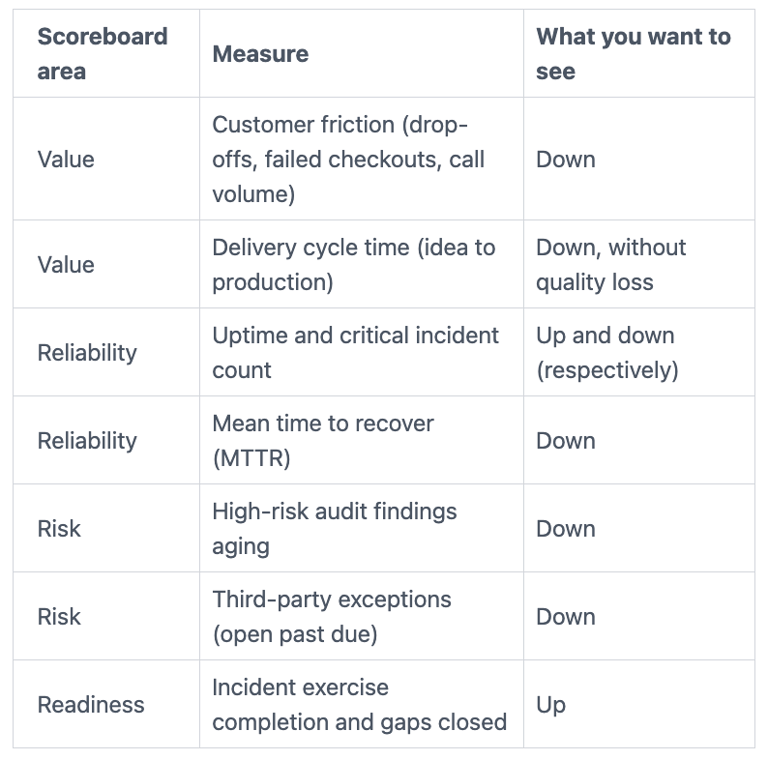
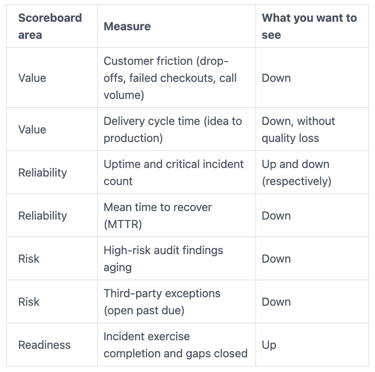
The point isn't perfection. The point is that you stop confusing "busy" with "better."
Why "digital transformation" turns into a risk problem you did not plan for
Transformation changes how your company works. As a result, it also changes what can break, what can leak, and what can be abused. Yet boards often hear, "Security is being handled." That phrase is usually a symptom, not a guarantee. The primary goal of tech oversight is to mitigate risks from these rapid shifts.
In practice, transformation expands your attack surface fast. You add cloud services, SaaS platforms, APIs, mobile features, data sharing, and vendor integrations. Each one is a doorway. Some are well-guarded, others are propped open because the business wants speed.
Privacy risk rises too, because more data moves to more places. Your teams may copy datasets into analytics tools, AI pilots, and vendor sandboxes. Even with good intent, controls can lag behind the new flows.
Resilience also changes. Legacy systems might be fragile, but they're familiar. New systems might be stronger long term, but only if you invest in monitoring, backup design, and recovery testing. Without that, you trade known problems for unknown outages.
A calm board posture helps most. Treat cyber and privacy as delivery requirements, not as a separate workstream that "catches up later."
New tech stacks multiply vendors, data flows, and control gaps
New York City organizations often sit in regulated or high-trust sectors, finance, healthcare, education, nonprofits handling sensitive donor or client data. Even when you're not "regulated," your customers still expect you to act like you are, especially where cybersecurity compliance is essential.
SaaS sprawl is a common cause of board surprises. One team buys a tool, another integrates it, then data starts flowing through connectors nobody fully owns. After that, access rules drift, logs go unreviewed, and contracts renew by default.
Instead of asking, "Is the vendor secure?", push for technical due diligence tied to ownership and exit:
Who owns the data once it enters the vendor system, and how do you get it back in usable form? Where are your top five vendors in the customer journey, and which ones could stop revenue if they go down? What's your exit plan if a provider raises price, fails an audit, or suffers a breach?
Those questions force management to treat vendor risk as a business dependency, not a procurement detail.
Artificial Intelligence and automation move faster than your oversight model
In February 2026, emerging technologies don't wait for committees. Teams can add AI to customer support, marketing, engineering, and analytics in weeks. That speed can help, but it can also create brand risk if outputs are wrong, biased, or based on sensitive data.
Boards also get tripped up by a simple confusion: AI as a tool vs AI as a product feature. If AI helps internal teams write faster, the risk profile is one thing. If AI touches customers, makes decisions, or changes pricing, the risk profile is different.
Before you scale AI, require a short, plain-language gate for responsible AI. A board-ready gate can fit on one page:
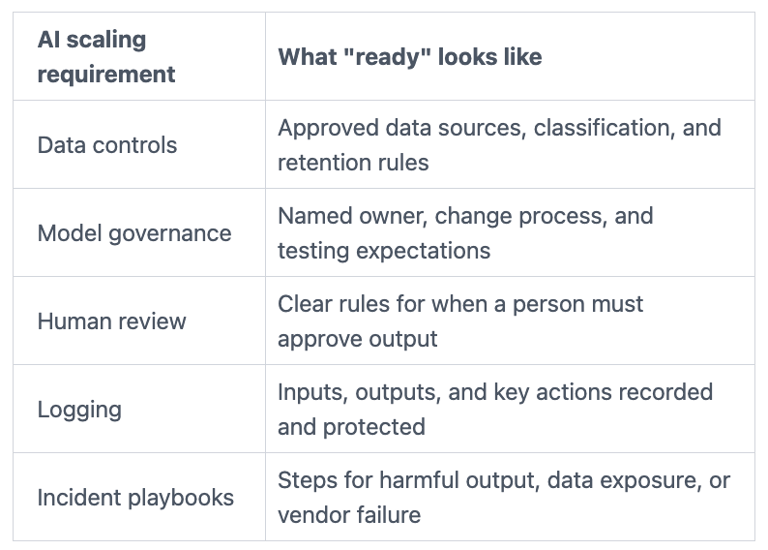
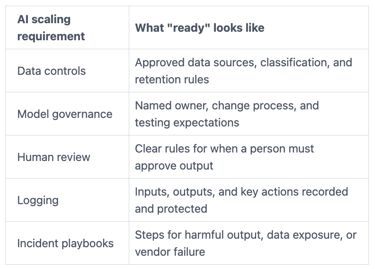
You're not blocking innovation. You're preventing a "move fast and explain later" moment that damages trust.
What a Technology Board Advisor NYC changes, fast
When you add a Technology Board Advisor NYC, you stop forcing directors to guess. You also stop forcing Executive Leadership to translate under pressure. The Advisory Board Member sits in the middle, then turns confusion into choices.
First, you get cleaner decisions that boost Board Effectiveness. Instead of approving "Phase 2," you approve a decision memo with options, cost ranges, and measurable outcomes. You see what must be true for success, and what happens if those assumptions fail.
Second, you get fewer surprises. Most board shocks come from gaps between delivery teams and governance. An advisor can test reality early, before the board hears about it through an outage, a whistleblower email, or a failed audit.
Third, you build stronger trust. Customers don't care about your roadmap. They care that services work, their data is handled with care, and incidents are managed with speed and honesty. Your board oversight should reflect that.
Board-ready deliverables tend to be simple, and that's the point:
A one-page risk view (top risks, trend, owner, and next action)
A transformation decision memo (options, tradeoffs, and clear ask)
A quarterly resilience review (uptime, recovery readiness, and control drift)
If you want a clear starting point for advisory support, use this page to engage a CISO advisor and define the scope around oversight, delivery, and risk.
You get a simple governance cadence that forces truth over optimism
A lightweight cadence beats a heavy committee structure. You want just enough structure to surface bad news early, and just enough repetition to make trends visible.
Start with consistent pre-reads. Each major initiative should report the same few items: last quarter commitments, what changed, key risks, decisions needed, and what will be stopped or delayed. Add a decision log that records what the board approved and why. That log becomes your memory when leadership changes or timelines slip.
Then use quarterly deep dives. Pick one or two topics, such as cloud migration risk, identity access, recovery testing, or vendor concentration. Go deeper than status, but stay tied to business impact.
Also be clear about where conversations belong. The full Board of Directors should focus on outcomes, material risk, and major tradeoffs. The audit or risk committee should go deeper on controls, incidents, and compliance posture. A tech committee (if you have one) should focus on Technology Strategy, architecture choices, delivery health, and vendor strategy. With that split, you avoid turning every board meeting into an operating review.
You align transformation to trust, resilience, and business value
Technology success looks different when you view it through trust. Reliability becomes a brand promise, not an IT metric. Privacy becomes a customer expectation, not a policy binder. Incident readiness becomes proof that leadership can act under pressure.
To make this real, tie each initiative to a trust outcome that a customer, regulator, or partner would care about. For example, if you're modernizing payments, tie it to fewer failed transactions and cleaner audit results. If you're rebuilding a data platform, tie it to tighter data access and faster incident investigation. If you're adding AI, tie it to measurable quality controls and clear escalation paths.
This is where a digital trust expert can help you connect security decisions to customer confidence and board oversight, without turning every meeting into a technical debate.
Conclusion
Digital transformation fails in the boardroom when you fund activity instead of making clear choices. It also fails when metrics stay fuzzy, because you can't see value or risk clearly. Most importantly, it fails when cyber, privacy, vendor exposure, and resilience are treated as side work. Those aren't side concerns, they are part of delivery.
Run a quick self-assessment at your next meeting to tackle governance issues:
What are we stopping to make this transformation achievable?
Which outcomes will prove progress in 90 days, not 12 months?
Which risks are we accepting, and who owns the decision?
If you need stronger oversight with boardroom diversity without adding noise, consider bringing in an experienced CISO for hire who can advise your board in business terms and keep execution tied to trust.
FAQs
What does a Board Technology Advisor NYC do?
You get a translator and a reality-check in one. They turn strategy into decision memos, tie delivery to outcome metrics, and make cyber and vendor risk visible. You also get a steadier cadence, so problems surface early.
How do we know if digital transformation is failing?
You see lots of projects, but a limited tech talent pool means customer experience and reliability don't improve. Timelines keep shifting, while risk exceptions pile up. Another sign is when leadership can't name what they stopped to fund the work.
Should the board have a tech committee, or is audit/risk enough?
Audit and risk can work if the cadence is strong and the reporting is clear. A tech committee helps when your roadmap is dense or vendor choices are material, supporting CEO succession through sustained tech alignment. The key is clarity on which topics go where.
How should you measure transformation without drowning in dashboards?
Use a small scoreboard that stays consistent each quarter. Mix value measures (friction, cycle time) with risk and resilience measures (audit issues, incident readiness, recovery time). Trends tell you more than one-off wins.
What's the fastest board action that reduces transformation risk?
Force a stop list and a decision log. That single move prevents "yes to everything" planning and creates accountability that survives leadership changes.
You don't need a bigger transformation story to drive growth. You need clear choices, visible tradeoffs, and outcome metrics you can defend when things go wrong. When you govern that way, modernization stops being theater and starts becoming performance your customers can feel.
Tyson Martin is the executive public and pre-IPO companies in financial services, AI/data, SaaS, and cloud hire to make trust a measurable asset, one accountable answer to Is it secure? Is it resilient? Is the AI governed?
© 2026. All rights reserved.
Navigation
Free Resources
Contact

Stay ahead of your next board agenda
Sign up for Reports & Learnings From the Boardroom. Plain-English AI and cyber governance insights, biweekly. No pitch.
No spam. Unsubscribe anytime. · Or download the Director's AI Question Pack — 25 questions free