
How Much Does Cyber Risk Assessment Cost?
Boards and CEOs feel cyber pressure fast, but cyber risk assessment cost depends on scope, urgency, and the follow-through you still have to fund.


What you pay for is only the invoice. The real cost also shows up in time, evidence, and follow-through.
You are trying to answer a simple question with real money behind it. The problem is that the price moves fast, depending on scope, urgency, company size, and how much clarity you already have.
The invoice is only part of the bill. Your team still has to gather documents, sit through interviews, review findings, and deal with the fixes after the report lands.
A cheap assessment can be expensive if it misses the business risk that matters. You do not need more technical noise. You need a clear read on what could hurt revenue, operations, trust, or the board's confidence.
TLDR
The price depends on scope, depth, urgency, and the level of reporting you need.
A narrow review costs less than a full-company assessment that includes cloud, vendors, incident readiness, and governance.
Your internal time is part of the real cost, especially when documents are thin or ownership is unclear.
The best value comes from plain-English findings, named owners, and clear decisions, not a thick report.
If you are under board pressure or incident pressure, expect the cost to rise because the work has to move faster.
What you are really paying for in a cyber risk assessment
A real cyber risk assessment is a decision tool. A checklist is not. You are paying for judgment, coverage, and the ability to separate what matters from what doesn't.
It comes down to people, process, technology, and evidence. More systems mean more work. More vendors mean more follow-up. Poor documentation means more interviews. Board-ready reporting adds another layer, because someone has to turn findings into decisions, not just facts.
If you want that level of output, compare it with board-ready cyber risk assessment services.
Scope is the biggest price driver
A narrow review of one system, one process, or one business unit costs far less than a full-company review. The price climbs as soon as you add cloud, vendors, incident response, data handling, or board oversight.
The right question is not "how much is a cyber assessment?" It is "how much scope do you actually need?"
Depth matters as much as size
A light review is mostly interviews and document review. A deeper assessment adds proof samples, control testing, and sharper recommendations.
That costs more, but it gives you something you can use. If you need to make budget, vendor, or governance decisions, depth matters.
Internal time is part of the real cost
Your team will spend time prepping documents, joining interviews, answering follow-up questions, and checking the draft findings. That hidden cost shows up fast when ownership is messy.
If you compare vendor quotes without counting internal time, you are comparing the wrong number.
Typical price ranges and what usually fits each one
Price bands are useful if you treat them as ranges, not promises. The table below is a quick way to compare shape, not chase a fake precision.
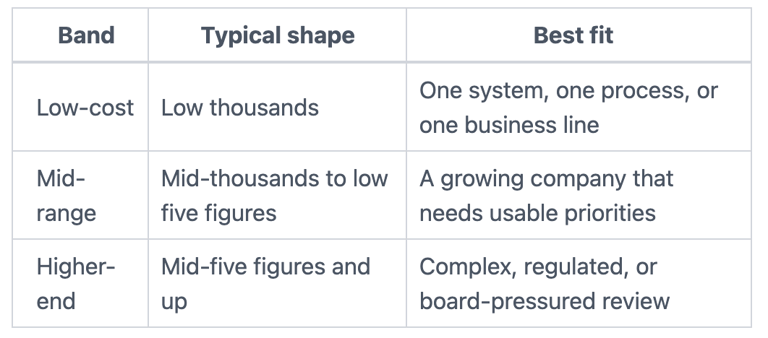
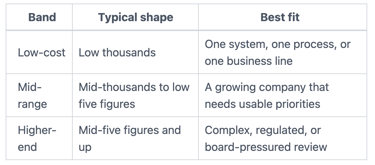
The middle band is where many leaders get the best value. You pay more than the cheapest option, but you get a result you can act on.
Urgent deadlines, incident pressure, or board timing can move you up a band fast. If you need the work done quickly, expect that to show up in the price.
Low-cost assessments
These are fast, narrow, and mostly interview-driven. They can be useful for a first look, but they may not uncover deeper ownership or control gaps.
The risk is a neat report that doesn't help you decide anything.
Mid-range assessments
This is the most common choice for a growing organization. You usually get interviews, document review, and selected testing.
It gives you a better balance of price and practical value when you need a plan, not just a snapshot.
Higher-end assessments
These are usually for more complex companies, regulated industries, acquisitions, or high-pressure board situations. They often include deeper evidence review, scenario testing, third-party risk, and board-level reporting.
If the stakes are high, this is where the extra cost starts to make sense.
The hidden costs leaders often miss
Many vendors quote the assessment. They do not quote the follow-on work. That is where the real budget pain shows up.
Technical trivia is not risk data. If the findings do not change a decision, they are expensive decoration.
Your team's time and attention
Executives, IT, security, legal, finance, and operations may all get pulled in. If your documentation is weak, the assessment turns into a working session.
The vendor quote won't show that. Your calendar will.
Remediation after the report
The assessment itself is only step one. The real cost appears when you fix identity gaps, vendor issues, reporting problems, backup weaknesses, or incident readiness gaps.
Ask what needs to change first. Start with the issues that can hurt the business fastest.
Bad scoping and repeat work
If the scope is too broad or too vague, you can pay twice. Once for a messy first pass, then again for a cleaner one.
A tight scope protects budget and timeline. It also keeps the work at the right level.
How to judge whether the assessment is worth the money
A useful assessment should help you decide what to accept, what to fix, and what to defer. If it does not do that, the price is too high even if the invoice looks small.
If you want a fast self-check before you spend, a board-style review like a cyber oversight scorecard is a good place to start.
Ask what decisions the assessment will support
A good provider should tell you how the work will support budget, risk acceptance, vendor, or governance decisions. If they cannot explain the decision path, the assessment may not be worth the spend.
Look for plain-English outputs
The report should translate cyber issues into business impact, like downtime, legal exposure, customer trust, and operational risk. It should name owners and next steps.
If you have to decode the report, it missed the point.
Frequently asked questions
How much does a small cyber risk assessment cost?
Usually less than a broader company review, because the scope is narrow and the work is mostly interview-led.
Why does a board-facing assessment cost more?
Because it includes clearer reporting, deeper validation, and more decision support.
Is the cheapest option ever enough?
Yes, if you only need a first look. No, if you need a defensible action plan.
What should the final report include?
Business risks, owners, priorities, timing, and the decision path.
Related reading
Conclusion
The right price is the one that matches your risk, urgency, and decision need. A small review can be enough when you are early and need orientation. A deeper assessment can save money when the company is under board pressure, in transition, or carrying a real gap.
Before you buy, tighten the scope, ask what business outcomes you need, and make sure the output is plain enough to act on. If you cannot explain the problem clearly, you are not ready to price it well.
If you want a quick way to check where you stand, See Where Your Board Actually Stands.
Tyson Martin is the executive public and pre-IPO companies in financial services, AI/data, SaaS, and cloud hire to make trust a measurable asset, one accountable answer to Is it secure? Is it resilient? Is the AI governed?
© 2026. All rights reserved.
Navigation
Free Resources
Contact
Stay ahead of your next board agenda
Sign up for Reports & Learnings From the Boardroom. Plain-English AI and cyber governance insights, biweekly. No pitch.
No spam. Unsubscribe anytime. · Or download the Director's AI Question Pack — 25 questions free