
How an Executive Tech Roadmap Turns Technical Noise Into Clear Decisions
Your dashboards are busy, but decisions stall. An Executive Tech Roadmap turns technical noise into clear calls on risk, spending, and ownership.


Too many dashboards. Too many opinions. Not enough clarity on what to do next.
You already know the feeling. The reports keep coming, the vendors keep talking, and every meeting seems to produce a new pile of technical detail with no clean decision at the end.
That's the real problem. You are not missing information. You are missing a way to turn that information into business choices about risk, spending, timing, and ownership. An Executive Tech Roadmap gives you that path. It cuts through tool talk, slows down sloppy debate, and helps you decide what matters, what can wait, and who owns the next move.
TLDR
An executive tech roadmap is not a project list. It is a decision tool.
You need it because more tools and more meetings do not fix unclear priorities.
The roadmap should connect risk, governance, and execution to business outcomes.
Good reporting shows trend, threshold, and action, not just counts.
Every item needs an owner, a date, and evidence that it changed something.
If the roadmap does not change decisions, it is shelfware.
Why you need a roadmap before you need another tool
A lot of leadership teams buy detail when they need direction. That is how they end up with five dashboards, three vendor opinions, and one long meeting that still ends in confusion.
The noise usually shows up in the same places. One leader wants faster delivery. Another wants tighter controls. IT says the gap is technical. Finance wants a number. The board wants to know whether the business is exposed. Nobody is wrong, but nobody is aligned either.
If every item matters, nothing gets decided.
That is why the roadmap matters. It is a leadership tool first. You are not buying more data. You are buying a clearer path to a decision.
What noise looks like in the real world
Noise has a pattern. The dashboards are full of counts. The reports stay green while risk stays high. Teams debate tools instead of outcomes. Leaders cannot say what changed since last quarter.
That is where time gets burned. It is also where trust slips. If the board keeps hearing technical trivia instead of business impact, people start to assume the program is busy, not effective.
A strong board will notice that fast. If you want a simple way to pressure-test that oversight, a board technology scorecard can help you see whether the current view is real or just polished.
What clarity looks like instead
Clarity is smaller than noise, but far more useful. It answers four questions cleanly: what is at risk, who owns it, what happens if we wait, and what decision do you need from leadership now?
Here is the difference in plain English:
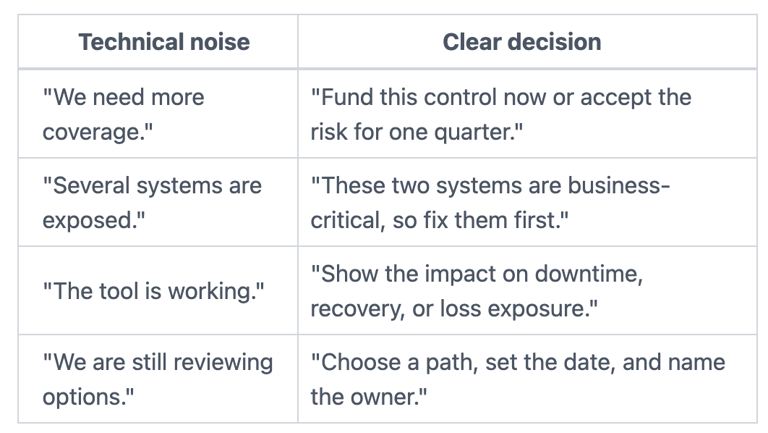
That shift matters because growth, AI adoption, cyber risk, and board scrutiny do not wait for better spreadsheets. They force decisions now.
What an executive tech roadmap actually is, and what it is not
A real roadmap is a short, prioritized plan that connects technology work to business outcomes, risk reduction, and decision rights. It tells you what gets done first, what gets delayed, and who is accountable for each call.
It is not a project dump. It is not a tool catalog. It is not a compliance checklist. And it is not a stack of technical tasks dressed up as strategy.
The value is in the choices. Which issue matters most? What can slip? What has to be fixed before the next board meeting? Which risk is accepted on purpose?
The three parts every roadmap needs
A useful roadmap has three parts.
Risk posture tells you what matters most. It keeps the focus on the few risks that can hurt revenue, operations, trust, or legal standing.
Governance tells you who decides. That means decision rights, escalation paths, and the point where something stops being an IT issue and becomes an executive issue.
Execution tells you what gets done and checked. Owners, dates, evidence, and expected impact belong here. Without those, you do not have a roadmap. You have a wish list.
The mistakes that turn a roadmap into shelfware
The usual failures are easy to spot. Too many priorities. No named owner. No date. No evidence. No link to board decisions.
That is how roadmaps end up in folders nobody opens. They look serious, but they do not change behavior. If a roadmap does not help you decide what to fund, defer, accept, or kill, it is not doing the job.
How the roadmap turns technical detail into business choices
This is where the roadmap earns its keep. It filters the noise so leadership can work with a smaller set of decisions, not a bigger stack of facts.
A security lead may bring ten issues. The roadmap should narrow that to three choices, each tied to a business impact. Fund the control. Accept the risk. Change the deadline. Shift priority. Wait, but only if the reason is clear.
Start with the question, not the answer
Good roadmaps begin with hard questions.
What is at risk? What could break? What would it cost if it did? What decision is needed now?
If you start with those questions, meetings stay out of the weeds. If you skip them, you end up debating technical trivia while the actual decision sits untouched.
Tie every item to an owner, a deadline, and a result
Every roadmap item should name one accountable person, one date, and one expected result. That sounds basic because it is basic. It is also where most plans fall apart.
You need owners, dates, evidence, and impact. Not "the team is on it." Not "we are monitoring it." You need something a CEO, board chair, or operator can read in a minute and understand.
If you need help turning that structure into practice, Get Board-Ready on AI and Cyber Risk is the sort of conversation that helps when the gap is bigger than the team can absorb on its own.
Use the roadmap to force tradeoffs
You cannot fund everything. You cannot fix everything at once. So the roadmap should make tradeoffs visible.
Maybe faster delivery means a weaker control this quarter. Maybe short-term risk acceptance buys time for a better fix. Maybe the urgent work is not the strategic work, and you need to say that out loud.
That is not a weakness. It is how good leadership works. Sequencing beats perfection every time.
Build the roadmap around the decisions your board and executives actually need
The best roadmaps do not just help with planning. They help with oversight. They give directors and executives a clean view of material risk, recovery, spending, vendor exposure, and accountability.
The board does not need a firehose. It needs to know what changed, why it matters, and what decision is needed next. If you are not getting that, the report is feeding the room, not helping it govern.
The questions senior leaders should ask
Keep the questions simple. If the answers are muddy, the roadmap is muddy.
What risk are we accepting right now, and why?
What business impact matters most if this goes wrong?
What can slip without real damage?
What cannot slip under any condition?
What happens if funding or staffing changes next month?
Those questions keep the conversation at the right altitude. They also expose whether management has a real plan or just a hopeful one.
What good reporting should show
Useful reporting shows trend, threshold, and action. It tells you whether risk is moving up or down, where ownership sits, and what needs a decision now.
That means fewer counts and more judgment. Fewer slides and more clarity. If the reporting still feels like a pile of status updates, the board is being asked to admire motion instead of govern outcomes.
If you want more examples of plain-English oversight, the AI governance question pack is useful when AI work is part of the roadmap and the board needs sharper questions, not more jargon.
How to keep the roadmap honest over time
A roadmap should change when conditions change. New threats show up. A vendor slips. A release moves. A control fails. The plan should reflect that.
Review it on a regular cadence. Check it against evidence. Ask whether it changed a decision. If it did not, the roadmap is drifting into theater.
The first 90 days: how to turn the roadmap into action
You do not need a perfect framework to get moving. You need a short list of risks, a clear sequence, and a decision rhythm that holds.
Pick the few risks that can hurt the business most
Start with the risks tied to revenue, operations, customer trust, legal exposure, or board concern. Keep the list short.
If you can't explain why a risk matters in business terms, it is probably not first on the list. That is the filter. Not every issue deserves equal weight.
Cut the work that does not change the decision
Some work creates motion without value. It fills meetings, produces status, and changes nothing.
Cut the reporting that nobody uses. Cut the review that never changes priority. Cut the task that looks busy but does not move risk, timing, or ownership. Redirect that effort to the items that do.
Set a weekly or monthly decision rhythm
The roadmap needs a cadence. Weekly when pressure is high. Monthly when things are stable. The point is the same either way. Review change, make tradeoffs, and track follow-through.
Keep the rhythm tied to owners and dates. Keep the evidence close. If the gap is serious, don't wait for the next quarter to clean it up. A direct advisory conversation like Get Board-Ready on AI and Cyber Risk can help you get the first decisions in order before the next meeting drifts off track.
Frequently asked questions
What makes an executive tech roadmap different from a project plan?
A project plan tracks tasks. An executive roadmap tracks decisions, risk, ownership, and business impact.
Who should own it?
One senior leader should own the roadmap, with clear input from security, IT, operations, finance, and legal when needed.
How often should it be reviewed?
Usually monthly, or more often if you are in transition, dealing with an incident, or pushing major change.
What should the board see?
The board should see what changed, why it matters, what is being accepted, and what decision is needed next.
What is the biggest mistake leaders make?
They treat the roadmap like a document instead of a decision tool.
Conclusion
An Executive Tech Roadmap is not about making technology look organized. It is about helping leadership decide what matters, what can wait, and who owns the next step.
When you turn technical noise into a clear roadmap, the business gets faster, calmer, and easier to govern. The work stops being a stack of opinions and becomes a set of choices you can defend.
Build it around decisions, not details. Then check whether the current one is actually changing outcomes.
Tyson Martin is the executive public and pre-IPO companies in financial services, AI/data, SaaS, and cloud hire to make trust a measurable asset, one accountable answer to Is it secure? Is it resilient? Is the AI governed?
© 2026. All rights reserved.
Navigation
Free Resources
Contact


Stay ahead of your next board agenda
Sign up for Reports & Learnings From the Boardroom. Plain-English AI and cyber governance insights, biweekly. No pitch.
No spam. Unsubscribe anytime. · Or download the Director's AI Question Pack — 25 questions free