
Fractional CISO for a PE-Backed Portfolio Company
A fractional CISO for a PE-backed portfolio company helps you turn cyber risk into clear board decisions before diligence or exit prep.


Plain-English guidance for boards, CEOs, and operators who need cyber risk under control before diligence, exit prep, or the next growth push.
Private equity does not reward busy. It rewards speed, control, and a clean story when the questions get hard.
You already know the pressure. Growth targets are real. Teams are lean. The board wants better answers. Customers want proof. Investors want less guesswork. Buying another tool will not fix that.
What you need is a strategy move, not a software purchase. A fractional CISO for a PE-backed portfolio company brings executive judgment to a place where security work is happening, but ownership is fuzzy. If you want a quick read on where oversight stands today, the board cyber governance scorecard is a practical place to start.
TLDR
A fractional CISO turns cyber risk into priorities, decisions, reporting, and follow-through.
The role matters most when growth, diligence, integration, or exit timing raises the cost of weak oversight.
You should not hire this help to run every technical task. You hire it to clarify what matters, who decides, and what gets done next.
Good support improves board reporting, risk acceptance, incident readiness, and third-party control.
The first 90 days should produce a risk snapshot, clear decision rights, and reporting the board can use.
Measure value by faster decisions and lower exposure, not by meeting count or tool inventory.
What a fractional CISO actually does in a PE-backed portfolio company
You are not hiring a security technician in a part-time wrapper. You are bringing in a senior leader who can turn cyber risk into business decisions.
That matters because portfolio companies often have the same problem in different clothes. Work is happening, vendors are talking, tools are in place, and nobody can say what matters most. A fractional CISO brings order to that mess. The role creates clearer decision rights, cleaner board visibility, and faster follow-through.
The best version of this role sits between management and the board. Management still owns the work. The fractional CISO owns the translation, the prioritization, and the accountability structure that keeps the work from drifting.
The problems this role should help you solve first
Start with the problems that slow the business down:
Unclear ownership, where everyone is involved and nobody is accountable.
Weak reporting, where the board gets activity but not decisions.
Third-party risk, where vendor promises are not backed by evidence.
Identity gaps, where access is broader than it should be.
Incident readiness that looks fine in a folder and shaky in practice.
Board updates that describe problems but never lead to a decision.
The right help should shrink the list of unknowns. It should make the next move obvious, even when the answer is uncomfortable.
What this role is not
It is not a firefighter who only shows up when the alarm goes off.
It is not a policy writer who hands you a binder and disappears.
It is not a substitute for management ownership, and it is not a shortcut around tough tradeoffs.
You are not buying more security activity. You are buying better judgment, better pacing, and fewer surprises.
Why PE-backed companies need this support earlier than most businesses
Private equity changes the tempo. The clock is faster, the reporting is sharper, and the cost of sloppiness shows up sooner.
A portfolio company can look healthy on the operating side and still carry weak cyber governance. That becomes a problem when the business is integrating an acquisition, answering lender questions, renewing a key customer contract, or preparing for exit. Cyber risk stops being a back-office concern and becomes part of value creation.
If your company is public, or moving toward public reporting, SEC cybersecurity disclosure expectations raise the bar again. The question is not whether you have controls somewhere in the stack. The question is whether you can explain the risk, the business impact, and the decision you want from leadership.
How the PE timeline changes the stakes
Longer holding periods let weak oversight linger. Shorter ones do not.
If the reporting is thin or the incident plan has never been tested, you lose time during diligence. You lose trust when a buyer asks for evidence and gets a slideshow. You lose leverage when the risk story is unclear and the other side knows it.
That is why a fractional CISO matters early. You do not want to wait for a transaction window to discover that ownership was never clean.
Why board pressure gets louder in portfolio settings
Investors do not want a wall of technical detail. They want to know what changed, what remains exposed, and what needs a decision now.
That is where decision-shaped reporting matters. The board should see a small set of issues, tied to cost, timing, exposure, and owner. If management wants more budget, the board should see why. If management wants to accept risk, the board should see the tradeoff. If timing slipped, the board should know what broke.
The signs you need a fractional CISO now
You do not always need a full-time CISO. You do need senior security leadership sooner than you think if the business is sending you the signal.
Look for these signs:
Leadership turnover left security work without a clear owner.
Growth outpaced the control environment.
Audit findings keep coming back.
Customer diligence keeps exposing the same gaps.
One vendor failure could hurt operations.
The incident plan has never been tested with the right people in the room.
Security updates are happening, but nobody can say what changed.
When those signals show up outside security, pay attention. Finance feels it when diligence stalls. Sales feels it when enterprise buyers push harder. Legal feels it when contracts carry more risk. Operations feels it when a vendor outage can stop the business.
If that sounds familiar, the issue is not only cyber. It is business risk becoming visible.
Signals from the business, not just from security
The strongest warning signs usually show up in ordinary work. A customer asks for proof before signing. Procurement keeps revisiting the same contract gap. A key supplier becomes a single point of failure. The board wants a cleaner story than the one management has today.
That is the point where security stops being a side conversation. It becomes an operating issue.
When full-time hiring is too slow or too much
A fractional model fits when you need senior judgment now, but you do not yet need a full-time executive seat.
That gives you speed without overcommitting. It also gives you structure before the next board meeting, the next diligence round, or the next incident. For many portfolio companies, that is the smarter move.
What good support looks like in the first 90 days
The first 90 days should not be a listening tour that turns into a pile of notes. You want a clean read on risk, ownership, and next steps.
Good support starts with three jobs: risk clarity, governance, and execution. If one of those is missing, the work stalls.
Start with a fast risk snapshot
A strong fractional CISO should quickly review the things that matter most:
Crown-jewel systems and data.
Key vendors and subcontractors.
Identity and admin access.
Endpoint coverage.
Cloud security setup.
Recent incidents and near misses.
Open exceptions that have been sitting too long.
The goal is not a giant assessment. The goal is to turn scattered facts into a short list of real business risks.
Set decision rights and escalation paths
Someone needs to know who can accept risk, who can fund fixes, who can stop work, and who briefs the board.
Without that, every issue becomes a debate. Every delay becomes "cross-functional." Every control gap becomes "temporary." That is how risk slips.
A simple decision-rights map should answer four questions:
Who owns the risk?
Who owns the fix?
Who approves the exception?
Who is told when things change?
Build reporting the board can use
Board-ready reporting is short and honest. It says what changed, what remains exposed, what management is doing, and what decision is needed.
It should not drown the board in technical trivia. It should give directors enough to accept risk, fund mitigation, or change priority. That is the whole point.
If the board cannot tell what changed, what it means, and what decision is needed, the report is not helping.
How you should measure value, not just activity
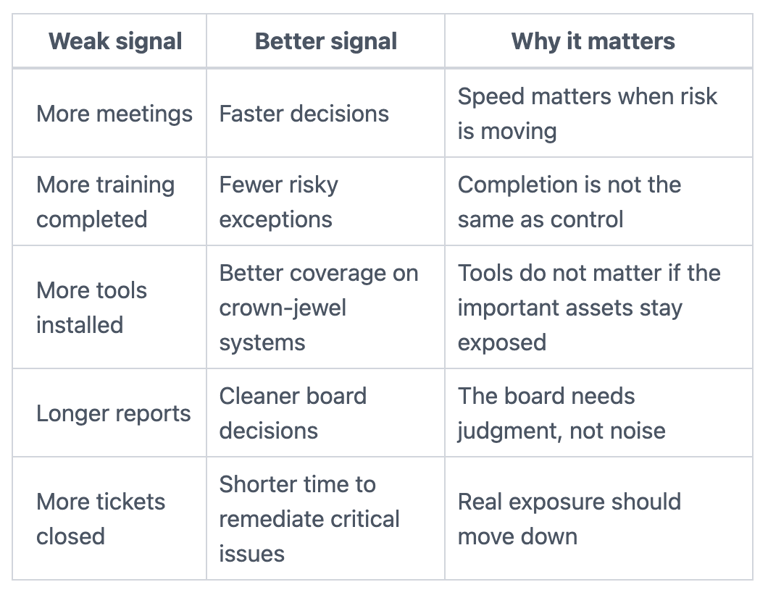
A fractional CISO is not helpful because they were busy. They are helpful because the business got clearer, faster, and less exposed.
Look for outcomes. Not theater.
Metrics that show risk is moving in the right direction
Use metrics that tie back to business outcomes:
Time to remediate critical issues.
Recovery readiness for key processes.
Vendor coverage on high-risk third parties.
Reduction in exposure on crown-jewel systems.
Clearer incident escalation with fewer surprises.
These are the numbers that tell you whether the company is getting safer in a way the board can defend.
Questions that reveal judgment, not jargon
A strong fractional CISO sounds like a decision plan, not a lecture.
Ask questions that force tradeoffs:
What is the top risk we are willing to accept right now, and why?
What business impact shows up if that risk hits?
What does it cost to reduce it?
What deadline actually matters?
What breaks if funding slips?
What is the fallback if a vendor, tool, or team is not there?
If the answer is mostly technical detail, you are hearing noise. If the answer names cost, time, impact, and residual risk, you are hearing judgment.
How to choose the right fractional CISO for your portfolio company
You want someone who understands how portfolio companies work. Speed matters. Value creation matters. So does the board's appetite for plain English.
Look for business judgment under constraints
The best candidates can frame options when the answer is not obvious.
Ask how they handle a weak identity control when launch timing is tight. Ask what they do when a vendor issue hits and the business wants reassurance before facts are ready. Ask how they set priorities when time, budget, and trust are all limited.
You are looking for someone who can choose, not just explain.
Look for board-level communication skill
The right person can brief a CEO, a board member, or an investor without hiding behind jargon.
That means short answers. Clear tradeoffs. No drama. No lecture.
You want someone who can make a board packet cleaner, not louder. Someone who can turn technical noise into a story that leads to action.
Look for someone who can align security with growth
Security should support diligence, integrations, new product launches, and customer trust.
A good fractional CISO protects speed without pretending speed has no cost. They know when to tighten controls and when to keep the business moving. They know how to say, "this is safe enough for now," and when that is not true.
That balance is the job.
Conclusion
A fractional CISO for a PE-backed portfolio company is worth it when you need faster decisions, cleaner oversight, and less guesswork. The role is not about stacking more security work on top of an already crowded calendar. It is about making ownership visible, reporting useful, and risk decisions defensible.
When the pressure is coming from growth, diligence, exit prep, or board scrutiny, that kind of leadership matters. The right support gives you a short list, clear owners, and a board conversation that leads somewhere useful.
If you want a cleaner read on where you stand before the next board meeting, start with the board cyber governance scorecard. If you already know the oversight gap is bigger than the current reporting cycle, Get Board-Ready on AI and Cyber Risk.
Tyson Martin is the executive public and pre-IPO companies in financial services, AI/data, SaaS, and cloud hire to make trust a measurable asset, one accountable answer to Is it secure? Is it resilient? Is the AI governed?
© 2026. All rights reserved.
Navigation
Free Resources
Contact
Stay ahead of your next board agenda
Sign up for Reports & Learnings From the Boardroom. Plain-English AI and cyber governance insights, biweekly. No pitch.
No spam. Unsubscribe anytime. · Or download the Director's AI Question Pack — 25 questions free