How a Fractional CISO Preps NYC Leadership for Board Questions, Metrics, Narratives, and Risk Language That Lands
With an Interim CISO in NYC, you walk into the boardroom with 3 to 5 metrics, clear risk scenarios, and a 2-week prep cadence your board can act on.


In New York City, your company can double in size before your next board meeting. Timelines stay tight in Manhattan, vendors pile up, and customers expect you to stay online no matter what. Meanwhile, cybersecurity scrutiny is higher in New York in March 2026 than it was even a year ago. If something goes wrong, it can become public fast, and your board knows it.
That's why an Interim CISO in NYC (fractional or interim) isn't just there to "run cybersecurity and information security." You need a CISO who can walk you into the boardroom with clear stories, simple metrics, and risk language that ties to business outcomes. Not fear, not jargon, and not a technical dump.
Here, you'll get a repeatable prep method your CISO uses for board questions, a tight set of board-ready metrics a CISO selects, and a narrative style a CISO crafts that lowers heat while raising trust. You'll also get a cadence a CISO recommends you can run every quarter so cyber oversight feels routine, not reactive.
Key takeaways (NYC board prep you can reuse):
Your CISO helps you rehearse the board's real questions drawn from your professional network, not the ones you wish they asked.
Your CISO equips you with 3 to 5 metrics that show trend and exposure, not trivia.
Your CISO teaches you to speak in scenarios, impact, likelihood, and decision asks.
Your CISO provides a two-week prep cadence that reduces surprises.
Editorial image prompt (photo-realistic): Calm, focused board-prep meeting in a modern NYC office conference room, over-the-shoulder view of leaders reviewing a printed risk brief and a laptop, hands marking notes, a whiteboard with shapes only (no readable writing), shallow depth of field, 25–35% negative space on one side, soft natural window light, deep navy and slate tones with subtle coastal blue or spruce green accents, warm gold highlights, off-white neutrals, clean premium composition, no logos, no readable screens or documents. Negative prompt: text, words, letters, numbers, typography, captions, labels, signage, watermarks, logos, brands, readable screens, readable documents, interface mockups, QR codes, banners, headlines, icons with letters, distorted text
Start with what your NYC board will actually ask, then build your prep around it
Boards don't want a tour of your tools. They want decision-quality clarity on governance and compliance. In NYC, that usually means three things: brand and customer trust risk, third-party exposure, and how fast you can recover if operations take a hit.
When you prep the right way, you stop answering questions like you're defending yourself. Instead, you answer like you're helping the board with risk management. That shift to effective risk management matters because directors often come in with headlines in mind: ransomware taking down operations, vendors leaking customer data, wire fraud, or an acquisition that brings hidden tech debt.
A fractional CISO helps you work backward from the board's questions. You choose a small set of risks, then support them with proof, trend, and a clear "here's what we need from you." Your job is to be specific without oversharing, and direct without being dramatic.
If your update doesn't change a decision, change the update.
The top board questions you should rehearse, and the trap behind each one
Use these as your rehearsal set for Directors, Vice Presidents, and Senior Directors. You're not memorizing lines. You're building muscle memory to align with your Chief Technology Officer and C-level peers.
"What are our top cyber risks right now?" Trap: listing ten technical issues. CISO move: name three business scenarios, each with impact and owner.
"How do you know those are the top risks?" Trap: "because the scanner said so." CISO move: show inputs (incidents, control testing, vendor data, audits), then explain your prioritization logic.
"What changed since last quarter?" Trap: reporting activity instead of exposure. CISO move: highlight trend, what drove it, and what you expect next quarter.
"Are we meeting our governance and compliance obligations?" Trap: vague assurance or legal overreach. CISO move: state posture in plain terms, note gaps, and show dates to close them (aligned with counsel).
"What happens if a key vendor gets hit?" Trap: "they told us they're secure." CISO move: describe your critical vendor list, coverage level, and failover or containment plan.
"How prepared are we for ransomware?" Trap: focusing on prevention only. CISO move: show detect, contain, restore times, and a tested recovery path.
"What's the business impact if this goes wrong?" Trap: only talking about data types. CISO move: talk downtime, revenue interruption, customer churn risk, and recovery cost ranges.
"Are we over-spending or under-spending?" Trap: arguing about tools. CISO move: tie spend to risk reduction, control strength, and residual risk.
How a fractional CISO turns questions into a simple board packet you can defend
You don't need a 40-slide deck. You need a packet that holds up under follow-ups and stays consistent quarter to quarter.
A lightweight structure that works:
1-page executive summary: what changed, what matters, and what you need from the board.
3 to 5 metrics with trend: show direction, not perfection.
Top risks with heat level: include a short scenario, current controls, and residual risk.
Incident readiness snapshot: last exercise date, top gaps in Security Operations, and next test.
90-day plan: owners, timelines, and measurable outcomes.
The real value is consistency. When your board sees the same structure each time, they can track progress without re-learning your format. A seasoned fractional CISO also pressure-tests every claim so you don't get cornered on "how do you know?" If you want that kind of steadying support, this is the kind of help you get from an experienced fractional CISO for hire.
Pick metrics that tell a story, not a scoreboard that confuses everyone
Boards like metrics, but they hate metric clutter. If you show 25 numbers, you're basically asking directors to guess what matters. As a CISO, a good board metric set does three jobs at once:
First, it shows trend. Second, it signals control effectiveness through your Security Strategy. Third, it hints at business exposure.
That's why "number of blocked attacks" rarely helps. It's noisy and it can rise when you improve monitoring. Instead, you want measures that stay stable over time, are hard to game, and connect to outcomes like downtime risk, fraud loss, or data exposure, all key for the CISO.
Before you pick a metric, ask two questions: Can you explain it in one sentence, and can the board act on it? If the answer is no, keep it off the board view and use it internally. This approach helps every CISO focus on what drives decisions.
Here's a compact set that most New York boards can understand quickly.
A board-ready cyber metrics set you can explain in plain English
This table gives you a practical starting point for the CISO. Keep the definitions stable, then improve the data quality over time. It draws inputs from Threat Intelligence to inform Information Technology leaders and Security Operations teams on priorities.
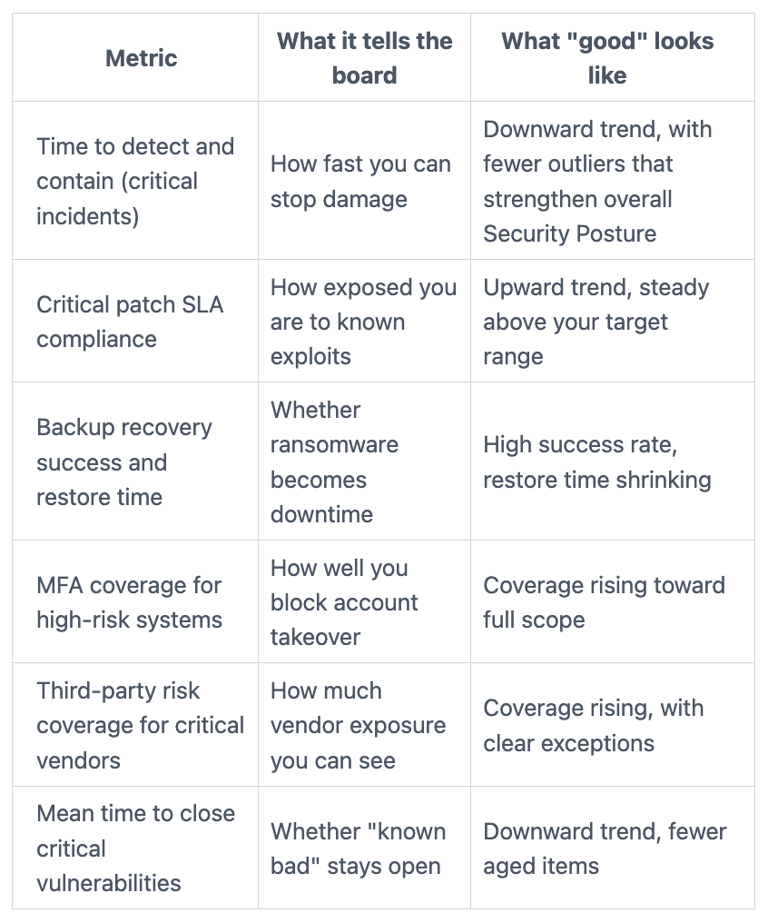
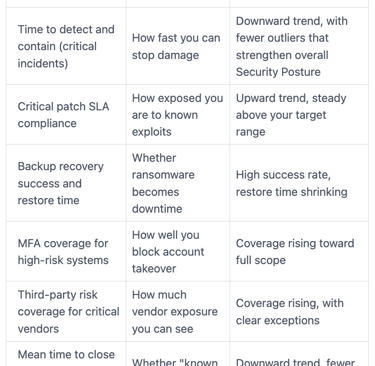
After the table, your job as CISO is to avoid fake precision. Boards don't need "87.3%." Give ranges and plain targets, such as "above 95% for critical patch SLAs" or "restore core services within 24 hours." Then explain what you'll do if you miss. With Artificial Intelligence automating attacks, CISO metrics like these must evolve to track AI-driven threats effectively.
If you want examples of how leaders frame this without noise, use board-level cyber oversight insights as a reference for tone and structure.
Translate technical work into business outcomes the board can weigh
A metric becomes board-relevant when it connects to an outcome the business cares about. You can make that link with a simple pattern your CEO can repeat without cringing, one every CISO should master:
"Because we improved X, we reduced the chance of Y, which protects Z."
Examples that land well in a New York boardroom:
Because restore time improved, you reduce the chance of multi-day downtime, which protects revenue and customer confidence.
Because MFA coverage expanded, you reduce account takeover risk, which protects funds movement and sensitive workflows.
Because critical vendor coverage increased, you reduce blind spots, which protects brand trust if a partner gets hit.
This is also where trust becomes more than a slogan. When you consistently connect controls to outcomes, you're building digital trust in a way the board can govern and defend, especially as Artificial Intelligence reshapes Security Operations and Information Technology. The board-facing version of that approach is described well here: building digital trust. CISOs who prioritize Security Operations metrics like these build lasting credibility.
Use risk language that lands, with narratives built for tough follow-ups
When the Governing Body pushes, it's rarely because they want to embarrass you. They push because uncertainty feels expensive. In New York, it can also feel personal because reputations travel quickly, and leadership networks overlap, positioning security leaders as Strategic Business Influencers.
A strong narrative makes uncertainty manageable. It replaces "here are 50 issues" with "here are two scenarios we're managing, here's the proof, and here's what we need." It also helps you handle the hardest follow-up of all: "Why didn't you prevent this?"
The honest answer is that you can't prevent every aspect of cyber defense. However, you can build cyber resilience by reducing likelihood, limiting blast radius, and recovering fast. Boards accept that when you speak with calm precision and show you're learning.
A simple risk narrative formula you can use in the room
Use this template for your Information Security discussions, and keep each part short:
Scenario: What could happen (one sentence).
Impact: What it would do to the business (downtime, revenue disruption, legal cost, customer trust).
Likelihood: High, medium, or low, plus the "why" in plain terms.
Controls in place: What you're doing now that reduces impact or likelihood.
Residual risk: What still remains even after controls.
Decision ask: Funding, appetite, policy, timeline, or ownership to strengthen our Security Posture.
Pick 1 to 2 scenarios that match your business and your New York risk profile. Three common ones are enough for most meetings: ransomware-driven downtime, vendor breach affecting customer data, and wire fraud through compromised identities.
Your narrative gets sharper each quarter if you treat it like a skill, not a document. That mindset, the idea that you should keep refining how you brief and decide, is part of evolving and learning as a CISO.
How a fractional CISO coaches you to answer like a leader, not a technician
A good fractional CISO doesn't just write the deck for the CISO role. They coach how you as a CISO deliver it with leadership tone. That CISO coaching is where board confidence often gets won.
Expect a practical process from the fractional CISO:
You'll rehearse your CISO presentation. Then you'll get your CISO answers tightened to one or two minutes each. Next, someone will "red-team" your CISO Q&A and hit you with the uncomfortable follow-ups. After that, you align CISO language with the CFO and general counsel so finance, risk, and legal aren't telling different stories.
As a CISO, tone matters as much as content for building cyber resilience. You want calm, direct, and transparent about gaps. The fractional CISO coaches you to avoid the two extremes: false confidence and defensive detail.
When you don't know something, say it like this: "I don't know yet. We're testing it this week, and I'll confirm by Friday." Directors trust that because it includes a plan and a date.
If you're looking for proof of CISO leadership capability in high-pressure moments, it helps to point to being certified to lead in high-stakes environments because boards often want signals that go beyond internal CISO titles.
Run a board-prep cadence that makes cyber oversight feel routine, not reactive
Board readiness shouldn't start a week before the meeting. If you treat it as a fire drill, you'll either over-talk or under-share. Both create doubt.
Instead, run a simple cadence every quarter. It keeps the story consistent, reduces last-minute debate, and makes cyber oversight feel like normal governance. This approach shines in board meetings or even an Executive Summit. It's especially useful when you're in a transition, such as rapid growth, vendor sprawl, an audit cycle, or M&A. It's also when an Interim CISO in NYC can stabilize your reporting while your team keeps executing.
The goal isn't to sound perfect. The goal is to prevent surprises.
Your 2-week board-prep checklist, from data to narrative to rehearsal
Here's a timeline you can actually follow:
T-minus 2 weeks: Confirm top risks, gather metric trend, and validate data definitions. The CISO owns this, with support from IT and security ops.
T-minus 1 week: Draft the board packet, align with COO/CFO/GC on impact framing, and lock the decision asks. The CISO leads this step, while the CEO should review the one-page summary.
T-minus 3 days: Pre-brief the board chair and committee lead on the two scenarios and any sensitive items. The CISO handles this to lower "gotcha" energy in the room.
Day before: Run a rehearsal with timed answers and hard follow-ups. The CISO tightens slides and removes anything you can't defend.
Day of: Open with decisions needed, then show what changed since last quarter. The CISO presents confidently.
FAQs NYC leaders ask before hiring an Interim CISO in NYC for board readiness
Fractional vs interim vs full-time, what's the difference?
Fractional means part-time, ongoing. Interim means temporary full-time or near full-time, ideal for New York firms needing quick stability. Full-time is a permanent hire, sometimes as a Global CISO.
How fast can you get board-ready?
Often within 2 to 4 weeks for a clean first packet, if data exists. If data is messy, the CISO can still brief with ranges and a plan.
What will you have after 30, 60, and 90 days?
At 30 days, expect a board packet draft, top risk list, and metric definitions from the CISO. At 60 days, expect trend reporting, clearer vendor scope, and an incident readiness view. At 90 days, expect a funded plan with owners and measurable outcomes.
How does this work with your current security team or MSSP?
A strong interim CISO doesn't replace them or the Global CISO structure. They set priorities, clarify ownership, elevate GRC, and make reporting defensible across Technical Infrastructure, so execution improves.
What does the board packet usually include?
A one-page summary, 3 to 5 trend metrics, top risks with scenarios, incident readiness status, GRC elements, and a 90-day plan that the CISO prepares.
How do you choose metrics without making people angry?
The CISO chooses metrics that reflect exposure and control strength, then agrees on definitions with Information Technology and Information Security. After that, you stick with them long enough to show trend.
How do you handle sensitive incidents and legal privilege?
The CISO coordinates early with general counsel in New York. You separate operational facts from privileged work, and you control distribution carefully.
Conclusion
When you walk into a New York board meeting as a Chief Information Security Officer (CISO), your goal isn't to prove you're busy. Your goal is to be clear enough that directors can govern. That means you anticipate the questions, choose a tight metric set for cybersecurity and information security, and tell risk narratives that connect to business outcomes. It also means you build a steady cadence so board oversight feels normal, not triggered by fear.
If you're preparing for a high-scrutiny quarter, a big vendor change, or a sensitive incident, consider fractional or interim CISO support. The right Interim CISO in NYC helps you show up with decision-ready clarity, fewer surprises, and a risk management plan your board can stand behind.
Tyson Martin is the executive public and pre-IPO companies in financial services, AI/data, SaaS, and cloud hire to make trust a measurable asset, one accountable answer to Is it secure? Is it resilient? Is the AI governed?
© 2026. All rights reserved.
Navigation
Free Resources
Contact
Stay ahead of your next board agenda
Sign up for Reports & Learnings From the Boardroom. Plain-English AI and cyber governance insights, biweekly. No pitch.
No spam. Unsubscribe anytime. · Or download the Director's AI Question Pack — 25 questions free