
How Boards Measure AI Business Value Without Guesswork
How boards measure AI business value starts with proof, not demos, so you can track owners, risk, and real results instead of AI theater.


Use a simple board rhythm to separate real results from AI theater.
Boards are under pressure to support technology investments without getting pulled into industry hype. While management is pushing to accelerate their enterprise AI strategy, directors are looking for a clear path toward responsible transformation rather than just keeping up with the latest trends. Vendors want approval, and everyone wants to look ahead of the curve.
That does not mean your technology initiatives are creating value yet. The real test is plain enough: is the technology improving revenue, speed, cost, quality, trust, or risk? If you cannot answer that clearly, you have activity, not proof.
If you need a structured place to start, use the AI Boardroom Question Pack. It gives you a cleaner way to pressure-test management answers and quantify AI ROI before the board gets buried in endless product demos.
TL;DR
AI value is a business result, not a pilot count or usage spike, and true AI ROI is measured by tangible improvements to the bottom line.
Start with the problem you want to solve, then choose the metric.
Measure four things: value, AI adoption, risk, and confidence.
Boards should track both leading indicators and lagging indicators to capture the full picture of long-term business outcomes.
Ask for before-and-after proof, not a polished story.
Give every metric an owner, a review date, and a decision.
Scale only when the use case shows real movement.
What Real AI Value Looks Like for Your Business
AI value must manifest in business outcomes you already track to drive operational excellence and clear P&L impact. That might look like a reduction in manual hours, faster contract review cycles, improved forecast accuracy, lower fraud losses, or a smoother customer handoff. If the initiative does not measurably change how the business performs, it does not count as value.
What AI value is not is just as important. It is not high model adoption, heavy chatbot traffic, record training completions, or an extensive list of pilot projects. These are merely inputs. They confirm that work happened, but they do not prove that the business improved.
If AI cannot change a business metric, it is a demo with a budget.
Separate activity from outcome
Many AI reports focus on motion, such as how many prompts were sent or how many workshops were held. These technical performance metrics are often used as leading indicators of engagement, but they fail to show whether the company is actually better off.
To provide meaningful reporting, you must distinguish between these leading indicators and lagging indicators that reflect actual financial performance. A better approach is to report on whether AI successfully reduced a service queue, cut rework, or improved operational efficiency. That is the kind of data boards can govern effectively.
Name the business problem first
Start with the problem, not the model. Are you trying to reduce call center load, accelerate contract review, improve forecasting, or lower fraud exposure? Each of these goals requires a different success measure. For many organizations, improving decision velocity is a critical metric that links AI output to strategic progress.
If you cannot clearly name the business problem, you cannot accurately judge the result. You end up measuring AI in a vacuum, which leads to attractive dashboards that have no tangible effect on your business outcomes.
Use a Simple Framework to Measure AI Business Value
Boards do not need a technical dashboard. They need a repeatable governance framework that makes it easy to see whether AI is producing value, gaining traction, staying within guardrails, and earning trust.
A four-part lens keeps this reporting clean and actionable:
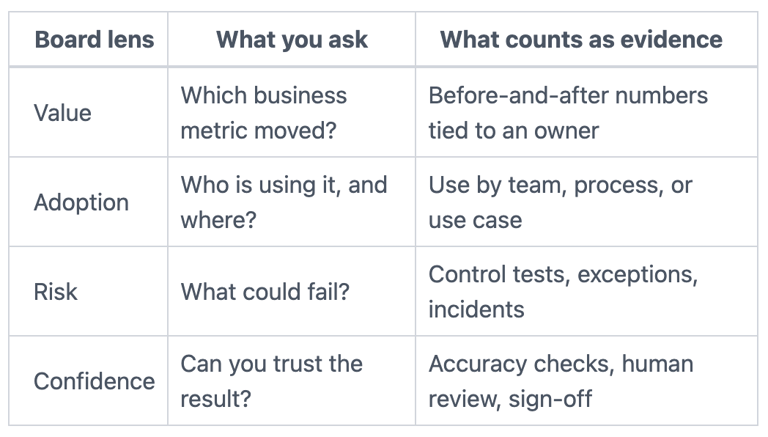
This kind of structure helps you avoid a long deck full of AI facts that never turn into decisions. Gartner's board-focused take on AI measurement also starts with the business goal, then narrows the field to a small set of proof points, which is the right instinct here, too. See board-level AI ROI metrics for that approach.
The point is not to collect more data. The point is to see whether the result is real.
Measure value in business terms
Use the language of the business, not the language of the model. Focus on revenue acceleration, hard savings, time to close, cost per case, error rates, customer churn, complaint volume, fraud loss, or recovery time. These are the board-level measures that matter.
If your investment is helping, you should see clear movement in one or more of these areas. If not, the use case might be technically interesting, but it is not yet generating actual value for the organization.
Check adoption with context
AI adoption matters, but only when it directly supports a core business goal. Aggregate companywide usage counts can often hide the truth. One team may use the tool heavily while another avoids it because the workflow is clumsy or the output is unreliable.
Look at adoption by team, process, and specific use case. That tells you exactly where the tool is helping and where it remains nothing more than a side experiment.
Test risk and confidence together
AI can create value and still become a significant problem. Bad outputs, weak data, privacy mistakes, security gaps, and poor human oversight can erase your gains fast.
Boards should ask whether the controls match the risk. When calculating this, remember that total cost of ownership and soft ROI are just as important as direct value. If the use case touches customers, financial decisions, or regulated data, your confidence in the output must match the value you claim to deliver.
Ask for the Right Evidence, Not Just a Good Story
A good AI story can sound impressive, but evidence is harder to fake.
You want trend lines, control results, and business-owner sign-off. You want to know what changed, when it changed, and what management did about it. If your board reporting is all demo and no data, you are looking at theater. If your current reporting feels thin, the See Where Your Board Actually Stands scorecard can help you see whether your oversight is real or mostly symbolic.
Request before-and-after results
Every serious AI use case should have a clear baseline measurement. What was the process like before? What does it look like now? What improved, by how much, and over what time period?
This comparison tells you whether AI is providing value or just adding noise. Without it, you cannot tell if a pilot is truly working or simply surviving. For ongoing initiatives, you should also look for trending ROI to ensure the project is consistently moving toward realized ROI rather than stagnating.
Look for owner, date, and decision
Every metric should point to one accountable owner, one review date, and one specific action if results are weak. That is how your oversight stays tied to governance instead of drifting into vague status updates.
If management cannot name the owner, the board does not have a decision yet. It has a conversation.
Use Board Questions That Expose Real Value Fast
You do not need twenty questions. You need the right five or six. The goal is to get past the pitch and into the business case.
Ask these in plain language:
What problem are you solving, and why now?
Why is AI the right tool instead of a process fix or simpler automation?
How will we know it is working?
Who owns the result if it misses the mark?
What could go wrong, and who is watching that risk?
What is the fallback if the model or workflow underperforms?
If management cannot answer those clearly, the board does not yet have a defensible AI oversight model.
What problem are you solving, and why now?
This question forces management to explain urgency. It also exposes weak use cases fast. Some problems need AI. Others need cleaner process, better data, or a manual fix.
Do not let AI become the answer before the question is clear.
How will we know it is working?
You want a success measure, a time frame, and the person who will confirm the result. That could be the COO, CFO, business unit leader, or customer operations head. To ensure the initiative remains grounded in technical reality, ask for periodic model accuracy reports as a baseline for performance.
If the answer stays vague, the project is probably too broad to govern.
What could go wrong, and who owns that risk?
Ask about bad outputs, hallucinations, security, privacy, legal exposure, and operational failure. The board must prioritize comprehensive risk mitigation to protect the organization from unforeseen consequences. Each risk should have an owner and an escalation path.
If nobody owns the risk, the board is carrying it by default.
Build a Reporting Rhythm the Board Can Actually Use
AI oversight should not depend on a once-a-quarter update or a crowded dashboard. You need a cadence that shows whether value is building, holding, or fading. To effectively demonstrate the maturity of your investments, focus on capability ROI as a core part of your reporting rhythm.
Monthly management reporting and quarterly board review is a solid start. High-risk or customer-facing use cases deserve a deeper look. A useful filter is to separate operational metrics from business value metrics. This AI ROI framework makes the same point: uptime, error rate, and usage matter, but they are not the same thing as business impact. Ultimately, boards should monitor trending ROI to distinguish between temporary performance gains and long-term strategic impact.
Track a small set of useful metrics
Keep the list short. A few good metrics beat a pile of weak ones. Your reporting should highlight how well your models perform while connecting that performance to the bottom line.
Use measures like:
Time saved in the target workflow
Time-to-value for new initiatives
Error reduction or rework reduction
Technical performance metrics such as model latency and accuracy
Cost impact by process
Adoption by team or use case
Exceptions, incidents, and overrides
User confidence or satisfaction
If a metric does not help you decide whether to scale, pause, or stop, cut it.
Review use cases by risk tier
Not every AI use case needs the same level of board attention. Internal scheduling help is not the same as customer-facing decision support or a model tied to money, pricing, or compliance.
Low-risk uses can stay at the management level. For high-risk use cases, board reporting must include a clearer analysis of the total cost of ownership, including maintenance and monitoring costs. These high-stakes initiatives should come back to the board with clearer evidence, sharper controls, and a more specific call to action regarding their strategic trajectory.
FAQ
What is the simplest way to measure AI business value?
Start with one business problem and one measurable result. Pick a key metric the business already cares about, such as financial performance, then track the change in that metric before and after the AI implementation goes live.
Should user adoption count as value?
Not by itself. High levels of user adoption only matter if they directly support a tangible business outcome, such as faster workflows, lower operational costs, improved quality, or mitigated risk.
How often should the board review AI results?
Quarterly is sufficient for most cases. However, more sensitive or customer-facing use cases should be reviewed sooner, especially if the project risk profile changes.
What if AI creates value but also adds risk?
Then you need a clear tradeoff decision. The board should be informed of the potential value, the associated risks, the assigned process owner, and the specific controls in place before deciding whether to continue the initiative.
What reporting is too weak for the board?
Anything that provides raw counts without sufficient context is ineffective. If your board reporting fails to show clear trends, defined ownership, a logical decision path, or details regarding model accuracy, it is not yet ready for a formal review.
Related reading
If you are looking for more resources to help your board measure AI business value without guesswork, explore these tools to improve your oversight and strategic decision-making:
Conclusion
AI is not valuable because people are excited about it. It is valuable when it aligns with your broader enterprise AI strategy and drives a business result you can see, measure, and defend.
The board rule is simple. If a use case cannot be tied to a business outcome, an accountable owner, and evidence of progress, it is not yet value. Challenge weak reporting, ask for better proof, and stop funding projects that look smart but do not move the business forward.
If your oversight model still feels fuzzy, Get Board-Ready on AI and Cyber Risk to ensure you are driving strategic impact and responsible transformation. When you move beyond the hype and focus on verifiable metrics, you can finally prove the AI ROI your stakeholders demand.
Tyson Martin is the executive public and pre-IPO companies in financial services, AI/data, SaaS, and cloud hire to make trust a measurable asset, one accountable answer to Is it secure? Is it resilient? Is the AI governed?
© 2026. All rights reserved.
Navigation
Free Resources
Contact


Stay ahead of your next board agenda
Sign up for Reports & Learnings From the Boardroom. Plain-English AI and cyber governance insights, biweekly. No pitch.
No spam. Unsubscribe anytime. · Or download the Director's AI Question Pack — 25 questions free