
How to Find a Qualified Board Candidate. The First 30 Days of a Search Done Right
How to Find a Qualified Board Candidate in 30 days, set outcomes, lock conflicts, score interviews, and use references so you pick a director who delivers.


If your last board search felt like speed dating with high stakes, you're not alone. Many searches fail because you start with a title and a wish list, then hope the "right" person shows up. That approach invites confusion, slow decisions, and a final pick that looks great on paper but doesn't change outcomes.
A better approach is a 30-day sprint built around outcomes, risk, and time. You get clear on what the board needs to accomplish, what could go wrong, and what work the role really requires between meetings. Then you run a structured process that produces evidence, not vibes. That's the difference between "we met impressive people" and "we found the right director."
This is for you if you're a CEO, board chair, nominating and governance committee member, or an investor helping shape oversight. To keep the search clean, set conflict-of-interest rules and confidentiality expectations on day one, before any outreach begins.
You can also ground your thinking in a trust-first view of oversight, especially if technology risk is rising. A helpful reference point is this perspective on being a digital trust expert and CISO.
Key takeaways you can use today (before you talk to a single candidate)
Define what success looks like in 12 months, not what the resume should look like.
Pick one decision owner, then set a clear vote and escalation path.
Write down your non-negotiables (time, independence, integrity) and protect them.
Agree on what "qualified" means for your board maturity stage.
Align the search with current risk, including cyber and technology oversight needs.
Decide who can outreach, and lock down confidentiality language.
Build a scorecard, then commit to using it in every interview and reference.
Set a 30-day cadence now, so scheduling doesn't quietly kill momentum.
Days 1 to 7: Get clear on what you need, and what you can realistically offer
Week one is about alignment and decision hygiene. If you skip it, you'll pay for it later with "committee blur," where everyone interviews, nobody owns the call, and the requirements drift after each conversation.
Start by naming a single process owner. In many companies, that's the board chair or the nominating and governance committee chair, with the CEO as a key voice. Either way, you want one person accountable for schedule, scorecard discipline, and closing the loop. Next, define who gets input (often committee members and key committee chairs), and who decides (usually the full board, based on a committee recommendation).
Then get specific about what you won't compromise on. Independence is common, but define it. Do you need no current vendor ties? No material investments in competitors? No advisory work that creates divided loyalties? Write it down. Also decide your confidentiality stance. If you're pre-IPO, in a turnaround, or handling a sensitive matter, you may need a tighter circle and coded calendar holds.
To give this week a worksheet feel, capture three things in writing:
Outcomes: What must change in the next year (strategy, audit readiness, risk oversight, growth discipline, capital planning)?
Constraints: Time demands, committee needs, independence rules, and timeline.
Signals: What evidence proves a candidate can deliver (examples, decisions, references, behavior under pressure)?
If you can't describe the work in plain language, you can't evaluate candidates fairly.
Write a board scorecard that ties the role to outcomes, not buzzwords
A scorecard keeps you from hiring a biography. It also helps you compare candidates who look different on paper but perform similarly in the room.
Use 5 to 7 dimensions, each with a simple definition:
Strategic pattern recognition: They spot second-order effects, not just trends.
Governance maturity: They understand committees, controls, and accountability, without hiding behind jargon.
Industry and regulatory fluency: They know how rules shape decisions, and when to push back.
Ability to challenge respectfully: They can disagree without creating a feud.
Time availability: Their calendar can absorb prep, travel, and crisis calls.
Relevant network access: They can open doors that matter to your priorities.
Culture add: They raise the bar on thinking and behavior, not "fit in."
Add red flags to score against, not just "bad feelings." Watch for the celebrity board member who trades on fame, the overboarded director who can't show up, and the candidate with vague impact who can't name decisions they changed.
If governance expectations are part of the role, it can help to understand what strong leadership credentials look like in practice. This overview of certified CISO leadership credentials is a useful example of how certifications can signal rigor, while still requiring real-world proof.
Pressure-test the role: time, committee fit, and the real work between meetings
A board seat is not four meetings a year. Prep time matters, committee work matters, and crisis time is real. So, pressure-test the role before you pressure-test candidates.
Clarify committee expectations early. Are you filling an audit, risk, technology, or compensation gap? Each has a different workload and a different kind of reading. Also plan for the "between meetings" work: prep calls with management, reviewing materials, and occasional stakeholder conversations.
Account for surge events too. Incidents, lawsuits, regulator inquiries, or an executive transition can compress months of work into two weeks. Your candidate needs capacity for that surge, not just the steady-state rhythm.
Compensation is part of realism. You don't need to negotiate numbers in week one, but you should align on the form (cash, equity, vesting, committee premiums) and what level of engagement it signals.
To confirm capacity, ask for explicit commitments:
Calendar reality: Current boards, operating role, travel load, and known peak seasons.
Employer permission: Any required approvals, especially for executives.
Conflict check preview: Vendors, competitors, advisory roles, and meaningful investments.
Days 8 to 15: Build a smart pipeline and screen for real signals
Week two is where you build a pipeline that's broad enough to be competitive, and tight enough to stay discreet. Warm intros help, but they can trap you in the same small circle. A strong pipeline mixes known quantities with fresh options, while keeping your evaluation consistent.
Diversity of background and thinking is not a side goal, it's performance insurance. Homogeneous boards miss signals. They also make the same assumptions at the same time, which is how risk hides in plain sight. So, widen your sourcing lanes, then use your scorecard to keep comparisons fair.
To stay organized, assign a single tracker owner and agree on a short set of stages (sourced, outreach approved, first screen, panel, finalist, references, offer). Keep notes in one place, and keep them factual. "Great vibe" is not data.
Bias traps show up fast in board searches. You'll see halo effect (one impressive brand wipes out weak substance), familiarity bias (you prefer people like you), and urgency bias (you settle because scheduling got hard). Your fix is structure, plus a willingness to hold the line on the scorecard.
Source candidates in multiple lanes, without creating noise or leaks
Use multiple lanes, but control who can reach out. If too many people "help," you create duplicates, awkward overlaps, and leaks.
Practical sourcing lanes that work without creating chaos:
Current investors (but keep independence rules in mind).
Operator networks (CEOs, CFOs, COOs, CIOs, CISOs) with real oversight experience.
Industry groups and director communities.
Executive search (especially if discretion is critical).
Customer and partner ecosystems (credible operators who know your space).
Retired executives with fresh experience and real time.
You can also research public company proxy statements as a way to understand committee assignments and tenure patterns. Treat it as a research tool, not a target list to spam.
Set simple confidentiality language for outreach. Keep it short, factual, and need-to-know. Also decide who is allowed to initiate contact. Often it's the chair, CEO, or a retained search partner, not every director with a phone.
If you want a sense of what board-facing advisory work looks like in high-stakes settings, this profile of an experienced CISO for hire shows the kind of board communication and governance muscle you should screen for when risk is rising.
Do a first-screen that checks judgment, not just pedigree
Your first screen should feel like a judgment check, not a biography review. You're testing how they think, how they prepare, and how they behave when stakes rise.
Use questions that force specifics:
"Tell me about a time you changed your mind in the boardroom. What caused it?"
"How do you prepare for an audit committee meeting?"
"What metrics do you ask for first when something feels off?"
"Describe a hard disagreement with a founder or CEO. How did you handle it?"
"What's your approach to risk oversight without turning everything into fear?"
"When did you realize you were wrong about a strategy call?"
"What do you do between meetings to stay useful?"
"How do you decide when to go deep versus stay at governance level?"
"What does 'independence' mean to you in practice?"
Then score the result:
Pass: Clear examples, sound judgment, realistic time, strong alignment to outcomes.
Hold: Some signal, but gaps to test in panel or references.
No: Vague stories, over-commitment, or repeated red flags.
Days 16 to 30: Run interviews, references, and close with confidence
Weeks three and four are where many searches stall. People get busy, interviews drift into storytelling, and nobody wants to do references. Your job is to keep pace and keep the process fair.
At this stage, match the candidate to your board's maturity and risk profile. A hands-on builder can be perfect for a scaling company, but frustrating in a highly structured public company board. Likewise, a polished public company director may struggle in a founder-led environment that moves fast and expects more between-meeting engagement.
Use a lightweight cadence so momentum holds. Here's a simple two-week rhythm to keep everyone aligned:
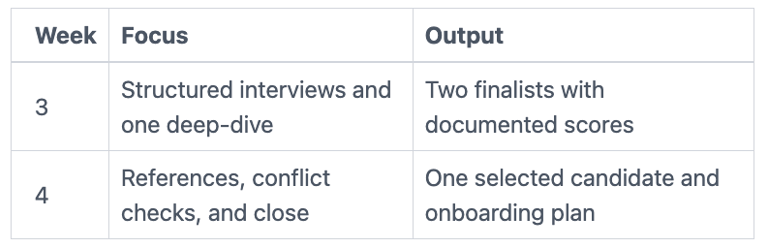
Speed comes from structure, not shortcuts. You don't "win" by skipping steps, you win by removing confusion.
Also remember the close is a two-way decision. You're evaluating them, but they're also evaluating whether your board is serious, aligned, and worth their time.
Use a structured interview loop so every conversation adds new data
A good interview loop avoids repetition and produces comparable notes.
Use a three-step loop:
Chair or CEO screen (30 to 45 minutes): Confirm outcomes, motivation, independence, and time.
Panel with key directors and committee leaders: Split topics so each interviewer owns a scorecard dimension.
Deep-dive on one real business case: Pick a situation that matches your risk profile, such as a strategy pivot, M&A decision, major incident, or regulatory event. Ask what they'd want to see, what questions they'd ask, and how they'd guide decisions.
Keep questions consistent across candidates. Capture notes in the same format, right after the call. Finally, watch for halo effect. A famous logo shouldn't outweigh weak reasoning or fuzzy examples.
If you value directors who stay sharp and keep learning, it helps to look for a proven pattern of growth. This background on an evolving CISO with elite education is a good reminder that learning mindset and decision quality often travel together.
Do references, conflict checks, and onboarding planning before you extend the offer
References only work when you ask for situations, then triangulate. Don't ask, "Were they good?" Ask for decisions, pressure moments, and patterns.
Strong reference prompts sound like this: "Tell me about a time they handled conflict," "When did they miss something," "How did they prepare," "What would you put them on a committee to do?"
Run conflict checks early enough to avoid embarrassment. Common areas include vendor ties, competitor exposure, meaningful investments, advisory roles, and any litigation history relevant to fiduciary duty. If you're regulated, confirm any extra requirements.
Then close with clarity. Spell out expectations, committee role, meeting rhythm, and what "between meetings" help looks like. Share a simple first 90-day onboarding plan: key stakeholders, top risks, current strategy, and the board calendar. Also state what support you'll provide, including access to management and prior materials.
Common ways board searches go sideways (and how you prevent them)
Moving goalposts: You keep rewriting "qualified" after each interview, fix it by locking the scorecard in week one.
Too many interviewers: Candidates hear the same questions six times, fix it with a defined loop and interviewer roles.
Rushing to a name brand: Prestige replaces proof, fix it by scoring red flags and demanding specific impact.
Ignoring culture: You hire a "heavy hitter" who poisons the room, fix it by testing respectful challenge and listening.
Skipping references: You trust the pitch, fix it by triangulating across levels and asking for situations.
Over-indexing on domain expertise: You hire a narrow expert, fix it by weighting judgment and governance maturity.
Failing to sell the mission: Great candidates opt out quietly, fix it by sharing the real work and why it matters.
Slow scheduling: Momentum dies in calendars, fix it by pre-booking key interview windows in weeks 3 and 4.
FAQs about finding and evaluating a qualified board candidate
How long should a board search take if you want a strong outcome?
If you run a structured 30-day sprint, you can often name a finalist quickly. Still, plan for 6 to 10 weeks end-to-end if calendars are tight. The key is to prevent long gaps between stages.
What does "qualified" mean for a board role?
Qualified means they can improve outcomes, not just advise from the sidelines. You should see evidence of judgment, preparation, and influence. Independence and time capacity also count as qualifications.
How do you evaluate cyber and technology oversight without hiring a technologist?
You're looking for governance skill, not keyboard skill. Ask how they frame risk, what metrics they want first, and how they guide management. A director who can ask clean questions often beats a deep specialist who can't govern.
How do you balance independence with needed expertise?
Start with your independence rules, then screen for conflicts early. After that, focus on whether their expertise matches your top risks. If a conflict is manageable, document it and set clear recusal rules.
Should you consider internal candidates, like an executive from your company?
Sometimes, but independence can get complicated. If you do it, be explicit about fiduciary duty, reporting lines, and the shift in relationship with the CEO. You should also compare them against external candidates using the same scorecard.
What if the committee can't agree on the scorecard?
Pause the search for 48 hours and force alignment. Ask each member to rank the top three outcomes and top three risks, then reconcile. If you can't align, you're not ready to evaluate candidates fairly.
Conclusion
In the first 30 days, you're not hunting for a unicorn. You're running a disciplined process: clarify what you need, build a discreet pipeline, validate judgment with consistent interviews and references, then close with clear expectations and onboarding.
When you move fast with structure, you reduce bias and protect confidentiality. You also give strong candidates a reason to say yes, because they can see you're serious.
This week, commit to two concrete actions: finalize your scorecard and lock your interview loop on the calendar. Once you do that, How to Find a Qualified Board Candidate becomes a repeatable process, not a stressful guessing game.
Tyson Martin is the executive public and pre-IPO companies in financial services, AI/data, SaaS, and cloud hire to make trust a measurable asset, one accountable answer to Is it secure? Is it resilient? Is the AI governed?
© 2026. All rights reserved.
Navigation
Free Resources
Contact


Stay ahead of your next board agenda
Sign up for Reports & Learnings From the Boardroom. Plain-English AI and cyber governance insights, biweekly. No pitch.
No spam. Unsubscribe anytime. · Or download the Director's AI Question Pack — 25 questions free