
Considering a NACD Certified Board Director Candidate? Here’s How to Vet the Right One
Vetting a NACD Certified Board Director Candidate, you verify certification, test judgment with scenarios, check conflicts, and confirm fit for risk.


A board seat isn't a trophy. It's a working role that shapes strategy, oversight, and how much trust your stakeholders place in you. That's why choosing a director can feel like hiring a pilot mid-flight. You don't just want confidence, you want judgment.
If you're considering a NACD Certified Board Director Candidate, one who has earned the NACD Directorship Certification, you're already looking at people who took governance seriously enough to study it. That's a strong signal of their governance expertise. Still, it's not the full story. A credential can't prove how someone behaves when the CEO is under fire, when the audit committee is split, or when a cyber incident forces hard tradeoffs.
This guide helps you vet for fit, independence, and real board impact. You'll define what you need, test how they think, verify how they operate, then close with a selection process you can explain to shareholders, regulators, and yourself.
Key takeaways
Define the board leadership job before you judge the person.
Vet for impact, not polished stories.
Test crisis judgment with a realistic scenario.
Confirm culture fit and independence with tough references.
Use a simple rubric so charisma doesn't win.
First, get clear on what you need this director to do for your board
Before you review any director candidates, get specific about the work you need done. Otherwise, you'll fall into a common trap: you select someone impressive, then you hope they fit. Hope is not a process.
Start with outcomes. Do you need better oversight with fewer surprises? Faster decisions because the board finally shares the same risk language? More management accountability without turning meetings into interrogations? The best director matches a real gap and helps close it, strengthening your board composition.
In many organizations, the gap sits in trust. Not "good vibes" trust, but trust as a business asset that affects growth, partnerships, and valuation. If you want that framing, align your board conversation to a clear model of trust and oversight (see this perspective on building trust with executives and boards: https://tysonmartin.com/digital-trust-expert).
Here's a short checklist you can use to define role expectations:
Committee contribution: Which committee needs them most (audit, risk, tech, compliance)?
Crisis readiness: Can they help the board lead through an incident, not just review it after?
Governance maturity: Can they improve reporting, escalation, accountability, and succession planning?
Management boundaries: Do they advise without running the business?
Decision pace: Can they help the board decide with imperfect info?
Culture and ethics: Will they raise tough issues early, and do it constructively?
Stakeholder confidence: Can they protect reputation while supporting growth?
Once you agree on these expectations, interviews become easier. This sharpens your board recruitment: you stop evaluating "great people," and start evaluating fit for a defined job.
Write the role scorecard in plain English, not a wish list
A scorecard keeps you honest. It turns vague needs into signals you can test. Keep it short, and write it like you'd brief a smart executive who has ten minutes.
Define what "good" looks like in three time windows: first 90 days, first year, and a crisis moment. Then decide what evidence would convince you, particularly in the scope of corporate governance reporting.
Sample scorecard bullets you can adapt:
Within 90 days: Improves board reporting on top enterprise risks, with clearer owners and timelines.
Within 90 days: Helps the board align on risk appetite for cyber, privacy, and third-party risk.
Within 12 months: Raises management accountability for remediation, with fewer repeat findings.
Within 12 months: Strengthens incident readiness through at least one executive tabletop.
In a crisis: Keeps the board focused on decisions, not technical noise and blame.
If a candidate can't speak to these outcomes, you're probably evaluating a brand, not a director.
Decide what kind of oversight you are missing right now (risk, growth, or both)
Different board gaps call for different director profiles. Map your situation to a plain scenario, then recruit accordingly.
If you're in rapid growth with platform risk, you need someone who can pressure-test product and vendor decisions without slowing delivery. Look for pattern recognition and strong prioritization.
If you're in a regulated environment with audit pressure, you need someone who understands controls, evidence, and governance cadence. Seek a director who can reduce audit surprises and clarify ownership.
If you've had a recent incident or near miss, you need resilience thinking. Choose someone who's calm, decisive, and experienced with communications, legal coordination, and recovery tradeoffs.
This step prevents you from hiring a generalist when you need a specialist.
How to vet a NACD Certified Board Director Candidate beyond the credential
The NACD.DC designation signals baseline knowledge and commitment. It suggests the person respects governance and has invested in learning. However, your board needs more than baseline. You need judgment, independence, and behavior that makes the whole room better.
So, treat the credential as a starting point. Then verify four things:
Judgment: Do they make sound calls with limited data?
Pattern recognition: Can they spot repeat failure modes across companies?
Independence: Will they challenge management when it's uncomfortable?
Boardroom behavior: Do they exhibit Director Professionalism by listening, simplifying, and moving the room toward decisions?
When you reference leadership standards and credibility, it also helps to understand how the person thinks about disciplined leadership and risk frameworks (this overview is a useful lens for what "certified to lead" can mean in practice: https://tysonmartin.com/certified-to-lead).
To keep your evaluation balanced, use a simple set of signals.
A quick view of common green flags and red flags:
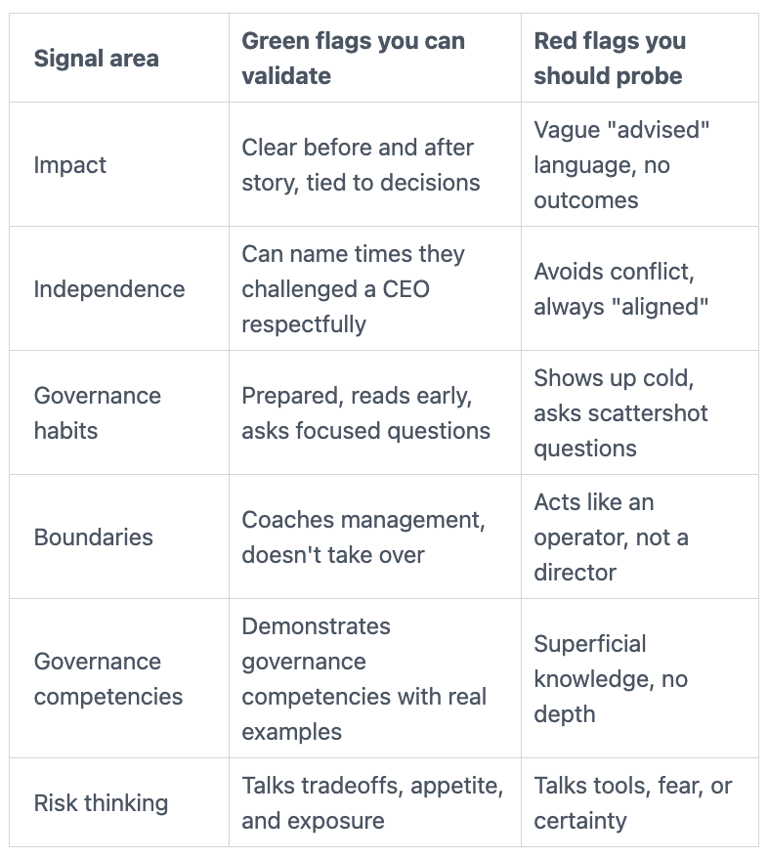
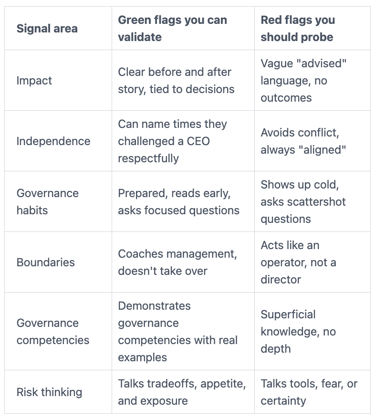
Your goal is simple: confirm they'll improve oversight without creating drag.
Ask for proof of impact: what changed because they were in the room?
You want specifics, not titles. These questions push candidates toward evidence and tradeoffs:
When you joined the board, what was the biggest governance gap you saw?
What decision did you influence that management didn't love at first?
What changed in reporting, metrics, or cadence because of your input?
Share a time you voted "no." What happened next?
How do you help a board separate noise from true risk?
Tell me about a time you were wrong. How did you handle it?
What do you expect from management, and how do you hold the line?
For cyber risk, how do you translate it into revenue, downtime, legal exposure, and reputation?
Listen for numbers, timelines, and concrete decisions. If they can't produce those, you're hearing performance, not proof.
Look for governance judgment under pressure, not just polished stories
A director's real value shows up under stress. So, test crisis thinking in the interview. You're not looking for the "perfect" answer. You're looking for calm structure, decision discipline, and respect for roles.
Use a case study mini scenario prompt like this:
You learn that a key vendor may have exposed customer data. The news could break within 24 hours. Management has partial facts, legal is cautious, and the CEO wants to reassure the market.
Ask how they would guide the board over the next day, week, and month. Strong answers usually include:
A clear decision cadence (what gets decided now versus later).
A focus on customers, materiality, and disclosure obligations.
Tight coordination with legal, comms, and incident leads.
A push for facts, while still acting on risk.
Weak answers drift into tool talk, panic, or "let management handle it" with no oversight structure.
Make sure they fit your board culture, ethics, and decision rhythm
Even a strong board director candidate can fail if they don't fit how your board works. Culture fit doesn't mean "easy to agree with." It means they can disagree without turning the room into a courtroom.
Pay attention to how they simplify complex topics. Watch whether they ask questions that help others think, not questions that prove they're smart. Also, test how they influence when they don't have formal authority, because that's the board's daily reality.
You can validate fit in practical ways:
Have them meet several directors, not just the chair.
Put them in a panel interview with management, then watch boundaries.
Ask for a writing sample, such as a short memo they used in board context.
Do backchannel checks via Equilar BoardEdge, discussion groups, and people who have seen them in real meetings.
Review conflicts early, and document how you'll manage them.
If you want ongoing perspective on board-level security oversight and how to keep it business-focused, you can also track executive-facing guidance here: https://tysonmartin.com/ciso-insights.
Run references that test trust, not just reputation
References often fail because you only speak with friends of the candidate. You'll hear glowing praise, then learn nothing. Instead, review their professional bio and LinkedIn profile, then ask for references across roles (peer director, CEO they challenged, and an executive they coached).
Use this tight script:
Where did they raise the board's performance, not just participate?
How do they prepare, and what do they do between meetings?
Tell me about a time they disagreed. How did they handle it?
Can you trust them with sensitive information? Any concerns?
Do they listen, or do they dominate discussion?
Do they ever overstep into management work? Give an example.
One caution: if every reference sounds rehearsed, get one more name from your network and verify the pattern.
Check for independence, conflicts, and "too many hats" risk
Independence is not a legal checkbox. It's practical. If a director has too many overlapping incentives, your oversight gets soft.
Common issues to probe include vendor ties, consulting relationships, major advisory roles, and competing board seats. Time is also a conflict. A director with "just one more commitment" often becomes unavailable when you need them most.
Keep mitigation simple and written. Document disclosures, recusal rules, and any limits on related-party work. Then revisit it yearly, not only during onboarding.
Close the loop with a practical selection process you can defend
A clean process protects your board. It reduces bias, supports fairness, and gives you a record if anyone questions the appointment later. It also keeps you from hiring the best storyteller.
Here's a process your nominating committee can run without drama:
Shortlist 3 to 5 candidates who have passed the Certification Exam, based on your scorecard.
Structured interview with the same questions for each candidate.
Scenario panel using one crisis prompt, scored in real time.
Reference checks that test trust and boundaries.
Final discussion and vote on directorship designation, with documented rationale.
Outside help can also sharpen your scenario prompts and risk framing, especially when cyber or third-party risk is a key driver. What matters is that you keep ownership of the decision.
Use a simple scoring rubric so you do not hire on charisma
Set up a basic rubric to assess corporate governance skills and score each category from 1 to 5. Weight the categories based on the role scorecard you wrote earlier.
Here's a simple model:
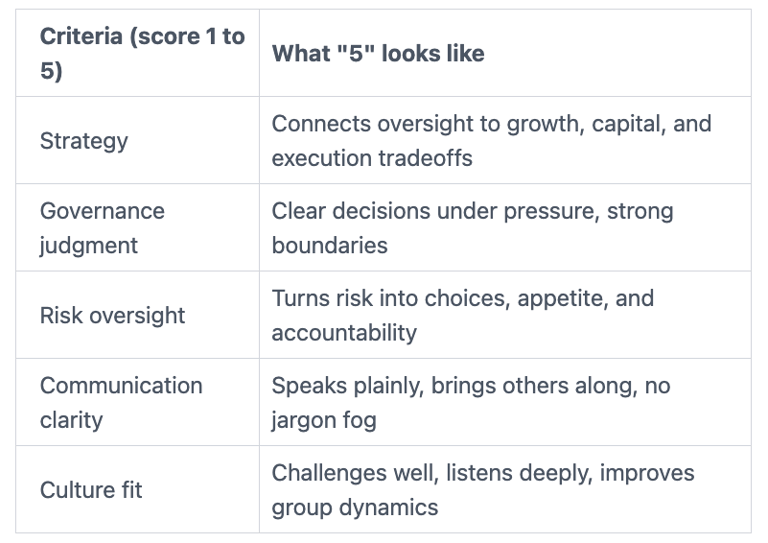
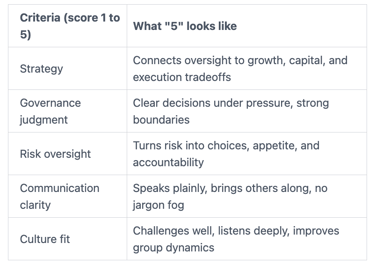
After scoring, discuss gaps out loud. If someone "felt great" but scored poorly, you've learned something.
Set expectations early: onboarding, first year goals, and how you will measure value
Onboarding should feel like setting a director up to contribute, not sending them a data dump. Assign briefings on strategy, top risks, and current control issues. Introduce them to key leaders, including legal, finance, and security.
Then set first-year goals that match your scorecard, including continuing education. Agree on committee assignments and meeting cadence. Also, confirm board-level boundaries in writing, so the director advises and oversees, but doesn't run the function.
Finally, do a first-year review. Ask one question: did this person reduce surprises and improve decision quality? If yes, you made a good call.
FAQs about choosing a NACD Certified Board Director Candidate
Common questions boards ask before making the appointment
Is NACD certification enough to qualify someone for a board seat?
It's a strong signal of commitment and shared language, particularly after passing the Certification Exam. Still, it doesn't prove impact, independence, or crisis judgment. You should validate those directly.
What should you ask in the first interview?
Ask for before and after examples tied to board decisions. Also ask how they handled disagreement with a CEO or chair.
How do you verify real governance experience?
Look for evidence of thorough preparation, such as use of the Study Guide, completion of the foundation course, taking the practice exam through Pearson VUE, meeting eligibility requirements as detailed in the Candidate Handbook, and records in the Certification Portal. Beyond that, seek specifics on committee work, decisions influenced, and measurable changes in reporting or accountability. References should confirm those specifics.
What if the candidate is also a consultant or vendor?
That can be fine, but verify active NACD membership, check the Certification Status Page for their digital badge, and confirm sufficient recertification credits before proceeding. Then manage conflicts with clear disclosure and recusal rules. If the business relationship is material, independence may be compromised.
How do you evaluate cyber oversight strength without getting technical?
Stay in business terms: downtime, customer harm, legal exposure, and recovery time. A strong candidate can discuss risk appetite, decision cadence, and accountability.
How many boards is too many?
There's no single number, but you should test availability in crisis conditions. If they can't commit time when pressure hits, capacity is already too tight.
What does success look like in year one?
You see fewer surprises, clearer reporting, and better decisions. You also feel stronger trust between board and management.
Conclusion
When you're considering a board director candidate, the right move is simple, even if the decision feels heavy. First, define the job your board needs done. Next, test for impact and judgment with structured questions and a crisis scenario. Then confirm culture fit, ethics, and independence through references you can trust. Finally, run a selection process you can defend, with clear scoring and written rationale that considers the NACD Directorship Certification.
Your next step is practical: write the scorecard prioritizing governance expertise and success on the Certification Exam, then run structured interviews against it. If cyber risk and trust are central to the role, you may also benefit from an experienced CISO advising boards on cyber governance (https://tysonmartin.com/experienced-ciso-for-hire). The goal isn't to add more noise, it's to make board oversight calmer, clearer, and more effective with NACD.DC.
Tyson Martin is the executive public and pre-IPO companies in financial services, AI/data, SaaS, and cloud hire to make trust a measurable asset, one accountable answer to Is it secure? Is it resilient? Is the AI governed?
© 2026. All rights reserved.
Navigation
Free Resources
Contact
Stay ahead of your next board agenda
Sign up for Reports & Learnings From the Boardroom. Plain-English AI and cyber governance insights, biweekly. No pitch.
No spam. Unsubscribe anytime. · Or download the Director's AI Question Pack — 25 questions free