
Technology Strategy Plan: What CEOs Should Have Before Approving the Next Big Initiative
This plan is for CEOs who need to cut through pressure, risk, and vendor noise, so you they approve, delay, or reject with clarity.


The plain-English test for major tech approvals before they turn into expensive guesses.
You already feel the pressure. Growth is moving, AI is showing up in more proposals, vendors are deeper in your stack than you want, and the board wants a clear answer now. Another demo, another policy draft, or another slide deck will not solve that.
This is not a tool problem first. It is a strategy problem, and your job is to see whether the plan behind the next big initiative is strong enough to support a defensible decision.
TLDR
A real Technology Strategy Plan for CEOs connects business goals, risk posture, governance, decision rights, and execution in one view.
If the proposal cannot explain the business problem in plain English, it is not ready for approval.
Every major initiative changes risk. You need to know what risk rises, what risk falls, and what the worst failure looks like.
Busy work is not readiness. You want evidence, named owners, milestones, and proof that controls work, not just that they exist.
Before you say yes, you should know the fallback plan, the reporting rhythm, and the point where you would stop, change scope, or exit.
What a real technology strategy plan does, and what it does not
A strong plan helps you make a business decision. It shows you what matters, who owns it, how risk is being handled, and what approval is needed now. That is the whole point.
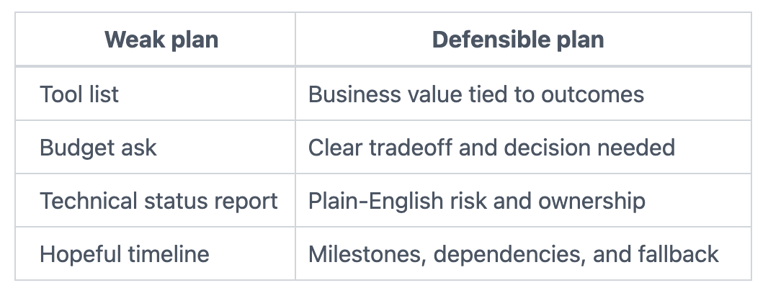
A weak plan does something else. It hands you a stack of tools, a budget request, and a lot of technical noise. That may keep the project moving, but it does not give you clear judgment.
The difference is simple. Planning keeps work organized. Decision support helps you choose, fund, accept, delay, or reject the initiative with your eyes open.
The difference between planning and real decision support
A plan is only useful when it changes the quality of your decision. If it does not help you choose, it is just administration.
If the plan cannot support a real decision, it is paperwork with a budget line.
You should be able to see the tradeoffs fast. What do you gain, what do you give up, and what risk are you willing to carry for speed or growth? If the answer is buried in jargon, the plan is not ready.
Why a tool list is not a strategy
Software, vendors, and controls are inputs. They are not the strategy.
A real plan says how the company will decide when priorities collide, when a timeline slips, or when a vendor promise turns thin. It also shows how you will measure success in business terms, not just activity counts.
If the initiative includes AI, keep the board AI question pack close. The same rule applies there. Tools do not create judgment. Governance does.
The five questions your next approval should answer
You do not need a 40-page packet. You need five honest answers. If management cannot give them in plain English, the initiative is not ready.
What business problem are you solving, and what changes if you do nothing?
What risk changes if you approve it, and what risk shrinks?
Who owns the decision, the budget, and the result?
What breaks if the timeline slips, a vendor misses, or a team comes up short?
What is the fallback plan if the initiative proves harder, slower, or costlier than expected?
What business problem are you solving
Start with the business issue, not the technology wish list. Growth, cost, trust, speed, resilience, and customer experience are all valid drivers.
If the answer sounds like, "we need modern tools," keep asking. Modern what? For which outcome? Why now? What changes for the business if you do nothing this quarter?
That line of questioning keeps you out of vanity projects and inside real value.
What risk changes if you approve it
Every major initiative shifts risk. Some of it moves down. Some of it moves up.
You want a plain view of business exposure, including downtime, financial loss, legal exposure, and trust damage. If there is a deadline tied to a contract, a customer promise, threat activity, or the SEC cybersecurity disclosure rule, name it.
Ask what becomes harder to recover if the plan slips. Also ask what legacy risk disappears. That is the tradeoff you are paying for.
Who owns the decision and the result
Approval without ownership is a trap.
You should know who is accountable, who advises, who approves exceptions, and who reports back when the plan slips. If a CISO, CIO, COO, or business leader owns part of the work, make the lane clear.
Good governance also means escalation. If something breaks, who calls the CEO, the audit chair, or the board? If no one can answer that cleanly, the structure is too loose.
How to test whether the plan is grounded in reality
This is where you stop listening for confidence and start looking for proof. Activity is not readiness. A busy team can still be exposed.
If you want a fast read on oversight gaps, see where your board actually stands.
Ask for evidence, not confidence
You need current facts, not optimism.
Look for evidence on systems, vendors, controls, staffing, and business impact. Ask for recent testing, recovery expectations, owner names, contract terms, exception tracking, and the dates each issue will be closed.
A few useful proof points:
current risk data, not old assumptions
tested controls, not just documented ones
vendor clauses on subcontractors, deletion, and exit support
milestones with dates and accountable owners
a short list of open issues tied to real reporting
If internal audit is involved, keep the line clean. Security fixes, audit tests.
Look for hidden dependencies before they become delays
Most initiatives do not fail because the idea was bad. They fail because the dependencies were missed.
The usual suspects are data, identity, cloud access, third-party support, and team capacity. A launch may look ready until one of those pieces slows down.
Ask one simple question: what breaks first? That answer usually tells you where the rework, cost, or delay will show up.
Separate busy work from real readiness
Dashboards can show motion without showing progress.
A good plan ties milestones to outcomes. A weak one counts tasks. Those are not the same thing. Closing 20 tickets does not mean the business is safer, faster, or better protected.
If the status report is full of technical trivia and light on risk movement, the plan is still immature.
What a CEO should have in place before saying yes
Before approval, you should have the basic leadership package in hand. Not the biggest title. Not the most expensive program. Just enough control to make the decision defensible.
A clear risk appetite for this initiative
You need to know what level of risk the company will accept, where it will not bend, and which tradeoffs are fair for speed or growth.
Risk appetite is not a slogan. It is the line between acceptable friction and unacceptable exposure. If the initiative crosses that line, you should see it plainly.
That is especially true when the initiative touches customer data, regulated data, high-availability systems, or a sensitive vendor chain.
A simple reporting rhythm that will not hide problems
Your updates should answer four things every time, what changed, what is still exposed, what decision is needed, and where help is required.
Keep the rhythm short and plain. Trend over trivia. Decision over decoration.
A strong update also shows whether risk is moving in the right direction. If you have a CISO or equivalent, tie their review to the outcomes you care about, like time-to-fix, recovery targets, and vendor coverage.
A fallback plan if the initiative slips
Every approval needs a Plan B.
What happens if the vendor misses? What if funding slips? What if the team cannot absorb the change? What if the initiative turns out to be more complex than the slide deck suggested?
You need one path if things go well, and one if they do not. That keeps you from turning a delay into a scramble.
Conclusion
The next big approval should not be driven by pressure or optimism. It should be driven by clarity.
A strong Technology Strategy Plan for CEOs gives you business value, named ownership, real evidence, and a fallback path. It helps you see what matters, ask sharper questions, and approve only what the business can support.
If the proposal still feels vague, use the framework above, then get a second set of eyes before you sign. A short advisory conversation can save you from a long and costly mistake. Get Board-Ready on AI and Cyber Risk
Frequently Asked Questions
What should a Technology Strategy Plan for CEOs include?
It should show the business problem, the expected outcome, the risk shift, the owner, the reporting rhythm, and the fallback plan. If it skips those pieces, it is not decision-ready.
How do you know a technology initiative is ready for approval?
You know it is ready when the answer is plain, the evidence is current, the owner is named, and the tradeoffs are visible. Confidence alone is not enough.
What is the biggest mistake CEOs make?
They approve the motion, not the judgment. A busy plan can look active while still hiding risk, weak ownership, or bad assumptions.
Where do AI and cyber risk fit into this?
They fit anywhere the initiative depends on data, automation, vendors, or customer trust. If AI is part of the proposal, pair the business case with clear oversight questions before you say yes.
Tyson Martin is the executive public and pre-IPO companies in financial services, AI/data, SaaS, and cloud hire to make trust a measurable asset, one accountable answer to Is it secure? Is it resilient? Is the AI governed?
© 2026. All rights reserved.
Navigation
Free Resources
Contact

Stay ahead of your next board agenda
Sign up for Reports & Learnings From the Boardroom. Plain-English AI and cyber governance insights, biweekly. No pitch.
No spam. Unsubscribe anytime. · Or download the Director's AI Question Pack — 25 questions free