
Technology Strategy Plan vs. Technology Roadmap: What Leaders Need to Know
Do you need a technology strategy or a technology roadmap to gain necessary clarity, escape from noisy meetings, reduce fuzzy approvals, and waste spending?


Plain-English guidance for boards and executive teams that need clearer priorities, cleaner approvals, and less wasted spend.
You are being asked for clearer answers while technology keeps moving faster than oversight. Budgets are tight, AI is showing up in more tools, vendors are multiplying, and your board still wants one thing: what matters now?
Buying another platform will not fix confusion. This is a strategy problem first, then an execution problem.
The hard part is that technology strategy and a technology roadmap are related, but they do different jobs. Mix them up, and you get scattered spending, fuzzy priorities, and board conversations that drift into technical noise.
TLDR
A technology strategy plan sets direction, tradeoffs, and business priorities. A roadmap turns that direction into sequence, owners, dates, and dependencies.
If you start with tools instead of business outcomes, you get busy work. Motion is not direction.
A weak strategy sounds broad and hopeful. A strong one says what you are solving, what risk you are taking on, and what success looks like.
A weak roadmap is a wish list. A strong one makes slippage, ownership gaps, and funding risk visible early.
Before you approve either one, ask what decision you are making, why now, what breaks if funding slips, and who owns the result.
What a technology strategy plan is, and what it is not
A technology strategy plan is the high-level decision document that says where you are going, why it matters, what risk you are managing, and how technology supports business goals.
It is not a project list. It is not a software shopping cart. It is not a pile of vendor pitches dressed up as leadership thinking.
You should use the strategy plan to set direction first, then decide what technology choices support it. That means the business outcome comes first. The tools come second.
Here is the clean way to separate the two:
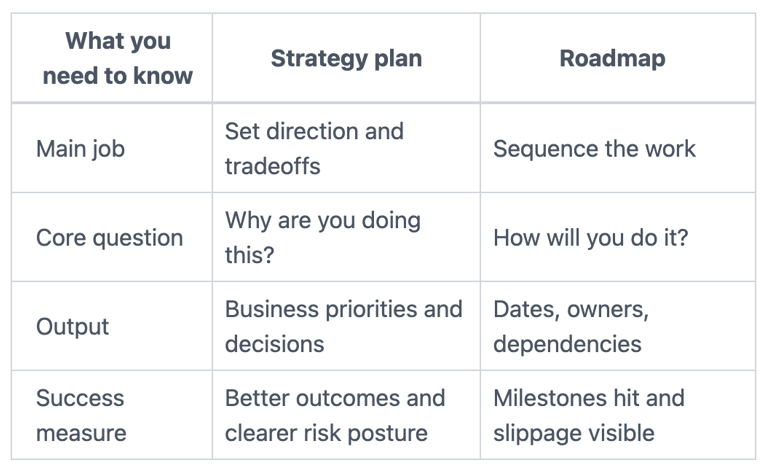
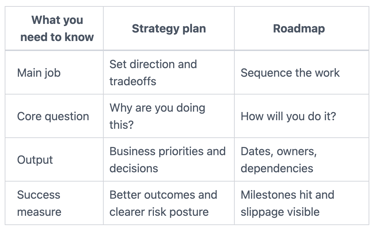
A strategy plan should help you choose, not just describe. If it cannot help you say yes, no, or not yet, it is too thin.
The questions your strategy plan must answer
You do not need technical detail here. You need clean answers.
Your strategy plan should answer these questions:
What business problem are you solving?
What risk matters most right now?
What does success look like in business terms?
What has to be true for this to work?
What decision needs executive approval?
If the answers are fuzzy, you are not ready to spend. You are ready to ask better questions.
A good plan also makes ownership clear. Who is accountable? What tradeoff are you making? What are you delaying so this can happen? If nobody can answer those questions, the plan is still a draft.
The signs you are looking at a wish list instead of a strategy
Weak strategy plans have a familiar smell. They talk about modernization, transformation, and future state without saying what changes first.
Watch for these signs:
Too many tools, not enough priorities
Broad promises with no tradeoffs
No link to revenue, resilience, customer trust, or risk reduction
No named owner for the hard decisions
No clear reason to act now
When a plan cannot connect to business outcomes, it is not helping leadership. It is decorating a meeting.
What a technology roadmap does that a strategy plan cannot
The roadmap is the execution path. It shows the order of work, the timing, the dependencies, the owners, and the milestones that move the strategy forward.
Think of it this way. The strategy says where you are headed. The roadmap says how you get there without crashing into the same wall three times.
A roadmap should answer:
What happens first?
What has to finish before the next step starts?
Who owns each step?
What is the budget range?
Where are the decision gates?
That is what leaders need. Not a pretty slide. A real path.
The roadmap details leaders should expect to see
A usable roadmap is inspectable. You should be able to look at it and spot risk before the risk turns into a surprise.
Expect to see:
Phases with clear dates
Named owners
Dependencies across teams or vendors
Budget ranges, not vague hand-waving
Risk checkpoints
Decision points where leaders can pause, change course, or approve more funding
When the roadmap is honest, it makes governance easier. You can see what is moving, what is stuck, and what changed.
That matters because delayed work rarely fails all at once. It slips a little, then a little more, then everyone acts surprised.
Why a roadmap without strategy creates busy work
If you start with projects first, you usually get whatever feels urgent.
That is how teams end up with disconnected fixes, duplicate tools, and spending that nobody can defend six months later. The board hears activity. The business gets motion. Neither gets clarity.
A roadmap without strategy also makes prioritization almost impossible. Why does one initiative matter more than another? Why now? Why this budget? If you cannot answer that, you are guessing.
And guessing is expensive.
How to tell whether you need strategy, roadmap, or both
Use the problem in front of you to decide.
If the organization does not know what matters most, start with strategy. If the direction is already clear but execution is messy, build the roadmap. If both are weak, fix strategy first, then sequence the work.
That shows up in real life all the time. A company in growth mode may need a strategy reset because cloud, AI, and third-party risk are outpacing the old model. A company after M&A may need a roadmap because the direction is set, but systems and ownership are a mess. A company with a leadership transition may need both because nobody can explain what is priority and who owns it.
If the board or executive team cannot say why the work matters, the roadmap will not hold up.
When the strategy plan should come first
Strategy comes first when leaders are unclear on goals, risk appetite, ownership, or tradeoffs.
This is the right move when you need to decide what to protect, what to delay, and what good looks like. It is also the right move when cyber, AI, or vendor dependence is creating more pressure than your current operating model can handle.
If the board cannot explain the why, no roadmap can save the how.
When the roadmap becomes the urgent next move
A roadmap matters most when the strategy already exists, but execution is drifting.
Maybe you have approved direction, but every team is doing something different. Maybe funding is in place, but no one can show progress cleanly. Maybe the plan sounds good in a meeting and falls apart in the week after.
That is when you need sequencing, deadlines, and accountability.
What leaders should ask before they approve either one
Before you approve a strategy plan or a roadmap, force it to become decision-shaped.
If the material cannot tell you what decision is being asked for, it is not ready. If it cannot connect to material business impact, it is too vague. If it cannot explain what breaks when funding slips, you are looking at optimism, not oversight.
See Where Your Board Actually Stands if you want a quick read on whether your oversight is real or just symbolic.
If the plan cannot change a decision, it is not a plan worth approving.
The approval questions that expose weak thinking fast
Use these questions in the boardroom, the executive meeting, or the committee packet:
What problem are you solving?
Why now?
What risk are you reducing?
What happens if you wait?
What else could you do instead?
What do you need from leadership today?
Those questions work because they force business judgment. They also keep you out of the weeds.
What good approval material looks like
Strong approval material gives you a clean choice.
It includes a clear business goal, a short list of options, the cost and risk of each option, a named owner, a realistic sequence, and measurable outcomes. It also says what is being deferred.
That is the difference between leadership material and technical trivia. One helps you decide. The other just fills a packet.
How to keep the strategy and roadmap aligned over time
Approval is not the finish line. It is the start of the discipline.
Business conditions change. Vendors slip. Staffing shifts. AI gets added to the stack. A merger changes priorities overnight. If you do not keep the strategy and roadmap aligned, the work drifts.
The fix is a simple review rhythm:
Review strategy on a slower cycle, such as semiannually or when the business changes
Review the roadmap more often, usually monthly
Track owners, dates, dependencies, and risks in every review
Escalate slippage early, before it turns into a rewrite
The point is not to add more meetings. The point is to keep the work honest.
The warning signs that your plan has gone stale
You know the plan is drifting when the same issues keep showing up.
Look for repeated delays, crowded priorities, hidden dependencies, and roadmap items that no longer match the business need. If leaders keep changing the goal but nobody revisits the plan, the problem is governance.
Not effort. Governance.
Frequently Asked Questions
What is the main difference between a strategy plan and a roadmap?
The strategy plan sets direction and priorities. The roadmap turns that direction into an execution sequence with owners, dates, and dependencies.
Which one should come first?
The strategy plan should come first when you do not yet know what matters most. The roadmap comes first only after the direction is clear enough to execute.
How often should you update them?
Review the strategy less often, but revisit it when the business changes. Review the roadmap more often, because execution slips show up there first.
What should the board want to see?
The board should see the business reason, the risk being reduced, the decision being asked for, the owner, and the milestone path. It should not have to hunt for the point.
What if technology work includes AI or cyber risk?
Then the questions need to be even sharper. You need to know what risk you are accepting, what controls are in place, and what decision the board is actually approving.
Conclusion
You need strategy to choose direction. You need a roadmap to move with control. One without the other leaves you with either abstract intent or busy work.
If you are heading into a budget meeting, a board review, or a major technology decision, tighten the decision clarity first. Then approve the work that actually changes the business, not the work that only looks active.
If you need a sharper outside view on that decision, Get Board-Ready on AI and Cyber Risk.
Tyson Martin is the executive public and pre-IPO companies in financial services, AI/data, SaaS, and cloud hire to make trust a measurable asset, one accountable answer to Is it secure? Is it resilient? Is the AI governed?
© 2026. All rights reserved.
Navigation
Free Resources
Contact


Stay ahead of your next board agenda
Sign up for Reports & Learnings From the Boardroom. Plain-English AI and cyber governance insights, biweekly. No pitch.
No spam. Unsubscribe anytime. · Or download the Director's AI Question Pack — 25 questions free