
What a Cyber Risk Advisor Actually Does for Your Board
You're under pressure from cyber noise and unclear ownership, so a cyber risk advisor helps you make board-ready decisions that hold up.


Plain-English guidance for leaders who need better cyber decisions, clearer ownership, and cleaner board reporting.
You are getting more risk, more tools, more vendor input, and less clarity about what to do first. Buying another platform or checking another box will not fix that.
A cyber risk advisor is not just another technical voice in the room. The job is to turn noise into better decisions, clearer ownership, and a board-level picture you can defend when pressure shows up.
That matters whether you sit in the chair as a CEO, board member, founder, CIO, CISO, or audit committee lead. It also matters if you are the practitioner trying to keep the program moving without becoming the only person who can translate risk into English.
TLDR
A cyber risk advisor helps you decide what matters now, what can wait, and who owns the call.
The role is not a tool, a scanner, or a project consultant with a prettier title.
You should expect help with vendor risk, incident readiness, board reporting, and risk acceptance.
The real value shows up when ownership is muddy or the reporting keeps turning into noise.
If your team can execute but leadership needs sharper judgment, advisory support can be enough. If decisions are stalling, you may need fractional or interim leadership.
What a cyber risk advisor does that a security tool or consultant cannot
A tool gives you data. A consultant often gives you tasks. A cyber risk advisor gives you judgment. That is the difference that matters when your team already has work in motion, but no one can say what should happen first.
In smaller and mid-market companies, this role is often fractional or advisory. You do not always need a full-time executive on day one. You need someone who can sort risk, set decision rights, and keep the board packet tied to business outcomes.
Turning technical findings into business choices
A weak access control issue is not just a security finding. It is a choice about cost, timing, and exposure. The same is true for an unpatched system, a vendor gap, or a recovery process that has never been tested under pressure.
A cyber risk advisor helps you ask the right question: what is the business impact if we leave this alone for another quarter? That pushes the conversation away from more technical detail and toward a better decision.
Helping you avoid unclear ownership
A lot of companies do not fail from lack of effort. They fail because no one is clearly accountable. Work gets split across IT, security, legal, finance, and vendors, then stalls in the gaps.
A strong advisor names the accountable leader, clarifies escalation paths, and keeps important work from getting lost between teams. If nobody owns the call, you do not have governance. You have motion.
The core responsibilities you should expect from a cyber risk advisor
Think of the role in three parts, priorities, reporting, and readiness. If those three things are weak, the business keeps guessing. If they are strong, leaders can move faster without guessing their way into trouble.
The best advisors do not try to own everything. They reduce noise, sharpen the questions, and help you build a steady operating rhythm that leaders will use.
Setting risk priorities so you fund the right work first
Good security programs are full of urgent things. That does not mean they are all equal. A cyber risk advisor ranks issues by business impact, not by the loudest voice in the room.
That usually means deciding what is truly urgent, what is acceptable for now, and what needs funding or executive attention. The point is not to chase the longest list. The point is to spend on the risks that can hurt revenue, operations, trust, or legal standing.
Building reporting that leaders can actually use
Board-ready reporting should answer three questions: what changed, what does it mean, and what decision do you need from us? If the report cannot do that, it is probably not helping.
Useful reporting stays tight. It focuses on trends, owners, deadlines, and open decisions. Green dashboards and activity counts can look neat, but they often hide the part that matters, whether risk is moving in the right direction.
Testing readiness before a real incident forces the issue
A cyber risk advisor should help you run tabletop exercises and fix what they expose. That is where you find the weak spots before a breach, ransomware event, or regulator inquiry does it for you.
After a good drill, you should have a current contact list, a clear decision tree, an evidence checklist, and draft communication templates. You should also know who calls legal, who speaks for the company, and what gets preserved first.
How a cyber risk advisor supports the board and executive team
The board does not need more technical trivia. It needs a smaller set of decisions that are clear enough to act on. That is where the advisor earns the seat at the table.
If you want a fast read on where your current oversight stands, start with the board cyber risk scorecard.
Keeping the board focused on decisions, not noise
A long cyber update can hide a simple truth, the board only has a few real choices. Accept the risk, fund the fix, change priority, or defer with eyes open. Everything else is commentary.
If the update does not end in a decision, it is not board reporting. It is background noise.
A cyber risk advisor helps compress the story so directors can see what matters fast. That makes the meeting more useful and the follow-up more disciplined.
Clarifying who is accountable when risk crosses into business impact
Directors should know who owns the risk, who can approve spending, who can stop work, and who speaks for the company during a serious event. They should also know where management ends and oversight begins.
That is why decision rights matter. When those lines are vague, incidents get messy and budgets turn into arguments. When they are clear, the company can move without chaos.
Helping you spot weak reporting before it becomes a governance problem
Weak reporting is often polite. It sounds busy, feels professional, and says very little. You hear phrases like "we are improving" or "we are on track," but the board still cannot tell what changed.
A cyber risk advisor catches that early. The job is to surface the gap before the board starts getting polished answers that do not change decisions.
When you need cyber risk advice most
You usually feel the need for outside judgment when the pressure changes. Leadership turnover, rapid growth, M&A, a vendor failure, a breach, or a new rule can all expose the same issue, the current operating model no longer fits.
This is also when a board or executive team tends to ask for a clearer picture. The right advisor helps you get one without creating panic.
After an incident or near miss
After a breach or near miss, you do not need drama. You need control. That means preserving evidence, organizing decisions, and reducing repeat risk before blame takes over the room.
A good advisor helps you keep people calm and focused. The first job is to stop the bleeding, not to build a perfect postmortem deck.
During growth, transition, or a leadership gap
Fast growth can break an old security model. So can an executive exit, a restructure, or a move into new markets. In those moments, you need continuity more than theory.
An advisor keeps priorities stable while the business is moving. That is often the difference between a program that holds together and one that drifts for months.
When the board wants clearer oversight, faster
Sometimes the trigger is not an incident. It is a board that no longer trusts the current reporting rhythm. The questions are getting sharper, and the answers are not keeping up.
A cyber risk advisor helps the board see what is real, what is missing, and what needs follow-up. That is a small move with a big payoff, because it cuts guesswork before it hardens into a governance problem.
How to tell if you need an advisor, a fractional leader, or a full-time executive
The right support depends on the problem in front of you. If the issue is judgment, advisory support may be enough. If the issue is daily execution and hard calls, you need more.
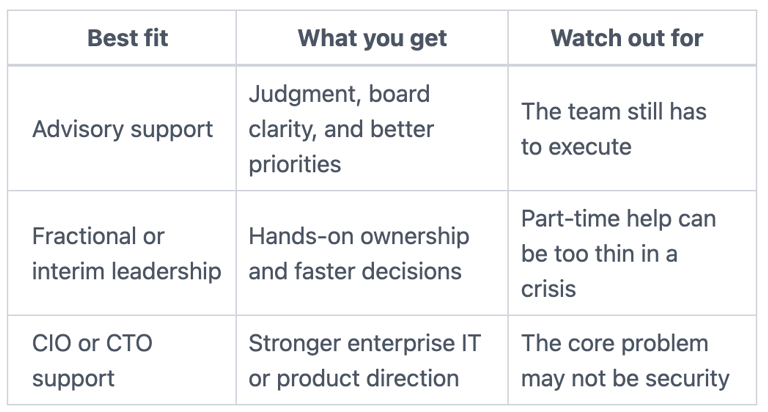
The table is simple on purpose. If the team can do the work but leadership needs clearer judgment, advisory support fits. If nobody can own the program, you need a stronger executive lane.
Choose advisory support when you need judgment and board clarity
This is the right fit when the team is competent, but the top of the house lacks a clean read on what matters. You need help with priorities, reporting, and oversight, not another person to manage tickets.
That is where a cyber risk advisor adds value fast. The work is about direction, not volume.
Choose fractional or interim leadership when decisions are stalling
If no one can own the program, make hard calls, or carry the team through disruption, advice alone is not enough. You need someone who can run the work, not only comment on it.
That is the gap interim and fractional leaders fill. They bring accountability, not just perspective.
Choose a different role when the core problem is not security
Sometimes the issue is product delivery, enterprise IT alignment, or broader technology operations. In that case, a CIO or CTO may be the better fit.
That distinction matters. The right title only matters if it solves the right problem.
Frequently asked questions
What is the difference between a cyber risk advisor and a CISO?
A CISO usually owns the security program. A cyber risk advisor helps leadership make better decisions about that program, especially at the board or executive level.
Can a cyber risk advisor help the board?
Yes. That is one of the main reasons to bring one in. The advisor helps directors ask sharper questions, avoid technical weeds, and get cleaner reporting.
When should you bring in a cyber risk advisor?
Bring one in when reporting is vague, ownership is unclear, the board wants more confidence, or the business is facing change. Those are the moments when outside judgment pays off.
Do you need a full-time executive for this work?
Not always. If your team can execute and you mainly need better direction, advisory support may be enough. If nobody owns the work, you need more than advice.
What should the first 30 days focus on?
Start with ownership, priorities, reporting, and readiness. Those four things tell you fast whether the program is under control or just staying busy.
Conclusion
A cyber risk advisor helps you make better decisions under pressure, not just manage more security work. That is why the role matters when risk, tools, and vendor noise start outrunning clarity.
If you get the role right, you get clearer ownership, better board reporting, stronger incident readiness, and less guesswork. If you want help sorting the gap before the next big decision, Get Board-Ready on AI and Cyber Risk is a direct next step.
Tyson Martin is the executive public and pre-IPO companies in financial services, AI/data, SaaS, and cloud hire to make trust a measurable asset, one accountable answer to Is it secure? Is it resilient? Is the AI governed?
© 2026. All rights reserved.
Navigation
Free Resources
Contact


Stay ahead of your next board agenda
Sign up for Reports & Learnings From the Boardroom. Plain-English AI and cyber governance insights, biweekly. No pitch.
No spam. Unsubscribe anytime. · Or download the Director's AI Question Pack — 25 questions free