
How Often Should I Update My Cyber Risk Strategy?
You feel the pressure now, learn when to update cyber risk strategy before stale reporting hides real business risk and board questions.


How to keep cyber oversight tied to current business risk.
You already feel the pressure. New threats show up faster, vendors hold more of your operations, AI is moving into daily work, and the board wants sharper answers.
The real question is not whether you have a cyber risk strategy. It is whether that strategy still matches the business you run today. This is a governance problem first, not a tooling problem. A good strategy helps you make cleaner decisions, not collect more slides. Here's how to know when to refresh it, and how to keep it useful instead of stale.
TLDR
Update your cyber risk strategy at least once a year, and sooner when the business changes.
Treat leadership changes, incidents, vendor shifts, and board pressure as review triggers.
A strategy should set priorities, ownership, risk appetite, and escalation paths.
If reporting does not change decisions, your strategy is already behind.
The board should see business impact, named owners, and clear next steps.
What a current cyber risk strategy should actually do for you
A current cyber risk strategy is a decision guide. It tells you what matters most, who owns it, what you will tolerate, and what gets fixed first. That is the real job.
A weak strategy is just a binder, a tool list, or a yearly presentation. A strong one connects risk, governance, execution, and reporting. It helps you protect revenue, operations, trust, and legal standing, because those are the things that suffer when cyber decisions go sideways.
What it is, and what it is not
It is a business-aligned guide tied to risk appetite and priorities. It is not a control catalog or a vendor promise.
That difference matters when the business moves fast. If you treat the strategy like a checklist, you will miss the point when a real event hits. The strategy should help you decide, not just document.
Why stale strategy creates real business risk
When the strategy gets old, ownership gets fuzzy. Escalation slows down. Reporting gets noisy. The board hears activity, but not judgment.
That is how small issues become larger ones. The cost is not only technical exposure. It is board confidence, customer trust, and time lost while the business waits for a decision.
The moments when you should update it sooner
There is no magic annual-only rule. You update the strategy when the business, threat picture, or governance model changes in a way that shifts risk.
After major business changes
Growth, M&A, new markets, new products, heavier cloud use, more AI, outsourcing, or a new operating model all change the attack surface. They also change decision rights.
If your team still runs the old playbook after a major shift, you are guessing. The strategy needs to reflect what the company is now, not what it was last year.
After risk or leadership shocks
A breach, ransomware event, regulator inquiry, audit finding, or the loss of a key security leader should trigger a review. These events expose weak spots fast.
They usually reveal gaps in ownership, reporting, and recovery planning. You do not want to discover those gaps twice.
After board or regulatory pressure changes
Sometimes the trigger is not an incident. It is a board that wants cleaner oversight, a customer that wants proof, or a regulator that has raised the bar.
That is when the strategy has to answer better questions, not produce more data. If you need a board-level standard for that, cybersecurity governance for boards is the right place to start.
A simple review rhythm that keeps the strategy alive
Most organizations do better with a light quarterly check, a deeper management review twice a year, and a full strategy reset once a year. Not every review should rewrite the plan. Most should confirm whether the top risks, owners, and priorities still make sense.
Here is a simple cadence.
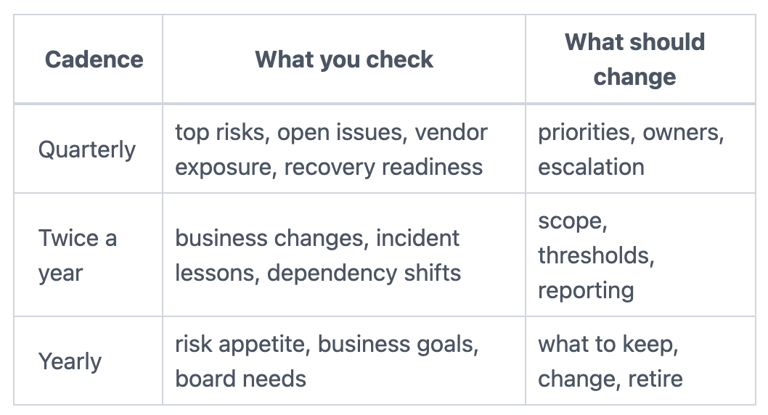
Quarterly checks that catch drift early
Keep this review short. Ask whether the top risks changed, whether any vendor or system now matters more, and whether recovery still looks real.
You are not looking for theater. You are looking for drift before it becomes habit.
Annual resets that test the whole picture
The annual review should go back to business goals, risk appetite, and major dependencies. It should also pull in lessons from incidents, audits, and board questions.
This is the time to decide what stays, what gets cut, and what needs a new owner.
What the board should look for in the update
The board does not need a technical dump. It needs to see what changed, what it means to the business, and what decision is needed now.
If the update cannot answer those three things, it is not board-ready. A good test is whether the reporting would pass the cyber oversight scorecard without hand-waving.
How to tell if your strategy is already out of date
Use this quick check.
You keep hearing the same issues every quarter.
Dashboards look green, but no decisions get made.
Ownership is split, vague, or buried in org charts.
Vendor dependence has grown, but the plan has not changed.
The business is using new AI, cloud, or data models that the strategy barely mentions.
If your strategy still talks about old priorities while the business has moved on, it needs a refresh.
You keep reporting the same issues with no change in direction
Repeated reporting without a new decision is a bad sign. It usually means the strategy is not driving action.
You may have activity. You do not have movement.
Your biggest risks have changed, but your plan has not
If AI use, cloud concentration, or vendor reliance has grown, last year's strategy may no longer fit. The old priorities can still matter, but they may not be the biggest issues now.
That is the point where you stop polishing the document and start rethinking it.
Frequently asked questions
How often should you update cyber risk strategy?
At least once a year. Review it sooner when the business, threat picture, or leadership changes.
Do you need a full rewrite every year?
No. Many updates are adjustments. The key is whether the strategy still matches current risk.
Who should own the update?
A clear executive owner should own it, usually the CISO or equivalent with support from the business and the board.
What should the board ask for?
The board should ask for business impact, named owners, current gaps, and the one decision needed now.
Related reading
For the board-side version of this work, read cybersecurity governance for boards.
Conclusion
The clean answer is simple. Update your cyber risk strategy at least once a year, and sooner when business change, leadership change, incidents, or regulatory pressure shift the picture.
The goal is not a perfect document. It is a living decision tool that helps you govern risk with clarity. Review the last quarter, name the top three gaps, and assign one owner to the update. If you want a fast read on whether oversight is real or symbolic, See Where Your Board Actually Stands.
Tyson Martin is the executive public and pre-IPO companies in financial services, AI/data, SaaS, and cloud hire to make trust a measurable asset, one accountable answer to Is it secure? Is it resilient? Is the AI governed?
© 2026. All rights reserved.
Navigation
Free Resources
Contact


Stay ahead of your next board agenda
Sign up for Reports & Learnings From the Boardroom. Plain-English AI and cyber governance insights, biweekly. No pitch.
No spam. Unsubscribe anytime. · Or download the Director's AI Question Pack — 25 questions free