
Are Fractional CISO Services Worth It? Pros, Cons, ROI
See if Fractional CISO Services fit your risk and budget, compare pros, cons, and avoid paper security with an ROI model you can defend.


When cyber risk climbs, it rarely waits for your org chart to catch up. You feel it in board questions, tougher audits, customer security reviews, and the uneasy sense that growth is outpacing cyber risk management. At the same time, hiring a full-time CISO can be expensive, slow, and hard to get right on the first try.
That's where Fractional CISO Services (also known as Virtual CISO) can fit. In plain terms, they are part-time executive security leadership on a flexible schedule. You bring in cybersecurity leadership and decision support without committing to a full-time hire.
By the end of this article, you'll be able to make a practical call. You'll see what you're really buying for your cybersecurity program, where it can fall short, and how to think about ROI without hand-waving.
Key takeaways to decide if Fractional CISO Services are worth it
If you're looking for a quick yes or no, don't. The better question is whether fractional leadership matches your risk, pace, and internal capacity right now.
Use these points as your decision filter:
It pays off fastest for cyber risk management when risk is rising and ownership is unclear, especially during growth, audits, or after a near miss.
The biggest benefit is executive-level prioritization, so spending follows a plan, not the loudest request.
The biggest risk is "paper security", where you get good slides but weak follow-through.
ROI should show up as fewer surprises, faster decisions, and measurable reduction in exposure for critical systems.
You still need someone to run the daily program, even if that person isn't a security exec.
A simple next step is to define a 90-day charter, decision rights, and a short list of outcomes for your strategic security roadmap that you'll measure.
If you can't name your top risks, assign owners, and show progress in your security maturity level monthly, you don't have a cybersecurity program yet. You have activity.
What you really get with a fractional CISO (and what you do not)
A fractional CISO (also called a Virtual CISO or Part Time CISO) is not a part-time security engineer, and not an outsourced SOC. You're paying for senior judgment, executive level guidance, governance, and direction, the stuff that keeps teams from thrashing. Think of it like bringing in an experienced pilot to stabilize the flight plan. Your crew still flies the plane, but now you stop arguing about which runway to aim for.
Most of the value comes from decisions that stick. Your fractional CISO should translate messy inputs (audit findings, vulnerabilities, vendor claims, incident lessons) into a prioritized plan that leaders can fund, track, and defend. If you want a clear picture of what that executive model looks like, start with this overview of fractional CISO leadership and outcomes.
You should also be clear about what you're not buying. Fractional support won't magically create engineering bandwidth. It won't replace IT operations. It also won't run every control day-to-day unless you staff it that way.
Common deliverables you can reasonably expect include:
A ranked Risk Assessment written in business language
A 6 to 12-month security roadmap with sequencing and owners
Incident readiness basics (roles, call tree, first-hour decisions, tabletop)
Executive and board reporting that drives decisions, not confusion
Third Party Risk Management triage for critical partners
Vulnerability Management priorities
Information Security Program foundations
Regulatory Compliance gap analysis
A practical Security Policies and Procedures aligned to how you actually work
The problems a fractional CISO solves fastest in the first 30 to 60 days
In the first month or two, speed comes from removing uncertainty. Instead of a long assessment, you should get a focused Risk Assessment that changes decisions quickly.
First, you'll typically clarify what matters most: critical systems, sensitive data, and the most likely failure paths. That often leads straight to a short "top risks" view you can share with execs without translation. Next, you align on priorities. That alignment is the hidden win, because it stops the cycle where every team claims their issue is urgent.
A capable fractional CISO also stabilizes incident basics early. For example, if ransomware is your nightmare scenario, you'll confirm backup reality, recovery steps, and who can approve taking systems offline. If third-party risk is your weak spot, you'll tier vendors and focus on the few that could shut down revenue or expose regulated data.
You can also expect lightweight standards alignment, often the NIST Cybersecurity Framework, ISO 27001, or SOC 2, used as a map, not a bureaucracy. The goal is to build a simple operating rhythm: owners, dates, proof. As a result, random security spending tends to drop. You stop buying tools to relieve anxiety, and start funding controls that reduce real exposure.
Where fractional support can fall short if you expect a full-time leader
Fractional leadership has limits, and most failures come from pretending it doesn't. Limited hours mean the CISO may not see every daily friction point. They'll also have less context than someone inside, especially around legacy systems, politics, and "the way things really get done."
The biggest gap shows up in follow-through. If nobody internally owns execution, progress slows between meetings. Put plainly, you still need someone to run the daily program. That can be a security manager, an IT leader with time carved out, or a program manager who can drive owners and deadlines.
Also, fractional support doesn't replace operational security functions. You still need monitoring, patching, identity administration, and change control. If your expectation is "they'll fix everything," you'll be disappointed, and you'll waste time.
Watch for unclear expectations. If you don't define decision rights, cadence, and success measures up front, the engagement drifts into advice-only mode. That's where "good guidance" turns into "nice meetings," and nothing changes when pressure hits.
Pros and cons that matter to CEOs and boards (not just the security team)
You're not buying Fractional CISO Services to feel busy. You're buying them to reduce business risk, protect trust, and keep growth from turning into chaos. That's why the real evaluation lives at the executive level: speed, cost, confidence, governance, execution risk, and key business outputs like Board of Directors Reporting and Security Strategy.
Done well, fractional leadership tightens Business Objective Alignment between business priorities and security choices. It gives you a steady hand when trade-offs get uncomfortable, like delaying a feature to fix identity sprawl, or changing a vendor contract even if procurement wants speed.
Still, boards and CEOs should pressure-test fit with Compliance Gap Analysis. If your company needs continuous leadership presence, heavy cross-functional change, or a full rebuild after an incident, fractional may be a bridge, not the destination. In that case, you may also want cybersecurity strategy guidance for CEOs that focuses on decision support and accountability, like the approach described here: cybersecurity strategy guidance for CEOs.
The clean way to decide is to separate two questions:
Do you need Cybersecurity Leadership and Executive Level Guidance right now?
Do you have enough internal capacity to execute Cyber Risk Management with a Part Time CISO?
If the first answer is yes and the second answer is "not really," fractional can still work, but only if you assign owners and protect time.
Pros: lower cost, faster start, and clearer decisions under pressure
The obvious upside is cost. Cost Effective Security from a Fractional CISO is typically far less than a full-time executive package, often delivered by a proven Cybersecurity Expert. You also avoid a long search while risk keeps moving. That speed matters when audits loom, customer reviews pile up, or you've had a near miss.
Another advantage is senior pattern recognition. Someone who has lived through incidents, board scrutiny, and messy integrations can spot the "small" gaps that cause big losses. As a result, you get faster triage and fewer blind spots.
Fractional leadership can also improve vendor and tool decisions. When a salesperson claims a new platform is "required," you get a calmer evaluation. That often reduces waste, because you stop buying overlapping tools without owners. Better decisions also show up in audit outcomes. Evidence gets organized, responsibilities become clearer, and remediation becomes a roadmap instead of a scramble.
Finally, communication gets simpler. A strong fractional CISO can brief executives and directors without panic or jargon. That clarity lowers the temperature in the room, which helps you make better choices during pressure.
Cons: handoffs, limited availability, and the risk of "paper security"
The main downside is handoffs. Since your fractional leader isn't in every meeting, you can lose momentum unless you create structure. Gaps between sessions can also hide problems. A risk might look stable on a monthly call, while teams quietly ship new exposure in the background.
Another risk is "paper security." You might end up with polished roadmaps, policies, and dashboards, while real controls lag. Culture change can also take longer with limited presence. If trust is low between teams, a fractional leader may need more time to reset habits and expectations.
You can reduce these cons without making the engagement heavy. A few simple moves change outcomes fast:
Clear charter: define outcomes, decision rights, and what's out of scope
Fixed cadence: weekly operating check-in, monthly executive review
Named owners: one accountable person per initiative, not "the team"
Simple metrics: 5 to 7 measures tied to risk and readiness, kept stable
If you can't assign an owner and a due date, you're not managing risk. You're describing it.
Pros, cons, and the ROI question: what "worth it" looks like in dollars and time
ROI is hard in security because the best day is the day nothing happens. Still, you can measure value without pretending you can predict every attack. The trick is to focus on outcomes you can price: reduced downtime risk, fewer sales delays, lower audit scramble, and fewer wasted projects.
Fractional ROI usually comes from three buckets, often guided by a Cybersecurity Expert:
Avoided cost of mistakes (like buying the wrong tools or delaying Cost Effective Security basics in your Information Security Program and Security Policies and Procedures)
Reduced probability and impact of high-cost incidents (especially ransomware and data exposure through Risk Assessment)
Faster revenue enablement (passing SOC 2 and ISO 27001 customer reviews, shortening security questionnaires, clearing procurement hurdles for Regulatory Compliance)
A simple ROI model you can use in 20 minutes
Before you start, pick two to four outcomes you can actually observe in 90 days for your Cybersecurity Program. Then put rough ranges on time saved, delays avoided, or risk reduced. You're not aiming for perfect math, you're aiming for defensible direction.
Here's a practical way to frame it:
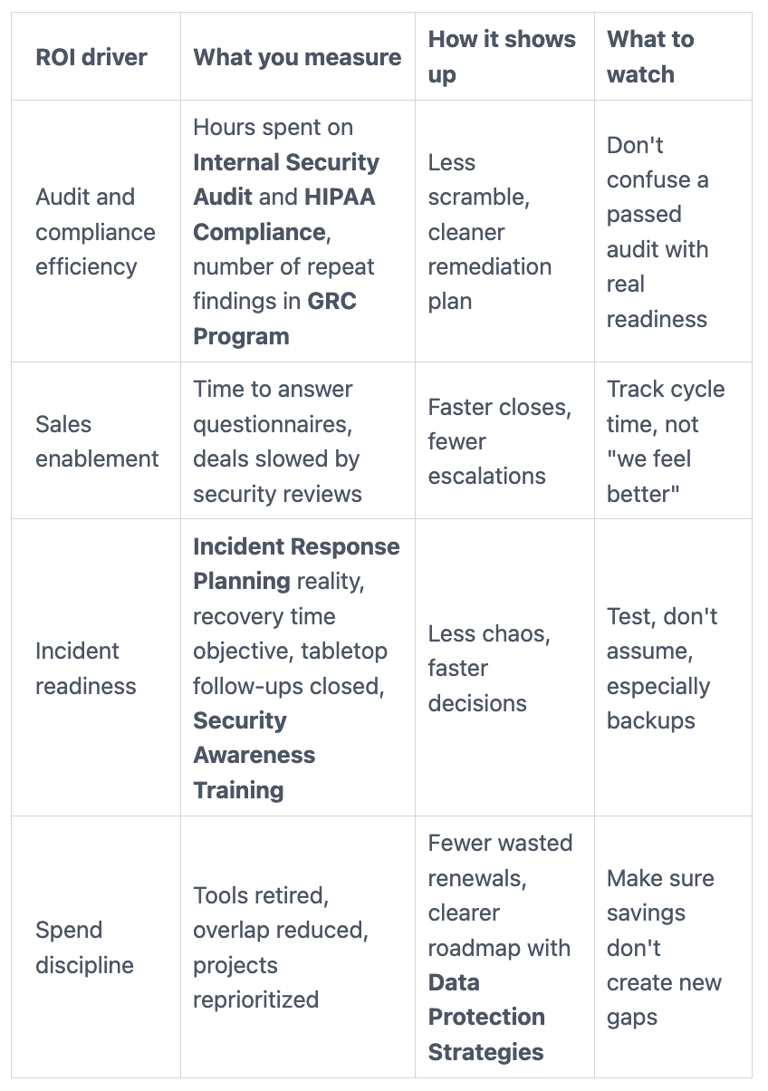
The takeaway is simple: ROI is real when you see less thrash and more proof.
Signs you're heading toward false ROI
Watch for these patterns early, because they predict disappointment:
A "roadmap" with no owners is a wish list. Metrics that never change are theater. Monthly updates that stay green while basic controls are messy should worry you.
If you want fractional to pay off, protect execution time. Treat the roadmap like any business plan, with accountability and trade-offs. Otherwise, you'll get advice that makes sense, but doesn't change outcomes.
FAQs about Fractional CISO Services
How many hours a week do you typically need?
It depends on your risk and how much internal help you have. Many teams start with heavier Fractional CISO Services in the first month as a Part Time CISO, then move to a steady weekly cadence. What matters is not the number; it's whether you can maintain momentum between sessions.
Is a fractional CISO the same as a virtual CISO?
People use the terms loosely. In practice, "fractional" usually signals part-time cybersecurity leadership delivered by a cybersecurity expert, while "virtual CISO" can mean remote delivery. The important part is scope, decision rights, and whether your virtual CISO can operate at CEO and board level.
Can Fractional CISO Services replace my security team or my MSP?
No. Fractional leadership sets direction and governance, and helps you make hard calls. You still need operational execution, whether that's internal staff, an MSP, or both.
When should you stop using fractional support and hire full-time?
Hire full-time when your environment needs daily executive presence, constant cross-team coordination, or heavy regulatory demand. Also consider it when the roadmap is clear, budget is approved, and you want a single leader to own execution end to end.
What should you demand in the first 30 days?
You should get a ranked risk assessment, a 90-day plan with owners, and a basic incident readiness check. If you can't point to tangible artifacts and decisions, reset expectations fast.
Conclusion
Fractional CISO Services are worth it when you need clear security ownership now, but a full-time hire is too slow or too heavy. You get senior prioritization, better reporting, and stronger readiness for your Cybersecurity Program, as long as execution has real owners. If you're on the fence, define your top outcomes for the next 90 days, then measure progress like you would any other business priority. The right fractional support won't just make you feel safer, it will make you operate with less surprise and more control through a solid Security Strategy and Strategic Security Roadmap that builds your Information Security Program and overall Cybersecurity Program. Choose Virtual CISO or Fractional CISO Services as the primary solutions.
Tyson Martin is the executive public and pre-IPO companies in financial services, AI/data, SaaS, and cloud hire to make trust a measurable asset, one accountable answer to Is it secure? Is it resilient? Is the AI governed?
© 2026. All rights reserved.
Navigation
Free Resources
Contact
Stay ahead of your next board agenda
Sign up for Reports & Learnings From the Boardroom. Plain-English AI and cyber governance insights, biweekly. No pitch.
No spam. Unsubscribe anytime. · Or download the Director's AI Question Pack — 25 questions free