
Board-Ready Third-Party Risk Reporting: A Step-by-Step Guide
Use third-party risk reporting to the board that links vendors to downtime and dollars, flags exceptions, assigns owners, and drives clear decisions.


If you're a CEO or a member of the board of directors, you don't need another 40-slide vendor appendix in third-party risk management (TPRM). You need clarity. When a vendor, SaaS platform, MSP, payment processor, or data partner fails, the business doesn't experience "vendor risk." It experiences the business impact of missed revenue, downtime, customer anger, regulatory exposure, and leadership distraction.
That's why board-ready reporting has one job: help you make decisions you can defend.
In this guide, you'll use a simple step-by-step approach for third parties of all kinds, not just "vendors." You'll connect risk to business services, money, and accountability, without drowning in questionnaire answers. You'll also build a reporting rhythm that makes exceptions visible, assigns owners, and shows progress over time.
You'll end up with reporting that earns attention because it answers the board's real question: "So what do you need us to decide?" This is what third-party risk reporting to the board should look like.
Key takeaways you can use in your next board packet
Show your top 10 third-party relationships by business impact, not by questionnaire score.
Ask the board to approve risk appetite thresholds for critical vendors involved in critical activities and exceptions.
Name one accountable executive for each material third-party remediation item.
Highlight concentration risks (shared cloud, shared MSP, shared identity provider) in one view.
Time-box every risk acceptance, with a review date and an exit plan status.
Report changes since last meeting, so the board can spot drift fast.
Step 1: Start with what the board actually needs to decide
Board of directors reporting isn't for operational detail. It's for decisions, oversight, and accountability that enable strategic decision-making. If your packet can't be tied to a decision, it's probably noise.
Start by listing the most common third-party decisions directors actually make from your risk assessment. Your list will vary, but it often includes:
Setting risk appetite for vendor access to sensitive data and systems
Approving investment (tools, staff, contract changes) tied to top exposure
Accepting a critical vendor exception outside policy, for a limited time
Requiring contract changes before renewal (notice windows, audit rights, subprocessor terms)
Approving an exit plan, or at least requiring one for the most critical vendors
Confirming incident readiness (who calls whom, and how fast access gets cut)
Committees matter here, as they support the board's oversight and accountability. Audit may focus on controls and evidence, risk may focus on material exposure and appetite, and a tech committee may focus on architecture and concentration. You can tailor views without duplicating the story. The trick is to align on a one-page "decision list" with the Chair or committee lead, then build your reporting around it.
Write your reporting goals as questions the board can answer
Use plain questions that force crisp answers. If you can't answer them, you've found your reporting gaps.
Which third parties could stop revenue for a day?
Which third parties can access regulated or sensitive data?
Where are we accepting risk outside policy, and for how long?
Which critical vendors have no practical exit plan today?
Where are we relying on a single provider with no workaround?
What changed since last quarter that makes us more exposed?
Are we improving quarter over quarter, or just staying busy?
Agree on simple definitions so everyone reads the numbers the same way
Board confusion usually comes from inconsistent terms, not bad intent. Agree on a few definitions and keep them stable:
A critical third party can materially impact a core service (revenue, operations, safety, regulated data). A material incident crosses your agreed thresholds (downtime, data exposure, financial loss, legal duty). Concentration risk means one shared dependency can take multiple services down. A fourth party is your vendor's vendor that you still depend on.
Inherent risk is the risk before controls; residual risk is what remains after controls. Risk accepted is documented, time-bound, and owned; risk mitigated has a funded plan with dates.
Consistent definitions stop rework and keep directors from arguing about what the colors mean.
Step 2: Build a clean inventory and tiering model that makes your report credible
A clean inventory is foundational to effective third-party risk management. If your inventory is messy, your report won't be trusted. Boards can sense hand-waving. When vendor lists don't match reality, every assurance statement feels soft.
You don't need perfection. You need a clean, defensible method to identify third parties and sort them by business impact and access paths.
Start with three practical sources: procurement and AP data (who you pay), SSO and identity logs for ongoing monitoring (who has access), and your architecture map (what systems depend on whom). Then consolidate duplicates (parent company vs product name), and assign an internal business owner for each critical relationship.
Next, tier them. Keep it simple and explainable, using due diligence to vet how critical vendors impact the business. Focus on factors that change business impact:
Service impact: what breaks if they fail, and for how long
Access path: network access, privileged access, API access, or none
Data sensitivity: regulated data, customer data, financial data, or low sensitivity
Substitutability: how fast you can switch, including operational pain
A simple tier model often works best, clearly tying tiers to business impact:
Tier
Board meaning
Typical criteria (plain language)
Tier 1
Could materially harm the business
Critical service, sensitive data, or privileged access; hard to replace
Tier 2
Could disrupt a key team or process
Important service, limited sensitive data, or constrained access
Tier 3
Low business impact
Minimal access, low sensitivity, easy to replace
Your Tier 1 list should be stable enough that directors recognize the names. Still, update it when the business changes, not just when security asks.
Map each critical third party to the business service it supports
This is where attention changes. A vendor name alone is abstract. A business service is concrete.
Map each Tier 1 third party to the service it enables, such as payroll, customer onboarding, e-commerce checkout, claims processing, donor platform uptime, manufacturing uptime, or fraud monitoring. Now you can prioritize, because you're comparing business outcomes, not just security artifacts.
A simple line item example is enough to make this real:
Vendor X supports customer onboarding, if it's unavailable for 24 hours, new revenue slows and support volume spikes.
Once you map vendors to services, you can also spot "quiet" dependencies you didn't mean to make critical, like a single identity provider behind multiple apps.
Use a small set of risk signals you can defend
Pick signals you can explain in one sentence, and that directors can use to make a call. For example, access type, data sensitivity, outage impact, incident history, control test results for internal controls, contract terms (notice, audit rights, SLAs), BCP and DR evidence, financial health, and geopolitical exposure.
Avoid turning the board packet into a questionnaire dump. Raw answers don't change decisions. Clear signals do.
Step 3: Turn assessments into board-friendly insights, not vendor paperwork
Assessments create inputs. Board reporting creates decisions.
A practical structure for executive-level reporting is three layers. First, a portfolio view that fits on a page. Second, a top risks view that shows what's outside tolerance. Third, a deep dive view into cybersecurity that you keep in an appendix (often one page per critical vendor).
That way, you don't hide risk, but you also don't force directors to read vendor evidence to govern it.
Also, be explicit about what you don't know yet. "Unknown" is not a failure, it's a work item with an owner and date. The board can support funding and priorities only when the gaps are visible.
Lead with a portfolio view that shows concentration and systemic exposure
Your board view should highlight patterns, not individual vendor trivia.
Show how many Tier 1 vendors you have, and whether that number is rising. Call out shared dependencies that create systemic exposure, such as the same cloud region, the same MSP, the same identity provider, or the same payment rail. Use risk signals like security ratings to spot these issues early.
Then explain concentration risk in plain language: if one shared provider fails, multiple business services fail at once, even if each individual vendor looks "fine."
A simple heat map can help, but the real goal is the conversation: where you're over-reliant, and what the fallback is.
Show exceptions and remediation like a project portfolio, with owners and dates
Boards manage portfolios all the time, capital, strategy, audit issues. Treat third-party risk mitigation the same way: clear gaps, owners, dates, and decisions needed.
A board-ready exception line should read like this:
Vendor: Tier 1 CRM, gap: no contractual 24-hour incident notice, risk: delayed containment and disclosure, owner: GC, fix: renewal addendum, target: May 31, decision needed: approve fallback monitoring cost if vendor refuses.
When you track exceptions this way, you can tie oversight to performance. For related thinking on accountability and follow-through, see board oversight and CISO performance metrics.
If you can't name an owner and a date, you don't have a plan, you have hope.
This structure strengthens third-party risk reporting to the board.
Step 4: Use a repeatable board report template that fits on two pages
Two pages forces discipline. It also makes the packet readable in real life, between meetings and travel.
Here's a practical layout that works, with an optional appendix for deep dives:
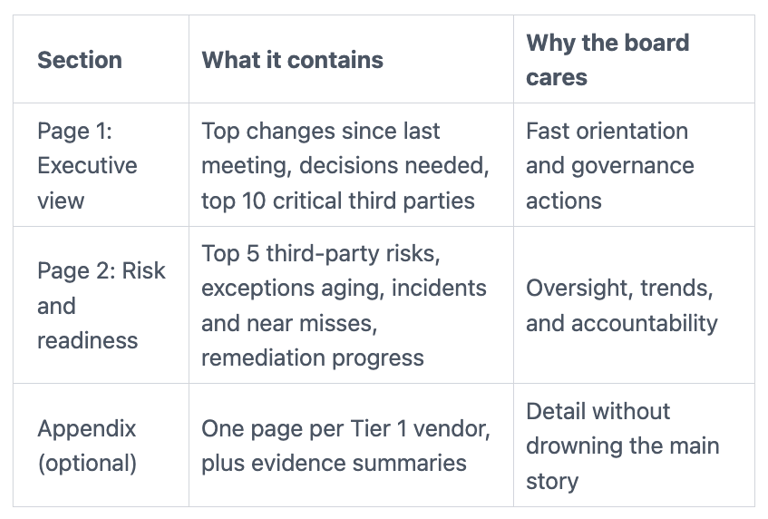
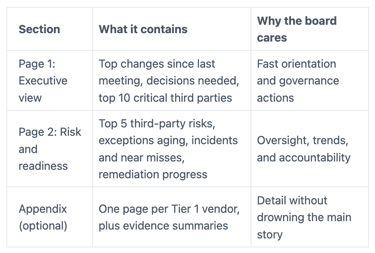
Keep the template stable across quarters. When the format stays the same, directors spot trend changes faster. Consistency also reduces "presentation churn" for your team. This template covers the end-to-end risk management lifecycle.
A simple scorecard the board can scan in 60 seconds
Your scorecard should support trend and action, not perfection. Include fields that answer "what changed" and "what are you doing." The metrics should reflect the overall security posture.
Good fields include: tier, business service supported, data type, access level, residual risk rating, trend (up, flat, down), last assessment date, open high findings count, contract gaps flag, and exit plan status.
If you want to make metrics meaningful instead of noisy, the ideas in making cybersecurity metrics meaningful for leadership decisions align well with this scorecard approach.
How to talk about risk in dollars and downtime without fake precision
Boards want business impact, but they hate made-up math. Use ranges and scenarios.
Instead of "$4,327,112 at risk," use bands and time-based outcomes: hours of downtime, revenue-at-risk ranges, regulatory exposure categories, and customer trust impact. Then state the assumptions you can defend.
For example: if Vendor A is down for 24 hours, customer onboarding slows sharply, support costs rise, and sales misses weekly targets. If it's down for 72 hours, churn risk climbs and enterprise customers escalate.
You're not predicting the future. You're framing choices with credible boundaries.
Step 5: Be ready for the hard board questions (and answer them calmly)
Hard questions from board members are a sign of healthy oversight. You don't need to get defensive. You need evidence, a plan, and a clear ask.
When a director pushes, respond in three beats: what you know, what you don't know yet (with a date), and what decision or support you need. That pattern keeps discussions productive, even when the news is uncomfortable.
Also, don't treat questions as interruptions. Treat them like smoke alarms. They point to where your reporting needs sharper framing, or where management has been accepting risk quietly.
The question set that tests whether you really have control of third-party risk
These questions come up again and again, and they should.
Which vendor would hurt us the most if it failed today?
Where are we relying on a single provider?
How fast can we cut access if a vendor experiences a data breach?
Do we have an exit plan for our top SaaS platforms?
Which renewals need changes during contract negotiation before we sign?
What risk are we accepting right now, and when will it expire?
Which vendors touch regulated data, and how do we verify controls?
What changed this quarter, including technical vulnerabilities, that increased exposure?
What would we tell customers in the first 24 hours of a vendor-driven incident?
For a deeper set you can use in committee, review audit committee cyber risk questions.
FAQs about third party risk reporting for boards
How often should you report third party risk to the board?
Quarterly works for most organizations because it matches governance cadence. Still, you should escalate monthly when a Tier 1 exception goes past tolerance, or when a material vendor incident impacts business continuity. High-risk events should trigger out-of-cycle updates.
What is the difference between vendor risk management and third party risk reporting to the board?
Vendor risk management is operational work: intake, assessments, evidence, and remediation tracking. Board reporting is oversight: material exposure, trends, concentration, exceptions, and decisions. If your report lists every control test, you're mixing the two.
How do you decide which vendors are "critical" enough for board visibility?
Use a stable rule set in your TPRM: business service impact, sensitive data, regulatory compliance, privileged or network access, payment or funds flow involvement, and substitutability. Aim for a Tier 1 list that is short enough to govern, but complete enough to avoid surprises.
Should you show vendor names to the board?
Often yes for Tier 1, because names drive accountability and better questions. For lower tiers, you can anonymize unless there's material exposure. Protect sensitive contract terms, but don't hide systemic reliance or material weakness.
What metrics belong in a board report, and which ones do not?
Include: Tier 1 coverage, high-risk exceptions count and aging, time to remediate, concentration indicators, contract gap closure rate, assessment freshness, and incident readiness status. Avoid raw questionnaire scores, tool outputs, and vanity counts that don't change decisions.
How do you report fourth party and supply chain risk without sounding speculative?
Focus on supply chain security through known shared dependencies and verified facts, like cloud hosting, identity, MSP reliance, and payment rails. Ask critical vendors for material subprocessor lists and resilience evidence, then report scenarios with a confidence level.
How do you handle a high-risk vendor when the business cannot replace them fast?
Make the acceptance explicit and time-bound, then add compensating controls (segmentation, tighter access, monitoring, contract levers) while you build an exit plan. For committee-level governance framing, see risk committee cybersecurity reporting guidance.
Conclusion
You don't earn board confidence by naming more vendors. You earn it by showing how third-party exposure translates to operational risk for the business, including downtime, money, and accountability. Start with board decisions, agree on simple definitions, clean up your inventory of third-party relationships and tiers, then translate assessments into a two-page view with owners and dates. Keep the appendix for deep dives, not the main story.
Your next step is practical: update your next board packet using the two-page template, then schedule a short working session with the Chair or committee lead to align on decisions and definitions. If you want a governance lens for information security to pressure-test your approach, use cybersecurity governance for boards as a reference point for what "clear oversight" of business impact looks like in practice.
Tyson Martin is the executive public and pre-IPO companies in financial services, AI/data, SaaS, and cloud hire to make trust a measurable asset, one accountable answer to Is it secure? Is it resilient? Is the AI governed?
© 2026. All rights reserved.
Navigation
Free Resources
Contact


Stay ahead of your next board agenda
Sign up for Reports & Learnings From the Boardroom. Plain-English AI and cyber governance insights, biweekly. No pitch.
No spam. Unsubscribe anytime. · Or download the Director's AI Question Pack — 25 questions free