How to Choose the Right Board Member in Bangor, Maine
Use a clear process to choose a board member Bangor Maine stakeholders will trust, with stronger fit, judgment, independence, and local context.


If you're a board chair, CEO, founder, or committee leader in Bangor, the choice can feel personal. It shouldn't start there.
The best board appointment is not the person with the biggest name or the longest resume. It's the person who fits your mission, your stage, your risk profile, and the local business context you operate in every day.
In Bangor, that context matters. Regional relationships, regulated industries, hiring limits, and local reputation can shape whether a board member helps or quietly slows you down. A clear process helps you avoid an expensive mistake and make the decision with confidence.
Key takeaways for choosing a board member in Bangor, Maine
Start with the gap on your board, not the person you already like.
Pick for judgment and oversight skill, not title prestige.
Local credibility helps, but it should support governance skill, not replace it.
Independence matters. A board member must be able to challenge management when needed.
Culture fit matters, but not if it turns into comfort and weak oversight.
Time commitment is not a side issue. Overcommitted directors weaken the board.
If you need to choose a board member Bangor Maine stakeholders will trust, focus on fit, clarity, and evidence.
Start with the role your board actually needs filled
Many weak board appointments start the same way. Someone knows a respected person. The board likes the resume. The seat gets filled before the board defines what the seat is for.
That is backward. A board seat is not an award. It's a working post.
Before you review names, define the need in plain language. Do you need stronger financial oversight? Better succession judgment? More experience in healthcare, compliance, fundraising, cyber risk, or growth strategy? If you skip this step, you will hire for chemistry and hope it works out later.
Match the board seat to your biggest business challenge
Start with the pressure point that matters most in the next 12 to 24 months. Your need may be growth, cost control, CEO succession, digital change, donor confidence, risk oversight, or community trust.
That challenge should shape the profile. A board that faces margin pressure may need someone who can read the business model with discipline. A nonprofit under funding strain may need a director who understands governance and stakeholder trust. A company facing more technology risk may need someone who can make oversight clearer, or bring in outside help such as a board cybersecurity advisor instead of forcing one new director to cover every specialist gap.
The point is simple: seek expertise that improves decisions, not optics.
Know when you need operating judgment, not just status
A well-known local figure can open doors. That can help. Still, name recognition does not mean the person will be useful in the boardroom.
You need someone who asks clear questions, spots weak assumptions, and stays calm when the facts turn bad. You need someone who understands the line between support and oversight. In plain terms, they must know when to back management and when to press harder.
The right director does not make meetings louder. The right director makes decisions better.
If the candidate's value rests mostly on status, you may be buying comfort. Boards need judgment more than applause.
Look for qualities that matter in Bangor, not just on paper
Bangor has its own business rhythm. Trust travels fast, and so do doubts. That means board selection should account for local reality, not only national-level credentials.
A polished resume can hide a weak fit. Meanwhile, a less flashy candidate may bring the exact mix of steadiness, independence, and local credibility your board lacks.
Why local knowledge can be a real advantage
Local knowledge can sharpen board judgment. A director who understands Bangor's labor market, referral networks, civic expectations, and business relationships may see risks or opportunities sooner.
That matters if your organization depends on community trust, regional partnerships, or a hard-to-find workforce. It also matters if you operate in sectors where reputation and relationships affect growth, such as healthcare, finance, education, nonprofit leadership, or public-facing services.
Still, local knowledge is an advantage, not a substitute. A candidate should bring both regional awareness and real governance discipline. If they know everyone but cannot read risk, challenge assumptions, or prepare well, the value is thin.
Check reputation, relationships, and possible conflicts
In a market like Bangor, reputation is part of the job description. So, look beyond the candidate's bio.
Ask how the person is viewed by peers, lenders, donors, regulators, and past colleagues. Review business ties that may create conflicts. Check whether they are too close to management, major vendors, or key counterparties. A trusted name with divided loyalties can weaken the board when pressure rises.
Independence is not about being distant. It is about being free enough to speak honestly. Trust and independence need to sit together.
Use a clear vetting process before you offer the seat
Once you have a shortlist, move from instinct to evidence. Use the same process for each finalist. That protects fairness, but it also protects the board from its own bias.
A structured process helps you compare how candidates think, not only how they present.
Ask interview questions that reveal how they think
Your interview should test judgment. Ask about strategy, oversight, risk, and disagreement. Ask how the candidate prepares for meetings. Ask how they handle bad news.
A few simple prompts can reveal a lot: Tell us about a time you challenged management constructively. How do you decide when to push harder on a risk issue? What would make you vote against a popular proposal? How do you prepare for a board packet when the issue is outside your core background?
Listen for clarity, not polish. Strong candidates answer with tradeoffs, not slogans.
Review board readiness, time commitment, and independence
A good candidate still fails if they do not have time. So, ask directly about other boards, executive duties, travel, and real availability.
Also confirm that the person understands fiduciary duties, confidentiality, and the difference between advising management and supervising it. In tense moments, you need a director who will speak plainly even when the room is uncomfortable.
Overcommitted directors often sound smart and contribute little. That is not a small issue. It is a governance problem.
Use references to confirm behavior, not just achievements
Reference checks often produce polished praise. Don't settle for that.
Ask former board colleagues or executives how the candidate behaves in meetings. Do they prepare? Do they listen? Do they dominate? Do they stay steady under pressure? Can they disagree without becoming political or passive?
Behavior matters more than biography. If several references describe the same strengths or the same concerns, pay attention to the pattern.
Watch for red flags that lead to poor board appointments
You do not need many red flags to stop a board search. One or two serious concerns can be enough.
This is where discipline matters most. Boards often talk themselves into a weak fit because the candidate looks impressive.
Big titles, weak fit, and unclear expectations
A senior title can hide a shallow match. The candidate may know their field well but still lack the exact judgment your board needs now.
That problem gets worse when the board offers the seat without clear success criteria. If you have not defined what good looks like in the first year, you are setting the person up to drift. Clarity should come before the offer, not after it.
Candidates who cannot challenge management constructively
Some directors are too passive. Others are too political. A few are so close to leadership that they cannot provide real oversight at all.
Avoid all three. Good directors ask hard questions without turning every meeting into a contest. They raise pressure where it belongs, on facts, priorities, and accountability.
If a candidate avoids tension at all costs, you may get harmony and weak governance. Boards do not need more comfort. They need honest challenge.
Make the final choice with a scorecard, not a gut feeling
Once you reach the final round, compare candidates on the same criteria. A simple scorecard keeps the board anchored to the work that needs to be done.
Use something like this:
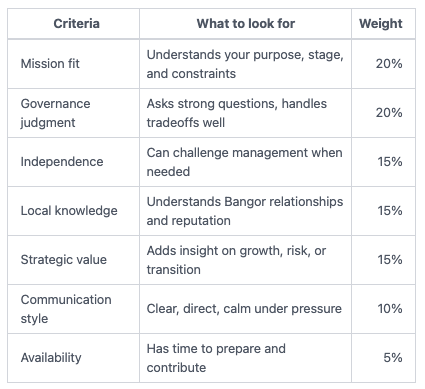
This does not make the decision mechanical. It makes it honest.
After selection, give the new director a short onboarding plan. Share recent board materials, committee charters, top risks, key relationships, and the issues that will likely come to a vote soon. If your board needs better structure for risk discussions, practical board-ready resources and templates can help the new member ramp up faster.
Common questions about choosing a board member in Bangor, Maine
Should you pick someone local?
Often, yes. Local knowledge can improve judgment and credibility. Still, pick local only if the person also brings real board skill.
How much industry experience matters?
It matters when your risks are technical, regulated, or fast-changing. Yet governance judgment still matters more than sector fame alone.
What should you ask in the interview?
Ask about oversight, disagreement, risk, preparation, and time commitment. Good answers show how the person thinks when facts are incomplete and pressure is real.
How do you judge culture fit?
Look for shared standards, not sameness. A strong culture fit means the person respects the mission and can work with others, while still speaking hard truths.
How many references should you check?
Three is a solid floor. Aim for references who have seen the person in board settings or under pressure, not only friendly peers.
What if your board needs cyber or technology oversight?
Do not force one board hire to solve every specialist need. In some cases, a director with some exposure helps. In others, outside support from a board cybersecurity advisor is the better answer.
A stronger board starts with the right seat
The right board member in Bangor is not the person with the biggest name. It is the person who fits your board's real need, your local context, and the pressure your organization will face next.
Define the gap. Vet with discipline. Use a scorecard. Then make the appointment with clear eyes and a clear purpose.
That is how you build a board that can guide the organization through growth, risk, and change.
Tyson Martin is the executive public and pre-IPO companies in financial services, AI/data, SaaS, and cloud hire to make trust a measurable asset, one accountable answer to Is it secure? Is it resilient? Is the AI governed?
© 2026. All rights reserved.
Navigation
Free Resources
Contact
Stay ahead of your next board agenda
Sign up for Reports & Learnings From the Boardroom. Plain-English AI and cyber governance insights, biweekly. No pitch.
No spam. Unsubscribe anytime. · Or download the Director's AI Question Pack — 25 questions free