
Defining Decision Rights: A worksheet for aligning the Board, CEO, and CIO on risk ownership.
Defining Decision Rights helps you clarify Board, CEO, and CIO risk ownership, set escalation thresholds, and make faster, cleaner decisions.

You define decision rights when you spell out who owns calls on major risks. These include cyber threats, vendor picks, and tech investments. Use this worksheet in one session. It aligns your board, CEO, and CIO.
Blurry ownership creates real pain. Decisions drag. Incidents spark blame. Risks escape notice. Growth stalls. Stakeholders lose trust. CEOs overload. Boards stay blind. CIOs chase tactics, not strategy.
The fix fits one page. List risks. Set thresholds. Assign owners. This worksheet delivers that. You print it. You run a 60-minute huddle. You leave with lanes that hold. Next, see why blurry rights hurt now.
Why Blurry Decision Rights Slow You Down and Raise Hidden Risks
Growth amps tech strain. AI pilots speed up. Cyber hits blend into ops threats. Vendor ties deepen. Yet ownership stays fuzzy. CEOs juggle all. Boards miss spots. CIOs fix daily fires.
You feel it in delays. A breach escalates late because no one owned the watch. Vendor deals balloon unchecked. Innovation stalls in debates. Incidents cost more. Trust erodes fast.
Clear rights change that. You set lanes. Calls speed up. Surprises drop. Teams trust reports. For board cyber risk oversight, check how boards set technology risk appetite. It ties appetite to ownership.
The Leadership Traps That Make Ownership Feel Fuzzy
Boards often think CEOs own everything. CEOs push to CIOs without limits. CIOs dodge big calls.
You spot gaps fast. Meetings loop endless. Escalations shock. Reports skip choices. Audit committees repeat cyber queries each quarter.
If your team debates "who decides" on AI tests or cloud shifts, rights blur. Endless loops waste time. Surprises hit hard. Ownership drifts.
Fix it. Name owners per risk. Set triggers. You cut confusion. Teams act.
What Sharp Decision Rights Look Like in Action
Sharp rights form a matrix. Board sets appetite. CEO owns strategy. CIO executes in bounds.
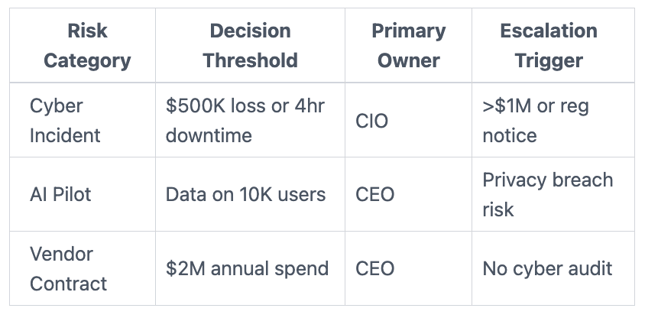
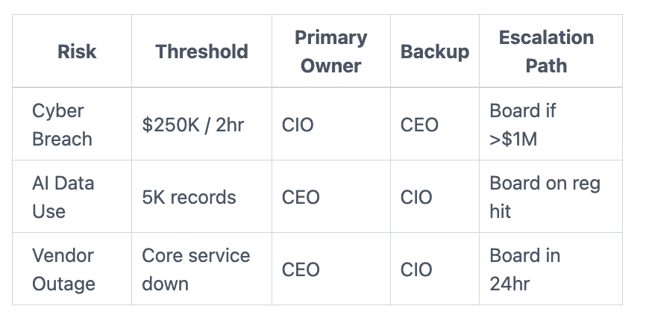
You see columns: risk type, threshold, owner, escalation. Rows cover cyber events, AI rollouts, cloud vendors.
Benefits hit quick. Moves accelerate. Surprises fade. Delegation builds trust.
This table sets context. You approve bounds. CIO handles inside them. Board steps in on triggers.
Outcomes strengthen. Resilience grows. Reports gain weight. You link to board incident response oversight for escalation details.
Peace comes. You know lanes hold.
Your Worksheet: Step-by-Step to Define Decision Rights and Align Your Team
Grab this one-page tool. You list top risks. Set thresholds. Assign owners. Define paths. Sign off.
Start with 8-10 risks. Cyber incidents top it. Add AI adoption, vendors, data loss.
Thresholds fit business. Use dollars, hours, users. $ loss, downtime, reach.
Owners match roles. Board for appetite. CEO for strategy. CIO for ops.
Escalation keeps it tight. Triggers pull CEO or board.
You print. Share pre-meeting. Run 60 minutes. Consensus rules.
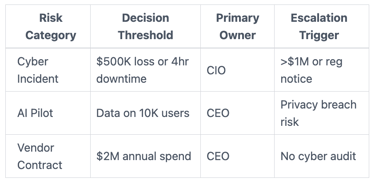
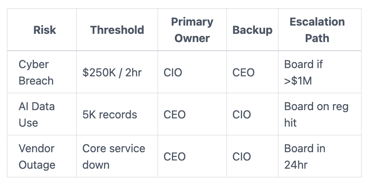
Sample worksheet below. Adapt it.
You finish aligned. Lanes stick. For cyber governance ties, see Tyson Martin expertise in cyber governance oversight.
Fill It Out in Your Next Leadership Huddle
Prep a risk list. Project the table. Ask: Who decides first? What pulls next?
Aim for agreement. Skip perfection. Common traps: CEO overload, vague limits.
You facilitate. Note pushback. Assign follow-ups. Sign with dates.
Sheet lives. Reference in meets. Ownership clarifies.
Track It: Review and Update Quarterly
Link to board rhythms. Revisit post-incident. Check business shifts.
You adjust thresholds. Add risks like new AI. Benefits: Stays real. Drift stops.
Quarterly keeps it sharp. Ties to reporting. You protect growth.
Key Takeaways on Defining Decision Rights
You cut decision time with clear owners.
Start with cyber, vendors, AI.
Board sets appetite; others execute.
Thresholds prevent overload.
Escalation triggers end surprises.
One sheet aligns in 60 minutes.
Quarterly reviews match business change.
You build trust through lanes.
Answers to Common Questions from Boards and CEOs
How often do you update the worksheet? Quarterly or after big shifts. You tie it to board packs. Keeps it fresh without churn.
What if CIO resists? You frame as shared wins. Faster ops for them. Less board heat. Consensus builds buy-in.
Does it cover AI risks? Yes. List pilots. Set data thresholds. CEO owns first. Escalates on scale.
How does it link to cyber governance? It sets rights board needs. Matches cybersecurity governance advisor for boards. Questions expose gaps.
Can thresholds change mid-year? Yes. Trigger on growth or incidents. You approve shifts.
What about vendors? Threshold on spend or downtime. CEO owns. Ties to contracts.
You hold the next move.
Print the worksheet. Book 60 minutes with CEO, CIO. Emerge with signed lanes.
Ask these starters: What risk keeps you up? Who owns it now? What threshold pulls board?
Stronger oversight follows. Growth gains resilience. You decide with clarity.
Tyson Martin is the executive public and pre-IPO companies in financial services, AI/data, SaaS, and cloud hire to make trust a measurable asset, one accountable answer to Is it secure? Is it resilient? Is the AI governed?
© 2026. All rights reserved.
Navigation
Free Resources
Contact

Stay ahead of your next board agenda
Sign up for Reports & Learnings From the Boardroom. Plain-English AI and cyber governance insights, biweekly. No pitch.
No spam. Unsubscribe anytime. · Or download the Director's AI Question Pack — 25 questions free