Introduction
Most boards hired a CISO expecting someone to manage firewalls and keep the network clean. What they got is something more complex: a C-suite executive who is now personally liable, expected to brief the board quarterly, and accountable for enterprise risk strategy across legal, finance, operations, and technology.
That gap between expectation and reality is costing organizations. According to PwC's Pulse Survey, only 46% of directors said they received consistent, decision-useful CISO reporting on key cyber risks — which means more than half of boards are flying partially blind on one of their most significant enterprise exposures.
This guide is built for the people who need to make decisions about that exposure — boards, CEOs, general counsel, and risk leaders who want clear answers on what the CISO role actually demands, where liability now sits, and how to staff the function in a way that holds.
Key Takeaways
- The CISO has moved from technical function to strategic C-suite role responsible for risk governance, board communication, and regulatory compliance
- Effective CISOs manage risk transparently — helping the organization accept, transfer, or mitigate it deliberately — not hide it
- Compliance embedded into daily operations beats compliance assembled before an audit, every time
- Personal liability is now a defining feature of the role; clear decision rights and direct board access are essential protections
- A fractional or interim CISO delivers executive-level security leadership without a 6-month hiring cycle
The CISO Role Has Changed: From Technical Specialist to Business Leader
Not long ago, the CISO was largely invisible to the C-suite. The job was defined by firewalls, endpoint security, and network defense — important work, but work that happened far from the boardroom.
What changed that calculus was consequence. Data breaches with enterprise-wide financial and reputational fallout forced organizations to treat cybersecurity as a business risk, not a contained IT problem.
When a single breach can trigger regulatory fines, shareholder litigation, and operational shutdowns simultaneously, the person responsible for preventing it needs a seat at the executive table.
The Reporting Line Problem
Where the CISO sits in the org chart matters more than most organizations acknowledge. Research cited by TechTarget points to better security outcomes when CISOs report directly to the CEO rather than the CIO — primarily because CIO-filtered reporting runs through a technology and operations lens that can mute or reframe risk signals before they reach decision-makers.
The current data on this is telling. According to IANS Research:
- 39% of CISOs now hold EVP/SVP-level titles, up from 35% two years prior
- Only 35% of executive-level CISOs at organizations under $1B revenue report to the CEO
- At organizations above $1B, that drops to 12%
- At large firms, more than one-third of CISOs are at least three organizational layers from top executives
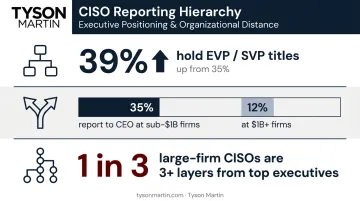
In practice, that distance means security risk assessments arrive at the board pre-filtered — and during an active incident or regulatory inquiry, filtered information is the most expensive kind.
The Stakeholder Translation Function
The most critical skill a modern CISO brings isn't technical — it's translation. Converting security findings into language that CEOs, general counsel, and board members can use to make decisions requires a different discipline entirely.
Rather than reporting that "identity controls are weak in the cloud admin layer," a board-ready framing looks like: "A compromised admin account could disrupt core systems, delay customer orders, and increase legal exposure if sensitive data is accessed." Same finding, completely different utility for a director trying to govern risk.
That translation function only works when the CISO operates across legal, finance, HR, operations, and product — not just IT. Risk now intersects with fraud prevention, third-party vendor exposure, regulatory obligations, and digital transformation decisions that touch every function.
Core CISO Responsibilities: Risk Management, Governance, and Execution
The CISO's job is not to eliminate risk. That's not achievable and pretending otherwise produces worse outcomes than honest governance. The actual job is helping the organization understand, accept, transfer, or mitigate risk deliberately — and ensuring that tradeoffs are visible and documented rather than hidden.
Risk Governance That Holds Under Pressure
Governance fails in predictable ways. Policies are vague, escalation thresholds aren't defined before an incident, and accountability structures collapse precisely when they're needed most. A functioning security governance model requires:
- Named owners for each risk category and major initiative
- Defined escalation thresholds that tell the organization when to brief the board and when management handles it
- Documented decision rights so no one spends an incident negotiating authority
- Evidence of execution — not strategy documents, but inspectable artifacts with dates and status
NIST CSF 2.0's Govern function codifies this expectation: subcategory GV.RR-01 explicitly states that organizational leadership is responsible and accountable for cybersecurity risk and must foster a risk-aware culture. This isn't aspirational — it's the framework regulators, auditors, and insurers are using to evaluate governance maturity.
Inspectable Execution: What a 90-Day Plan Actually Looks Like
Good CISOs don't produce open-ended roadmaps — they build programs where progress can be measured and verified. A well-structured 90-day plan includes:
- Named owners for each major initiative — not "the security team" generically
- Explicit definitions of done: "drafted" is not finished; completion means published artifacts with evidence
- Cost ranges and resourcing needs so leadership can make informed funding decisions
- A short list of decisions leadership must make this month — approvals that would otherwise stall execution
- Weekly progress cadence with defined blockers and deadlines
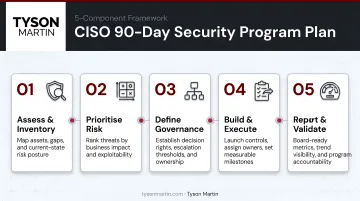
This approach feeds directly into board reporting. Directors should see 3–4 metrics per outcome area with trend arrows, top risks with owners and due dates, and a two-paragraph narrative covering what changed and what decision they need to make.
Execution quality also determines how the organization performs when something goes wrong — which makes incident response the third pillar of the CISO's core responsibilities.
Incident Response Leadership
The quality of pre-incident preparation determines organizational performance under pressure. IBM's 2025 Cost of a Data Breach Report found that organizations with mature incident response teams and extensive IR testing averaged $2.32M in breach costs — $1.79M lower than organizations without IR teams or testing protocols.
That gap is entirely a function of preparation. Tabletop exercises, documented playbooks, and pre-approved escalation chains aren't documentation exercises. They are the difference between a controlled response and an improvised crisis.
Decide the following before an event, not during one:
- Who declares an incident
- Who can authorize system shutdowns
- Who speaks externally
- When to engage outside counsel
How the CISO Leads Compliance Without Slowing the Business
Compliance assembled in the weeks before an audit is compliance as theater. The most effective CISOs embed regulatory readiness into daily operations so that when a regulator asks questions or an audit begins, the organization's posture is already documented, current, and defensible.
The Regulatory Landscape Boards Need to Understand
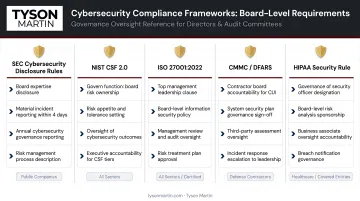
Most enterprise organizations touch multiple overlapping frameworks. The ones with the most direct board implications:
- SEC Cybersecurity Disclosure Rules: Public companies must disclose material incidents within four business days of determining materiality, and annual filings must describe the board's oversight role and management's risk management process
- NIST CSF 2.0: The new Govern function establishes that leadership — not just the security team — is accountable for cybersecurity risk strategy and oversight
- HIPAA Security Rule: Healthcare-adjacent organizations must conduct risk analysis and assign formal security responsibility as administrative safeguards
- PCI DSS 4.0.1: Requirement 12 mandates security policies, role definitions, and formal information security responsibility assignment
- CCPA/CPRA: California's final regulations require annual cybersecurity audits for businesses whose processing presents significant security risk, with audit reports directed to the executive responsible for the security program
Compliance as Operations, Not Event
Three recurring touchpoints keep regulatory readiness current:
- Weekly: Execution check-ins tracking owners and open blockers
- Monthly: Risk management reviews covering top risks and active exceptions
- Quarterly: Board updates tied to trend metrics and decisions required
The business case is straightforward. Organizations with continuous compliance readiness experience fewer audit disruptions and carry stronger negotiating positions in vendor due diligence, partnership agreements, and insurance renewals. In financial services and healthcare especially, counterparties run their own vendor risk assessments — and documented posture is the difference between a quick approval and a protracted review.
The Personal Liability Landscape: What Every CISO Needs to Know
Two legal cases reshaped how CISOs think about their own exposure — and how organizations should think about the protections they owe their security leaders.
Joseph Sullivan, Uber's former CSO, was convicted in 2022 of obstruction of FTC proceedings and misprision of felony for concealing a data breach from regulators and internal processes. He was sentenced in 2023 to three years probation, a $50,000 fine, and 200 hours of community service. The conviction established that criminal exposure exists for concealment — not just technical failures.
Timothy Brown, SolarWinds' CISO, was charged personally by the SEC in October 2023 with fraud and internal control failures related to cybersecurity disclosures. The SEC voluntarily dismissed the case with prejudice in November 2025. While no liability was ultimately established, the case demonstrated the SEC's willingness to name a CISO personally in cyber disclosure litigation. That willingness has not gone unnoticed across the industry.
Proofpoint's 2025 Voice of the CISO report, surveying 1,600 CISOs at organizations with 1,000+ employees across 16 countries, found 67% were concerned about personal liability for cyber incidents.
The Defensive Security Problem
Personal liability changes reporting behavior in dangerous ways. When CISOs face individual exposure, honest risk assessments get replaced with legally hedged language, known gaps go undocumented, and the board hears a version of reality that has been filtered through self-protection rather than transparency. That pattern makes organizations less secure, not more.
What Organizations Must Provide
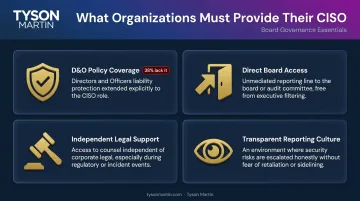
Given this environment, CISOs require — and boards should proactively offer:
- D&O policy coverage confirmed in writing before the CISO accepts the role (Hunton reports 38% of CISOs are not covered by their company's D&O policy)
- Direct, unmediated board access — not access filtered through the CIO or CFO
- Independent legal support during contract negotiation, not just company counsel
- A reporting culture that rewards honest risk disclosure over comfortable narratives
In-House CISO vs. Fractional or Interim CISO: Choosing the Right Model
The right model depends on where the organization is, not just how big it is.
When a Full-Time CISO Is the Right Answer
Organizations with complex, mature regulatory environments and security programs that require sustained strategic leadership benefit from a dedicated in-house CISO. Full-time engagement allows deep embedding in company culture, continuous stakeholder relationship-building, and long-term program ownership that fractional models rarely match over time.
Compensation benchmarks matter here. According to IANS/Artico research covering 862 security executives, average total compensation for small and mid-market CISOs reached $415K in 2025, with the broader CISO market ranging from $160K to $3.2M — a 20x spread driven primarily by company size, industry, reporting line, and equity exposure.
When Fractional or Interim Is the Smarter Choice
Many organizations need executive-level security leadership immediately — but not permanently. The scenarios where fractional or interim is the cleaner answer:
- Leadership transitions where a CISO has departed and the organization can't wait 3–6 months to hire permanently
- Post-incident stabilization where an organization needs someone who can establish risk posture and triage exposure within days
- M&A activity where security due diligence, integration risk, and identity consolidation require executive oversight without a permanent hire
- Rapid growth where a company has outgrown informal security practices and needs governance architecture before a full-time hire makes financial sense
- Regulatory preparation where an audit cycle or new compliance obligation requires executive-level documentation and board reporting
Tyson Martin steps into exactly these moments, providing interim or fractional CISO, CIO, and Chief Digital Officer leadership for organizations that need stability now, not months from now. Engagements typically begin within days to two weeks and run 60–180 days depending on scope.
Each engagement is structured from day one with a transition plan that leaves organizations with documented decision rights, inspectable risk registers, and board-ready reporting formats — built for independence, not continued reliance on the engagement.
What Boards and CEOs Should Expect from Their CISO
Boards should receive plain-English briefings — not technical inventories. A well-structured board briefing covers:
- Current risk posture in business terms (financial exposure, operational disruption, regulatory risk)
- What changed since the last briefing — not everything, just what moved
- Decisions or approvals the board needs to make — with clear framing of the options
A 45-minute board session should allocate roughly 15 minutes to top risks and board questions, 10 minutes reviewing dashboard trends, 10 minutes on posture and what changed, and 10 minutes on decisions and escalation thresholds.
What the Dashboard Should Show
The security dashboard should include 6–9 metrics, no more. It should display:
- Three to four metrics per outcome area (reduce exposure, improve response, strengthen recovery) with trend arrows
- Top five risks with named owners, next milestones, and due dates
- Exceptions and risk acceptances with aging and expiration dates
- A two-paragraph narrative: what changed and what decision is needed
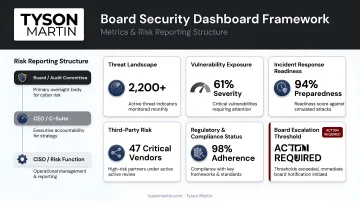
Raw scan counts, tool feature lists, and control catalogs belong in appendices — not in the board presentation.
The Board's Governance Responsibility
A clean dashboard is only half the job. Boards that use those metrics effectively ask specific accountability questions — and expect direct answers:
- "What are our top three cyber risks, by name and owner?"
- "What risk did we accept last quarter, and who approved it?"
- "What would we show a regulator as evidence of oversight?"
Boards should also define escalation thresholds before an incident. That means agreeing in advance on:
- Who can approve containment actions that may disrupt systems
- When to engage outside counsel
- When to contact the cyber insurance provider
- Who owns external communications
Pre-approved rules mean the team spends incident time solving the problem, not negotiating authority.
The NACD's 2026 Director's Handbook on Cyber-Risk advises boards to establish formal cyber oversight structures — including dedicated committee consideration — and ensure the CISO has sufficient agenda time and board access at least quarterly.
Frequently Asked Questions
Is CISO a high position?
Yes. The CISO is a C-suite executive responsible for enterprise-wide cybersecurity strategy, risk governance, and regulatory compliance. At most major organizations, the role reports directly to the CEO or board and carries significant organizational accountability — and, increasingly, personal legal exposure.
What's higher, CIO or CISO?
The CIO traditionally holds a broader mandate covering infrastructure and IT operations, while the CISO focuses specifically on security and risk. In some organizations the CISO reports to the CIO; in others, directly to the CEO or board. That reporting structure significantly affects how risk gets communicated and acted upon.
What is the highest salary for a CISO?
Total CISO compensation ranges from $160K to $3.2M according to IANS research, with small and mid-market CISOs averaging $415K in 2025. The top 5% reach seven-figure packages driven primarily by equity — with significant variation depending on company size, industry, and whether the role is full-time, fractional, or interim.
What does a CISO do on a daily basis?
A CISO's day spans risk review and prioritization, stakeholder briefings, governance oversight, regulatory monitoring, team leadership, and incident readiness preparation. Hands-on technical configuration is handled by the security team the CISO leads — the CISO's work is directing, deciding, and communicating.
What is the difference between a CISO and a fractional CISO?
A full-time CISO is a permanent executive embedded in the organization. A fractional CISO provides the same strategic leadership and governance on a part-time or contract basis — giving organizations access to senior-level security expertise without the cost structure or hiring timeline of a permanent role.
When should a company hire a fractional or interim CISO?
A fractional or interim CISO makes the most sense during leadership transitions, post-incident recovery, M&A activity, regulatory audit cycles, or when an organization needs to stand up a security program quickly. These are situations where waiting months to complete a permanent hire creates real organizational risk.