Introduction
AI systems are no longer in pilot. They're in production — making hiring decisions, flagging insurance claims, triaging patient records, and generating customer-facing content at scale. For boards and executive teams, the question has shifted from "should we govern AI?" to "which frameworks apply to us, and what do we actually have to do?"
The governance landscape in 2026 is complex — and moving fast. Four developments define the current terrain:
- The EU AI Act is in active enforcement
- All 50 U.S. states introduced AI legislation in 2025, with 38 enacting roughly 100 measures
- Voluntary frameworks like NIST AI RMF and ISO 42001 have become de facto standards of care in regulated industries
- EO 14179 has shifted the U.S. federal posture from precautionary to permissive
This article maps the nine frameworks that matter most in 2026 — what each requires, who it applies to, and how they fit together. It's written for boards, audit committees, and executives who need to make defensible governance decisions, not just acknowledge that governance exists.
Key Takeaways
- AI governance frameworks split into two categories: legally binding (EU AI Act, U.S. state laws) and widely adopted voluntary standards (NIST AI RMF, ISO 42001).
- Most organizations operate under multiple frameworks simultaneously, not a single chosen standard.
- Start with binding requirements for your jurisdiction, then layer in voluntary frameworks that structure your internal program.
- Boards should ask whether management can demonstrate a defensible, inspectable governance structure — not simply point to policy documents on a shelf.
What Are AI Governance Frameworks?
AI governance frameworks are structured systems of principles, policies, and practices that guide how organizations develop, deploy, and oversee AI responsibly. That's distinct from AI security — which focuses on protecting AI systems, models, and data from threats like adversarial attacks and data poisoning — but the two aren't interchangeable, and neither replaces the other.
The gap between organizations with formal governance programs and those without is measurable and widening. McKinsey's 2025 global AI survey found that 47% of organizations experienced at least one negative consequence from generative AI use — while only 1% described their gen AI rollouts as mature.
Deloitte's 2025 research put a finer point on why: managing risk and regulatory compliance ranked as the top two barriers to scaling gen AI in the enterprise.
In financial services, healthcare, and retail — sectors where accountability expectations are highest — the absence of formal governance creates direct regulatory exposure, not just operational friction on the ground.
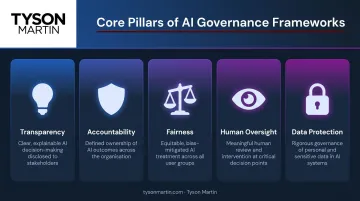
The nine frameworks covered here vary in enforceability (binding vs. voluntary), geographic reach (regional vs. global), and target audience. Most share five common pillars:
- Transparency — explainability of AI decisions and outputs
- Accountability — clear ownership when things go wrong
- Fairness — controls against discriminatory outcomes
- Human oversight — meaningful intervention points, not just checkboxes
- Data protection — governance over what's collected, retained, and used
What differs is how each framework operationalizes those pillars — and the consequences when organizations don't.
9 Key AI Governance Frameworks in 2026
Frameworks vary by enforceability, geographic reach, and intended audience. Most organizations don't operate under just one. The goal is understanding which apply, what they require, and how they interact.
EU AI Act
Background: The EU AI Act is the world's first comprehensive, legally binding AI regulation. It entered into force on August 1, 2024, with prohibited practices and AI literacy obligations applying from February 2025, most provisions from August 2026, and certain high-risk product rules extending to August 2027.
Critically, it applies to any organization placing AI systems on the EU market — regardless of where the company is headquartered. U.S. enterprises with European customers, partners, or operations are directly in scope.
Why it matters: The Act's risk-tier classification creates concrete obligations based on use case:
- Unacceptable risk — prohibited outright (certain biometric surveillance, social scoring)
- High risk — mandatory risk assessments, human oversight, and transparency documentation; applies to AI used in hiring, financial services, healthcare, law enforcement, and critical infrastructure
- Limited and minimal risk — transparency obligations or no specific requirements
Penalties under Article 99 reach EUR 35 million or 7% of global annual turnover for prohibited-practice violations. Boards with EU exposure should treat 2026 as the operational readiness year.
| Attribute | Detail |
|---|---|
| Enforceability | Legally binding |
| Geographic Scope | EU (applies globally for organizations serving the EU market) |
| Best Suited For | Organizations operating in or selling AI-powered products into the EU |
NIST AI Risk Management Framework (AI RMF 1.0)
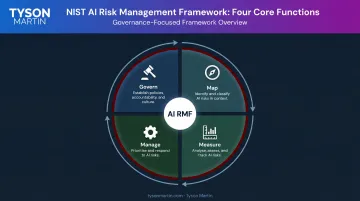
Background: Published by the U.S. National Institute of Standards and Technology in January 2023, the NIST AI RMF is voluntary and organizes AI risk management into four functions: Govern, Map, Measure, and Manage. The structure is designed for adaptation — applicable to any industry or organization size.
Why it matters: The NIST AI RMF has become the internal playbook for U.S. enterprises building AI governance programs. Its voluntary nature allows incremental adoption, and it maps cleanly onto existing cybersecurity and enterprise risk frameworks — particularly for organizations already using the NIST Cybersecurity Framework.
Treasury's financial-sector AI resources released in early 2026 make NIST AI RMF alignment an expected baseline in regulated industries — even without a formal mandate.
| Attribute | Detail |
|---|---|
| Enforceability | Voluntary (widely adopted as a standard of care) |
| Geographic Scope | U.S.-focused, with global applicability |
| Best Suited For | U.S. enterprises building or scaling formal AI governance programs |
ISO/IEC 42001
Background: ISO/IEC 42001:2023 is an internationally recognized management system standard for AI — the first of its kind that organizations can certify against through third-party audit. Like ISO 27001 for information security, it provides a structured, auditable framework for responsible AI practices.
Why it matters: Certification signals AI governance maturity to customers, partners, regulators, and boards in a way that internal policy documentation alone cannot. It's increasingly referenced in vendor risk management and enterprise procurement contexts — making it valuable not just for compliance, but for competitive positioning in regulated markets.
| Attribute | Detail |
|---|---|
| Enforceability | Voluntary (certifiable) |
| Geographic Scope | International |
| Best Suited For | Organizations seeking third-party validation of AI governance maturity, or managing supplier AI risk |
UK Pro-Innovation AI Framework
Background: The UK's non-statutory AI framework, set out in its March 2023 white paper, outlines five core principles — safety, security and robustness, appropriate transparency, fairness, accountability, and contestability — applied through existing sector regulators rather than a single centralized AI authority. A January 2026 one-year update confirmed the regulator-led approach remains intact.
Why it matters: This framework is not legally binding, but it shapes enforcement posture across financial services, healthcare, and other regulated UK sectors. Organizations already working through NIST or EU AI Act compliance will find the principles map closely — reducing the incremental effort for UK alignment.
| Attribute | Detail |
|---|---|
| Enforceability | Non-statutory (voluntary, sector-enforced) |
| Geographic Scope | United Kingdom |
| Best Suited For | UK-based organizations or those with significant UK market exposure |
OECD AI Principles
Background: Originally adopted in 2019 and updated in 2024, the OECD AI Principles represent the first intergovernmental standard on AI. They've been adopted by 47 adherents across OECD members and partner nations, and are frequently cited as the foundational language behind many national AI regulations.
Why it matters: The OECD Principles are the common denominator across most frameworks on this list. Organizations that structure governance programs around these principles tend to be well-positioned as new national regulations emerge. They're particularly relevant for multinationals managing AI governance across multiple jurisdictions simultaneously.
| Attribute | Detail |
|---|---|
| Enforceability | Voluntary (internationally adopted as baseline) |
| Geographic Scope | International (OECD member countries and partners) |
| Best Suited For | Multinational organizations seeking a cross-jurisdictional governance baseline |
UNESCO AI Ethics Framework
Background: Adopted in November 2021 by all 193 UNESCO member states, the UNESCO Recommendation on the Ethics of Artificial Intelligence is the first global standard on AI ethics. It emphasizes human rights, gender equality, environmental sustainability, and inclusive access to AI benefits.
Why it matters: For organizations in education, healthcare, public services, or with strong ESG commitments, UNESCO alignment demonstrates that AI governance extends to ethical commitments, not just legal ones. It also provides a governance reference point for AI use in developing economies and global supply chains.
| Attribute | Detail |
|---|---|
| Enforceability | Voluntary |
| Geographic Scope | Global (193 UN member states) |
| Best Suited For | Organizations with global operations, public sector accountability, or strong ESG commitments |
U.S. Executive Order on AI (EO 14179, 2025)
Background: EO 14179, titled "Removing Barriers to American Leadership in Artificial Intelligence," was signed January 23, 2025, revoking the Biden administration's EO 14110. It directs federal agencies to revise or repeal guidance that may impede AI innovation and called for development of a national AI action plan — released by the White House in July 2025, followed by a national policy framework published in the Federal Register in December 2025.
Why it matters: EO 14179 directly binds federal agencies. For the private sector, its influence is indirect — but material. Federal contractors, regulated industries, and defense-adjacent enterprises need to understand how the updated federal posture intersects with sector-specific requirements.
Organizations that built compliance programs around EO 14110 should audit which elements carry forward — and which have been effectively vacated.
| Attribute | Detail |
|---|---|
| Enforceability | Binding for federal agencies; influential for regulated industries and federal contractors |
| Geographic Scope | United States |
| Best Suited For | Federal agencies, government contractors, and heavily regulated U.S. industries |
U.S. State-Level AI Regulations
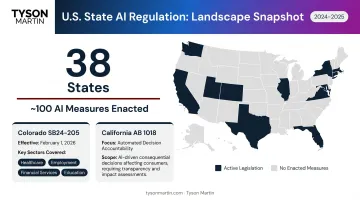
Background: In the absence of federal AI legislation, states have moved fast. Colorado's SB24-205 (effective June 30, 2026) prohibits algorithmic discrimination in high-risk AI systems used in healthcare, employment, financial services, and education. California's AB 1018 would extend automated decision system accountability requirements to consumer-facing AI. According to NCSL, 38 states enacted or adopted approximately 100 AI measures as of mid-2025 — and the pace hasn't slowed.
Why it matters: State laws are locally enforceable now. For organizations operating across multiple states, compliance complexity compounds with each new enactment. Boards and legal teams need a current map of applicable state requirements — state-level AI regulation is an active compliance reality today.
| Attribute | Detail |
|---|---|
| Enforceability | Legally binding (varies by state) |
| Geographic Scope | United States (state-by-state) |
| Best Suited For | Consumer-facing enterprises, HR/hiring AI users, healthcare and financial services operating across U.S. states |
G7 Code of Conduct for Advanced AI
Background: Established under the Hiroshima AI Process and welcomed by G7 leaders on October 30, 2023, the G7 Code of Conduct is a voluntary commitment outlining best practices for the safe, secure, and transparent development of advanced AI systems — including foundation models and generative AI.
Why it matters: Organizations developing or deploying foundation models, large language models, or generative AI at scale should treat the G7 Code of Conduct as an emerging industry standard. Its principles are already shaping regulatory drafts across G7 economies — organizations that align now reduce rework as binding rules follow.
| Attribute | Detail |
|---|---|
| Enforceability | Voluntary |
| Geographic Scope | G7 nations (Canada, France, Germany, Italy, Japan, UK, United States) |
| Best Suited For | Organizations developing or deploying foundation models, LLMs, or generative AI at scale |
How to Select the Right AI Governance Framework for Your Organization
Most organizations won't choose one framework — they'll need to operate under several simultaneously. The question is how to sequence and layer them.
Start With What's Legally Required
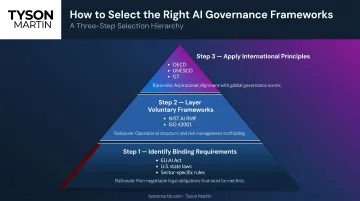
Use this decision hierarchy:
- Identify binding requirements first — EU AI Act if you serve the EU market; applicable state laws for U.S. operations; sector-specific requirements (Treasury guidance for financial services, ONC rules for healthcare)
- Layer in voluntary frameworks that structure your internal program — NIST AI RMF for risk management architecture; ISO 42001 if third-party certification is a strategic or procurement priority
- Use OECD, UNESCO, and G7 as policy alignment and board-level principles, particularly for multinational governance and ESG positioning
Common Mistakes to Avoid
- Treating governance as a one-time exercise rather than an ongoing operational function with owners, cadence, and measurable outcomes
- Skipping the AI use case inventory — you can't map to risk tiers without first knowing what AI systems you're actually running
- Siloing ownership in IT or legal — effective AI governance requires cross-functional accountability, board-level oversight, and defined decision rights that hold under pressure
What Boards and Audit Committees Should Demand
Avoiding these mistakes clarifies what "done well" actually looks like. The critical question isn't which frameworks theoretically apply — it's whether management can demonstrate a defensible, inspectable governance structure mapped to applicable requirements. That means:
- A clear inventory of AI systems and their risk classifications
- Documented decision rights for AI deployment, exception approval, and escalation
- Stable reporting metrics that show trend, not just status
- Evidence that governance controls would hold under regulatory scrutiny
This is where a board advisor with AI governance experience accelerates the process. Tyson Martin's board advisory engagements typically begin with a plain-language risk posture assessment — clarifying current AI use cases, identifying applicable frameworks, and producing a decision-rights map with escalation thresholds within the first 30 days.
The output is board-ready: an inspectable governance structure with named owners and target dates, not a policy document that sits in a drawer.
Conclusion
AI governance frameworks in 2026 are not theoretical. Several are legally binding, enforcement is active, and the gap between organizations with formalized programs and those without is a real liability — regulatory, reputational, and operational.
Selecting the right combination of frameworks requires honest answers to three questions: Where do you operate? What industry risk profile applies? What AI systems are you running? From there, the hierarchy becomes clear — binding requirements first, voluntary frameworks layered on top, international principles as your cross-jurisdictional baseline.
As agentic AI systems scale and generative AI moves deeper into core business processes, governance requirements will get more specific and more enforced — not plateau.
Boards that establish clear oversight structures now — defined decision rights, stable reporting dashboards, auditable governance processes — will have more room to move fast on AI opportunities without accumulating hidden regulatory or reputational risk.
If your board or executive team is ready to build a defensible AI governance structure, connect with Tyson Martin for board-level AI governance advisory. The starting point is always the same: what applies to your organization, and what it concretely demands of your leadership.
Frequently Asked Questions
What are the key pillars of AI governance?
Most established frameworks — including NIST AI RMF, the EU AI Act, and ISO 42001 — are built around five core pillars: transparency, accountability, fairness, human oversight, and data protection. Emphasis varies: the EU AI Act centers on risk classification and human oversight, while ISO 42001 prioritizes management system accountability.
What is the NIST framework for AI governance?
The NIST AI Risk Management Framework (AI RMF 1.0) is a voluntary, U.S.-developed framework built around four functions: Govern, Map, Measure, and Manage. It's flexible enough to fit any industry or organization size, making it a practical starting point for U.S. enterprises building internal AI risk programs.
What are some AI governance frameworks?
Key frameworks include the EU AI Act (binding, risk-tiered), NIST AI RMF (voluntary, U.S.-focused), ISO/IEC 42001 (international, certifiable), OECD AI Principles (global voluntary baseline), and the G7 Code of Conduct for Advanced AI. The right combination depends on where your organization operates and what AI systems you deploy.
Is the EU AI Act legally binding for U.S. companies?
Yes. The EU AI Act applies to any organization that places AI systems on the EU market or whose AI outputs are used within the EU — regardless of where the company is headquartered. U.S. enterprises with European customers, operations, or partners are directly in scope and subject to its compliance requirements and penalties.
What is the difference between AI governance and AI security?
AI governance defines how decisions are made about AI development, use, and oversight — covering policy, accountability, ethics, and regulatory compliance. AI security focuses on protecting AI systems, models, and data from threats such as adversarial attacks, data poisoning, and unauthorized access. Both are necessary; one doesn't substitute for the other.
How should boards oversee AI governance?
Boards should verify that management has inventoried AI use cases, mapped them to risk tiers, identified applicable frameworks, and established clear escalation thresholds. Review stable metrics on governance program performance — not technical implementation details — and be prepared to defend that structure to regulators if asked.