Introduction: Why Your Enterprise AI Policy Is Already Behind
AI-generated content isn't coming — it's already in your external communications, client summaries, legal briefs, financial analyses, and production code. The policies meant to govern it were written for a slower adoption cycle. That gap is where the real risk lives.
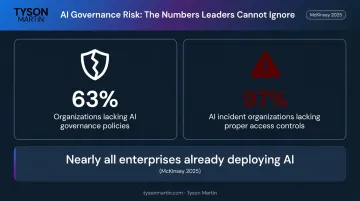
According to IBM's 2025 Cost of a Data Breach Report, 63% of organizations lack AI governance policies to manage AI or prevent shadow AI — and 97% of organizations that reported an AI-related security incident lacked proper AI access controls. Meanwhile, McKinsey's 2025 survey found that nearly all enterprises are already using AI, and many have begun deploying AI agents.
That deployment reality has outpaced most governance frameworks. What follows is what boards, general counsel, and senior executives need to know in 2026: the regulatory deadlines now in force, why shadow AI and agentic systems have broken conventional policy frameworks, and what defensible governance looks like when a real incident hits.
Key Takeaways
- 57.6% of organizations use AI without a governing policy — and many "formal" policies are still being developed or haven't been shared with staff
- EU AI Act full enforcement for high-risk AI systems began August 2, 2026 — organizations without a live AI inventory face active regulatory exposure
- Shadow AI drives a significant share of enterprise data breaches — exposing source code, regulated data, and IP
- Effective AI governance in 2026 is a cross-functional operating system with clear ownership, inspectable controls, and continuous monitoring — not a policy document
The AI Governance Gap: Where Enterprises Actually Stand
The numbers are direct: more than half of organizations using AI have no governing policy. Among those that do, Brafton's 2026 survey captured responses including "It is still being developed," "Leadership has not yet shared the policy with us," and "Will be creating a more robust AI policy in 2026."
Call it what it is: governance theater.
The underlying pattern is consistent across industries: organizations prioritize deployment speed and competitive pressure over governance infrastructure. This holds even in regulated sectors where governance obligations are explicit.
What "Having a Policy" Usually Means
Most enterprise AI policies in 2026 function as liability disclaimers. They state what's permitted in broad terms, they don't define inspection mechanisms, and they don't answer the questions that matter when something goes wrong:
- Who has authority to approve a new AI tool?
- Who can expand an existing AI system's scope?
- Who can shut down an AI-driven process when a risk materializes?
- At what threshold does an AI incident escalate to the board?
In most organizations, none of those escalation thresholds exist in writing — and they don't hold in real incidents.
Those unanswered questions point to a structural problem: enterprises haven't defined who owns AI decisions, who can inspect AI outputs, or who holds accountability when a system causes harm. That gap creates real financial and regulatory exposure — and boards are increasingly the ones left explaining it.
The Regulatory Landscape Boards Must Understand
EU AI Act
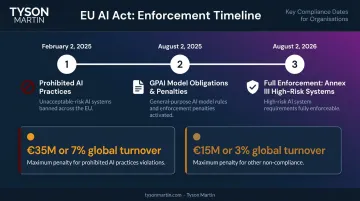
The EU AI Act (Regulation 2024/1689) has been rolling out in phases:
| Obligation | Effective Date |
|---|---|
| Prohibited AI practices | February 2, 2025 |
| GPAI model obligations and penalties | August 2, 2025 |
| Full enforcement for Annex III high-risk systems | August 2, 2026 |
Annex III high-risk categories cover AI deployed in:
- Critical infrastructure
- Employment and worker management
- Education and vocational training
- Access to essential services
- Law enforcement and administration of justice
The penalty framework is significant: up to €35M or 7% of global annual turnover for prohibited-practice violations, and up to €15M or 3% for other non-compliance. Article 50 transparency requirements and ongoing monitoring obligations all presuppose a live AI system inventory — which most organizations still don't have.
U.S. State Requirements
Federal preemption challenges are active, but executive orders don't void enacted state statutes. Enterprises must comply with applicable state requirements regardless of federal litigation posture.
Active obligations include:
- California ADMT regulations — effective January 1, 2026; covers consumer rights, risk assessments, and annual cybersecurity audits for automated decision-making
- Colorado AI Act — original SB24-205 revised by SB26-189 (signed May 14, 2026); key deployer provisions now take effect January 1, 2027
- New York RAISE Act — signed December 19, 2025; developer-focused, with incident reporting requirements and penalties up to $3M for repeat violations
The December 2025 Executive Order established an AI Litigation Task Force to challenge state laws — but the CRS framework confirms executive orders must rest on Article II authority and are subject to judicial review. State laws remain operative.
Standards That Now Function as Requirements
Enacted law isn't the only exposure. Two standards now operate as practical requirements:
- NIST AI RMF (including the GenAI Profile, NIST AI 600-1, published July 2024) — the de facto governance standard for U.S. enterprises and the baseline most regulators reference
- ISO/IEC 42001:2023 — the first certifiable AI management system standard, increasingly required in enterprise procurement and partnership contexts
Aligning to both satisfies anticipated federal requirements and reduces third-party risk exposure.
Enforcement Environment
The FTC's Rite Aid enforcement — banning the retailer from using AI facial recognition for five years — established a clear precedent: deployers of AI tools, not just developers, face regulatory consequences. The FTC's Operation AI Comply, announced September 2024, reinforced that there is no AI exemption from existing consumer protection laws.
The "we bought it from a vendor" defense does not hold.
Additional pressure points:
- SEC FY2026 examination priorities identify AI-driven threats to data integrity as a focus area, including AI washing and automated investment tool risks
- Cyber insurers (Marsh, Munich Re, Aon) are increasing AI-specific underwriting questions; human oversight and red teaming appear as generative AI risk mitigants in carrier guidance, and organizations without demonstrable AI security practices face growing scrutiny
Shadow AI and Agentic AI: Why Existing Policies Are Already Outdated
The Shadow AI Reality
Netskope's 2026 Cloud and Threat Report puts concrete numbers on what's actually happening inside enterprise environments:
- Data sent to SaaS generative AI apps increased sixfold — from 3,000 to 18,000 prompts per month per organization
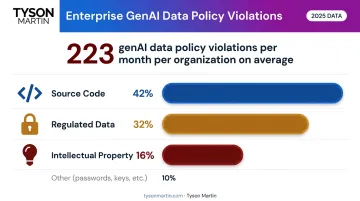
- The average organization experienced 223 genAI data policy violations per month; the top quartile averaged 2,100
- 50% of organizations lack enforceable data-protection policies for genAI apps
What employees are actually sending to these tools isn't hypothetical: source code (42%), regulated data (32%), and intellectual property (16%) dominate genAI data policy violations. Passwords and keys appear regularly.
The share of AI users relying on personal AI apps (rather than enterprise tools) declined from 78% to 47% — which means the substitution problem is real, but improvement is possible when organizations provide enterprise-grade alternatives.
The Agentic AI Problem
The most acute governance risk in 2026 isn't an employee using ChatGPT. It's an employee using Microsoft Copilot Studio, Zapier AI features, or a direct foundation model API to build an automated agent that processes business data, sends external communications, and makes operational decisions — without IT visibility or security review.
Gartner forecasts that 40% of enterprise applications will feature task-specific AI agents by end of 2026, up from less than 5% in 2025. An unauthorized agent with persistent OAuth access to a CRM, email, and calendar is an autonomous system operating inside critical infrastructure — not merely a data exposure risk.
Traditional governance frameworks were designed for human-speed, human-initiated interactions. They cannot keep pace with autonomous agent behavior that executes at machine speed, chains across multiple systems, and operates continuously.
The OWASP Top 10 for LLM Applications (2025) identifies the attack surfaces that agentic systems expand most:
- Prompt Injection (LLM01) — malicious inputs that hijack agent instructions
- Sensitive Information Disclosure (LLM02) — agents surfacing data they shouldn't share
- Excessive Agency (LLM06) — agents taking actions beyond their intended scope
- Unbounded Consumption (LLM10) — unconstrained resource use that creates operational and cost risk
Governance of agentic AI must monitor what AI does autonomously — not just what employees do with AI.
What an Enterprise AI-Generated Content Policy Must Actually Contain
The AI Inventory: Non-Negotiable Starting Point
No other governance mechanism holds without this. An AI system inventory must cover:
- All approved tools in organizational use
- Vendor-embedded AI (often the most overlooked category)
- Shadow AI surfaced through governance exercises
Each system should be classified by risk level, regulatory exposure, business criticality, and identified owner. Without this foundation, every control you build sits on an unknown floor. ISACA's 2025 shadow AI audit guidance recommends discovery through cloud services and security information/event-management (SIEM) systems as the starting mechanism.
Tiered Tool Classification
A ban list doesn't work. Employees route around it. A tiered classification model gives employees a usable decision framework:
| Tier | Description | Data Handling |
|---|---|---|
| Approved | Sanctioned enterprise tools | Full use per data classification |
| Limited Use | Specific use cases with defined data rules | No sensitive data; non-proprietary content only |
| Prohibited | Blocked; no business justification | No use permitted |
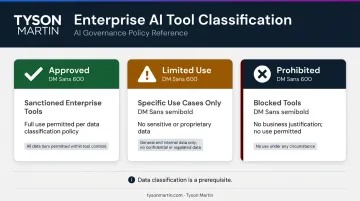
Data classification is a prerequisite for this to work. Employees cannot make safe decisions about what to share with an AI tool without an operationally useful definition of what counts as sensitive in an AI data-processing context.
Continuous Monitoring and Real-Time Coaching
Periodic audits find yesterday's problems. Effective governance operates in real time.
Real-time contextual warnings at the point of data entry — for example, flagging a document that appears to contain customer PII before it's submitted to a generative AI tool — outperform post-incident investigation. The goal is friction at the decision point, not paperwork after the fact.
Designing this infrastructure requires more than tooling — it requires decision-rights clarity, defined escalation thresholds, and a governance dashboard built for trend visibility. That's the advisory work Tyson Martin does with boards and executive teams: governance frameworks that hold under real incident conditions, not just during scheduled reviews.
Who Owns AI Governance at the Board Level
Cross-Functional Ownership
AI governance that lives exclusively in IT produces policies that address the risk surface IT can see. That's a fraction of the actual surface.
Effective ownership maps across functions:
- Legal — contractual exposure, liability, vendor agreement review
- Compliance — regulatory mapping (EU AI Act, NIST AI RMF, HIPAA, SOC 2, SEC requirements)
- Business unit leaders — use case inventory; they know what AI is actually being used for
- HR — training, acceptable use policy communication, performance implications
- Security — detection, incident response, technical monitoring
- IT — approved tooling, technical controls, integration governance
The RACI structure matters because shadow AI is a distributed organizational problem. It doesn't surface in a server log.
Board-Level Fiduciary Framing
Board-level AI governance is now a fiduciary responsibility with legal teeth.
The FTC's Operation AI Comply established there is no AI exemption from existing laws. Italy's €15M fine against OpenAI for GDPR violations (later overturned on appeal, but triggering parallel investigations across Europe) illustrates that AI enforcement actions carry material cost regardless of final outcome.
Boards that cannot demonstrate structured AI governance — documented inventories, risk classifications, monitoring cadences — face regulatory and legal exposure that didn't exist two years ago. The gap is rarely technical. It's the translation layer: converting AI risk into defensible board-level decisions with clear escalation thresholds, rather than routing technical reports to the board unfiltered.
That translation work is where Tyson Martin's board advisory engagements focus. His governance frameworks give boards an amber/red trigger system — worsening trends, near misses, threshold breaches — with documented escalation paths and pre-defined response owners.
What Board Oversight Should Actually Produce
Inspectable AI governance, from the board's perspective, looks like:
- A stable dashboard showing trend over time — five metrics that matter, with thresholds and direction, not a list of technical events
- Documented decision rights covering who approves new AI tools, who can expand scope, and who can shut a process down
- Quarterly inventory reviews rather than annual audits — the AI landscape changes too fast for annual cadences
- An escalation protocol with pre-defined triggers: what constitutes an amber condition, what constitutes red, who gets notified, and in what timeframe
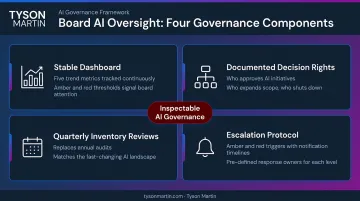
Boards that can demonstrate this structure are better positioned in regulatory examinations, insurance renewals, and — critically — in the hours after an incident when every decision gets scrutinized.
Frequently Asked Questions
What AI regulations must enterprises comply with in 2025 and 2026?
Active obligations include: EU AI Act enforcement for high-risk systems (August 2, 2026), California ADMT (January 1, 2026), Colorado's revised AI Act (key provisions January 1, 2027), and the New York RAISE Act (signed December 2025). NIST AI RMF and ISO/IEC 42001 function as de facto governance standards in the U.S. State laws hold regardless of federal preemption challenges.
How are enterprises building AI agents in 2026?
Many organizations are building agentic AI workflows — both sanctioned and unsanctioned — using platforms like Microsoft Copilot Studio, Zapier AI, and direct foundation model APIs. Gartner forecasts 40% of enterprise applications will embed task-specific AI agents by year-end 2026. Governing these agents requires monitoring autonomous AI behavior and its access to connected systems, not just tracking employee AI usage.
What's the difference between an AI policy and an AI governance framework?
An AI policy is a document stating what is and isn't permitted. An AI governance framework is an operational system with defined ownership, inspectable controls, continuous monitoring, and escalation thresholds that function during real incidents when a real incident occurs. Most enterprises have the former without the latter.
Who should own AI governance — IT, legal, or the board?
Effective AI governance requires cross-functional ownership: Legal owns liability exposure, Compliance owns regulatory mapping, Business units own the use case inventory, Security owns detection, and IT owns technical controls. The board owns oversight — ensuring the governance structure is inspectable and defensible, with clear accountability at every layer.
What should a board AI oversight dashboard include?
At minimum: trend metrics on AI system inventory changes and shadow AI incidents, current compliance status against active regulatory obligations, documented escalation decisions made since the last briefing, and a plain-language summary of what changed in AI risk posture. A director should leave each briefing knowing what changed, what was decided, and what requires board-level action before the next meeting.