Introduction
Most organizations have deployed AI faster than they've built guardrails for it. AI tools are already running inside business operations — drafting communications, scoring credit, routing supply chains, flagging fraud — while governance policies remain a future agenda item. Regulators are not waiting: the EU AI Act began enforcement in 2024, and the SEC has made clear that AI-related disclosure failures fall under existing materiality obligations. That gap is the problem boards need to close now.
This post addresses two dimensions of risk that gap creates: security exposure (what ungoverned AI allows attackers and insiders to exploit) and compliance liability (what regulators, auditors, and courts will look for when something goes wrong).
For boards and executive teams, this is not an IT problem to delegate. Inadequate AI governance produces auditable failures — missing documentation, undocumented data flows, absent decision rights — that create direct personal liability for directors when enforcement arrives.
Key Takeaways
- 78% of AI users bring their own tools to work, creating data exposure outside any organizational control
- Ungoverned AI expands the attack surface — and monitoring rarely keeps pace
- Major regulations — EU AI Act, GDPR, CCPA, HIPAA — require demonstrable controls, not stated intent
- SEC, FTC, and EU regulators have already penalized AI governance failures — enforcement is active, not theoretical
- The first structural fix is almost always the same: clarify who owns AI decisions and what triggers board escalation
What "Inadequate AI Governance" Actually Looks Like
Inadequate AI governance isn't the absence of a policy document. Most organizations have something on paper. The real failure is the absence of enforced controls, clear decision rights, and inspectable processes around how AI is selected, deployed, and monitored.
The distinction matters: governance that exists only on paper provides no protection when an auditor asks for evidence, or when a regulator asks why sensitive customer data was processed by a tool that was never formally assessed.
The Shadow AI Problem
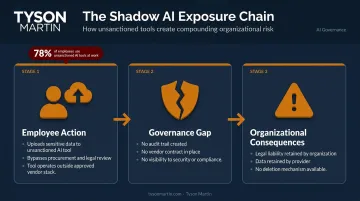
Shadow AI is governance's first and most widespread failure point. It covers employees using unsanctioned tools: consumer chatbots, browser-based AI assistants, and third-party automation that operates entirely outside organizational visibility.
The scale is not marginal. According to the 2024 Microsoft and LinkedIn Work Trend Index, 78% of AI users bring their own AI tools to work — spanning every generation, from Gen Z to baby boomers.
Why this matters from a governance standpoint:
- Sensitive data is being processed by systems the organization has never evaluated, approved, or contracted with
- There is no audit trail if something goes wrong
- The organization retains legal accountability for data handling even when it had no visibility into it
- Vendor data-use and retention practices are entirely unknown
Cisco's 2024 Privacy Benchmark Study confirmed the exposure directly: employees reported entering internal process information, non-public company data, and employee records into generative AI applications.
That survey data has real-world consequences. In 2023, a Samsung employee uploaded sensitive source code to ChatGPT, prompting a company-wide ban on external AI tools — one of the most public early illustrations of what ungoverned AI adoption costs.
Security Risks: How Ungoverned AI Opens the Door to Threats
AI systems require access to sensitive data to function, which makes them high-value targets. Without governance defining what data AI can access, how it's protected, and who can query it, organizations expand their attack surface without realizing it.
Data Exposure and Privacy Failures
Large language models used internally can surface or reproduce fragments of sensitive data — PII, financial records, health information — in unexpected outputs. Without data governance integrated into AI deployment, there is no control over what enters the model or what exits it.
The numbers support the concern. Harmonic Security's 2025 research found that 8.5% of prompts entered into generative AI tools in 2024 contained sensitive information, including payroll data and legal documents. That figure represents real organizational data flowing into systems with unknown retention policies and training-data practices.
The Samsung incident is the clearest enterprise example: sensitive code entered into a public AI tool, retained by the provider, with no mechanism for the organization to retrieve or delete it.
Adversarial Attacks and Model Manipulation
Ungoverned AI systems lack the monitoring needed to detect adversarial inputs. NIST's 2025 adversarial machine learning taxonomy identifies data poisoning, evasion attacks, and abuse as documented threat classes across AI system life-cycle stages.
If an AI system is influencing fraud detection, credit scoring, clinical triage, or supply chain routing and that system has been manipulated, the organization may not discover the compromise until downstream failures surface. At that point:
- The audit trail is missing
- The contaminated outputs have already influenced real decisions
- Regulatory exposure exists for decisions made using a compromised system
Accountability Gaps When Incidents Occur
Without governance defining decision rights for AI systems, incident response becomes chaotic. When a breach or failure involves an AI system, organizations without clear ownership structures struggle to determine who is responsible, creating delays in containment and gaps in regulatory reporting timelines.
This "who owns this?" problem is the predictable result of deploying AI without named accountable owners, defined escalation thresholds, or integration into existing incident response plans. The gap doesn't emerge during a crisis — it was baked in at deployment.
Compliance Risks: The Regulatory Exposure You Can't Ignore
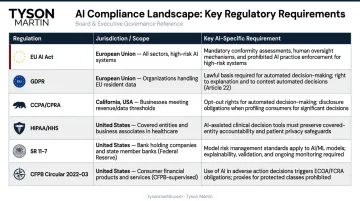
AI is no longer operating in a compliance vacuum. Multiple regulatory frameworks — with real enforcement teeth — now have direct implications for how AI is deployed and documented.
| Regulation | What It Requires |
|---|---|
| EU AI Act | Risk-based documentation, logging, human oversight, and conformity assessment for high-risk AI systems (Articles 9–15) |
| GDPR | Lawful, accountable data processing; individual rights regarding automated decisions with significant effects (Article 22) |
| CCPA/CPRA | Risk assessments, cybersecurity audits, and consumer opt-out rights for automated decision-making; effective January 1, 2026 |
| HIPAA/HHS | Privacy and security obligations for AI processing health data; written business associate agreements required |
| SR 11-7 (Federal Reserve) | Model inventory, validation, governance, and effective challenge for financial institutions |
| CFPB Circular 2022-03 | Algorithmic complexity does not excuse failure to provide specific adverse-action reasons in credit decisions |
Documentation and Auditability Failures
Regulators expect organizations to produce evidence — not assertions — that AI systems were evaluated, monitored, and controlled. Organizations without governance infrastructure cannot produce the evidence trail an audit demands.
The EU AI Act specifies what high-risk AI documentation must include:
- Technical documentation completed before deployment
- Automatically generated logs retained for audit
- Instructions for use and human oversight design
- Quality management systems and post-market monitoring records
The NIST AI RMF 1.0 similarly expects defined roles, policies, accountability mechanisms, and evidence of risk management across its four functions: Govern, Map, Measure, and Manage.
The absence of documentation is itself a compliance violation in many frameworks — even if the AI system performed correctly. When an organization cannot prove compliant performance, the gap creates liability that actual performance cannot cure.
Third-Party and Vendor AI Risk
Many organizations deploy AI capabilities through vendors and SaaS tools without assessing those vendors' own governance practices. Under GDPR Article 28, controllers must govern processors through contract. Under Article 82, vendor failures can still create controller liability.
US regulators have drawn the same boundary. In 2024, the FTC confirmed there is no "AI exemption" from privacy and confidentiality obligations — the organization that deployed the vendor's AI system remains accountable for what it does with data.
Vendor AI assessments should cover at minimum:
- Data-use and retention terms specific to AI processing
- Sub-processor disclosure and restrictions
- Audit rights and deletion obligations
- Whether vendor AI training uses customer data
The Cost of Non-Compliance
Enforcement is no longer theoretical. Recent actions establish the financial stakes:
- SEC (2024): Delphia fined $225,000 and Global Predictions fined $175,000 for false or misleading AI-related statements
- FTC (2023): Rite Aid banned from facial recognition surveillance for 5 years following deployment without reasonable safeguards
- Italian DPA (2021): Foodinho fined €2.6 million for algorithmic rider-management and discrimination concerns
Fines are recoverable. Operational bans and forced model deletion are not — and boards that cannot demonstrate governance oversight face personal exposure when enforcement reaches the director level.
The Board Accountability Gap: Why This Is a Leadership Problem
AI governance is a board-level fiduciary issue. The NACD has framed AI oversight as a board responsibility involving responsible AI principles, risk management, and business strategy — not just a technology function to delegate to IT.
The D&O liability dimension is becoming concrete. DLA Piper tracked more than 50 AI-related securities class action filings over five years, with 7 in 2023, 14 in 2024, and 12 in the first half of 2025 alone. When AI-related incidents occur — a data breach, a discriminatory algorithm, a regulatory enforcement action — boards without documented oversight may face shareholder scrutiny for failing to exercise appropriate control over a known material risk.
When There Are No Clear Decision Rights
The most common governance failure at the leadership level is not malice. It's ambiguity. No one knows who has authority to approve an AI deployment, who can halt one, or at what threshold an AI failure requires board notification.
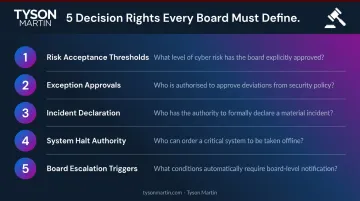
A workable decision rights structure answers five questions:
- Who accepts AI risk and at what threshold?
- Who approves exceptions to AI use policy and for how long?
- Who declares that an AI-related incident has occurred?
- Who can halt an AI system if it's producing harmful outputs?
- What triggers escalation to the board committee chair — and what triggers full board notification?
For boards working with an independent advisor, clarifying decision rights and escalation thresholds is typically the first structural gap to close. Tyson Martin's work with boards focuses here: building the decision architecture that holds during an actual incident, not just when conditions are favorable.
That means the governance structure needs to be inspectable under pressure — with a clear decision-rights map and board-ready oversight reporting that directors can rely on when it matters most.
Reputational and Trust Consequences
Financial penalties are the measurable consequence. Reputational damage is harder to quantify — and often longer-lasting. Edelman's 2025 AI Trust research finds that transparency and governance are the primary drivers of whether consumers and investors extend trust to organizations using AI.
When governance failures become public — through regulatory action, a discriminatory outcome, or a data breach traced to an uncontrolled AI tool — the damage extends well beyond the enforcement action itself. the damage extends well beyond the enforcement action itself. Boards that can demonstrate documented oversight and clear decision rights are in a substantially stronger position, both with regulators and with the market.
The categories of exposure are distinct:
- Regulatory: Fines, consent orders, and mandatory remediation
- Investor: Shareholder litigation and proxy scrutiny
- Market: Customer attrition, partner hesitation, and brand erosion
What Good AI Governance Actually Requires
Governance does not mean slowing AI adoption. It means building the structural conditions under which AI can be used confidently and defended under scrutiny.
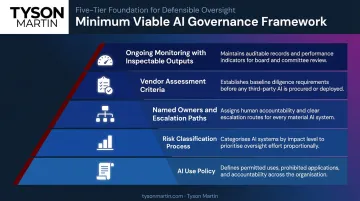
The minimum viable governance stack:
- An AI use policy that specifies approved tools, permitted data classifications, and what employees must do before adopting a new application
- A risk classification process that tiers deployments by potential impact (high, medium, low), keeping compliance effort proportional to actual risk
- Named owners and escalation paths for each AI system, with clear thresholds for what triggers management versus board-level response
- Vendor assessment criteria — specific AI-related questions that must be answered before any new vendor is approved
- Ongoing monitoring with inspectable outputs: logs, performance reviews, and anomaly detection that produce evidence an auditor can examine
Three established frameworks provide the scaffolding — organizations don't need to build from scratch:
- NIST AI RMF 1.0 covers four functions — Govern, Map, Measure, Manage — establishing policies, roles, risk mapping, and monitoring in a single integrated structure
- NIST Privacy Framework is designed to run alongside the AI RMF wherever AI systems touch personal data
- EU AI Act risk tiers (prohibited, high-risk, limited-risk, minimal-risk) offer a practical prioritization lens for compliance effort, even for organizations outside the EU
For organizations in transition — new leadership, post-incident, or accelerating AI adoption without governance infrastructure in place — the practical challenge is shortening the path to a defensible framework. Tyson Martin's board and executive advisory work is built for exactly this situation: a focused risk assessment, a decision-rights map, a board-level AI policy, and a 90-day plan with named owners and measurable milestones. The goal is governance you can inspect and defend, not a policy document that sits in a drawer.
Frequently Asked Questions
Why do we need an AI governance framework?
An AI governance framework defines who owns AI decisions, what controls apply, and how accountability is assigned when something goes wrong. Without one, there's no visibility into what data AI is processing, no documentation trail for regulators, and no clarity on who is responsible when something goes wrong.
What are the biggest security risks of unmanaged AI?
Three risks surface consistently. First, AI systems process sensitive data without access controls, creating exposure that standard security reviews miss. Second, adversarial techniques like prompt injection and data poisoning can manipulate outputs in ways that are hard to detect. Third, when AI is involved in a breach, organizations often have no defined response path — because no one planned for that scenario.
How does poor AI governance lead to compliance violations?
Most AI-relevant regulations require organizations to document, evaluate, and monitor their AI systems. When those practices are absent, the organization cannot demonstrate compliance — and in frameworks like the EU AI Act, missing documentation is itself a violation, regardless of intent.
What is shadow AI and why is it a governance risk?
Shadow AI refers to unsanctioned tools employees use without organizational approval or visibility. It bypasses data controls, creates undocumented flows, and leaves the organization liable for how those tools handle sensitive information — without any audit trail regulators or counsel can inspect.
Who is responsible for AI governance in an organization?
AI governance requires cross-functional ownership across legal, security, IT, and business leadership. Without a defined accountable owner — typically a CISO or equivalent — and clear decision rights, no one owns the gaps, and they surface during incidents rather than before them.
What should boards know about AI governance oversight?
Boards should understand the organization's AI risk posture, confirm that governance structures exist and are inspectable, and ensure escalation thresholds are defined so material AI-related risks reach leadership before they become incidents rather than after.