

Introduction
Most boards today can name their AI risks faster than they can name a single AI decision they've made. That gap — knowing the risks but still not acting — is AI governance paralysis. And it costs more than most organizations want to admit.
The problem isn't awareness. Boards and executive teams are drowning in risk briefings, regulatory updates, and vendor pitches — yet still can't answer basic questions like "Who approves an AI deployment?" or "What happens when a model causes harm?"
The data backs this up. According to NACD's 2024 research, 95% of senior leaders said their organizations were investing in AI — but only 34% were incorporating AI governance. That 61-point gap isn't a data problem. It's a decision-making problem.
What follows is a diagnostic and a path forward — starting with decision rights, not more committees.
Key Takeaways
- 95% of organizations invest in AI; only 34% govern it — the gap is the problem
- Paralysis has three sources: regulatory uncertainty, committee overload, and risk aversion dressed up as diligence
- Waiting for a perfect framework doesn't reduce risk — it relocates it
- The single most important fix is defining decision rights before building anything else
- Boards own risk appetite and escalation thresholds; management owns execution within those guardrails
Why AI Governance Paralysis Happens
Paralysis rarely has a single cause. It typically results from three overlapping pressures that leaders in regulated industries feel most acutely.
Regulatory Uncertainty Creates a Waiting Game
The pace of AI development has dramatically outrun the pace of regulatory policy. Executive Order 14110 established a federal governance approach in 2023. Executive Order 14179 revoked parts of it in 2025. OMB M-25-21 replaced M-24-10 the same year. By the time any framework is finalized, the technology it governs has already moved.
This volatility leaves organizations waiting for a definitive federal or industry standard before acting. That waiting posture is especially pronounced in financial services, healthcare, and retail — sectors where regulatory missteps carry real legal and reputational consequences.
The practical lesson: waiting for stable federal AI law before assigning internal accountability is itself a governance failure.
Committee Overload and Accountability Diffusion
Many organizations respond to AI risk by creating oversight structures — ethics boards, AI steering committees, cross-functional working groups. The instinct is reasonable. The execution typically isn't.
Stanford Law's CodeX analysis describes what happens when organizations stack seven or more oversight bodies: "decision diffusion," finger-pointing, and what they call "governance theater." When responsibility spreads across too many nodes, individual ownership disappears.
Every committee assumes another has conducted the rigorous review. The result is superficial approval from all quarters and genuine scrutiny from none.
The fix isn't fewer committees — it's one accountable owner with cross-functional input, not serial veto bodies.
Fear Masquerading as Caution
Many leaders aren't waiting for clarity. They're avoiding blame.
Inaction feels safe because it can't be audited. But that's a leadership gap, not a risk strategy. Governance paralysis is risk displacement. It trades one set of risks for another without acknowledging the trade-off. When an AI incident eventually occurs (and it will), the organization that couldn't answer "who was accountable?" faces exponentially worse consequences than the one that built clear ownership before the pressure hit.
The Cost of Standing Still
Organizations waiting for a "perfect" governance framework aren't managing AI risk. They're choosing a different kind of risk.
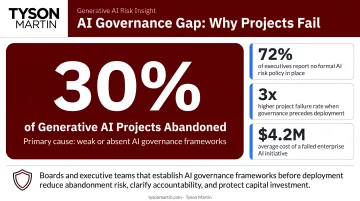
Gartner predicted in 2024 that at least 30% of generative AI projects would be abandoned after proof of concept by the end of 2025 — due to poor data quality, inadequate risk controls, escalating costs, or unclear business value. Governance isn't what slows AI adoption. Weak governance is what kills it.
The competitive cost is concrete:
- Capability gap: Competitors already deploying AI are building institutional knowledge and process muscle that becomes harder to close over time
- Decision speed: Organizations without governance frameworks make slower decisions, not faster ones — every deployment triggers a new debate from scratch
- Value on the table: Faster customer insight, better operational efficiency, and more defensible decision-making all require AI, and all require governance to sustain
Organizations that delay too long typically end up making panicked, poorly governed AI decisions under competitive pressure — without the safeguards they spent months waiting to build. Caution without a plan doesn't reduce risk. It defers that risk to a moment of maximum pressure and minimum readiness.
Warning Signs Your Organization Is Stuck
Governance paralysis has observable indicators. Boards and executives should watch for:
- No documented AI use policy — not a draft, not a framework, nothing employees can actually reference
- AI initiatives stalled at proposal stage for more than one quarter, with no named decision-maker accountable for moving them forward
- Oversight processes functioning as checklists rather than real decision-making tools: boxes get checked, but no one is accountable for what the checking means
- Briefings that describe risk without recommending action. Analysis without a decision request isn't oversight; it's information delivery
The Governance Theater Test
"Governance theater" describes organizations that form committees, draft policies, and produce documentation to demonstrate diligence — without actually guiding any decisions.
Two diagnostic questions will tell you whether your organization is governing or performing:
- How long does it take to deploy a low-risk AI model after technical readiness? If the answer is months, governance is the bottleneck.
- If an AI-assisted decision caused harm tomorrow, could your board clearly identify who was accountable? No clear answer means decision rights aren't actually assigned — only assumed.
If either answer is uncomfortable, the problem isn't more documentation. It's structural.
Breaking the Paralysis: A Practical Framework for Action
Effective AI governance isn't a compliance exercise built around committees. It's a structure that tells every person in the organization what they're allowed to decide, what requires escalation, and what the board owns. The goal is enabling speed within clear guardrails, not slowing everything down.
Calibrate Oversight to Actual Risk
Not all AI models carry the same risk profile. Treating them as if they do wastes resources and creates bottlenecks.
A simple three-tier structure, consistent with the EU AI Act's risk-based approach:
| Risk Tier | Example Use Cases | Approval Mechanism |
|---|---|---|
| Low risk | Internal productivity tools, summarization | Self-certification and peer review |
| Medium risk | Customer-facing analytics, scoring models | Business owner approval and ethics checklist |
| High risk | Credit decisioning, clinical decision support | Structured multi-stakeholder review |
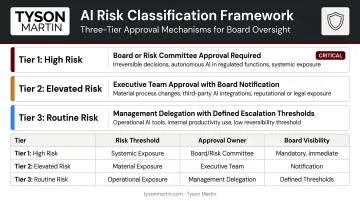
Over-scrutinizing low-risk models isn't responsible governance. It's a tax on productivity that trains teams to route around governance entirely.
Establish Clear Decision Rights Before You Build Anything Else
The single most important structural change boards and executive teams can make is defining who owns what. Decision rights must answer:
- Who can greenlight an AI use case?
- What threshold triggers board-level review?
- Who is accountable when an AI-assisted decision causes harm?
Without this, every other governance mechanism is performative.
In practice, a decision-rights map must answer five questions without debate:
- Who accepts risk, and at what threshold?
- Who approves AI exceptions, and for how long?
- Who decides when security competes with delivery?
- Who declares incident severity?
- Who owns vendor go/no-go decisions?
Tyson Martin's advisory approach centers on exactly this: building inspectable governance structures where decision authority is visible, escalation thresholds are defined in advance, and outcomes trace to named owners rather than dispersed across committees.
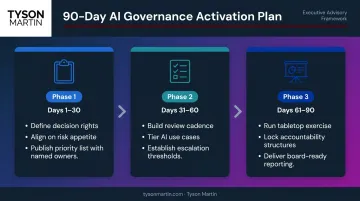
A 90-day governance activation plan built on this foundation looks like:
- Days 1–30: Define decision rights, align on risk appetite, publish a one-page priority list with named owners and dates
- Days 31–60: Build review cadence, tier existing AI use cases, establish escalation thresholds
- Days 61–90: Run a tabletop exercise, lock in accountability structures, deliver board-ready reporting
Replace Sequential Reviews with Parallel Ones
Most organizations run AI reviews sequentially — ethics review completes, then legal reviews, then security, then compliance. Each handoff adds weeks.
Running these reviews in parallel under a single accountable owner cuts time-to-deployment without reducing scrutiny. The key structural requirement is cross-functional representation with clear ownership, not separate veto bodies operating in sequence. Stanford Law's research supports this directly: multiplying sequential review bodies creates decision diffusion, not more rigorous oversight.
Build a Living Framework, Not a One-Time Document
The goal is not a perfect governance policy produced once. It's a principle-based, iterative structure that can be implemented now and improved over time.
Singapore's IMDA Model AI Governance Framework was designed as a "living and voluntary" framework that translates AI ethics into practical organizational measures, with the expectation of evolution rather than perfection. The first version doesn't need to be comprehensive. It needs to be actionable.
A minimum viable AI governance structure includes: a decision-rights map, a risk register with named owners, an escalation ladder with pre-defined triggers, and a regular reporting cadence. That's enough to govern, inspect, and improve.
What Boards and Executives Need to Do Differently
The distinction that matters most at the board level: boards own oversight, not operations.
The board's role in AI governance isn't to approve every use case. It's to set the risk appetite, demand clear reporting on whether AI activities fall within that appetite, and ensure accountability is structurally enforced below them.
What Credible AI Reporting Actually Looks Like
Not a list of AI tools in use. Not a vendor scorecard. Credible board-level AI reporting answers:
- What is our current AI risk posture?
- What changed since the last briefing?
- What decisions require board-level input right now?
- Are our existing guardrails holding under actual deployment conditions?
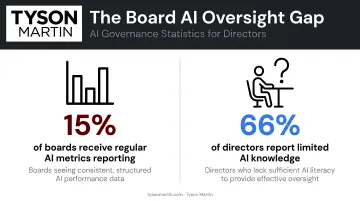
McKinsey's 2025 research found that only 15% of boards received AI-related metrics — and 66% of directors reported limited or no AI knowledge. Boards that accept tool inventories as AI oversight are getting activity reports, not governance.
Define Escalation Thresholds Before You Need Them
Most organizations haven't defined when an AI issue escalates from management to the board. When an incident occurs, that ambiguity causes delay, creates legal exposure, and guarantees the board learns about problems after the fact rather than in time to act.
Escalation thresholds should be anchored to business impact — revenue loss, operational downtime, data sensitivity, and legal exposure — not technical severity alone.
Boards must define these thresholds explicitly, in advance. The one-page escalation ladder — who notifies whom, under what conditions, within what timeframe — should exist before any AI deployment goes live.
When External Help Accelerates the Work
For organizations in transition — new leadership, post-M&A, post-incident, or undergoing technology modernization — the window to establish AI governance with authority and clarity is especially compressed.
Internal teams often can't self-generate credible governance structure quickly enough during these moments. An external board advisor or fractional CISO brings the structure, independence, and speed to close that gap.
Boards and CEOs in these situations should treat AI governance activation as a 90-day priority with named owners and inspectable outcomes. Structure it as a sprint, not a standing committee.
Frequently Asked Questions
Is AI governance possible?
Yes — but only when it's treated as a living, principle-based structure rather than a one-time compliance exercise. Effective governance clarifies decision rights, calibrates oversight to actual risk levels, and improves iteratively. Organizations that wait for a perfect framework before starting rarely build one at all.
What is AI governance paralysis?
It's the state of organizational inaction in which leaders recognize the need for AI governance but can't move forward — due to regulatory uncertainty, fear of missteps, or over-complicated committee structures that diffuse accountability without enabling decisions.
What are the biggest mistakes boards make with AI governance?
The most common mistakes: treating governance as a compliance checkbox rather than a decision-making structure, delegating without defining accountability, and confusing activity (forming committees, drafting policies) with actual oversight. Boards that receive tool inventories instead of risk posture reports are particularly exposed.
How do you build an AI governance framework without slowing the business?
Calibrate oversight to risk level. Low-risk AI use cases get lightweight, fast-track review; high-risk uses receive structured scrutiny. Parallel reviews, pre-approved data sources, and defined decision rights let organizations move faster while keeping accountability intact.
What decisions belong to the board versus management when it comes to AI?
The board owns risk appetite, escalation thresholds, and oversight assurance — not individual AI deployment approvals. Management is accountable for operating within the guardrails the board sets. The board's job is to verify those guardrails are real, enforced, and holding under actual conditions.
What are the 7 Sutras of AI governance?
The "7 Sutras" language originates from India's AI Governance Guidelines, published in February 2026. Regardless of framework terminology, effective AI governance consistently returns to the same core principles: clear ownership, risk-proportionate oversight, inspectable accountability, and iterative improvement.