

Introduction
Boards are approving AI initiatives faster than governance structures can keep pace. That gap is no longer a theoretical concern — it's showing up in enforcement actions, regulatory fines, and algorithmic bias incidents that land directly on the board's agenda.
The consequences are concrete. A $365,000 EEOC settlement over AI-driven age discrimination in hiring. A five-year FTC ban on facial recognition after inadequate safeguards. A €30.5 million Dutch DPA fine for an illegal biometric database. These are the documented costs of deploying AI without governance you can actually inspect.
This article provides a practical roadmap for building a global AI governance framework that enables real oversight without slowing operations. It covers the five core pillars, how to structure board roles and decision rights, the global regulatory landscape, and the most common failure modes to avoid.
If your organization is deploying AI — or approving budgets for teams that are — this is where governance gets operationalized.
Key Takeaways
- A governance framework is built on clear decision rights, defined escalation thresholds, and a consistent board reporting cadence — policy documents alone are not enough
- Five pillars form the foundation: risk and accountability, transparency, bias mitigation, data privacy, and continuous monitoring
- The board owns oversight, not operations: define what information you need, at what frequency, and who is accountable for delivering it
- The regulatory landscape is fragmented but converging — US, EU, and Asia-Pacific frameworks must be addressed simultaneously
- AI governance requires scheduled review cycles and defined trigger events — not a one-time compliance effort that sits on a shelf
Why AI Governance Must Be Global — and Why Now
AI systems don't respect jurisdictional boundaries. A model trained on US data, deployed by a US company, and used to screen EU customers triggers obligations under the EU AI Act — regardless of where the organization is headquartered. Training data crosses borders. Vendor relationships span continents. The risk surface follows the deployment, not the org chart.
The cost of inaction is no longer abstract. Consider what inadequate AI oversight has produced in just the past two years:
| Incident | Consequence |
|---|---|
| iTutorGroup AI hiring software rejected applicants over 55 and 60 | $365,000 EEOC settlement |
| Rite Aid deployed facial recognition without adequate safeguards | 5-year FTC ban on facial recognition |
| Clearview AI's illegal biometric database | €30.5M Dutch DPA fine |
| SafeRent algorithmic tenant screening | DOJ/HUD Fair Housing Act action |
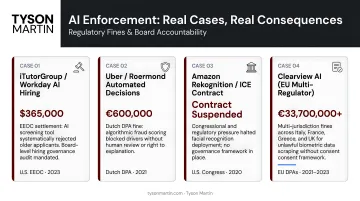
Regulators took notice. The regulatory calendar accelerated in direct response. The EU AI Act entered into force on August 1, 2024, with obligations phasing in at 6, 12, 24, and 36 months. The UN adopted its Global Digital Compact in September 2024. The US, UK, Singapore, and Japan all issued AI-specific guidance or rulemaking between 2023 and 2025.
Boards that delay governance decisions now will pay more to remediate later. The IBM Institute for Business Value found that AI ethics spending rose from 2.9% of AI spend in 2022 to 4.6% in 2024, with 5.4% projected next. Organizations building governance proactively are setting that budget intentionally — not absorbing it as incident response.
What a Global AI Governance Framework Actually Covers
A global AI governance framework is not a single policy document. It is an interconnected system of policies, accountability structures, oversight mechanisms, and technical controls that governs how AI is developed, deployed, monitored, and retired across the organization and its vendors.
Why Traditional IT Governance Falls Short
Traditional IT governance — built on deterministic, rule-based systems — was not designed for AI. Standard ITIL and COBIT frameworks manage systems that produce predictable outputs. AI governance must account for:
- Probabilistic and emergent model behavior
- Model drift as data distributions shift over time
- Bias encoded in historical training data
- Ethical risk areas that firewall policies don't address
- Autonomous or agentic systems that take actions, not just recommendations
Governance vs. Compliance: A Critical Distinction
These terms are frequently used interchangeably, but they answer different questions:
| Question Answered | Primary Audience | |
|---|---|---|
| Compliance | Are we meeting minimum legal requirements? | Regulators |
| Governance | Are we making responsible AI decisions that hold up under scrutiny? | Boards and leadership |
Compliance is what you demonstrate to regulators. Governance is the foundation it's built on. Organizations that pursue compliance without underlying governance create a fragile structure — one that can collapse the moment a regulator looks past the documentation and asks to inspect the actual controls.
The Core Pillars of an Effective Global AI Governance Framework
Pillar 1 — Risk Management and Accountability
Every AI system carries risk: model drift, adversarial misuse, bias amplification, regulatory non-compliance. The question is not whether risk exists — it's who owns it.
Accountability chains must be explicit. Without named owners and documented escalation paths, governance exists on paper only. Effective accountability structures define:
- Who owns each AI system from development through retirement
- What decisions require escalation versus management authority
- How risk ownership transfers when systems are updated or repurposed
- What happens when a model behaves outside its defined parameters
When decision rights are vague, risk gets expensive fast. The first 30 days of any governance engagement should focus on naming owners and documenting what must come to the board versus what management handles independently.
Pillar 2 — Transparency and Explainability
Boards and regulators increasingly require the ability to understand why an AI system made a particular decision. In regulated industries, explainability is legally required, not optional.
Specific requirements include:
- CFPB Circular 2023-03: Creditors using AI credit models must provide specific and accurate adverse-action reasons. Generic explanations are insufficient; black-box complexity is not an excuse.
- EU AI Act: High-risk AI systems must be sufficiently transparent for deployers to interpret and act on outputs appropriately.
- GDPR Article 22: Individuals have rights regarding decisions made solely through automated processing with significant legal effects.
- ONC HTI-1: Establishes transparency requirements for predictive algorithms in certified health IT systems.
For a board audience, "meaningful explainability" means being able to answer this question: If a regulator, plaintiff, or journalist asked why your AI system made a specific decision affecting a specific person, could you show them?
Pillar 3 — Bias Mitigation and Fairness
AI systems trained on historical data can encode and amplify systemic bias. The iTutorGroup case is instructive: software that automatically rejected female applicants over 55 and male applicants over 60 was not designed to discriminate — but it did, and the EEOC settled the case for $365,000. The SafeRent algorithmic screening case raised similar concerns about disparate impact on Black and Hispanic rental applicants.
Effective bias governance requires:
- Continuous testing across demographic groups, maintained throughout the model lifecycle, not only at initial deployment
- Defined fairness metrics tied to the specific use case (hiring, lending, screening)
- Documented evidence of testing throughout the model lifecycle
- Clear escalation paths when bias metrics exceed acceptable thresholds
Pillar 4 — Data Privacy and Security
AI models consume massive amounts of data, often including personally identifiable information. Governance must embed data minimization and purpose limitation throughout the AI lifecycle, not just at the point of collection.
Third-party AI vendors require particular attention. Outsourcing AI operations does not transfer enterprise accountability. The CFPB has stated that institutions remain responsible for adverse-action compliance even when using black-box vendor models, and the FTC's Rite Aid case cited failure to oversee service providers as a core governance failure. Contract controls alone are insufficient — vendor agreements must include verifiable data-use controls and output-explanation requirements.
Pillar 5 — Continuous Monitoring and Oversight
Models degrade. Data distributions shift. Regulatory requirements evolve. Continuous monitoring is what keeps governance alive after a model goes into production.
A functional monitoring program includes:
- Performance thresholds defined in advance, with quantified "in appetite" and "out of appetite" states
- Single-owner accountability for monitoring — one named person, not a shared team
- Two-tier automated alerting: amber for worsening trends and near misses, red for threshold breaches and repeat incidents
- Documented escalation procedures covering notification timelines, containment expectations, and return-to-appetite plans
- A structured review cadence: monthly dashboards for trend signals, quarterly deep dives on specific risk areas
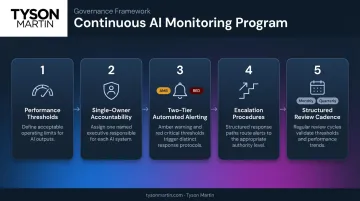
A metric without a trigger is just a record. Tie every monitoring output to a named decision right and a required action — or it won't drive behavior when it matters.
Building the Governance Structure: Board Roles, Decision Rights, and Reporting
The Board's Role
The board's job is oversight, not operations. Boards do not build AI governance frameworks. They define the expectations management is held to, receive reporting against those expectations, and intervene when risk appetite is exceeded.
Confusion about this boundary is one of the most common governance failures. When boards attempt to operate rather than oversee, they create accountability gaps at the management level. When boards stay too distant, they receive activity reports instead of risk intelligence.
Decision Rights
Build an explicit decision rights matrix that maps AI risk categories to the appropriate level of oversight:
| Risk Level | Decision Authority | Approval Requirement |
|---|---|---|
| Low risk | Management | Accept within existing policy |
| Medium risk | Executive team | Formal approval required; time-limited review |
| High risk | CEO + board committee chair | Full board escalation when thresholds are crossed |
This matrix should be tested against real escalation scenarios, not just documented. Tabletop exercises that run AI-specific scenarios — model failure, bias incident, regulatory inquiry, or third-party vendor breach — are the most reliable way to validate that the matrix holds under pressure.
Governance Structure Options
The right structure depends on the organization's AI maturity, AI risk profile, and regulatory environment:
- Existing committees (audit, risk, technology): Appropriate for organizations with limited or lower-risk AI use cases and mature committee structures already covering technology risk
- Dedicated AI oversight committee: Better suited for organizations with high-risk AI use cases, significant AI deployment at scale, or regulatory environments that require specific AI accountability
Neither structure works without a defined reporting cadence and clear decision rights — which makes the design of board reporting as consequential as the structural choice itself.
What Board Reporting Should Look Like
Boards need a stable dashboard that shows trend, not trivia. A well-designed AI governance report includes:
- A plain-English risk posture summary — what is the current state and what changed since the last briefing
- Key metrics against defined thresholds with trend lines showing quarter-over-quarter movement
- Top risks with named owners and target states
- Escalated incidents or near misses, including those involving third-party vendors
- Decisions required from the board — not just updates
Avoid the trap of reporting activity (number of AI projects underway) rather than risk position. A board that knows how many AI projects are running but doesn't know their risk classification has no useful oversight capability.
When Fractional or Interim Leadership Fills the Gap
Organizations in transition — new leadership, post-incident, or scaling AI rapidly — often face a timing problem: AI is already deployed faster than governance infrastructure can catch up. Bringing in an experienced fractional executive, such as a fractional CISO or board advisor with AI governance expertise, can compress a six-month build to six weeks. The first 30–90 days can be used to inventory AI systems in use, assign risk classifications, establish decision rights, and build the board reporting cadence — before a permanent governance structure is fully operational. That sequence matters: governance built after deployment is damage control; governance built alongside deployment is how oversight actually works.
Navigating the Global Regulatory Landscape
The Core Frameworks
US organizations operating across jurisdictions need to align to multiple frameworks simultaneously:
| Framework | Scope | Type |
|---|---|---|
| NIST AI RMF 1.0 | Govern, Map, Measure, Manage AI risks | Voluntary US baseline |
| EU AI Act | Risk-based categories, prohibited uses, high-risk obligations, extraterritorial reach | Binding EU law |
| ISO/IEC 42001 | AI management system requirements | Auditable international standard |
| OECD AI Principles | Trustworthy AI principles, updated 2024 | International policy alignment |
| Singapore MAS Veritas | FEAT evaluation for financial AI solutions | Financial sector reference |
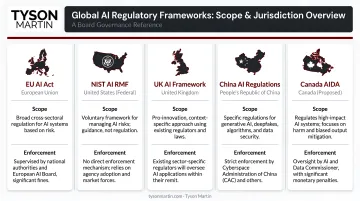
The EU AI Act's extraterritorial reach has direct implications for US organizations. It applies to any provider placing AI systems on the EU market regardless of where they are established — and to any third-country provider when AI output is used in the EU. A US company whose model produces recommendations consumed by EU customers may already be subject to EU AI Act obligations.
The Cross-Border Compliance Challenge
Meeting NIST AI RMF guidance does not satisfy EU AI Act high-risk system requirements. The two frameworks overlap in intent but diverge significantly in obligation. Meta's 2024 pause on launching AI features in Europe makes the stakes concrete: the Irish privacy regulator requested a delay over data-governance concerns, halting deployment entirely despite compliance with other frameworks.
The lesson is straightforward: framework compliance in one jurisdiction does not transfer.
Multinational organizations need regulatory mapping embedded in governance architecture before any AI system reaches deployment, not retrofitted after the fact.
What Boards in Regulated Industries Should Ask
Boards in financial services, healthcare, and retail face sector-specific AI guidance on top of general frameworks:
- Financial services: CFPB adverse-action requirements, OCC model risk guidance
- Healthcare: HHS Section 1557 nondiscrimination rules, ONC HTI-1 transparency requirements
- Consumer protection: FTC guidance on AI claims, data use, and vendor oversight
The right board question is: Does a regulatory horizon-scanning function exist, and are our AI systems currently classified against applicable risk taxonomies?
Common Pitfalls and How to Future-Proof Your Framework
The most common governance failure is treating governance as a documentation exercise. A framework that cannot be inspected — where no one can verify that controls are actually working — provides the appearance of oversight without the substance. PwC's 2025 Responsible AI survey found that only 33% of organizations have reached an "embedded" Responsible AI maturity stage. The gap between policy and operational reality is where regulatory exposure lives.
Agentic AI outpacing governance models. Current governance frameworks were designed for narrow AI applications that produce recommendations. Agentic AI systems that take actions — scheduling, purchasing, communicating on behalf of the organization — require governance models that account for continuous autonomous behavior, not periodic audits. Gartner forecasts that over 40% of agentic AI projects will be canceled by end-2027 due to escalating costs, unclear business value, or inadequate risk controls.
Organizations should begin mapping which AI systems are moving toward autonomous action before governance catches up after the fact.
What a sustainable framework actually requires:
- Named owners for every AI system and every governance control
- Measurable outcomes tied to defined thresholds — not vague descriptors
- A defined review cadence that makes drift visible before it becomes a crisis
- Escalation thresholds that hold under real pressure, not just tabletop conditions
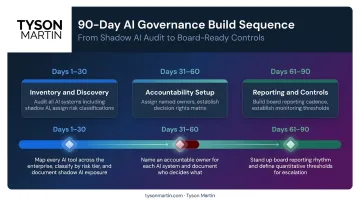
Those requirements only hold if execution starts before the documentation does. In the first 90 days, begin with an inventory of all AI systems currently in use — including shadow AI deployed without central oversight. Classify each by risk level. Assign named owners. Establish the board reporting cadence. Build comprehensive policy documentation after the foundation is operational, not before.
Frequently Asked Questions
What is a global AI governance framework?
A global AI governance framework is the integrated system of policies, accountability structures, oversight mechanisms, and technical controls that governs how AI is developed, deployed, and retired across an organization's global operations and vendor relationships. It is not a compliance checklist. It is the operational structure compliance programs are built on.
How is AI governance different from AI compliance?
Compliance answers whether you're meeting minimum legal requirements. Governance answers whether you're making responsible AI decisions that will hold up under scrutiny from regulators, courts, and the public. Governance is the foundation; compliance is what you demonstrate once that foundation exists.
What role should the board of directors play in AI governance?
The board's role is oversight — not operations. Boards define the expectations management is held to, receive reporting against those expectations, and intervene when risk appetite is exceeded. Building and managing governance programs is a management function, not a board function.
Which AI regulatory frameworks should US organizations follow?
Start with the NIST AI RMF as your US baseline, then add EU AI Act obligations if you have European market exposure. ISO/IEC 42001 provides an auditable management-system structure, and sector-specific guidance from the CFPB, OCC, HHS, or FTC applies depending on your industry.
What are the biggest challenges in building a global AI governance framework?
The hardest problems are fragmented regulatory requirements across jurisdictions, AI innovation outpacing governance infrastructure, and frameworks that exist on paper but cannot be inspected in practice. That last one is the most dangerous — it creates the appearance of oversight without the substance.
Where should an organization start when building an AI governance framework?
Begin with an inventory of all AI systems in use, including those deployed without central oversight. Classify each by risk level, assign named owners, and establish a board-level reporting cadence before building policy documentation. The inventory typically reveals that AI deployment is far broader than leadership realized.