Introduction: AI Governance Without Structure Is Just a Policy Document
Picture this: an AI system flags a job applicant as high-risk and removes them from consideration. A complaint lands. The CHRO asks who approved the model. HR points to IT. IT points to the vendor. Legal didn't know the system existed. Nobody owns it.
This isn't a hypothetical. It's the pattern that emerges when organizations treat AI governance as a documentation exercise rather than an organizational design problem.
According to Microsoft's 2024 Work Trend Index, 75% of knowledge workers now use AI at work, while 60% of leaders say their organization lacks a vision and plan to implement it. Adoption is running well ahead of accountability.
The organizations that hold up under regulatory scrutiny aren't the ones with the longest AI ethics statements. They're the ones with structure: defined owners, clear decision rights, and execution that can actually be inspected when a real incident hits.
This article breaks down what that structure looks like — and how to build it before you need it.
Key Takeaways
- Most organizations have AI policies; few have the structural accountability to enforce them
- 78% of AI users bring their own tools to work — a structural failure that policy alone won't fix
- Effective AI governance requires five elements: executive ownership, a cross-functional body, an AI inventory, an audit trail, and defined escalation paths
- The board's job is oversight — risk appetite, framework approval, and asking the right questions — not approving individual deployments
- Working governance is inspectable: documented approvals, logged escalations, and board reports tied to real operational data
Why Organizational Structure Is the Missing Layer in AI Governance
Most AI governance conversations start with frameworks — NIST AI RMF, ISO 42001, the EU AI Act. These are useful maps. But maps don't drive themselves.
The harder question is: who inside your organization is responsible for executing against those frameworks? And the answer, in most organizations, is nobody specific.
The Accountability Gap Is Documented
PwC's 2025 Responsible AI survey found 49% of organizations struggle to translate responsible AI principles into operational processes. Principles are easy to publish. Operationalizing them requires roles, workflows, and someone whose job it is to enforce them.
Three structural failures tend to follow:
- Shadow AI use without oversight — 78% of AI users bring their own tools to work, often without IT or legal awareness
- Unclear escalation when an AI system produces a harmful or biased output
- Vague board reporting because no one owns the underlying data
Each failure traces back to the same root cause: the organization has a policy, but no structure to back it up.
Governance by Policy vs. Governance by Structure
| Governance by Policy | Governance by Structure |
|---|---|
| States what the organization values | Assigns named owners |
| Sits in a document | Creates audit trails |
| Describes ideals | Defines what happens when something breaks |
| Passes a compliance checkbox | Holds up under regulatory scrutiny |
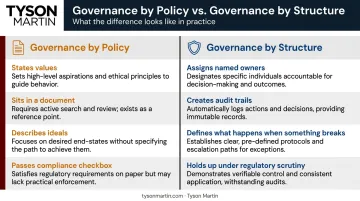
AI specifically demands structural clarity in a way previous technology waves didn't. AI systems make decisions autonomously, update behavior over time, and operate across functions simultaneously. The traditional IT governance model — siloed, reactive, ticket-based — is structurally incompatible with that profile. The question isn't whether your frameworks are sound. It's whether anyone is structurally accountable for executing them when something goes wrong.
The Key Structural Elements Every AI Governance Program Needs
A working AI governance program isn't a committee and a policy document. It has five concrete structural components.
1. An Executive Owner With Explicit Authority
Assigning AI governance to an existing committee dilutes accountability. Shared accountability means no accountability when something goes wrong.
A named individual (whether a Chief AI Officer, CISO, CIO, or CDO) must hold the program's outcomes. That person's name should appear in the governance framework, the incident escalation path, and the board report.
Organizations without a full-time executive in this role often bring in a fractional CISO or board advisor to build the structure before a permanent hire is made. The point is that someone named must own it — not a committee, not a shared inbox.
Tyson Martin's AI Governance Starter Pack is designed specifically for this transition: a 30-day sprint that produces a decision-rights map, an AI risk assessment, and board-level policy before a permanent executive is in place.
2. A Cross-Functional Governance Body With Real Authority
This isn't a quarterly review committee. It needs real decision authority over:
- AI risk classifications
- Deployment approvals for high-risk systems
- Escalation responses when incidents occur
Minimum representation: legal, risk, technology, affected business lines, and internal audit. If internal audit isn't at the table, there's no independent check.
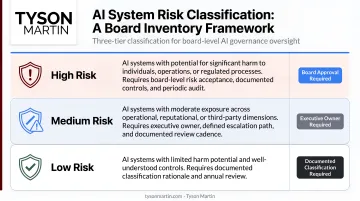
3. An AI Inventory, Classified by Risk Level
Oversight of AI systems you don't know exist is theoretical. Every governance program needs a current map of what AI systems the organization uses or is building, with each system classified by risk level.
A practical tiering approach:
- High-risk: Systems that influence lending, hiring, healthcare decisions, or law enforcement — these require the most rigorous oversight
- Medium-risk: Systems that affect customer experience or operational workflows with meaningful downstream impact
- Lower-risk: Internal productivity tools with limited decision authority
Classification drives the level of oversight, documentation, and approval required. NIST AI RMF GOVERN 1.6 specifically calls for mechanisms to inventory AI systems, resourced by risk priority.
4. Documentation and Audit Trails
Documentation serves internal accountability as much as regulatory compliance. An inspectable record should answer:
- Who approved a model for deployment?
- What risks were identified and assessed?
- What controls were applied?
- Who reviewed it, and when?
The FTC's enforcement action against Rite Aid illustrates what the absence of this looks like. After alleged deployment of AI facial recognition without adequate safeguards — resulting in consumers being incorrectly flagged as security risks — the FTC imposed a five-year ban on facial recognition use and mandated annual board-level reporting, pre-deployment assessments, and long-term recordkeeping. The remediation requirements essentially imposed the governance structure the organization should have had before deployment.
That pattern — regulators mandating what internal governance should have prevented — is exactly what the fifth element is designed to avoid.
5. Defined Escalation Paths
A governance structure without escalation paths is an organizational dead end. When an AI system produces a biased output, triggers a regulatory inquiry, or causes a data exposure, the escalation chain must already exist with time thresholds and decision authority assigned at each level.
Pre-agreed escalation means the organization doesn't spend the first hours of an incident figuring out who's in charge.
Defining Decision Rights: Who Decides What, and When
Decision rights are the operational core of AI governance. Without them, governance bodies stall, individuals freelance, and risk accumulates in the gaps between teams.
Decision rights for AI aren't just org charts. They're explicit assignments of who has authority to approve, escalate, block, or retire an AI system — documented before an incident forces the question.
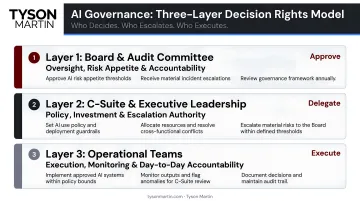
A Practical Three-Layer Model
Board level — decisions about:
- Risk appetite for AI use across the organization
- Governance framework design and approval
- Material AI incidents that cross defined thresholds
- Open questions that require director-level input
C-suite level — decisions about:
- AI strategy and deployment thresholds
- Cross-functional policy
- Vendor AI system approvals above defined risk tiers
- Escalations that cross from team-level to executive-level
Operational teams — responsible for:
- Model selection within approved parameters
- Vendor assessments for lower-risk tools
- Day-to-day monitoring and reporting
Blurring these layers creates either micromanagement or abdication — and either way, accountability disappears.
The Escalation Threshold Question
Governance structure must specify when a risk moves up the chain. Examples of triggers that should be pre-defined:
- An AI model producing discriminatory outputs at scale → executive-level, board-level if outputs affect protected classes or trigger regulatory exposure
- A vendor AI system involved in a data breach → executive-level minimum, board notification if material
- A regulatory inquiry related to AI use → legal and executive immediately, board within defined timeframe
- An AI system behaving outside its intended parameters → operational escalation with time threshold for executive notification
Organizations that have been through leadership transitions, M&A, or major incidents often discover their decision rights were never formally defined for AI — they existed informally or were assumed.
In regulated industries, regulators expect to see documented accountability. "We assumed the CISO owned it" is not a defensible answer to an OCC examiner or an FCA review.
What the Board's Role in AI Governance Actually Looks Like
The board should not be approving individual AI deployments. That's management's job. Boards that drop into operational detail on AI are usually doing it because the business issue was never made clear at the right level: a reporting failure, not a governance feature.
The board's actual role:
- Set risk appetite: what types of AI use are acceptable, and at what threshold do they require escalation?
- Review governance framework design to confirm accountability is clearly assigned.
- Monitor material AI risks and open exposures that require board input.
- Ensure executive accountability: a named owner, properly resourced.
What Good Board-Level AI Reporting Looks Like
This is not a technology briefing or a jargon-heavy vendor presentation. Effective board-level AI reporting covers five things:
- Current AI risk posture and where the organization stands
- What changed since the last briefing (not a static snapshot)
- Material incidents or near-misses, including those involving third-party AI systems
- Compliance status against applicable frameworks: EU AI Act, NIST AI RMF, and sector-specific requirements
- Open decisions that require board input
Tyson's board reporting approach is built around this structure: stable dashboards that show trend, not trivia, with every metric tied to a target, a trend, and a trigger. The board should be able to ask a governance question and get a documented answer, not a verbal assurance.
Five Questions Boards Should Be Asking Management
- Do we have a current AI inventory, covering every system classified by risk?
- Who owns AI governance at the executive level, by name?
- How are high-risk AI systems identified, reviewed, and approved before deployment?
- What is the escalation path when an AI system causes harm or triggers a regulatory flag?
- How are we tracking compliance obligations against specific owners?
Most boards aren't close to being able to answer these. Deloitte's 2024 survey of board members and C-suite executives found AI had not appeared on the agenda for 45% of boards, and 79% reported limited or minimal board AI knowledge. Boards that can't ask these five questions are operating with a material blind spot.
Signs Your AI Governance Structure Is Working — Not Just Documented
The difference between governance on paper and governance in practice is observable. A functioning governance structure produces outputs you can see and verify.
Indicators that governance is working:
- AI incidents are escalated and resolved within documented timeframes, with resolution records to match
- New AI deployments clear a documented approval process with named approvers and recorded risk assessments
- The AI inventory is current, classified, and reflects actual deployment — not what was planned 18 months ago
- Compliance obligations carry named owners, not a collective assignment to "the team"
- The board asks a governance question and receives a specific, documented answer — not a verbal reassurance
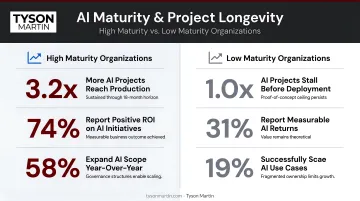
Gartner's 2025 research found that 91% of high-AI-maturity organizations had dedicated AI leaders, and those organizations kept 45% of AI projects operational for three or more years compared to 20% in low-maturity firms. For boards and executive teams, that gap is the difference between AI that delivers and AI that quietly gets abandoned.
When governance exists only on paper, the pattern is consistent: approvals happened informally, escalation logs are empty, inventories don't match actual deployment, and board reports describe what the policy says rather than what operations show.
Frequently Asked Questions
What is the difference between AI governance and AI risk management?
AI governance is the structural framework — roles, policies, decision rights, and oversight mechanisms. AI risk management is one function within that framework: the process of identifying, measuring, and mitigating specific threats. Governance establishes who has authority to act on risks and how; risk management identifies what those risks are.
Who should own AI governance in an organization?
A named executive must hold accountability: CISO, CIO, CDO, or a Chief AI Officer, depending on organizational structure and AI maturity. Organizations without a full-time executive in this role often use a fractional executive or board advisor to establish structure before a permanent appointment.
What does a board need to ask management about AI governance?
Five questions cover the essentials:
- Is there a current AI inventory?
- Who owns governance by name?
- How are high-risk systems reviewed before deployment?
- What is the escalation path when an AI system causes harm?
- Are regulatory compliance obligations tracked against specific owners?
How do you know if your AI governance structure is actually working?
Look for inspectable outputs: documented deployment approvals with named owners, logged escalations with resolution records, a current AI inventory with risk classifications, and board reporting that reflects real operational status rather than policy statements.
What's the first step for an organization with no AI governance structure?
Start with an AI inventory (what systems are in use, who uses them, what decisions they influence) and assign a named executive owner. These two actions create the foundation on which policy, risk management, and board reporting can be built.
How does AI governance differ from traditional IT governance?
AI systems are autonomous, adaptive, and operate across functions simultaneously — unlike traditional IT assets, which are static and siloed. This requires governance structures that are dynamic, cross-functional, and focused on decision accountability rather than access control and change management. A helpdesk ticket model doesn't work for a system that makes decisions on its own.