That gap isn't an IT problem. It's a board accountability problem — and regulators are starting to treat it that way. The SEC charged two investment advisers in 2024 for misleading AI claims, resulting in $400,000 in combined civil penalties. The FTC banned Rite Aid from using facial recognition for five years after finding the company deployed the technology without reasonable safeguards. In both cases, the absence of governance was itself the finding.
The divide isn't between organizations that use AI and those that don't. It's between those that can see and govern their AI and those flying blind. This article gives boards and executives a practical framework to close that gap.
Key Takeaways
- Most boards discuss AI but lack formal oversight structures — agenda time is not governance
- Strategic visibility means leadership can see what AI is running, what data it touches, and whether it's operating within approved parameters
- Risk-based tiering focuses oversight where harm is most likely and least reversible
- AI inventory, named ownership, and documented escalation paths form the minimum viable governance posture
- AI governance belongs inside existing risk and cybersecurity frameworks, not parallel to them
What AI Governance Actually Means for Business Leaders
AI governance is the set of decision rights, controls, and accountability structures that determine who can deploy AI, how its risks are managed, and what the board can reliably see and act on. That definition matters because it's different from a "responsible AI" ethics statement — those are policy positions. Governance is an operating control.
The distinction matters in practice. Ethics principles don't stop a model from drifting. A vendor that changed its AI behavior between releases won't be caught by a values statement. And when a regulator requests an audit trail, principles don't produce one.
Why Traditional IT Governance Falls Short
AI governance is structurally different from governing traditional software. Three properties make static policies and periodic audits inadequate:
- AI systems learn and drift — a model approved in January may behave differently by July, even without a deliberate change
- Probabilistic decisions at scale — AI doesn't apply a rule; it makes a probabilistic judgment across thousands of decisions simultaneously, meaning errors compound before anyone notices
- Context sensitivity — the same system may behave acceptably in one population and produce biased outcomes in another
Regulators have absorbed this. The EU AI Act (Regulation EU 2024/1689) now requires high-risk AI providers to maintain continuous risk management, data governance, logging, human oversight, and audit-ready documentation — not annual reviews. The shift is from "trust us" to "show us."
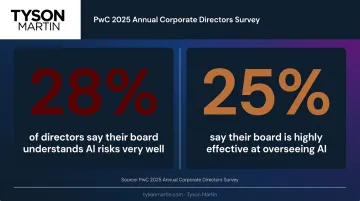
According to PwC's 2025 Annual Corporate Directors Survey, only 28% of directors say their board understands AI risks and opportunities very well, and just 25% say their board is highly effective at overseeing AI. Most boards are still governing AI the way they governed enterprise software a decade ago — and the exposure is compounding.
Why AI Governance Is Now a Board-Level Responsibility
AI isn't confined to data science teams. It's embedded in customer interactions, credit decisions, hiring workflows, fraud detection, and financial reporting. McKinsey's 2024 global survey found 65% of organizations regularly use generative AI in at least one business function. In finance, Gartner reported 58% of finance functions used AI in 2024 — up 21 percentage points in a single year.
When AI-driven decisions cause harm at that scale, regulators and courts ask a direct question: did the board provide adequate oversight? The absence of a governance structure is an answer — just not a defensible one.
The Questions Boards Must Be Able to Answer
Boards that lack formal AI oversight can't reliably answer:
- What AI systems are currently operating across the enterprise?
- What decisions are those systems influencing, and at what volume?
- Who owns accountability for outcomes when something goes wrong?
- What would we do — specifically — if a high-risk system failed tonight?
Inability to answer these isn't an IT gap. It's a governance gap.
The Shadow AI Problem
The harder version of this problem: AI often arrives without central awareness. Business units embed it in SaaS tools. Marketing teams adopt a vendor that added "AI-powered" features to its latest update. Employees use generative AI tools with company data outside any approved channel.
Cisco's 2024 Data Privacy Benchmark Study found 27% of organizations banned GenAI outright over privacy and data-security concerns — largely because employees were entering non-public company data and internal process information into external tools. That's shadow AI exposure, and the risks compound across three fronts:
- Unmonitored data access — sensitive information entering external systems with no visibility
- Unreviewed vendor terms — contractual data rights accepted without legal or risk review
- No named owner — when something breaks, accountability is unclear and response is slow
Boards that establish governance before an incident have the standing to ask these questions. Those that don't are left explaining why they didn't.
The Strategic Visibility Gap: You Can't Govern What You Can't See
Strategic visibility is leadership's ability to see which AI systems are operating, what data they're using, what decisions they're influencing, and whether those systems are performing within acceptable parameters. This is distinct from technical monitoring, which is what IT teams track in logs and dashboards.
Boards need visibility across four dimensions:
| Dimension | What It Covers |
|---|---|
| Operational | Where AI is deployed and what it's doing |
| Risk | What could go wrong and what the exposure is |
| Compliance | Whether AI decisions can be explained and defended |
| Business | Whether AI is actually serving strategic objectives |
What "No Visibility" Looks Like in Practice
Visibility failures aren't dramatic. They're quiet and cumulative:
- Model drift that nobody detects until a pattern of bad decisions surfaces
- Bias that compounds over months in hiring or credit decisions
- AI outputs that conflict with business policy, with no mechanism to catch them
- A regulatory inquiry that exposes gaps in audit trails nobody knew were missing
The failure mode doesn't announce itself. It accumulates.
Governance Without Visibility — and Vice Versa
Two partial governance states are worth naming:
- Governance without monitoring: The policy defines what should happen, but no one can confirm it's happening
- Monitoring without governance: IT sees the alerts, but no one has the authority or accountability to respond
- Both without integration: Risk accumulates in the gap between the two functions
Effective oversight requires both working together. Governance defines what should happen. Visibility confirms what is happening.
The Board-Level AI Visibility Report
Leadership should receive AI status through a stable, executive-readable summary focused on trend information, not raw technical data. A board-level AI visibility report should include:
- AI system inventory and status — what's running, who owns it, last review date
- Active risk flags — systems showing performance degradation or compliance concerns
- Compliance indicators — audit readiness status for regulated AI applications
- Threshold exceptions — any decisions that exceeded defined parameters since the last report
The difference between a report boards use and one they file away is specificity: flagged items with owners, thresholds that were set in advance, and enough context to make a decision without convening a technical briefing first. That's the standard Tyson Martin's board advisory engagements are designed to meet.
Risk-Based Classification: Proportional Oversight for AI Systems
Not all AI carries the same risk. Treating a customer service FAQ bot with the same governance intensity as an AI-driven credit decision wastes resources and creates compliance theater. Risk-based tiering focuses oversight where it matters most.
A Practical Three-Tier Model
Classify each AI system using four criteria:
- Customer impact — who is affected and how severely
- Data sensitivity — what information the AI accesses or produces
- Reversibility — can a bad decision be corrected, or is the harm already done?
- Degree of automation — is a human in the review loop, or not?
| Tier | Description | Oversight Requirements |
|---|---|---|
| Low risk | Internal tools, content suggestions, low-stakes automation | Basic inventory, periodic review |
| Medium risk | Customer-facing tools, moderate data access, some automation | Named owner, performance monitoring, human review thresholds |
| High risk | Credit decisions, hiring, fraud detection, regulated outputs | Continuous monitoring, audit trails, escalation protocols, board-level awareness |
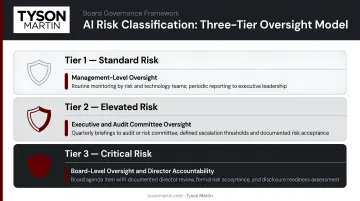
The EU AI Act's Annex III identifies high-risk categories including biometrics, employment decisions, credit and essential services, law enforcement, and healthcare. If your AI system touches any of these domains, it warrants tier-three treatment regardless of how it was scoped or sold to your organization.
Getting the classification right is a prerequisite for everything that follows — monitoring cadence, audit trail requirements, and how much board visibility each system deserves.
What Board-Ready AI Governance Actually Looks Like
The AI Inventory
The foundation of any AI governance program is a centralized register documenting every AI system in use — including AI embedded in vendor and SaaS platforms. Each entry should capture:
- Business owner (named individual, not a team)
- Business purpose and the decisions it influences
- Data accessed and sensitivity level
- Risk tier
- Human oversight model (in-the-loop vs. on-the-loop)
- Compliance status and last review date
According to NACD's 2025 data, only 21% of boards had audited their current AI use. Without an inventory, governance is aspirational. With it, governance has a foundation.
Decision Rights
Decision rights are the governance mechanism boards most consistently overlook. Clarity requires answering:
- Who can approve a new AI deployment?
- Who can modify an AI system already in production?
- What triggers escalation to the board versus what management handles independently?
Boards that haven't defined these rights will discover them for the first time during an incident — which is the worst possible moment to figure it out. That gap connects directly to the next question: once a decision is made, who actually watches what happens next?
Human Oversight Thresholds
High-risk AI requires human-in-the-loop controls: a human must review, approve, or override the AI's output before it takes effect. Lower-risk systems may operate with human-on-the-loop monitoring, where a human can intervene but isn't required to approve each decision.
Either way, the threshold must be explicit, documented, and auditable — not assumed.
Audit Trails
Audit trails are what regulators will inspect. For high-risk systems, records must capture: inputs, outputs, model version at the time of the decision, decision context, and who was notified. The FTC's Rite Aid action illustrated what happens when those records don't exist — no trail means no defense.
For boards, that means asking management not just whether audit trails exist, but whether they're retained long enough and structured in a way that would hold up under regulatory scrutiny.
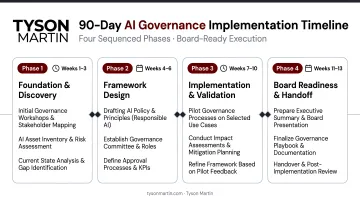
Building Your AI Governance Foundation in 90 Days
Don't wait for a perfect framework. The first 90 days should produce four concrete outputs:
- A complete AI inventory — every system, including vendor AI, with basic attributes captured
- A risk tier assigned to every system — using the criteria above
- A named business owner for each system — not a technical contact, a business owner
- At least one documented escalation path for every high-risk AI system
That's the minimum viable governance posture — not comprehensive, but sufficient to make decisions, assign accountability, and respond when something goes wrong.
The Sequenced Steps
Here's how to sequence the work to hit all four outputs by day 90.
Weeks 1-3 — Inventory: Review all tools, SaaS vendors, and internal workflows. Surface where AI is operating, including embedded vendor features.
Weeks 4-5 — Classify: Apply the three-tier model. A reasonable tier applied consistently beats perfect tiering applied inconsistently.
Weeks 6-7 — Assign ownership: Every AI system gets a named business owner who can answer for outcomes.
Weeks 8-12 — Define thresholds: Specify what triggers human review and what triggers board notification. Document it. Test it against a hypothetical scenario.
One objection worth addressing: formal governance slows AI adoption. The opposite is true. Organizations with defined approval processes deploy AI faster than those where every deployment triggers an ad hoc debate about whether it's allowed. Clear guardrails accelerate responsible adoption.
Connecting AI Governance to Your Existing Cyber and Risk Framework
AI governance should not be a standalone program. Boards already have risk registers, audit schedules, vendor management processes, and escalation protocols. AI risks belong inside those structures — not running parallel to them.
The specific integration points:
- AI handling sensitive data → falls under existing data governance and privacy programs
- AI vendor relationships → fall under third-party risk management; vendor AI capabilities need the same scrutiny as any other data access
- AI system failures → fall under incident response and business continuity frameworks
- AI compliance exposures → fall under legal and regulatory reporting
The cybersecurity governance maturity journey is a useful model. A decade ago, boards accepted "we have a firewall" as a meaningful security assurance. Today, boards expect defined security programs with measurable controls, regular reporting, and board-level metrics.
AI governance is on the same trajectory. Organizations that have already built cybersecurity governance muscle can apply that same discipline to AI without starting from scratch.
COSO's AI guidance, co-authored with Deloitte, is designed precisely to help organizations align AI risk management with enterprise risk management strategy and execution using existing COSO ERM principles. The architecture is already there — and extending it to cover AI means new inventory items, updated risk criteria, and an expanded vendor questionnaire, not a new governance layer running alongside the existing one.
Frequently Asked Questions
Frequently Asked Questions
What are the 4 pillars of responsible AI?
The most recognized pillars are fairness, accountability, transparency, and safety/reliability. These translate into governance through specific operational controls: bias monitoring, named ownership, explainability requirements, and performance testing — all of which must be verifiable by an auditor, not just stated in a policy.
What are the 5 pillars of trustworthy AI?
NIST identifies seven trustworthy AI characteristics: validity, safety, security, accountability, explainability, privacy, and fairness. Rather than navigating multiple competing frameworks, organizations should select one authoritative framework and apply it consistently across all AI systems.
What are the 4 pillars of data governance?
Data quality, data security, data accountability/stewardship, and data compliance. These matter directly to AI governance because AI systems are only as reliable and auditable as the data flowing through them — bad data governance produces AI outputs that can't be explained or defended.
What is the 10-20-70 rule for AI?
According to BCG, AI success comes roughly 10% from algorithms, 20% from data and technology, and 70% from people, processes, and organizational change. The governance implication: most AI governance failures are organizational, not technical.
What is the difference between AI governance and AI risk management?
Governance defines the structure — who owns AI decisions, what controls exist, how accountability flows. Risk management identifies and mitigates what can go wrong within that structure. Both are necessary — neither functions without the other.
How should a board oversee AI risk without deep technical expertise?
Boards don't need to understand models — they need to understand outcomes, accountability, and escalation. Three questions at every board cycle cover the essentials: What AI systems carry our highest risk? Who owns them? What would trigger a report to this board?