Introduction
AI governance is no longer a strategy document — it carries enforcement mechanisms, compliance deadlines, and personal accountability for the executives and directors who get it wrong.
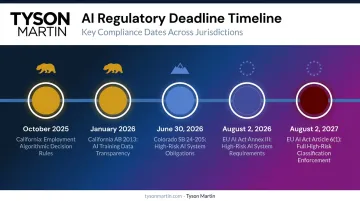
The EU AI Act enters full effect in August 2026, Colorado's AI law has a compliance deadline of June 30, 2026, and California's automated employment decision regulations took effect in October 2025. Boards and executive teams that treated AI governance as a future priority now face concrete compliance deadlines and personal liability exposure.
According to IBM's 2025 Cost of a Data Breach Report, 63% of organizations lack formal AI governance policies, and 97% of those that experienced an AI-related security incident lacked proper AI access controls.
The oversight gap runs to the top. Deloitte's 2025 survey of 695 board members and C-suite executives across 56 countries found that 66% of boards have limited to no AI knowledge or experience.
Four trends are defining what AI governance must actually look like in 2026 — spanning regulatory compliance, board oversight, procurement accountability, and agentic AI risk.
Key Takeaways
- AI regulation is legally enforceable in 2026 — and shadow AI has become a direct compliance liability, not just an IT headache.
- Auditors now require verifiable technical documentation (model cards, data lineage), not policy statements.
- Explainability is now a standard operational requirement for AI driving high-stakes decisions in regulated sectors.
- Expect regulators to treat continuous model drift monitoring as a baseline requirement, not a best practice.
Trend 1: AI Regulation Maturity and the Rise of Shadow AI
The Regulatory Landscape Has Changed
The shift from voluntary frameworks to legally enforceable obligations is now complete in several jurisdictions. Key deadlines organizations must track:
- EU AI Act — Annex III high-risk AI rules apply from August 2, 2026; Article 6(1) product-safety regime rules follow on August 2, 2027
- Colorado SB24-205 — compliance required by June 30, 2026, covering deployers of high-risk AI systems with algorithmic discrimination protections, impact assessments, and annual reviews
- California — AB2013 requires generative AI training data documentation as of January 1, 2026; employment automated-decision regulations effective October 1, 2025
- New York — NYC's automated employment decision tool rules are in force; state-level A8884 was in committee as of early 2026
Under the EU AI Act's Article 26, deployers of high-risk AI systems must monitor operations, retain logs for at least six months, notify affected individuals, and ensure input data is relevant and representative. Auditors will check for evidence of each requirement. Organizations that treat these as aspirational will find that defense does not hold.
Shadow AI Is Now a Compliance Gap
Those regulatory obligations assume organizations know what AI tools are in use. Many do not. Shadow AI — employees adopting chatbots, productivity assistants, and coding tools outside approved IT channels, without security review or governance documentation — is where that assumption breaks down.
KPMG's 2025 Trust in AI study, covering over 48,000 people across 47 countries, found:
- 57% of employees hide AI use and present AI-generated work as their own
- Nearly half use AI in ways that contravene company policies, including uploading sensitive data into public tools
- Only 40% of workplaces have generative AI policies or guidance
This is no longer just an IT problem. If an organization cannot inventory what AI tools employees are using, it cannot document what it does not know exists. Regulators will treat that gap as a compliance failure — and the KPMG data suggests most organizations are nowhere close to closing it.
The Board Question
That compliance gap lands squarely in the boardroom. Boards overseeing regulated organizations should ask management directly: Does a current AI system inventory exist? Who owns it? How is shadow AI adoption being detected?
If management cannot answer those questions, the organization is exposed — not because something went wrong, but because no one was watching.
Trend 2: Audit Expectations Shift to Technical Evidence
From Policy Statements to Verifiable Documentation
Where auditors once accepted high-level policy statements about responsible AI, 2026 standards require something different: verifiable, technical documentation that can be examined, version-controlled, and independently validated.
McKinsey's survey of more than 750 leaders across 38 countries placed average responsible-AI maturity at 2.0 on a 0-to-4 scale — meaning most organizations are nowhere near the documentation standards now expected. That middle ground is where regulatory requirements are landing.
What Model Cards Are — and Why They Matter
A model card is a standardized document that travels with a trained AI model. Standard sections include:
- Model details (architecture, version, developer)
- Intended use cases and out-of-scope uses
- Performance benchmarks across relevant conditions
- Known limitations and failure modes
- Training data characteristics and evaluation data
The NIST AI Risk Management Framework Playbook references model cards and datasheets explicitly, recommending standardized documentation covering business justification, scope, risks, assumptions, limitations, and algorithmic methodology.
Under the EU AI Act, technical documentation for high-risk AI systems is required under Article 11 and Annex IV before deployment. Model cards have moved from optional artifact to required audit evidence.
Data Lineage: The Input Side of Model Integrity
Data lineage is the documented trail of where a model's training data came from, how it was transformed, who had access to it, and how it flows through the model. NIST AI 600-1 recommends documenting data provenance across:
- Sources, origins, and transformations
- Augmentations and labels
- Dependencies and metadata
You cannot certify the integrity of a model's output without understanding its inputs. For high-risk AI systems, that chain of custody is now entering audit scope.
Organizational Infrastructure Requirements
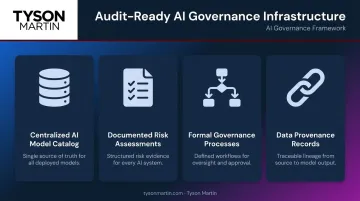
Companies building toward audit readiness need:
- Centralized AI model catalogs that track versions and ownership
- Documented risk assessments for each model
- Formal governance processes for model changes
- Data provenance records tied to each training dataset
Organizations without internal capacity to build this infrastructure are increasingly working with fractional CISOs or board-level technology advisors to establish these frameworks before audit pressure creates urgency. Tyson Martin's AI Governance Starter Pack is a 30-day sprint designed for exactly this situation: it delivers an AI risk assessment, decision-rights map, and board-level policy for organizations that need to move from no formal governance to a defensible posture quickly.
Trend 3: From Visibility Gaps to Deep Model Understanding
What Explainability Means at the Board Level
Explainability is the ability to describe, in plain language, why an AI system reached a particular decision and which factors most influenced that outcome. This is not a technical luxury — it is a standard operational requirement wherever AI is used in high-stakes decisions.
Current regulatory expectations by domain:
| Domain | Requirement |
|---|---|
| Credit scoring | CFPB Circular 2022-03 requires specific adverse-action reasons even for complex algorithm-driven credit decisions |
| Insurance underwriting | NAIC AI Model Bulletin requires governance, documentation, and controls for adverse consumer outcomes |
| HR / employment | NYC AEDT rules require bias-audit summaries; EEOC guidance covers ADA screening obligations |
| Healthcare | FDA transparency principles require communication of information that could impact patient risks and outcomes |
The Methods Regulators Are Watching
Organizations are integrating several tools to meet explainability expectations:
- SHAP and LIME — identify which variables drove a specific AI decision
- Counterfactual analysis — answers "what would have changed this outcome?"
- Model documentation — records design choices, training data, and known limitations
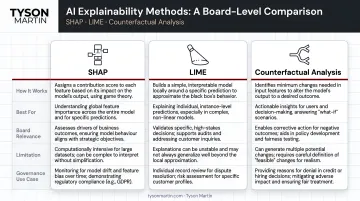
The BIS has cited SHAP and LIME as examples used to explain credit assessment outputs. Regulators have not mandated specific tools, but they do expect a clear, auditable account of how any high-risk AI decision was reached.
That explanatory capacity must be built into production pipelines — not reconstructed after the fact when an adverse outcome is challenged.
The Board Question
For any high-risk AI application in use today, boards should ask management one question: Can we explain this AI's decision to a regulator, a judge, or a customer who was adversely affected?
The follow-up matters just as much: Is that capability already built in, or would we be starting from scratch if someone asked tomorrow?
Trend 4: The Rise of Continuous AI Quality Assurance
Model Drift: What It Is and Why It Happens
AI systems trained on historical data do not automatically stay accurate as the real world changes. Model drift describes what happens when the data coming into a model in production no longer matches the data it was trained on — accuracy declines, often gradually and without any alert.
Two forms matter for governance:
- Data drift — the statistical characteristics of incoming data change (applicant demographics shift, customer behavior changes)
- Concept drift — the relationship between inputs and outcomes changes over time (what once predicted loan default no longer does)
A practical example: a loan approval model trained on pre-recession data encounters a fundamentally different applicant pool during an economic downturn. The model keeps running, decisions keep generating, and accuracy keeps declining — often until the harm is already downstream.
Performance Degradation Is a Separate Risk
Models can continue operating for months while accuracy erodes without warning. A customer service AI that resolved 85% of inquiries at launch may decline to 70% as products and policies change — not because the system broke, but because the world around it did. The real risk is that degradation goes undetected long enough for material harm to accumulate.
What Continuous Monitoring Requires
Regulatory expectations are converging on this point. The EU AI Act's Article 26 requires deployers to monitor high-risk AI operation and report relevant risks to providers; Article 72 requires providers to establish post-market monitoring systems proportionate to the nature and risks of their AI. Federal Reserve SR 11-7 model risk guidance has long required ongoing monitoring for financial models, and AI systems are now squarely within that scope.
Operationally, continuous monitoring means:
- Baseline performance metrics established at deployment
- Ongoing tracking of prediction behavior across time periods and data segments
- Validation datasets capable of detecting drift before harm accumulates
- Logging sufficient to reconstruct what the model saw and decided
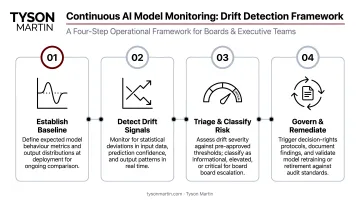
AI quality assurance is no longer a data science team concern. Poor AI quality creates material operational, legal, and reputational risk — it belongs in the enterprise risk register.
What These 4 Trends Mean for Board Oversight
AI governance has moved from a technology team responsibility to an infrastructural function embedded in how organizations operate. That means board oversight must evolve from "do we have an AI policy?" to "is our AI governance inspectable, documented, and defensible?"
Questions Boards Should Be Asking Management in 2026
- Do we have a current AI system inventory — and does it capture shadow AI adoption?
- Are our high-risk AI applications documented with model cards and data lineage?
- Can we explain AI-driven decisions to a regulator or an adversely affected individual?
- Are we monitoring for model drift and performance degradation — and what triggers escalation?
- Who is accountable when an AI system fails or causes harm?
The governance gap is real. Deloitte's 2026 State of AI in the Enterprise report, based on 3,235 senior leaders across 24 countries, found only one in five companies had a mature governance model for autonomous AI agents. That number should concern any board overseeing an organization with AI in production.
When executed well, AI governance is not a compliance tax. It becomes the connective tissue between technical teams, compliance functions, and board leadership — and organizations that build inspectable frameworks now will face significantly less regulatory friction than those scrambling to retrofit governance after an audit finding or an incident.
That gap between having AI in production and having governance that can withstand scrutiny is exactly where boards get caught. For organizations navigating leadership transitions, regulatory pressure, or accelerating AI deployment without dedicated governance capacity, a fractional CISO or board-level technology advisor can establish that infrastructure without a lengthy hiring cycle. Tyson Martin works with boards and executive teams in that position — helping them build AI risk governance they can inspect, report on, and defend when regulators or auditors ask.
Frequently Asked Questions
What is a key trend in AI governance?
The most consequential shift is AI regulation moving from voluntary guidance to enforceable law. The EU AI Act reaches full enforcement in August 2026, while Colorado, California, and New York are advancing state-level frameworks that carry verifiable technical requirements — not just policy expectations.
What is the future of AI governance?
AI governance is becoming a continuous operational discipline, not a one-time policy exercise. That means ongoing model monitoring, audit documentation, and explainability built into production systems. Regulatory frameworks will expand in scope and specificity over the next several years.
What is shadow AI and why is it a governance risk?
Shadow AI refers to AI tools adopted by employees outside formal IT approval or oversight. Organizations cannot inventory, document, or govern systems they do not know exist, creating a direct compliance gap. Regulators will treat that invisibility as an organizational failure, not an oversight.
What are model cards and why do boards need to understand them?
A model card is a standardized document capturing a model's intended use, performance metrics, known limitations, and training data characteristics. Under the EU AI Act and parallel U.S. frameworks, model cards are required audit evidence. Their existence — or absence — is a board oversight concern, not just a technical one.
How does the EU AI Act affect organizations outside the European Union?
The EU AI Act applies to any organization deploying AI systems that affect individuals within the EU, regardless of where the organization is headquartered. U.S. companies serving EU customers or operating in EU markets must comply with its documentation, transparency, and risk management requirements.
How should a board prepare for AI audit expectations in 2026?
Confirm that a current AI system inventory exists, high-risk applications have model cards and data lineage documentation, and continuous monitoring is in place. Then verify that AI governance accountability is clearly assigned and appears in the enterprise risk register, not just in a policy document.