

Introduction: The AI Governance Gap Boards Can't Afford to Ignore
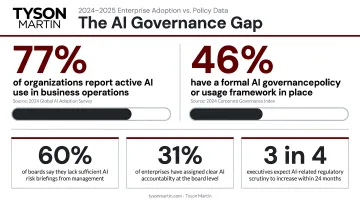
Boards are caught between two legitimate pressures: the competitive imperative to adopt AI quickly and mounting regulatory expectations that demand they prove AI systems are operating responsibly. According to McKinsey's 2024 research, 72% of organizations have adopted AI, yet only 18% have an enterprise-wide council authorized to make responsible AI governance decisions. That gap is where exposure lives.
The common response is to treat this as a technology problem: hand it to IT, procure a platform, and drop an AI policy into the compliance library. AI governance breaks down precisely because of that reflex. It's a decision-making problem. The failure point is almost always the same — no one can answer who owns this decision, what risk is acceptable here, and how the organization will know if the system is working.
ISACA's 2025 research found 70% of employees are already using AI while only 15% of organizations have formal policies. That gap means employees are making consequential AI decisions daily — without guardrails, accountability structures, or any board-level visibility into the exposure accumulating beneath them.
This article presents a practical framework for boards and executive teams: why generic governance breaks down, what contextual intelligence means for governance, and four elements that boards must own directly.
Key Takeaways
- Most organizations have deployed AI without governance structures to match — by design, not oversight
- Generic, rule-based governance fails because it ignores context: who, where, under what conditions
- Contextual intelligence adapts governance decisions to jurisdiction, role, history, and operational conditions
- Boards must own four elements: decision rights, risk thresholds tied to context, credible reporting, and escalation protocols
- Boards don't need to become AI experts—they need frameworks designed for non-technical oversight
Why Generic AI Governance Frameworks Break Down
Most organizations inherited compliance frameworks built for human decision-making—approval chains, segregation of duties, audit trails designed around people making choices. Then AI arrived, and those frameworks got extended rather than rethought.
The result is predictable. A policy that says "AI outputs must be reviewed before use" doesn't account for whether that review requirement applies to a finance analyst running sensitivity models, a procurement manager screening vendors, or a call center agent using an AI-suggested response. Same rule, vastly different risk profiles.
The Shadow AI Problem
Microsoft and LinkedIn's 2024 Work Trend Index reported that 78% of AI users bring their own tools to work. That figure illustrates what happens when governance doesn't fit the work: people route around it. They find tools that let them do their jobs, and the official framework becomes irrelevant.
When governance frameworks don't reflect operational reality, three things happen:
- Inconsistent decisions across business units as each team interprets vague policy differently
- Undocumented AI use that becomes invisible to governance teams when employees work around official tools
- Audit exposure when regulators or the board ask how AI systems operate and no one can demonstrate it credibly
The Structural Failure
NIST's AI Risk Management Framework notes that AI risks differ fundamentally from traditional software risks due to data dependency, emergent model behavior, and opacity in how decisions are made. That is a structural difference, not one you can fix by adding an AI clause to an existing compliance policy.
The failure is rarely intentional. Most organizations applied a reasonable framework to a context it was never designed for. Fixing that requires governance built around operational context — which is the core of what a risk-calibrated AI framework actually does.
What Contextual Intelligence Means in a Governance Context
Contextual intelligence, in plain terms, is a governance system's capacity to adapt its decisions based on the specific situation — not apply the same rule regardless of who's involved, what regulations apply, or what's at stake operationally.
Static governance produces friction. Context-aware governance produces defensible, auditable outcomes aligned to actual risk.
The Six Dimensions That Matter
For governance decisions to be context-aware, they need to account for six dimensions:
| Dimension | What It Captures |
|---|---|
| Organizational | Department, authority level, reporting lines |
| Regulatory | Jurisdiction, applicable framework (SOX, HIPAA, GDPR, EU AI Act) |
| Operational | Current risk conditions, transaction patterns, system state |
| Historical | Past decisions, audit findings, precedents for similar situations |
| User | Role, access rights, expertise level |
| Temporal | Deadlines, regulatory cycles, time-sensitive conditions |
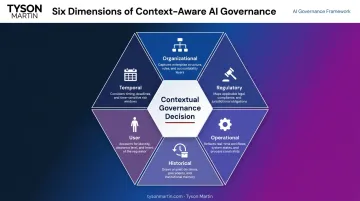
A high-value vendor transaction processed by a finance analyst in a regulated jurisdiction carries a different risk profile than the same transaction processed by an operations manager in a low-exposure context. Static governance treats them identically. Contextual governance doesn't.
Context Is a Data Quality Problem First
Governance systems can only be as intelligent as the information they draw from. That makes data quality the first constraint — not model sophistication.
Gartner projects that by 2027, 60% of organizations will fail to realize anticipated AI value due to incohesive data governance frameworks. That's not a model problem—it's a data integrity problem upstream of the model.
Boards should ask: is the data driving our governance decisions certified, current, and semantically consistent across business units? If the same vendor is classified differently in three systems, or if user roles aren't synchronized with access rights, the governance system is making decisions with bad inputs.
What This Means for Board Reporting
When governance is context-aware, board reporting shifts from reactive to diagnostic. Instead of an incident list, the board receives trend data. Instead of "here's what went wrong," the board sees "here's whether the system is working as designed" — which is the question oversight should actually be answering.
A Strategic Framework: The Four Elements of Context-Aware AI Governance
These four elements are governance disciplines, not technology features. Boards and executive teams must own them—not delegate them entirely to IT or legal.
Decision Rights and Ownership
Decision rights answer one question: who has the authority to approve AI use cases, modify risk thresholds, or override AI-generated outputs?
When decision rights are unclear, accountability gaps follow. Finance believes legal owns a regulatory AI output. Legal believes finance does. Neither acts. When a regulator or auditor asks who was responsible, the answer is uncomfortable.
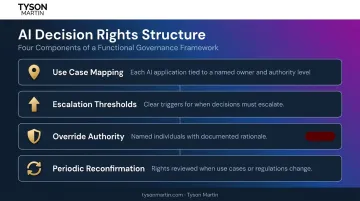
A functional decision rights structure for AI governance includes:
- Use case mapping: Each AI application tied to a specific authority level and named owner
- Escalation thresholds: Clear triggers that define when a decision must move up
- Override authority: Named individuals who can override AI-generated outputs, with documented rationale
- Periodic reconfirmation: Decision rights reviewed when use cases change or regulation shifts
Only 18% of organizations have an enterprise-wide council authorized to make responsible AI governance decisions, per McKinsey. That means 82% have AI operating without clear ownership. The gap isn't technical. It's a governance problem.
Tyson Martin's approach maps decision rights by asking four questions for every AI use case: Who approves it? Who can modify its parameters? Who resolves escalations? Who owns the outcome if something goes wrong? If any answer is "unclear," that's where to start.
Context-Aware Risk Thresholds
Clarifying who owns a decision is only half the work. The other half is calibrating what triggers a response in the first place.
Static risk ratings—high, medium, low applied uniformly—miss the situational variables that change the actual risk profile.
A high-value vendor transaction in a multi-jurisdictional regulated environment carries different risk than the same dollar amount in a low-exposure, domestic context. Applying the same threshold triggers either under-reaction (missing real risk) or over-reaction (flagging everything), and both outcomes erode trust in the governance system.
Context-aware risk thresholds account for:
- The department initiating the decision and its regulatory exposure
- The vendor or counterparty's historical risk profile
- The applicable regulatory framework for that transaction
- Current operational conditions (elevated alert state, regulatory review period, audit cycle)
The NIST AI RMF is explicit: risk tolerance is not prescribed—it depends on organizational priorities, legal requirements, and application context. That's the authoritative basis for moving away from static ratings.
Thresholds should trigger different responses depending on the combination of factors present, not just the face value of the transaction or output.
Credible Reporting Mechanisms
Boards don't need AI model metrics. They need to know whether AI systems are operating within approved parameters, whether exceptions are being resolved, and what changed since the last briefing.
The false-positive rate on an anomaly detection model isn't a board-level question. Reporting that leads with technical statistics buries the information executives actually need.
A board-ready AI governance report should answer five things:
- Current AI risk posture — plain-English summary, not model statistics
- Control status — are key controls operating as designed, or are there gaps?
- Exceptions — what was flagged, and how was it resolved?
- Regulatory developments — any changes that affect the exposure picture?
- Trend — is the overall governance posture improving, stable, or declining?
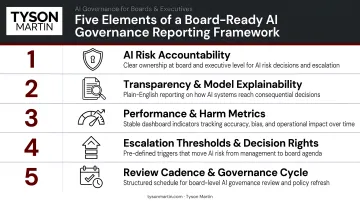
NACD's 2025 survey found more than 62% of public company boards now set aside specific agenda time for AI discussions—but the same analysis noted governance practices lag behind that increased attention. Boards are paying attention. The question is whether the reporting gives them something actionable to do with it.
Escalation and Incident Protocols
Governance frameworks are tested by incidents, not audits. A protocol that looks correct in a policy document often fails the moment an AI system produces an unexpected output or a regulatory inquiry arrives without warning.
Functional escalation protocols include:
- Clear triggers tied to business impact (financial loss, regulatory exposure, customer harm), not subjective severity assessments
- Named owners at each level — not "the appropriate team" but a specific person
- A defined path to the board — when does the board chair get a call, and who makes it?
- Pre-approved first-30-minutes decisions — containment authority, communication protocols, spending approval—resolved before the incident, not during it
- Documented rationale for every decision made under pressure
The FTC's action against Rite Aid illustrates what escalation failure looks like externally: an AI facial recognition system deployed without adequate safeguards, consumers harmed by false identifications, and a five-year ban on the technology as a result. The governance failure was the absence of controls that should have caught the problem long before it reached that scale.
Stress-testing through executive tabletop exercises involving the CISO, legal, communications, and operations validates these protocols before they're needed.
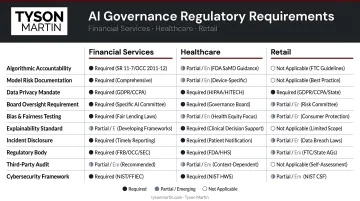
What Context-Aware AI Governance Looks Like in Regulated Industries
In financial services, healthcare, and retail, governance failure isn't measured in internal friction. It's measured in regulatory fines, reputational damage, and loss of operating licenses.
Financial Services
The Federal Reserve, FDIC, and OCC issued revised model risk management guidance (SR 26-2) in April 2026, primarily relevant to banks with more than $30 billion in assets. It supersedes SR 11-7 and requires four things:
- Model validation and ongoing monitoring
- Comprehensive model inventories
- "Effective challenge": critical analysis by qualified experts with authority to identify limitations and drive change
- Documentation sufficient for examiner-level review
The key governance demand for financial services AI: decisions must be explainable to examiners, not just auditable in logs. That requires documentation of the context in which AI outputs were generated and the human oversight applied.
Healthcare
Under 45 CFR 92.210, covered entities are prohibited from discriminating through patient care decision support tools and carry an ongoing duty to identify tools using protected-characteristic variables and mitigate discrimination risk. HIPAA's Security Rule adds administrative, physical, and technical safeguard requirements for any AI touching electronic protected health information.
The governance question in healthcare isn't just what data can be used—it's what data, in what context, by whom, for what decision. The six-dimension contextual framework maps directly to those clinical and administrative AI requirements.
Retail
Retail faces pressure from both ends of the regulatory spectrum. The FTC issued information orders to eight companies in July 2024 seeking details on surveillance pricing products incorporating consumer data. The EU AI Act's penalty structure—fines up to €35 million or 7% of global turnover for prohibited practices—applies to retail organizations with European operations.
AI-assisted pricing, inventory optimization, and customer analytics can trigger antitrust scrutiny when the underlying decision logic isn't documented and defensible. For retail boards specifically, that means governance programs need to cover not just data privacy—but decision transparency at the algorithmic level.
Making AI Governance Inspectable: What Boards Should Ask
Governance isn't working if the board only learns about it when something goes wrong. Inspectable execution means the board can verify, at any time, that AI systems are operating within approved parameters—not just receive assurance that they are.
Working with a board advisor or interim CISO/CDO who has built these frameworks in enterprise environments can compress the time significantly. The frameworks, escalation triggers, and reporting structures don't need to be invented from scratch. They need to be adapted to your specific regulatory context and AI use cases.
That adaptation starts with knowing what to ask. Five questions every board should be able to answer from current AI governance reporting:
- Which AI systems are operating within our approved risk parameters right now?
- What decisions has AI influenced since our last briefing, and were any escalated?
- Are our decision rights being followed, or are there workarounds?
- What regulatory changes have occurred that affect our AI exposure?
- What is our 90-day plan for closing the gaps we've identified?
If any of these questions can't be answered clearly from current reporting, that's the gap to address first.
The goal is not for boards to become AI experts. It's for governance frameworks to be designed so that non-technical leaders can exercise meaningful oversight with clear information, clear delegation, and clear accountability. That's a design problem with a clear solution: build the reporting structure before the board has to ask for it.
Frequently Asked Questions
What is contextual intelligence in AI governance?
Contextual intelligence is the ability of a governance system to adapt its decisions based on who is involved, which regulations apply, what historical precedents exist, and what current operational conditions are present. Static, rule-based governance applies uniform logic regardless of situation; context-aware governance produces defensible outcomes instead of unnecessary friction.
What are the 4 pillars of ethical AI?
The widely cited pillars are transparency, fairness, accountability, and safety. NIST and OECD frameworks both ground these in trustworthy AI characteristics. Effective governance operationalizes these principles into inspectable processes—audit trails, documented decision rights, bias monitoring—not just policy statements.
What is the difference between AI governance and AI regulation?
Regulation is external: legal requirements set by governments and regulators, such as the EU AI Act or SR 26-2. Governance is internal: the frameworks, decision rights, and oversight mechanisms organizations build to manage AI responsibly and remain defensible when regulators or boards ask questions. Regulation defines the floor; governance determines whether you're actually standing on it.
How should boards oversee AI risk without becoming technical experts?
The board's role is to set risk appetite, approve decision rights, and receive plain-English reporting on whether AI systems are operating within approved parameters. Interpreting model outputs or data architectures is management's job. Boards need clear delegation, clear accountability, and reporting that shows trend over time—not technical detail incident by incident.
What are the first steps to building an AI governance framework?
Start by mapping your current AI use cases and their risk exposure. Establish clear decision rights and ownership for each. Then build a reporting mechanism that shows the board trend over time rather than incident-by-incident surprises. Prioritize the highest-risk or most regulated use cases first—don't try to govern everything simultaneously.