
Boards approve policies. Committees convene. Risk registers get updated. And AI systems still produce harm, expose liability, or erode trust. The problem isn't effort or commitment — it's structure. Specifically, four structural breakdowns: blurred ownership, disconnected oversight, governance that can't keep pace with deployment speed, and frameworks built for compliance theater rather than inspectable execution.
This article breaks down why those failures happen, what they actually cost, and what governance that holds looks like in practice.
Key Takeaways
- 68% of organizations haven't appointed anyone to coordinate AI governance — accountability doesn't exist by default
- Governance fails when it clarifies policy but not decision rights — documentation satisfies audits, not incidents
- Real-world failures (Air Canada, Zillow, Amazon) trace back to structural gaps, not just technical errors
- Effective governance starts with one question: who owns the outcome?
- Boards don't need technical expertise — they need plain-English risk posture and clear escalation thresholds
What AI Governance Failure Actually Looks Like
Practitioners recognize the pattern immediately: frameworks exist on paper, committees meet regularly, and the same governance gaps resurface every quarter. Unresolved risk ratings. Unclear escalation paths. Accountability that dissolves when something goes wrong.
Governance failure rarely looks like a catastrophic breakdown. More often it's slow erosion:
- Models deployed without meaningful review
- Risk assessments that wave through decisions without real scrutiny
- Boards receiving updates too vague to act on
The data confirms how widespread this is. KPMG's 2023 survey of 225 US executives found only 5% had a mature responsible AI governance program. Meanwhile, 49% intended to stand one up but hadn't. The gap isn't about intent. It's structural.
Real-world AI failures across financial services, retail, and healthcare — including chatbot misinformation, algorithmic bias in credit and hiring, and AI-driven financial losses — consistently trace back to governance weaknesses rather than purely technical errors. The industries where the stakes are highest tend to have the most fragmented governance structures.
The Root Causes: Why AI Governance Efforts Fail
Blurred Decision Rights and Ownership Gaps
The most common and most overlooked root cause: nobody actually owns the outcome.
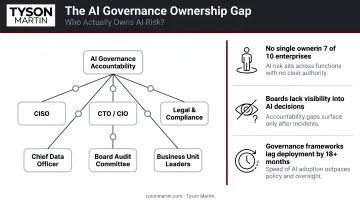
When cybersecurity, compliance, legal, data, and the business all have a stake in an AI system, accountability diffuses. Everyone reviews. No one owns.
KPMG found 68% of organizations hadn't appointed a central person or team to coordinate their AI governance response, and only 6% had a dedicated team for AI risk evaluation and mitigation.
This is what "organized irresponsibility" looks like in practice: multiple functions sign off on different dimensions of the same AI system, but no single owner is accountable for what happens next. When harm occurs, the causal chain runs through so many handoffs that responsibility disappears entirely.
Governance Speed vs. Deployment Speed
AI systems are being built and deployed faster than governance processes can review them. Committees that meet monthly cannot meaningfully oversee systems that change weekly.
The fix is tiered oversight that matches review intensity to actual risk level, with explicit criteria for what triggers full board-level escalation versus delegated sign-off. Without that tiering, governance becomes a bottleneck that gets bypassed rather than a check that gets respected.
Risk Frameworks That Fragment Under Pressure
Unified risk taxonomies almost always fracture at implementation. Cybersecurity may classify a system as high-risk; compliance classifies the same system as medium; IT calls it low. These aren't wrong assessments. They're measuring genuinely different dimensions of the same tool.
The consequence shows up in two predictable ways on executive dashboards:
- False precision: complexity gets suppressed into a single risk number that doesn't reflect reality
- Paralysis: divergent classifications get surfaced without resolution, leaving boards unable to act
Either outcome produces the same result — boards making decisions from data they can't trust.
Lack of Inspectable Execution
There's a critical difference between governance that exists on paper and governance that can be verified under pressure.
In a real incident, can the board trace which AI decisions were reviewed, by whom, and on what basis? Most organizations cannot. Frameworks built for audit compliance (rather than operational accountability) produce documentation but not defensibility. That distinction matters enormously when regulators or courts start asking questions.
Board-Level Blind Spots
Deloitte's 2024 global survey found 45% of respondents said AI hadn't made it onto the board agenda at all, and 79% said boards had limited, minimal, or no AI knowledge. Only 2% described their boards as highly knowledgeable.
Board reporting on AI risk defaults to technical metrics or high-level policy updates rather than plain-English risk posture: what changed, what's being watched, what decisions need board input. Boards that don't understand what they're overseeing can't provide meaningful oversight.
That gap is increasingly a directors' and officers' liability exposure, not just an operational concern.
The Real-World Cost of Getting It Wrong
Documented AI governance failures illustrate exactly what's at stake:
| Case | What Failed | Outcome |
|---|---|---|
| Air Canada chatbot | Chatbot gave incorrect bereavement-fare information; no accountability mechanism caught it | Found liable for negligent misrepresentation; ordered to pay damages and fees |
| Amazon recruiting AI | Internal tool downgraded resumes associated with women; bias went undetected in development | Tool discontinued; reputational damage and scrutiny of AI hiring practices |
| Zillow Offers | AI home price forecasting exceeded reliable bounds without adequate governance checks | $304M inventory write-down, $328M GAAP net loss, 25% workforce reduction planned |
| Rite Aid facial recognition | Deployed surveillance AI without reasonable harm-prevention procedures | FTC banned facial recognition use for five years |
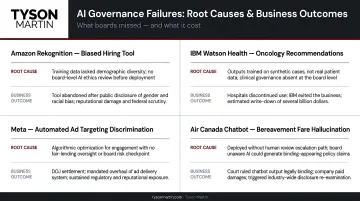
These aren't edge cases. They're the predictable result of deploying AI systems without governance structures that assign clear ownership, require documented rationale, and create accountability that survives an incident.
Litigation exposure is accelerating. WTW reported 42 AI-related securities class-action filings from 2020 to 2025, with 29 still pending as of January 2025. D&O underwriters are increasingly requiring AI-specific renewal disclosures — board-level expertise, risk assessments, and internal monitoring controls.
Valuation follows liability. That scrutiny has a direct valuation consequence. Intangible assets — data, IP, reputation — now constitute approximately 92% of S&P 500 market capitalization, according to Ocean Tomo's 2025 study. When AI failures trigger regulatory action or investor litigation, these are the assets that take the hit — and they rarely recover quietly.
What Actually Works: Building AI Governance That Holds
Clarify Decision Rights First
Effective AI governance starts with one question: who owns the outcome? Not who reviews it — who owns it.
Governance structures need clear decision rights before process or technology gets layered in. That means defined accountability at each stage of the AI lifecycle — procurement, deployment, monitoring, incident response — with named owners and escalation thresholds that hold under pressure.
A Decision Rights Map for AI systems should answer five questions without ambiguity:
- Who accepts risk at each stage, and at what threshold?
- Who approves exceptions, and for how long?
- Who can halt or roll back a deployed system?
- Who is accountable when an AI-driven decision causes harm?
- At what point does a management decision escalate to board level?
Organizations in transition — new leadership, M&A, or under regulatory pressure — often need this established quickly rather than built from scratch under pressure.
Match Oversight Intensity to Risk Level
Build a practical tiering system with clear, agreed-upon criteria for what makes an AI application high-risk:
- High-risk indicators: Decisions that affect individuals (credit, hiring, healthcare), use of sensitive or protected data, material regulatory exposure, limited human review in the decision loop
- High-risk treatment: Full committee review, documented rationale, named accountability at each lifecycle stage
- Low-risk treatment: Delegated sign-off with documented rationale — faster, but still traceable
Tiering only works when criteria are explicit and shared across functions. If each domain applies its own undisclosed threshold, the result is the same fragmentation problem in a different form.
Build Reporting That Boards Can Actually Use
Risk tiering sets the exposure picture — but only if boards can see it clearly.
Effective board-level AI reporting covers:
- Risk posture in plain English — not technical metrics
- What changed since the last briefing
- Which AI applications carry the highest current exposure
- What decisions require board input versus management discretion
The contrast with common failure: dashboards full of activity metrics that give the appearance of oversight without enabling it. Boards need trend, not trivia — a stable view of whether exposure is shrinking or growing, not a count of policies reviewed.
Embed Governance Into Deployment, Not After
Governance added as a final gate before deployment — or as a post-incident response — is too late. Checkpoints at procurement, design, and testing stages create documented rationale that can be traced in an incident.
The standard worth building toward: if an AI system causes harm, can you show exactly when it was reviewed, by whom, on what basis, and who signed off? Organizations that can answer those questions clearly enter regulatory inquiries and litigation with documented evidence of responsible oversight — those that cannot are left explaining why no one was accountable.

What Boards Should Be Asking Right Now
Boards don't need to become AI experts. They need governance structures that give them clear oversight, credible reporting, and the ability to make defensible decisions. Five questions worth putting to management:
- Do we have a complete inventory of AI systems currently in use, and does each one have a named owner?
- Can we trace accountability for any AI-driven decision that causes harm — who approved deployment and on what basis?
- Does our board reporting show risk trend or just governance activity?
- What are our highest-exposure AI applications right now, and what oversight do they receive?
- If an AI incident occurred tomorrow, what's the escalation path, and who decides what?
If those questions don't have clear answers, the governance structure isn't functioning — regardless of what the framework document says.
That's especially true for organizations in regulated industries or navigating leadership transitions. A structured diagnostic (AI risk assessment, decision-rights map, and board-level policy) can move an organization from no formal governance to a defensible posture in weeks, not quarters.
Frequently Asked Questions
What is one of the main challenges of AI in governance?
The central challenge is fragmented ownership. When multiple functions each govern a different dimension of AI — security, compliance, legal, conduct — no single owner is clearly responsible for the outcome. That structural gap is what regulators and courts have started treating as a leadership failure.
Why do AI governance frameworks keep failing even when leadership supports them?
Leadership support doesn't solve the structural problem. Frameworks fail when they clarify policy but not decision rights — producing documentation that satisfies audits but doesn't hold up when something goes wrong.
Who is responsible when an AI system causes harm?
Responsibility defaults to whoever the regulator or plaintiff can reach — which is increasingly the board. Without explicit accountability mapped to each stage of the AI lifecycle, D&O insurers and courts treat the gap as a governance failure at the top, not a technology team problem.
How should boards oversee AI without becoming technical experts?
Effective board oversight doesn't require technical fluency. It requires plain-English reporting on risk posture, clear escalation thresholds, and the ability to ask: who owns this, and can we trace accountability if it goes wrong?
What is the difference between AI governance and AI compliance?
Compliance satisfies external requirements — regulations, audits. Governance determines how AI decisions are actually made, reviewed, and owned internally. Compliance without governance produces paperwork, not accountability.
How can organizations govern AI without slowing down innovation?
The tension is real but manageable. Risk-tiered oversight — lighter review for low-risk applications, rigorous review for high-risk ones — lets organizations move quickly where it's safe while maintaining meaningful oversight where it matters most.