The problem isn't knowledge. It's framing. Only about half of corporate directors report receiving sufficient information from management on AI and GenAI risks, according to PwC's 2024 Annual Corporate Directors Survey — and the gap isn't closing fast enough. Boards are now legally and fiduciarily expected to oversee AI risk. Reporting it effectively requires deliberate preparation, a specific structure, and the discipline to speak in business consequences rather than control inventories.
This guide walks through exactly how to do that.
Key Takeaways
- Build an AI inventory and risk register before the meeting — visibility is a prerequisite for governance
- Express every material risk in financial and operational terms, not technical ones
- Structure the briefing around what changed, what needs board attention, and what decision you're requesting
- Use a stable, repeatable dashboard that shows trend direction across every reporting cycle
- Close with a specific ask (approve, reject, or delegate) — not an open-ended status update
How to Report AI Risks to Your Board: Step-by-Step
Step 1: Build an AI Inventory and Risk Register Before the Meeting
You cannot brief a board on AI risk if you don't know what AI systems you're running. That sounds obvious. It rarely gets done.
Start by identifying every AI system in use — formally approved platforms, vendor-embedded AI, and shadow deployments across business units. Gartner found that 69% of organizations have evidence or suspicion of employees using prohibited public GenAI tools, and predicts more than 40% of enterprises will experience a security or compliance incident linked to unauthorized shadow AI by 2030. The board needs to see the full scope of organizational exposure, not just the systems IT formally approved.
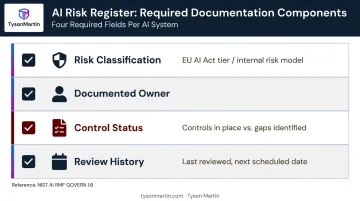
For each system, document:
- Risk classification (tied to a framework the board recognizes — EU AI Act categories, or an internal high/medium/low model linked to business criticality)
- Documented owner
- Control status — what's in place, what's missing
- Whether the system has been reviewed since deployment
The NIST AI RMF (GOVERN 1.6) explicitly calls for mechanisms to inventory AI systems according to risk priorities. If your organization doesn't have this yet, the pre-briefing phase is the time to build it — treat it as a permanent governance asset, not just preparation for this one meeting.
Step 2: Translate Each AI Risk Into a Business Impact Statement
Technical findings don't drive board decisions. Business consequences do.
For every material risk in your register, rewrite the finding as a business consequence: what revenue stream, regulatory obligation, or stakeholder relationship is at risk, and under what conditions. The translation template is simple:
"Because [technical condition], [business outcome] is at risk under [circumstances]."
Concrete examples of what this looks like in practice:
- ❌ "Model drift detected in credit decisioning algorithm"
- ✅ "Our AI-powered lending tool is producing inconsistent outcomes that increase fair lending regulatory exposure and could require retroactive remediation"
For your top two or three risk scenarios, include a financial exposure range — not a false-precision figure, but a directional range across likely, plausible, and worst-case outcomes. Boards evaluate risk in financial terms — and regulators do too. The SEC charged two investment advisers a combined $400,000 in civil penalties for misleading AI claims. The FTC banned Rite Aid from using AI facial recognition for five years after its system generated thousands of false-positive matches.
Those are the kinds of business consequences that land in the boardroom and stay there.
Step 3: Structure the Briefing Around What the Board Is Responsible For
Once you have your risks framed as business consequences, the next question is how to organize them for the room. Directors are not there to learn about AI. They're there to govern it.
Lead with risk posture and what has changed since the last briefing — not a tour of every AI initiative underway or every technical control in place. From there, organize the briefing into three distinct segments:
- Current AI risk posture and material changes — where things stand and what's shifted
- The one or two scenarios that warrant board-level awareness or decision — with business impact framing and supporting evidence
- What you are asking the board to approve, direct, or formally acknowledge — specific, not vague
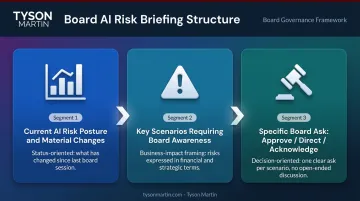
The third segment is where most briefings fall apart. Presenters end with "any questions?" and walk out without a governance record. Every briefing needs a defined close.
Step 4: Present a Stable Dashboard, Not a One-Time Slide Deck
A new framework every quarter doesn't build oversight — it builds confusion. Boards gain confidence from consistent metrics that show direction over time.
Introduce a repeatable AI risk dashboard with metrics that remain stable across reporting cycles. Trend visibility is what builds board confidence — not any single data point. Core metrics to track:
- Number of high-risk AI systems without documented controls
- Third-party AI vendor risk status (current vs. overdue assessments)
- Regulatory compliance posture and open gaps
- Time-to-detect for AI-related anomalies
- Material changes since the last briefing
Each metric should connect explicitly to a business outcome the board oversees. Keep the total dashboard to 8–12 metrics. If a metric can't answer "in appetite or out of appetite," it belongs in management reporting, not the board packet.
Step 5: Close With Clear Decisions and Escalation Thresholds
Every AI risk briefing should end with explicit decision requests. For any item that exceeds the organization's stated AI risk appetite, the board needs to either approve a course of action, set or confirm a threshold, or formally acknowledge an escalation.
Ambiguity about what the board decided creates governance gaps — the kind that surface as liability in a regulatory review or post-incident investigation.
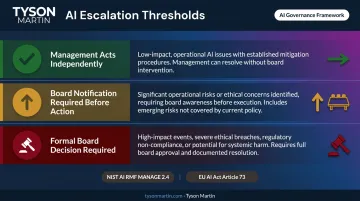
Beyond the immediate ask, define and confirm the escalation thresholds the board has agreed to:
- What conditions authorize management to act independently
- What conditions require board notification before action
- Who notifies whom, in what timeframe, with what information
The NIST AI RMF (MANAGE 2.4) requires organizations to establish methods to supersede or deactivate AI systems that perform inconsistently with their intended use. The EU AI Act (Article 73) requires providers of high-risk AI systems to report serious incidents to market surveillance authorities. Your escalation thresholds should be consistent with both.
What You Need Before Your Board AI Risk Briefing
The quality of a board briefing is almost entirely determined by what happens before the meeting. Arriving without a current AI inventory, a risk owner map, or a defined risk appetite statement means the board cannot make informed decisions — regardless of how well the briefing is delivered.
AI Risk Register and Ownership Map
You need a current register that identifies each AI system, its risk classification, its documented owner, and the control status. Without this, risk conversations devolve into anecdote rather than governance.
Many organizations use the pre-briefing preparation phase to build this register for the first time. That's the reality for most mid-market and enterprise companies — AI governance formalized faster than the infrastructure to support it. The goal is to build it once and maintain it as a living document, not reconstruct it before every board meeting.
Defined Risk Appetite Statement for AI
Confirm that your organization has — or is presenting for adoption — a written AI risk appetite statement. This document tells the board what level of exposure is acceptable across financial, operational, reputational, and regulatory dimensions.
Without it, the board has no reference point for evaluating whether current AI risk posture is within acceptable bounds. A one-page document is sufficient: define your material thresholds and spell out what the organization will and won't accept. That single document anchors every subsequent governance conversation.
Regulatory and Compliance Landscape Summary
Prepare a one-page summary of the regulatory obligations that apply to your AI use cases. Depending on your organization's profile, this may include:
- NIST AI RMF obligations (GOVERN, MAP, MEASURE, MANAGE)
- EU AI Act requirements for high-risk systems
- State-level laws: Colorado's SB 24-205, Illinois AEIA, California's automated employment decision regulations (effective October 2025)
- Industry-specific requirements
Compliance with these frameworks is a floor, not a ceiling. Meeting the standard does not mean the organization is resilient.
Translating AI Risk Into Language Boards Understand
The most common reason AI risk briefings fail is vocabulary mismatch. The presenter speaks as a technologist; the board evaluates everything through fiduciary responsibility, strategic impact, and stakeholder trust. Every AI risk must be anchored to one of those dimensions.
Replace Technical Descriptions With Business Consequence Statements
Closing that vocabulary gap starts with a single reframing question: what decision is the board already equipped to make, and how does this risk connect to that decision?
Instead of "model drift in our credit decisioning algorithm," say "our AI-powered lending tool is producing inconsistent outcomes that increase fair lending regulatory exposure and could require retroactive remediation."
The former requires translation. The latter does not.
Distinguish Compliance From Resilience Explicitly
Many boards assume regulatory compliance means the organization is protected. Address this directly.
Compliance frameworks define minimum obligations, not protection against AI-driven losses. A system can pass every audit and still make biased decisions, expose sensitive data during inference, or degrade in ways that create liability. Tyson Martin draws the line clearly:
"Compliance shows you met a defined requirement at a point in time. Resilience shows you can take a hit, keep operating, and recover fast. You want both, but they aren't the same thing."
Deloitte found that only one in five companies has a mature governance model for autonomous AI agents — which means most organizations operating AI have compliance postures that significantly outpace their actual governance maturity.
Map AI Risks to the Board's Existing Risk Categories
Don't ask the board to learn a new framework. Connect AI risk to the categories they already use:
| AI Risk Type | Board's Existing Category |
|---|---|
| Model bias or inconsistent outputs | Regulatory liability / legal exposure |
| Shadow AI and ungoverned deployments | Operational risk / internal controls |
| Third-party AI vendor failures | Third-party / vendor risk |
| Data exposure during AI inference | Reputational risk / data governance |
| Regulatory non-compliance | Compliance risk |
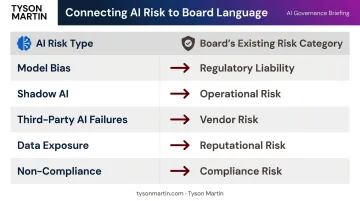
Directors can start asking the right questions immediately — because the risk is already named in a category they own.
Common Mistakes When Reporting AI Risks to the Board
Burying the bottom line in a technical inventory. A list of AI tools, models, or vulnerabilities forces directors to do the interpretation work. Open with current risk level, what changed, and what it means for the business — then support it with evidence.
Mixing AI risk governance with AI strategy updates. These are different conversations. Combining them blurs accountability and dilutes the urgency of the risk discussion.
Ending the briefing without a specific ask. Every AI risk briefing needs a defined action: approve a course of action, confirm a risk appetite threshold, or formally acknowledge an escalation. If nothing is decided, that outcome still needs to be documentable.
Treating a compliance check as proof of resilience. Telling the board "we are compliant with NIST AI RMF" without explaining what that means operationally creates a false sense of security. Compliance and resilience are not the same thing — the briefing needs to make that distinction explicit.
Frequently Asked Questions
What is the board's responsibility for artificial intelligence oversight?
Boards have a fiduciary duty to oversee material risks, and AI now qualifies on multiple dimensions — both the AI the organization deploys and the AI-enabled threats it faces. NACD guidance, SEC disclosure trends, and emerging state-level regulations are all formalizing this expectation, as is Caremark liability exposure for companies with substantial AI investments.
Who should be held accountable when an AI system causes harm?
Accountability flows from documented ownership. The business unit deploying the system owns operational accountability; legal and compliance own regulatory exposure; the board owns governance adequacy. The critical point is that these accountabilities must be assigned and documented before an incident — not reconstructed after one.
How often should AI risk be reported to the board?
Quarterly reporting to the audit or risk committee is the emerging norm for material AI risk, with escalation to the full board for high-severity events or decisions that exceed delegated authority thresholds. The EU AI Act and SEC cybersecurity disclosure rules both provide event-driven escalation models that can inform how AI-specific triggers are defined.
What should be included in an AI risk dashboard for the board?
Core elements include: high-risk AI systems with and without documented controls, third-party vendor risk status, regulatory compliance posture, material changes since the last briefing, and items requiring board decision. Metrics should show direction — improving, stable, or deteriorating — not just point-in-time values that mean nothing without a baseline.
What's the difference between AI compliance and AI resilience?
Compliance confirms you met a defined standard at a point in time; resilience means you can absorb a failure, keep operating, and recover. An organization can be fully compliant with NIST AI RMF and still have ungoverned model deployments, undocumented decision rights, and no escalation path when an AI system degrades. Boards need visibility into both.