
Introduction
Most boards are now being asked to oversee AI decisions they cannot fully evaluate, using reports that were never designed to help them govern. That is a governance problem — and in 2026, it carries real consequences.
According to EY's Center for Board Matters, only 40% of Fortune 100 companies disclosed at least one board-level committee with AI oversight in 2025. Meanwhile, the Conference Board found that 72% of S&P 500 companies flagged AI as a material risk — up from just 12% in 2023. That gap between disclosure and actual governance is where liability lives.
Most boards are engaged — the problem is structural. They receive information reports when governance requires decision-ready ones. This guide offers a practical 2026 framework for structuring AI risk reporting so directors can escalate faster, ask sharper questions, and defend the decisions they make.
Key Takeaways
- AI risk reporting has crossed from a technology topic to a fiduciary obligation with personal liability exposure
- Most boards receive project status updates when they need risk posture summaries and decision prompts
- A board-ready AI risk report covers five components: posture, changes since last quarter, stable metrics, decisions required, and a 90-day priority list
- Dashboard metrics must stay consistent across quarters — changing them each period signals story curation, not risk reporting
- Regulatory pressure in 2026 hits from multiple directions — EU AI Act enforcement, SEC priorities, and a growing patchwork of state laws
Why AI Risk Reporting to the Board Has Changed in 2026
From Technology Topic to Fiduciary Obligation
AI has moved off the innovation agenda and onto the risk register. The SEC Division of Examinations' FY2026 priorities name AI representations, AI supervision, and cybersecurity controls as active examination focus areas. The Division has stated it will review the accuracy of registrant claims about AI capabilities and assess whether firms have adequate policies for monitoring and supervising AI technologies. That is a disclosure accuracy standard — not a technology readiness standard.
The board-level implication: what your company says about AI in public filings, earnings calls, and investor materials must be supportable. Directors who sign off on those disclosures carry personal exposure when claims outpace reality.
The Director Fluency Gap
The data on board-level AI readiness points in one direction. While more than 62% of directors set aside full-board agenda time for AI discussions (NACD, 2025), the EY disclosure benchmark found only 44% of Fortune 100 companies mentioned AI in director qualifications. Boards are discussing AI without necessarily having the fluency — or the right reporting — to govern it.
This is not primarily a talent problem. It is a reporting structure problem. When the report doesn't surface the right questions, even a capable board cannot ask them.
Two Failure Modes That Both Destroy Value
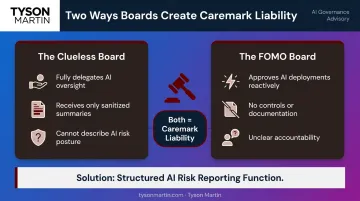
Boards tend toward one of two failure modes when AI governance is weak:
- The clueless board delegates AI oversight entirely, receives sanitized quarterly summaries, and goes silent when asked to describe its AI risk posture
- The FOMO board approves AI deployments to stay competitive — without controls, documentation, or anyone clearly accountable when something goes wrong
Both are Caremark oversight failures. The Delaware courts' treatment of oversight liability in technology risk cases — the SolarWinds cybersecurity matter is the clearest recent example — established that "mission critical" risks require a functioning monitoring system, not just a policy. That standard now applies directly to AI. The mechanism that prevents both failure modes is a well-structured AI risk reporting function.
What Boards Actually Need vs. What They Usually Get
The Typical Management Report
Most management-prepared AI risk reports answer the wrong question. They tell the board what the organization is doing with AI — project status, vendor lists, technology metrics, compliance checklists. That is an activity summary, not a governance tool.
A board cannot determine actual risk exposure from a project update, make resource allocation decisions from a vendor list, or hold anyone accountable from a checklist that lacks named owners.
As Tyson Martin frames it in his board advisory work: if you can't tell what decision to make from the report, the report needs redesign.
What Governance Reporting Actually Looks Like
The board's actual information need is narrower than most management teams assume:
- Current risk posture — are we in an acceptable position or not?
- What changed — what is materially different since the last briefing?
- Decision rights — which risks are within management's authority to resolve, and which require board action?
- Trend — is the situation improving, deteriorating, or stable?
A single-quarter metric without a prior-period baseline tells the board nothing. Trend requires a stable set of indicators tracked consistently over time — not a new dashboard every quarter.
The Decision-Rights Gap and AI Washing Exposure
Most AI risk reports present risks without specifying what the board is supposed to do about them. Directors need reports that clearly distinguish between:
- For your awareness — no action required at this time
- For your oversight — management is handling this; board should monitor
- Decision required — this exceeds management's authority or risk appetite
AI washing adds another layer of exposure. When board reports overstate AI capability, maturity, or compliance readiness, directors face securities disclosure risk. The SEC charged two investment advisers in March 2024 with false and misleading statements about AI use, resulting in $400,000 in civil penalties.
That standard extends to board-level disclosures. Directors must be able to stand behind the AI claims in their company's public materials — and that requires reports accurate enough to support them.
How to Structure an AI Risk Report the Board Can Act On
The Five Components
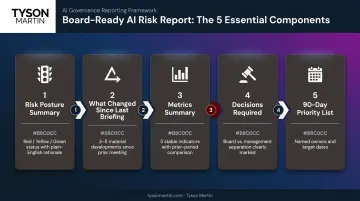
A board-ready AI risk report contains five sections, in this order:
- Risk posture summary — Red/Yellow/Green status with a one-paragraph plain-English rationale tied to business impact, not technical architecture
- What changed since last briefing — limited to three to five material developments; not a project update list
- Metrics summary — no more than five stable indicators, each compared to the prior period
- Decisions required — separates board decisions from management-delegated actions, with clear labels
- 90-day priority list — named owners, measurable outcomes, and specific dates
Writing the Risk Posture Summary
The posture summary is where most reports fail. Here is the difference:
Technical update (not governance-ready):
"Our AI model inventory stands at 47 deployed models. 12 are in validation. Model drift monitoring coverage is at 68%."
Governance-ready posture summary:
"Our AI risk posture is Yellow. Three high-risk AI systems affecting customer credit decisions currently lack completed bias assessments, creating regulatory exposure under California and Colorado requirements effective this year. Management has a remediation plan in place; board awareness is appropriate given the potential for regulatory inquiry."
The second version tells a director what the risk is, why it matters, and what is being done. That is governable.
Format and Length Discipline
A board AI risk report that requires more than 10 minutes of pre-reading is unlikely to produce informed discussion. The board-facing summary should fit on one to two pages. Technical detail, model inventories, and vendor assessments belong in a supplemental appendix available to directors who want depth, not in the main report itself.
Committee-Level Routing
Not all AI risk content belongs in front of the full board. Route report components by committee responsibility:
| Committee | Receives |
|---|---|
| Audit | Assurance content, disclosure accuracy, AI washing risk |
| Risk | Risk appetite, escalation thresholds, open control gaps |
| Full Board | Strategic AI posture, decisions exceeding management authority |
Establishing this structure with clear ownership from the outset prevents AI risk from falling into a governance gap between committees — a failure mode that typically surfaces only after an incident has already escalated.
Assigning Committee Ownership and Escalation Thresholds
Define escalation thresholds in advance. Conditions that should trigger automatic escalation from management to the board include:
- Unauthorized AI deployment in a board-restricted category
- A high-risk AI incident affecting customers or regulators
- Material variance between approved AI spending and documented outcomes
- A regulatory inquiry or examination notice related to AI use
Escalation thresholds only work when governance documents define them explicitly and someone tests them. Boards should require management to present a brief escalation policy for approval.
Tabletop exercises should include at least one AI-specific scenario annually. A practical example: a biased AI decision affecting customer outcomes triggers a regulatory notification — who escalates, by when, and who decides whether to disclose.
Building an AI Risk Dashboard That Shows Trend, Not Trivia
The Stability Principle
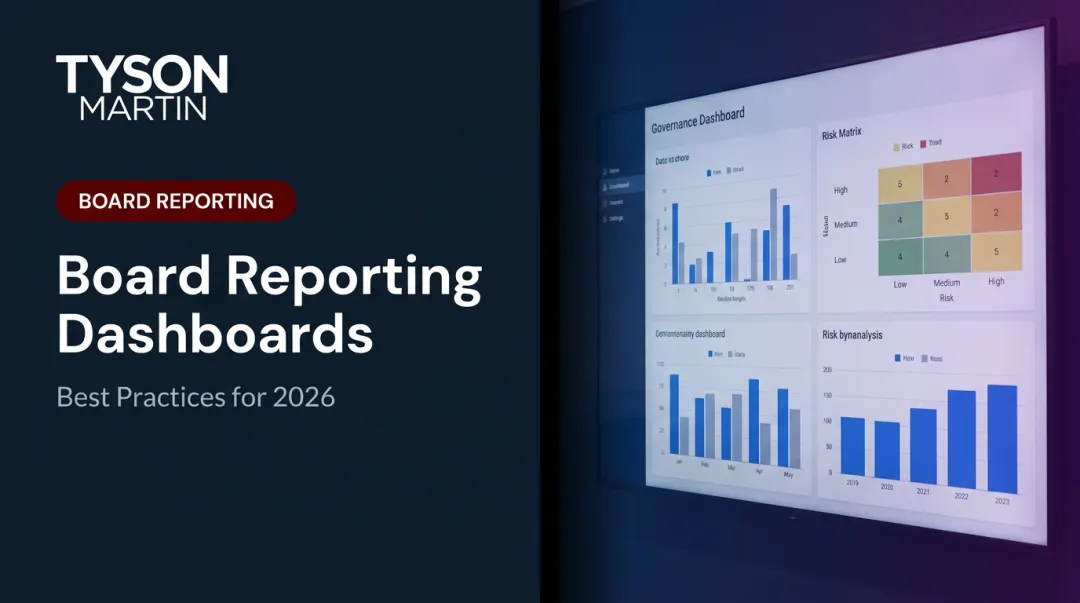
The core design rule for a board AI risk dashboard: use the same metrics every quarter. A new metric set each period signals that management is curating the story. Consistent metrics are what make trends visible — and trends are the only thing a board can actually act on. Directors should be able to look at this quarter's dashboard alongside the prior two quarters and see whether the program is improving.
That stability has a framework anchor. The NIST AI Risk Management Framework defines GOVERN, MAP, MEASURE, and MANAGE as its core functions — with MEASURE specifically covering quantitative and qualitative tools for benchmarking AI risk over time. A board dashboard operationalizes the MEASURE function at the governance level.
The Five Dashboard Metrics
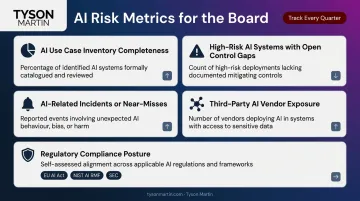
Keep the board dashboard to five stable indicators:
- AI use case inventory completeness — percentage of known AI systems with a documented risk tier and named owner
- High-risk AI systems with open control gaps — count of Tier 1 systems lacking completed controls, tracked against prior periods
- AI-related incidents or near-misses — count in the period with a brief description of severity
- Third-party AI vendor exposure — number of critical AI vendors with completed risk assessments
- Regulatory compliance posture — status across active jurisdictions (EU AI Act, California ADMT, Colorado, NYC LL144)
Tiering: Not All AI Carries Equal Risk
The dashboard should surface Tier 1 systems — those affecting health, safety, large financial decisions, or protected classes — separately from lower-risk systems. Board attention should be proportionate to actual exposure. An AI system that recommends marketing copy carries different risk than one that makes credit decisions or affects employment outcomes.
Compliance Metrics vs. Risk Posture Metrics
Tier-based reporting only works if the metrics themselves measure the right things. A compliance metric asks: are we checking the boxes? A risk posture metric asks: are we actually safer?
| Compliance metric (input) | Risk posture metric (outcome) |
|---|---|
| AI ethics training completion rate: 87% | Human override rate on high-risk AI decisions: trending up or down? |
| Model documentation policy adopted | Percentage of Tier 1 models with current bias assessments |
| Vendor AI terms reviewed | Critical AI vendors with open risk gaps |
Push management to report outcome-based indicators. Training completion rates tell the board that people attended a course. Override rate trends tell the board whether the human oversight function is working. That distinction — input vs. outcome — is the difference between a dashboard that tracks activity and one that tracks exposure.
The 2026 Regulatory Backdrop Every AI Risk Report Should Address
The US Landscape
There is no comprehensive federal AI governance framework, but the picture is not blank. The White House released its National Policy Framework for AI in March 2026, calling for regulatory sandboxes, use of existing regulators rather than a new AI body, and federal preemption of state laws that impose undue burdens. That framework signals direction but leaves existing state requirements in place.
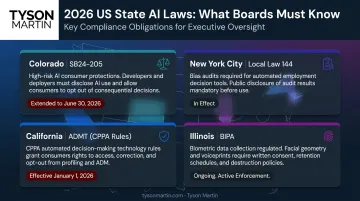
State-level laws create concrete obligations for boards with multi-state operations:
- Colorado SB24-205 — high-risk AI consumer protections, with requirements for risk management programs and impact assessments; requirements extended to June 30, 2026
- New York City Local Law 144 — requires independent bias audits for automated employment decision tools before use, with public disclosure and candidate notice
- California ADMT regulations — CPPA finalized rules effective January 1, 2026, covering automated decision-making technology and consumer rights
- Illinois BIPA — applies to any AI system that collects biometric identifiers including facial geometry, voiceprints, or fingerprints
Boards in regulated industries face additional sector-specific pressure from the FTC, HHS, and banking regulators.
EU AI Act Enforcement
The EU AI Act entered its general application phase on August 2, 2026. It applies to any company whose AI outputs are used in the EU — which means US companies with European operations or customers cannot treat this as someone else's compliance problem. The top penalty tier reaches €35 million or 7% of worldwide annual turnover, whichever is higher, for prohibited AI practices.
AI washing — overstating AI capability or compliance readiness in public disclosures — now triggers enforcement under both frameworks. The combination of SEC disclosure scrutiny and EU Act penalties means that kind of overstatement creates exposure on two continents simultaneously.
The Caremark Connection
The Delaware courts established in the SolarWinds case that cybersecurity constitutes a "mission critical" risk requiring a functioning board-level monitoring system. The Harvard Law School Forum on Corporate Governance has applied the same Caremark logic directly to AI oversight: boards without a functioning AI risk reporting system face personal liability exposure when an AI-related incident produces regulatory action or shareholder derivative litigation.
The practical implication: the reporting structure is not an administrative convenience — it is the evidence that oversight existed.
Frequently Asked Questions
How often should AI risk be reported to the board?
AI risk should appear on the full board agenda at least quarterly, with material incidents escalated immediately. The audit or risk committee should receive more frequent updates when the organization's AI footprint is large or regulatory exposure is active — and that cadence should scale with deployment.
What metrics should be included in an AI risk dashboard for the board?
The five core categories: AI inventory completeness, open control gaps on high-risk systems, incidents in the period, third-party AI vendor assessment status, and regulatory compliance posture. The same metrics must appear every quarter — trend only becomes visible when the measurement is consistent.
Which board committee should own AI risk oversight?
No single committee owns it entirely. The risk committee holds risk appetite and escalation thresholds. Audit owns assurance and disclosure accuracy. Workforce impact sits with human capital. The full board owns strategic AI posture and any decisions that exceed management's delegated authority.
Which AI safety and impact reports should inform board-level AI risk reporting?
The NACD Director Survey, EY Center for Board Matters disclosures benchmark, Conference Board AI risk disclosure analysis, NIST AI RMF, and the WEF Centre for Cybersecurity's annual reports are the core reference set. Boards should also review the SEC's FY2026 examination priorities as a direct signal of regulatory focus.
What 2026 AI regulations should boards consider when establishing AI risk reporting practices?
The primary framework includes the EU AI Act (August 2026 general application), the White House National Policy Framework (March 2026), SEC disclosure rules, and state laws in Colorado, New York, California, and Illinois. Regulated industries layer FTC, HHS, and banking regulator guidance on top of that baseline.