Introduction
Most boards are receiving AI security updates they cannot act on. Slide decks full of vulnerability counts, compliance scores, and threat intelligence summaries — delivered by a CISO or a vendor — that leave directors nodding politely while walking out with no clearer sense of whether the organization is managing AI risk well or poorly.
That gap is a governance failure. As organizations deploy AI agents, copilots, and automated pipelines across regulated operations, AI security posture has moved from security engineering into board-level accountability. Regulators are paying attention, and directors are being held responsible for oversight failures they may not even realize exist.
According to McKinsey's 2025 State of AI survey, 23% of organizations are already scaling agentic AI systems somewhere in the enterprise — systems making decisions or taking automated actions with limited human review. That number will grow faster than most board AI governance frameworks can keep pace with.
What follows covers what AI-SPM means at the board level, what a useful AI security posture report actually contains, the questions directors should be asking, and how decision rights between the board and management should be structured.
TLDR
- AI security posture is a board governance obligation, not just a CISO concern — regulators and courts are making this explicit
- Three AI risks demand board visibility: shadow AI, sensitive data exposure through AI outputs, and autonomous systems without human approval gates
- Board AI-SPM reports should answer three questions only: current risk exposure, what changed, and what the board needs to decide
- Directors should demand demonstrated trend data — not verbal reassurances
- Written escalation thresholds and explicit decision rights are the governance infrastructure that holds up under real incidents
Why AI Security Posture Is Now a Board Governance Issue
For most of the past decade, cybersecurity was a board concern primarily through the lens of incident response and compliance. AI changes the shape of the risk — and it changes who is accountable.
The Regulatory Pressure Is Real
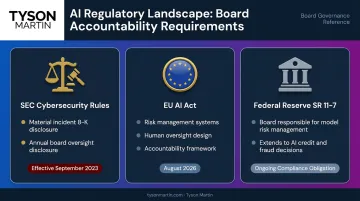
The SEC's cybersecurity disclosure rules, adopted July 2023 and effective September 5, 2023, require annual disclosure of the board's oversight of cybersecurity risks under Regulation S-K Item 106. Material incidents trigger a Form 8-K disclosure generally within four business days of determining materiality. When AI systems are involved in a material incident — a data breach through model outputs, an unauthorized AI deployment that exposes customer data — that disclosure requirement applies.
The EU AI Act (Regulation 2024/1689, effective August 2026 for most provisions) goes further for organizations operating in European markets. Articles 9, 14, 17, and 26 require formal risk management systems, human oversight design, and an accountability framework that explicitly assigns responsibilities to management. Article 27 requires fundamental-rights impact assessments for specified high-risk uses.
In financial services, the Federal Reserve's SR 11-7 has long established that the board of directors is ultimately responsible for an effective model risk management framework — a standard that extends naturally to AI systems making credit decisions, fraud assessments, or customer-facing recommendations.
What Makes AI Risk Different for Boards
Traditional cyber risk is primarily about protecting systems that humans operate. AI risk includes the organization's own systems acting autonomously on its behalf — making decisions, generating outputs, and taking actions. A board can receive a strong cybersecurity posture report while having zero visibility into whether their AI systems are exposing sensitive data through model responses, making biased decisions, or operating without any human review.
Boards at enterprise organizations in regulated industries face compounded exposure across every sector where AI is now embedded:
- Financial services: AI drives credit decisions, fraud assessments, and transaction monitoring
- Healthcare: AI touches clinical workflows, diagnostic tools, and patient records
- Retail: AI processes customer data at scale across personalization and fulfillment systems
In 2023, the FTC banned Rite Aid from using AI facial recognition for five years after finding the company deployed the technology without reasonable safeguards — that's what regulatory action looks like when board-level AI governance is absent.
What AI-SPM Actually Means at the Board Level
AI Security Posture Management is the organization's ongoing ability to know what AI systems are running, what data they access, what actions they can take, and whether any of those systems are behaving outside acceptable boundaries. In plain terms: it answers "are we managing AI risk, and how do we know?"
How It Differs from Traditional Cybersecurity Posture
Traditional security posture management governs infrastructure: networks, endpoints, cloud configurations, and access controls. AI-SPM governs the workloads sitting on top of that infrastructure — the models, agents, and automated pipelines that process data and make decisions.
A board can have excellent scores on traditional cybersecurity metrics while having no visibility into AI posture risk. These are not the same thing, and treating them as equivalent is one of the most common governance errors boards in regulated industries make right now.
If the organization lacks a current registry of every AI model, agent, pipeline, and third-party AI integration in production (sometimes called an AI Bill of Materials), no AI security posture report is credible.
Directors should ask management directly:
"Do we have a complete, maintained inventory of every AI system running in this organization, including tools deployed by business units without IT review?"
The answer tells the board more about actual AI governance maturity than most posture reports will.
What a Board-Ready AI Security Posture Report Should Include
Board AI-SPM reporting has one job: answer three questions.
- What is our current risk exposure from AI?
- What has changed since the last briefing?
- What decisions or resources does the board need to provide?
Everything else — technical vulnerability data, compliance scores, vendor threat intelligence — belongs in management-level reporting, not board materials. The distinction matters because reports built to demonstrate activity are not the same as reports built to support governance.
Core Elements of a Credible Board AI-SPM Report
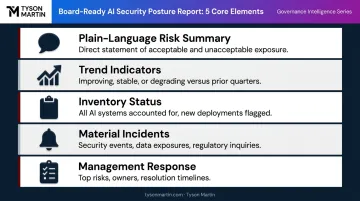
A useful board AI security posture report contains:
- Plain-language risk posture summary — not technical scores, but a direct statement of whether AI risk exposure is at an acceptable level and why
- Trend indicators — is posture improving, stable, or degrading compared to the prior two or three quarters?
- Inventory status — are all AI systems accounted for, and have any new systems been deployed since the last briefing?
- Material incidents or near-misses — any AI-related security event, data exposure, or regulatory inquiry since the last update
- Management's current response — what is being done about the top two or three risks, who owns it, and when it will be resolved
Tyson Martin's board reporting approach builds on exactly this structure: a one-page executive summary covering current posture, what changed, and what the board needs to decide — supported by three to five metrics with trend direction and a short decision backlog.
Every metric should pass a simple test: what decision does it support, and what happens if it moves in the wrong direction? Metrics that cannot answer that question are reporting activity, not enabling oversight.
That distinction also clarifies what does not belong in board materials.
What Should Not Be in a Board Report
Directors who receive the following should ask why it is in board materials rather than management reporting:
- Vulnerability counts without business context
- Raw compliance scores without interpretation
- Technical architecture diagrams
- Vendor threat intelligence summaries
- Any metric that does not connect to a business risk or require a board-level input
Reporting Cadence
Quarterly full-board briefings cover the three core questions above. The audit committee may receive more frequent updates — monthly signals on key AI posture metrics are appropriate when the organization is scaling AI deployment. Any material AI security incident, regulatory inquiry, or significant posture deterioration should trigger an out-of-cycle briefing, with escalation thresholds defined and agreed upon in advance.
Deloitte Canada's Governance of AI survey found 31% of boards report that AI is not on the board agenda at all — a gap that is increasingly difficult to defend under current regulatory expectations.
The Questions Every Board Director Should Be Asking
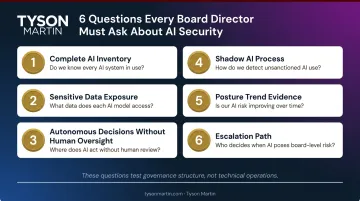
Well-informed directors ask questions that test governance structure and management capability — not questions that direct specific technical decisions. Each of the six questions below belongs at every relevant board or audit committee meeting.
"Do we have a complete, current inventory of every AI system running in this organization — including tools deployed by business units without IT or security approval?" If management cannot answer yes with evidence, the board has no governance foundation.
"What sensitive customer, patient, or financial data is being processed by our AI systems — and what controls govern how that data is accessed, retained, and protected?" This addresses the data exposure risk that most traditional security reporting misses entirely.
"Which of our AI systems make or influence consequential decisions without a human approval step — and has that been reviewed and deliberately approved?" Autonomous AI action without governance is an explicit regulatory concern, not just a theoretical risk.
"What is our process when an employee or business unit deploys an AI tool we haven't reviewed?" The answer reveals whether shadow AI governance exists in practice or only on paper.
"Show me the trend in our AI security posture over the past three quarters and tell me what drove any change." This separates boards that govern from boards that receive status updates. Management should produce demonstrable trend data — not reassurance.
"If an AI system caused a material data exposure or a regulatory inquiry today, what is the escalation path : who decides what, and how quickly?" If escalation protocols are not written and tested, they won't hold when it matters.
The Difference Between Oversight and Micromanagement
These questions have a consistent boundary: does the right governance structure exist, and does management have the resources and authority to execute? Directing which AI security tools to deploy or which vendors to select crosses that line. The former is governance. The latter creates liability without improving outcomes.
The legal standard is grounded in Caremark doctrine: directors who fail to establish reasonable AI risk monitoring systems face the same duty-of-oversight exposure that applies to other material enterprise risks. Accepting reassurance without evidence does not satisfy that standard.
Defining Decision Rights: What the Board Oversees vs. What Management Executes
Unclear decision rights are the most common governance failure in AI security oversight. Boards either get too deep into operational decisions — which tools to use, which vendors to select — or provide no meaningful challenge at all. The solution is an explicit, written framework that specifies which AI risk decisions live where.
Board-Level Decisions
The categories of AI security decisions that belong at board level:
- Setting AI risk appetite — how much AI-related exposure is acceptable, expressed in terms the organization can actually measure
- Approving material AI deployments that touch regulated data, customer-facing decisions, or financial transactions where failure creates direct liability
- Reviewing responses to material incidents that cross a defined threshold — an AI-related breach, a regulatory inquiry, or an AI system causing customer harm
- Ensuring security leadership has the authority and resources to govern AI risk effectively
Management-Level Decisions
Day-to-day AI security operations belong entirely to management:
- Tool and vendor selection for AI security monitoring
- Technical posture assessments and remediation sequencing
- Routine compliance evidence generation
- Operational response to non-material AI security events
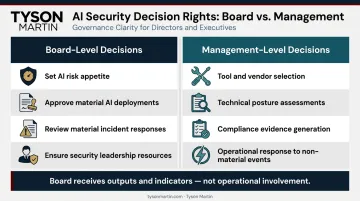
The board should receive outputs and indicators from these activities — not be involved in executing them.
Escalation Thresholds Must Be Written and Tested
The board and management need to agree in advance on the specific conditions that trigger out-of-cycle board notification. Those thresholds should cover:
- AI security incidents above a defined data exposure or customer impact threshold
- Regulatory inquiries related to AI systems
- Discovery of AI systems operating outside approved parameters (agentic systems taking unapproved actions, for example)
- Significant posture deterioration between reporting cycles
Written, board-approved escalation thresholds are the governance infrastructure that holds under real incidents and regulatory scrutiny. Improvising these criteria during an actual incident is when governance failures occur and when personal director liability becomes a real concern rather than a theoretical one.
Tyson Martin structures this framework for boards in advisory engagements: decision rights written clearly enough to survive a crisis, with verification built in so directors can confirm they are being followed, not simply reported on.
Leadership Transitions and Rapid AI Deployment
The governance infrastructure described above is most vulnerable during leadership transitions. When a CISO role is vacant or an organization is scaling AI quickly, board visibility into AI posture risk decreases at exactly the moment the risk is increasing. Interim or fractional CISO arrangements maintain governance continuity during these periods: board-ready reporting, decision rights documentation, and escalation protocols in place without disrupting deployment timelines.
The governance work that matters during a transition covers three milestones: explicit decision rights established in the first week, board-ready AI posture reporting produced by day 30, and documented processes with stable metrics the board can inspect after the transition ends.
Frequently Asked Questions
What should a board AI security posture report actually look like?
A board AI-SPM report should be a one-to-two page summary covering current risk posture in plain language, what changed since the last briefing, and what decisions or resources the board needs to provide. It is not a technical metrics dump or compliance scorecard — those belong in management reporting.
How often should boards receive AI security posture updates?
Quarterly full briefings are the standard cadence, with the audit committee potentially receiving monthly trend signals. Any material AI security incident, regulatory inquiry, or significant posture change triggers an out-of-cycle briefing based on written escalation thresholds.
What is the difference between AI-SPM and traditional cybersecurity board reporting?
Traditional cybersecurity reporting covers infrastructure protection — networks, endpoints, data stores. AI-SPM reporting covers the AI workloads running on top of that infrastructure: models, agents, and automated pipelines. These create distinct risks — data exposure through outputs, shadow AI deployment, and autonomous decision-making without oversight.
What questions should board members ask about shadow AI?
The primary question: "Do we have a complete, current inventory of every AI tool being used across the organization, including tools deployed by business units without IT or security review?" If the answer is anything other than an unambiguous yes, that gap is the first governance problem to solve.
Who is accountable at the board level for AI security posture?
Most boards assign primary AI risk oversight to the audit committee or a dedicated risk committee, with the full board responsible for setting AI risk appetite. Written decision rights governing what the board approves versus what management executes are what make accountability real rather than nominal.
How does a board know if its AI security posture reporting is adequate?
After each briefing, directors should be able to answer three questions without ambiguity: what is our current AI risk exposure, is it trending better or worse, and do we have the right governance structure in place? If any of those three cannot be answered, the reporting needs to change.