
Introduction
Most organizations deploying AI today are doing so without formal governance in place. According to IBM's 2025 Cost of a Data Breach report, 63% of breached organizations studied lacked AI governance policies — and only 37% had any AI approval or oversight mechanisms at all. That's not a technology gap. It's a board-level liability.
The pressure is arriving from multiple directions at once:
- The EU AI Act's first compliance deadlines took effect in February 2025
- U.S. federal agencies are actively reshaping AI policy
- State-level regulations in Colorado and California are advancing toward enforcement
- Shadow AI is spreading through enterprise environments faster than procurement teams can track it
Each of these forces demands a response — and most boards don't yet have one. This guide covers what an AI governance framework actually is (and isn't) and the specific security and compliance risks that demand board attention in 2025. It also compares the three leading frameworks and maps a path from policy to an inspectable governance program that doesn't stall the business.
Key Takeaways
- 63% of breached organizations lacked AI governance policies, per IBM's 2025 research
- EU AI Act fines reach €35M or 7% of global turnover — enforcement is no longer theoretical
- 78% of employees using AI at work bring their own tools, creating shadow AI exposure at scale
- NIST AI RMF, EU AI Act, and ISO/IEC 42001 are the three dominant frameworks in 2025 — mature organizations operate across all three
- Effective governance means named owners, a living AI risk register, and a 90-day execution plan with measurable outcomes
What Is an AI Governance Framework — and Why 2025 Is the Inflection Point
An AI governance framework is the structured set of policies, controls, accountability structures, and oversight mechanisms that govern how AI systems are developed, deployed, monitored, and retired. Not an ethics statement. Not aspirational language on a website. A working system with decision rights, audit trails, and escalation paths.
The distinction matters. Many organizations publish responsible AI principles without building any infrastructure to enforce them. Regulators don't accept good intentions as proof of compliance.
The Four Core Functions (NIST Model)
The NIST AI Risk Management Framework defines what governance actually encompasses — and it's the most widely adopted internal operating playbook across U.S. industries:
- Govern — Establish the policies, roles, and accountability structures
- Map — Identify and classify AI use cases by risk type and business impact
- Measure — Assess and track risks using defined metrics and testing protocols
- Manage — Respond to identified risks through controls, monitoring, and escalation
Originally developed for federal agencies, it now maps directly to the governance structure boards should be asking management to demonstrate — regardless of industry or company size.
Why 2025 Specifically
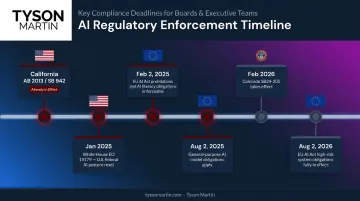
For boards and executive teams, the NIST model is no longer just a best-practice reference — it's the baseline against which regulators are beginning to measure. The enforcement calendar is now running:
- February 2, 2025 — EU AI Act prohibitions and AI literacy obligations became enforceable
- August 2, 2025 — General-purpose AI model obligations apply
- August 2, 2026 — Most high-risk AI system obligations take full effect
- January 2025 — White House Executive Order 14179 reset U.S. federal AI posture, with OMB memoranda M-25-21 and M-25-22 reshaping federal acquisition and governance requirements
- Colorado SB24-205 — Effective February 2026, requires developers and deployers of high-risk AI to protect consumers from algorithmic discrimination
- California AB 2013 and SB 942 — Training data transparency and AI-generated content disclosure requirements already in effect
Agentic AI and generative tools are accelerating the exposure. Employees are adopting AI faster than governance programs can track, creating concrete board-level risks: prompt injection attacks, hallucination liability, and shadow AI data leakage. Boards that lack a documented governance framework have no clear answer when regulators or plaintiffs ask how AI risk is being managed.
The Security and Compliance Risks Boards Can No Longer Ignore
Shadow AI and Data Leakage
The 2024 Microsoft and LinkedIn Work Trend Index found that 78% of employees using AI at work were bringing their own tools — tools not approved, not governed, and not subject to enterprise data retention policies.
Cyberhaven's analysis of 3 million workers found that corporate data entered into AI tools increased 485% between March 2023 and March 2024. More alarming: 27.4% of that data was sensitive, up from 10.7% the prior year. The same analysis found that 94.4% of Gemini usage and 95.9% of Bard usage occurred through non-corporate accounts.
This creates a dual exposure: insider threat risk and regulatory liability, simultaneously, in the same action.
Model-Specific Attack Vectors
AI systems introduce attack surfaces that traditional endpoint security wasn't designed to address:
- Prompt injection — Malicious inputs that manipulate model outputs or exfiltrate information
- Training data poisoning — Corrupting the data an AI model learns from to degrade performance or introduce backdoors
- Model extraction — Reverse-engineering model weights through repeated querying
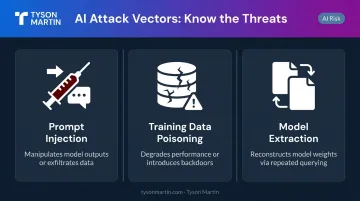
The OWASP Top 10 for LLM Applications lists prompt injection and training data poisoning as top risks. These require governance controls (access policies, input validation, model documentation) that conventional security tooling wasn't built to handle.
Regulatory Non-Compliance and Hallucination Liability
AI systems making consequential decisions in hiring, lending, healthcare triage, or fraud detection now face transparency and auditability requirements across multiple regulatory regimes. When an organization cannot produce an audit trail showing how an AI system reached a decision, the exposure is direct.
Enforcement is already moving. The SEC charged Delphia and Global Predictions in March 2024 for false and misleading statements about AI use, settling for $400,000 in civil penalties. In Mata v. Avianca, a law firm received a $5,000 sanction after court filings cited nonexistent cases generated by ChatGPT. These are early cases — the pattern is accelerating.
For regulated industries, acting on an AI hallucination creates real liability. Governance frameworks must include output validation layers and clear escalation paths before AI-generated content reaches a consequential decision point.
Bias and Discrimination Risk
AI trained on historical data can perpetuate systemic bias in hiring, credit decisions, clinical care, and customer service. Regulators have noticed:
- The EEOC published guidance in April 2024 on employment discrimination and AI
- HHS/OCR's 2024 Section 1557 final rule applies nondiscrimination principles to clinical AI decision-support tools
- The CFPB issued Circular 2024-06 on algorithmic scores used in employment decisions triggering FCRA obligations
For boards overseeing regulated industries, bias testing is a compliance obligation with direct legal exposure — not a discretionary audit item.
The Three Leading AI Governance Frameworks Compared
No single framework is right for every organization. Selection depends on industry, geography, and risk profile. Most mature organizations in 2025 are using all three in combination.
| Framework | Type | Best For |
|---|---|---|
| NIST AI RMF | Voluntary, U.S.-focused | Internal operating playbook, especially for organizations building from scratch |
| EU AI Act | Legally binding, global reach | Compliance floor for any organization whose AI outputs affect EU users |
| ISO/IEC 42001 | Certifiable standard | Third-party certification and demonstrated governance maturity |
NIST AI RMF
Released January 2023, the NIST AI RMF is voluntary, flexible, and built to align with existing NIST cybersecurity standards. Its Govern-Map-Measure-Manage structure is practical enough to serve as a genuine internal playbook, not just a compliance checklist. For organizations without a mandatory regulatory baseline, it's the right starting point, particularly for those building governance infrastructure for the first time.
EU AI Act
Regulation (EU) 2024/1689 is legally binding and applies to any organization deploying AI whose outputs are used in the EU, regardless of where the company is headquartered.
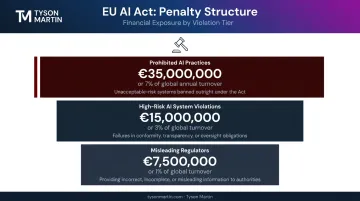
The fine structure makes non-compliance genuinely expensive:
- Prohibited AI practices: Up to €35,000,000 or 7% of global annual turnover
- High-risk AI system violations: Up to €15,000,000 or 3% of global turnover
- Misleading regulators: Up to €7,500,000 or 1% of global turnover
High-risk categories include AI in healthcare, financial services, hiring, critical infrastructure, law enforcement, and education. These systems face strict transparency, testing, and registration requirements before deployment.
ISO/IEC 42001
ISO/IEC 42001:2023 is the first internationally certifiable AI management system standard. It operates like ISO 27001 does for cybersecurity: structured documentation, risk assessment, and third-party certification.
Its primary value is external: demonstrating governance maturity to customers, regulators, auditors, and M&A counterparties. Organizations frequently use a hybrid approach: NIST AI RMF as the internal playbook, ISO/IEC 42001 for certification structure, and EU AI Act as the legal compliance floor.
Managing that complexity across three distinct regulatory environments is where most organizations stall. Tyson Martin's advisory work addresses this directly through the Cloud Security Alliance's AI Controls Matrix, which maps across ISO 42001, NIST AI RMF, and EU AI Act simultaneously — so organizations can satisfy multiple regulatory environments without rebuilding their governance architecture from scratch for each one.
Key Components of an Effective AI Governance Framework
Governance is operational or it isn't governance. The following components must be present and functional — not just documented:
- AI risk register — A living inventory of AI systems in use, with risk tiers, owners, and review dates
- Data governance and lineage tracking — Documentation of what data feeds which models, with controls on access to PII, PHI, and financial data
- Model audit trails — Technical documentation showing how AI systems were trained, tested, and validated before deployment
- Bias testing protocols — Scheduled, recurring testing — not one-time pre-deployment review
- Incident response plans specific to AI — Separate from general IR, covering model failure, adversarial inputs, and output errors
- Risk tier classification — A process for classifying new AI systems before deployment, not after
Data Governance as the Foundation
AI systems inherit the quality, bias, and privacy risks of their training data. Data governance isn't a separate program; it's the prerequisite for AI governance. Organizations in regulated industries handling PII, PHI, or financial data must know which data feeds which models and maintain traceable lineage.
Two regulations make this concrete. The EU AI Act's Article 10 requires data governance and management practices for high-risk AI training data. California's AB 2013 requires training data documentation to be publicly available for covered generative AI developers. Neither is a future requirement — both are in effect.
Continuous Monitoring
AI models drift. As data distributions shift over time, model performance and bias characteristics change without intentional modification. NIST's AI RMF explicitly identifies data, model, and concept drift as triggers for maintenance and corrective action.
This means governance programs need ongoing monitoring cadences, not just pre-deployment audits. Boards need trend-based reporting that shows whether controls are holding over time — not a compliance snapshot that's stale within months. Without that visibility, directors cannot fulfill their oversight role when drift or failure occurs.
Who Owns AI Governance: Board vs. Management Accountability
Boards set risk appetite. Management builds and operates the controls. Confusing these roles — boards that micromanage technical implementation, or management that waits for board direction on execution — is one of the most common governance failures.
The board's questions:
- Does a formal AI governance framework exist?
- Are there stable, trend-based metrics showing whether controls are working?
- Is there a clear escalation path for material AI risk events?
Management's responsibilities:
- Maintain the AI risk register with owners and due dates
- Operate the cross-functional governance structure
- Escalate material issues — with the context boards need to make decisions
- Document accountability gaps before they become incidents
Cross-Functional Ownership
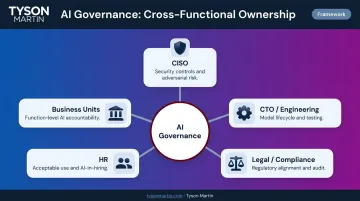
Effective AI governance doesn't belong to a single function. It requires defined ownership across the organization:
- CISO — Owns security controls, adversarial risk management, and access governance for AI systems
- CTO/Engineering — Manages model lifecycle, testing protocols, and technical documentation
- Legal/Compliance — Handles regulatory alignment, audit documentation, and disclosure readiness
- HR — Enforces acceptable use policies, employee training, and AI-in-hiring governance
- Business units — Accountable for AI use within their own functions and risk boundaries
Organizations in transition — new leadership, post-incident, or rapid AI adoption — often lack the internal capacity to stand up this structure quickly. Tyson Martin works with boards and executive teams to establish decision rights, risk thresholds, and reporting cadence: governance they can inspect, not just document.
Getting Started: A Practical AI Governance Roadmap
Phase 1: AI Use-Case Inventory (Days 1-30)
Before any governance structure means anything, organizations need to know what they're governing.
Start with a complete inventory:
- Identify all AI systems in use — sanctioned and unsanctioned, departmental and enterprise-wide
- Document what data each system touches — PII, PHI, financial data, proprietary information
- Assign preliminary risk tiers — using EU AI Act categories or NIST's risk mapping approach
- Flag shadow AI — tools in use without IT or legal review
This inventory step surfaces the exposure that organizations often don't know they have. It also creates the foundation for a defensible governance posture if a regulator asks.
Phase 2: Governance Structure (Days 31-60)
Structure determines whether policies hold under pressure. Three elements must be in place before any policy document carries weight:
- AI governance committee — Cross-functional representation with defined authority
- Escalation path — Clear route to senior leadership and the board for material AI risk events
- AI risk register — Named owners, risk ratings, and review dates, maintained as a living system with scheduled inspection points
Phase 3: Execution and Measurement (Days 61-90)
A plan with named owners and measurable outcomes is what separates governance that holds during real incidents from policy that exists only on paper. Boards should ask for this plan directly — not just the policy document.
The four deliverables that indicate execution readiness:
- Risk register with named owners and current ratings
- Decision-rights map clarifying who approves what at each risk level
- 90-day roadmap with specific milestones and accountable owners
- Metrics pack showing trend over time, not point-in-time snapshots
Frequently Asked Questions
What is the AI governance and compliance framework?
An AI governance framework is the structured system of policies, controls, and oversight mechanisms that ensure AI systems are developed and used responsibly and in compliance with applicable regulations. Compliance frameworks like the EU AI Act and NIST AI RMF provide the external standards organizations build from — governance is how those standards get enforced and put into practice inside the organization.
What is the data governance framework for AI?
A data governance framework for AI defines how data is collected, classified, accessed, and tracked throughout the AI model lifecycle — covering data quality, provenance (where data came from and how it moved), privacy compliance, and access controls. It forms the foundation for any credible AI governance program because AI systems inherit the risks of the data they are trained on.
What are the key components of an AI governance framework?
Core components include an AI risk register, defined decision rights and accountability structures, model audit trails, data access controls, bias testing protocols, incident response plans, and a continuous monitoring process. All must be working in practice, not just written down. A policy binder with no execution behind it will not satisfy a regulator or an auditor.
What is the difference between AI governance and AI ethics?
AI ethics defines the values and principles — fairness, transparency, accountability — that should guide AI. AI governance puts those principles into practice through enforceable policies, technical controls, and audit mechanisms. Organizations can publish ethics statements without any governance infrastructure, but regulators require evidence of actual controls, not stated intentions.
How should a board oversee AI risk without getting lost in technical detail?
Boards should focus on three questions: Does a formal AI governance framework exist? Are there stable, trend-based metrics showing whether controls are working? And is there a clear escalation path for material AI risk events? Boards set risk appetite and ask for inspectable outcomes; management owns the technical execution.