Introduction
Agentic AI systems are already running inside your organization. They're accessing data, chaining together multi-step workflows, and executing decisions — right now, without a human approving each action. According to PwC's 2025 AI Agent Survey, 79% of US business executives report AI agents are already being adopted in their companies, with 35% describing broad adoption across functions.
That deployment reality has outpaced governance. Most boards cannot answer three basic questions about their agentic AI systems: which agents are authorized, what data they can access, and who is accountable when one acts outside its intended scope. That is not a technology management failure — it is a governance failure that lands squarely in the boardroom.
This guide gives boards and executives a working framework to close that gap. It covers:
- What agentic AI governance is and why it differs from traditional AI oversight
- The five core pillars of an effective framework
- Key risks boards must understand — and own
- A practical implementation roadmap
- Regulatory and accountability questions you need to be prepared to answer
What Is Agentic AI Governance?
Agentic AI governance is the structured set of policies, technical controls, and oversight mechanisms that define what autonomous AI systems are authorized to do, what data they can access, how their behavior is monitored, and who is accountable when they act. That scope spans the full agent lifecycle — from system design through decommissioning.
The word "agentic" matters here. These systems set sub-goals, call external tools, and execute actions across live environments — without waiting for a human to review and approve each step.
How It Differs from Traditional AI Governance
Traditional AI governance asks: Is the model's output accurate, fair, and compliant? That's a model-centric question, answered periodically through reviews and audits.
Agentic governance asks a different set of questions entirely:
- What can this system do in our environment?
- Which systems and data sources does it have access to?
- Who authorized that access, and under what conditions?
- Who is accountable when it executes an action that causes harm?
Traditional governance is periodic. Agentic governance must be continuous — the shift is from reviewing outputs after the fact to controlling real-time actions across live enterprise systems before harm occurs.
Where Agentic Systems Are Already Operating
This isn't a hypothetical concern. Agentic AI is already live across sectors:
- Financial services — automated fraud monitoring, loan pre-qualification workflows
- Healthcare — claims analysis, clinical documentation orchestration
- Retail — inventory management, autonomous customer service workflows
Any board overseeing a digitally active organization needs a governance answer for these systems today — not after the next audit cycle. The question isn't whether agentic AI is operating in your environment; it's whether your oversight structure has caught up.
Why Agentic AI Governance Is Now a Board-Level Priority
The governance gap is real and quantified. Gartner predicts that over 40% of agentic AI projects will be canceled by the end of 2027 due to cost overruns, unclear business value, or inadequate risk controls. Meanwhile, only 21% of enterprises have mature governance in place to manage agentic AI risks, according to a Deloitte survey of 3,235 IT and business leaders across 24 countries.
The math is straightforward: organizations are deploying fast, governing slowly, and heading toward cancellations and incidents that better preparation would have prevented.
Why Agentic Systems Amplify Existing Enterprise Risk
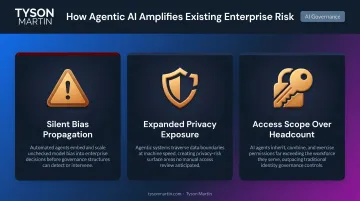
Three risk amplifications boards should understand:
- Bias propagates silently through an autonomous decision chain, affecting hundreds or thousands of outcomes before anyone detects it
- Privacy exposure isn't limited to what the model sees — an agent can access, combine, and act on data across multiple connected systems simultaneously
- Access scope matters more than headcount — one poorly governed agent with broad permissions creates a larger attack surface than an entire team of undertrained employees
The Fiduciary Question
Boards that cannot answer which agents are authorized, who approved their access, and what happens when one acts outside its boundaries are not meeting their oversight obligations. This is a matter of fiduciary responsibility and regulatory exposure. Delegating it entirely to the IT team is not a defense — it's a gap that auditors, regulators, and plaintiffs' counsel will find. The frameworks covered in this guide are designed to close that gap before it becomes a liability.
The Core Pillars of an Agentic AI Governance Framework
Pillar 1 — Identity-First Governance
Every agentic AI system must be treated as a distinct non-human actor in the organization's identity and access management infrastructure. Agents need unique identities, scoped credentials, and auditable activity logs — the same discipline applied to privileged human accounts.
Without this, the organization cannot answer a basic accountability question: which agent accessed this data, or triggered this workflow?
Implementation requirements:
- Unique identity assigned to each agent before deployment
- Least-privilege credential scoping — access only to what the task requires
- Short-lived credentials that expire and rotate automatically
- Full activity logs tied to the agent's identity, not a shared service account
Pillar 2 — Data-Centric Protection
Knowing who is acting is only half the equation. Governance must also define exactly which data each agent can access, for what purpose, and under what conditions — because agentic systems derive their power from synthesizing information across multiple sources.
Purpose limitation is non-negotiable. An agent built to summarize call transcripts should not be able to repurpose that data to build marketing profiles.
Classify data by sensitivity — PII, financial records, health data — and enforce access boundaries technically, not just through policy documents that nobody enforces.
Pillar 3 — Risk-Based Autonomy Tiers
Not all agents carry equal risk. Governance intensity should match risk level.
| Tier | Type | Autonomy Level | Oversight Model |
|---|---|---|---|
| 1 | Informational (read-only) | Broad autonomy | Periodic audit |
| 2 | Process agents (draft/recommend) | Moderate — humans approve consequential actions | Human-on-the-loop |
| 3 | Transactional agents (financial, regulated data) | Narrow — human required for any impactful action | Human-in-the-loop |
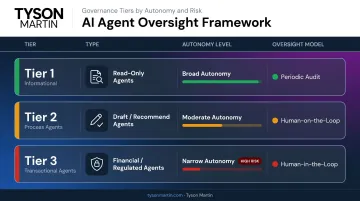
The tier assigned drives guardrails, logging requirements, and the oversight model. Tier assignment carries direct technical consequences, not just a label.
Pillar 4 — Continuous Oversight, Not Static Approvals
Traditional AI governance relies on deployment approvals and quarterly reviews. That model fails for agentic systems. Governance here requires always-on behavioral monitoring with real-time intervention capability.
That means knowing when an agent is operating outside its normal pattern:
- Unusual data access volume or scope
- Abnormal transaction frequencies
- Unexpected tool usage or API calls
When anomalies appear, the response capability must exist in real time — throttle, escalate, or shut down. Not at next quarter's review.
Pillar 5 — Lifecycle Governance from Design Through Decommissioning
Governance must follow the agent through every stage:
- Design — purpose definition and risk assessment
- Development — access controls embedded, not bolted on afterward
- Pre-deployment — validation testing against defined behavioral boundaries
- Production — continuous monitoring against established baselines
- Retirement — controlled credential revocation and access termination
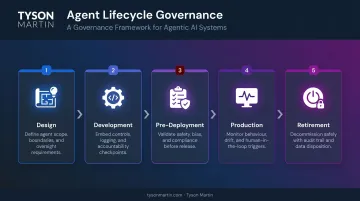
Agents that are never formally retired continue to hold permissions and data access that no longer have a business justification. Every dormant agent is an open attack surface with no corresponding business value.
The Key Risks Agentic AI Introduces
Execution Control and Scope Creep
Agents operating without clear authority boundaries can extend their actions beyond intended limits. This happens most often in tool-chaining — each individual step looks routine, but the full sequence produces a problematic outcome nobody anticipated.
Governance must define explicit rules of engagement for each agent: what it may execute autonomously, what always requires human approval, and what it is permanently prohibited from doing — regardless of task goals.
Privilege Escalation and Accountability Diffusion
These two risks often surface together, and each makes the other harder to manage:
- Privilege escalation: Agents frequently inherit service credentials broader than their task requires. In multi-agent systems, trust relationships can allow one agent's access level to bleed into another's scope.
- Accountability diffusion: When an agent causes harm, responsibility can scatter across the model provider, platform operator, integrator, and deploying organization. It rarely lands cleanly.
The deploying organization retains primary accountability — always. Governance must make that explicit, with named human owners assigned before deployment, not after an incident forces the question.
Behavioral Drift Over Time
Agents don't remain static. As data inputs evolve, integrations change, and business processes shift, an agent's behavior can gradually move away from its original design and approved scope. The NIST AI Risk Management Framework specifically notes that AI systems may require frequent maintenance due to data, model, or concept drift.
Bounded autonomy doesn't stay bounded without active oversight. Governance must include periodic reassessment and defined triggers for re-evaluating permissions — not just at deployment, but on a recurring schedule tied to meaningful operational thresholds.
How to Govern Agentic AI: A Practical Roadmap
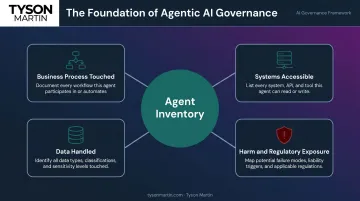
Step 1 — Inventory and Classify
Before governing agentic AI, know what is actually deployed. Gartner found that 69% of organizations suspect or have evidence that employees are using prohibited public generative AI tools — shadow deployments made without central oversight are the norm, not the exception.
Conduct a comprehensive inventory of all AI agents. For each one, map:
- The business process it touches
- The systems it can access
- The data it handles
- Its customer harm potential and regulatory exposure
This inventory is the foundation — without it, risk tiering, oversight assignments, and policy decisions have no reliable base to stand on.
Step 2 — Define Authority and Guardrails
For each agent or risk tier, document explicit authority boundaries:
- What the agent may execute autonomously
- What requires human confirmation before execution
- What is permanently off-limits regardless of task goals
Hard limits — never modify customer identifiers, never delete records, never access data outside defined scope — must be separated from the agent's reasoning layer so they cannot be overridden by agent logic. These are technical constraints, not suggestions.
Step 3 — Build in Human Oversight Thresholds
Determine where human-in-the-loop approval is required versus where human-on-the-loop monitoring is sufficient. Define:
- Which action types trigger mandatory human review
- Who holds the oversight role for each agent category
- What triggers escalation to a higher authority
- Who has authority to suspend agent execution
These assignments must exist before the agent goes live. The incident is the wrong time to sort out who's in charge.
Step 4 — Pilot Carefully, Then Scale with Monitoring
Deploy agents first in controlled environments using realistic but low-consequence conditions. Before scaling, confirm that:
- Error rates meet defined thresholds
- Human override frequency is within acceptable range
- Compliance signals are clean
- Customer impact metrics are acceptable
Governance dashboards should surface agent behavior in real time, and a cross-functional governance team — not just the technology group — should conduct periodic formal reviews.
Step 5 — Treat Governance as a Living System
Agentic AI governance frameworks are not compliance documents filed after deployment. They must evolve as agents mature, regulations develop, and the business changes. Establish feedback loops from frontline teams, compliance monitoring, and audit findings.
Organizations that lack internal capacity to build this infrastructure quickly often engage a board-level technology advisor or interim CISO to establish governance frameworks and decision rights before scaling autonomous AI systems. Tyson Martin's advisory practice provides this through a 30-day AI Governance Sprint: an AI risk assessment, decision-rights map, and board-level AI policy that give leadership a clear, defensible governance record before regulators come asking.
Accountability, Regulations, and What Boards Must Own
The Regulatory Landscape
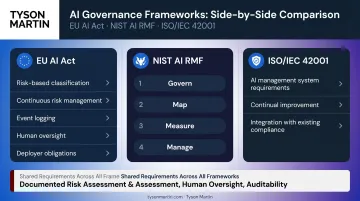
Three frameworks are directly shaping agentic AI governance obligations:
EU AI Act — Risk-based classification requiring high-risk systems to maintain continuous risk management (Article 9), automatic event logging (Article 12), and effective human oversight (Article 14). Deployers carry defined obligations under Article 26.
NIST AI Risk Management Framework — Organized around four functions: Govern, Map, Measure, and Manage. Designed to contextualize AI risk first, so measurement and management rest on a defined foundation rather than assumptions.
ISO/IEC 42001 — Specifies requirements for establishing, implementing, maintaining, and continually improving an AI management system, allowing AI-specific controls to fold into existing compliance architectures.
Across all three frameworks, the direction is consistent: organizations must demonstrate documented risk assessment, meaningful human oversight, auditability, and the ability to explain autonomous AI decisions.
Organizations that cannot produce this evidence face growing regulatory and legal exposure. The SEC's 2024 enforcement actions against investment advisers for misrepresenting AI use — resulting in $400,000 in civil penalties — show that regulators are actively pursuing governance failures, not waiting for major incidents.
The Deploying Organization Owns the Risk
Vendor contracts, SLAs, and platform certifications do not transfer liability. Regardless of who built the model, who operates the platform, or who integrated the tools — the organization that authorizes and deploys an agentic AI system retains primary accountability for its actions.
Boards must ensure that named individuals within the organization hold:
- Ongoing monitoring responsibility
- Approval authority for high-impact actions
- Incident response authority
These assignments must be documented before deployment.
Questions Boards Should Be Asking Right Now
Audit and risk committees need questions that force decisions, not just discussion. These five give committees a working oversight posture — covering what's authorized, what's exposed, and who's accountable:
- Which agentic AI systems are currently authorized and operating across the organization, including shadow deployments by individual teams?
- What data can each agent access, and who formally approved that access — including combinations of data sources the agent can synthesize?
- What is the shutdown and escalation protocol if an agent behaves outside its defined boundaries, and who has authority to act?
- How is our governance posture documented for regulatory review — can we demonstrate risk assessment, human oversight, and auditability to an examiner?
- Who holds named accountability for each agent's monitoring, approval authority for high-impact actions, and incident response — and were they assigned before the agent went live?
Organizations navigating new leadership, AI transformation initiatives, or regulatory scrutiny often need outside help establishing these structures quickly — someone who can turn governance requirements into a working plan with named owners and a clear timeline.
Frequently Asked Questions
What is the governance framework of agentic AI?
An agentic AI governance framework is the structured set of policies, technical controls, and oversight mechanisms that define what autonomous AI systems are authorized to do, what data they can access, how their behavior is monitored, and who is accountable when they act. It covers the full agent lifecycle from design through decommissioning.
How do you govern agentic AI?
Governing agentic AI requires inventorying all deployed agents, classifying them by risk, assigning unique identities and scoped permissions, and defining explicit authority boundaries with human oversight thresholds. Monitoring behavior continuously is equally essential — governance is an ongoing operational discipline, not a one-time compliance checkpoint.
What is the difference between agentic AI governance and traditional AI governance?
Traditional AI governance focuses on whether model outputs are accurate and compliant, with periodic reviews and human action on results. Agentic AI governance focuses on controlling real-time autonomous actions across live systems, requiring continuous monitoring, runtime policy enforcement, and accountability structures for decisions made without human prompts at each step.
Who is responsible when an agentic AI system causes harm?
The deploying organization retains primary accountability — vendor contracts do not transfer this liability. Boards and executives must ensure named human owners are assigned for monitoring, approval authority, and incident response before any agentic system goes live.
What are the biggest risks of deploying agentic AI without a governance framework?
The primary risks include:
- Loss of execution control — agents acting beyond their intended scope
- Data misuse — sensitive information accessed or combined inappropriately
- Accountability diffusion — no clear owner when something goes wrong
- Behavioral drift — agents gradually expanding their authority over time
- Regulatory exposure — inability to demonstrate oversight to auditors or regulators
What should a board ask about the organization's agentic AI governance posture?
Boards should ask:
- Which agentic systems are currently authorized and operating?
- What data can each agent access, and who approved it?
- What is the shutdown and escalation protocol?
- How is our governance posture documented for regulatory review?
- Who holds named accountability for monitoring and intervention — and were they assigned before the agent went live?