Introduction
Your legal team discovered it during a routine vendor review. An AI agent deployed six months earlier by a product team was still active, still held admin credentials to three internal systems, and the developer who built it had left the company in February. Nobody knew it was running. Nobody owned it.
That scenario plays out across enterprises right now — and it's not hypothetical. It's a governance failure hiding in plain sight. AI agents are being deployed across business units, automating workflows, resetting credentials, processing transactions, and accessing sensitive systems. Governance structures are still catching up.
The question is no longer whether to adopt AI agents. It's whether your organization can govern them without sacrificing the speed advantage they create. Most can't answer that yet — and that gap is precisely where exposure accumulates.
Effective AI governance gives boards and executives something they don't currently have: visibility into what agents are running, who owns them, and what they can touch — before the next vendor review finds the answer for you.
Key Takeaways
- 82% of organizations already use AI agents in production, but only 44% have policies to secure them
- AI agents are a fundamentally different risk class: autonomous, fast, and capable of chaining actions without human checkpoints
- Existing IAM and governance frameworks weren't built for non-human actors at machine speed
- Effective governance requires four things: inventory, decision rights, least privilege, and continuous auditability
- Strong governance accelerates AI deployment by replacing case-by-case negotiation with a repeatable approval path
AI Agents Have Moved From Experiment to Enterprise Reality
The numbers confirm what most security and governance leaders already suspect. According to SailPoint's 2025 AI agent adoption report, 82% of organizations already use AI agents, and 98% plan to expand that use within the next year. Meanwhile, only 44% report having policies to secure them.
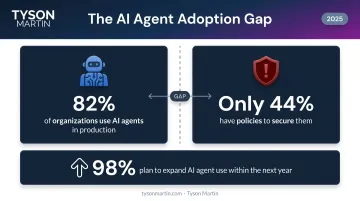
That gap — between deployment rate and governance rate — is the problem.
Gartner adds another dimension: task-specific AI agents were present in less than 5% of enterprise applications in 2025, with a forecast of 40% by end of 2026. The deep application integration is still early — and accelerating fast.
The Shadow Agent Problem
That pace of expansion makes visibility harder — not easier. AI agents don't only enter the enterprise through IT-approved channels. They arrive through departmental vendor tools, individual developer experiments, and productivity integrations that bypass security review entirely.
SailPoint calls this "Shadow AI": agents deployed outside IT governance. The data behind it tells the real story:
- More than half of organizations report gaps in visibility and ownership over what their agents can access or do
- CyberArk's 2025 data shows machine identities now outnumber human identities 82:1
- Most organizations lack governance structures built for that identity ratio
Each AI agent is a non-human identity with credentials, permissions, and access scope. Without deliberate oversight, that ratio becomes a board-level liability.
The Governance Gap: Where Real Risk Lives
AI agents don't behave like traditional software. They act autonomously across multiple systems, chain actions without human intervention at each step, and operate at a speed no security team can manually monitor in real time.
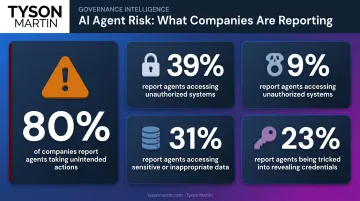
The consequences are already visible. SailPoint's research found:
- 80% of companies report AI agents taking unintended actions
- 39% report agents accessing unauthorized systems or resources
- 31% report agents accessing sensitive or inappropriate data
- 23% report agents being tricked into revealing access credentials
The Orphaned Agent Problem
When a project lead or developer who built an agent leaves the organization, the agent doesn't leave with them. It keeps running. It retains its permissions. Without a designated owner, there is no update process, no review cadence, and no de-provisioning trigger. Okta's NHI Top 10 lists "Improper Offboarding" as the top non-human identity risk for exactly this reason.
CyberArk reports 35% of organizations struggle to identify who is authorized to access and use specific machine identities. That number describes an orphaned agent problem at scale.
Over-Permissioning and Blast Radius
Those identity gaps compound a separate but related problem: permission scope. Agents frequently inherit broader access than their function requires, because permission structures weren't designed with non-human actors in mind. An over-permissioned agent expands the blast radius of any compromise and can take damaging actions faster than a security team can detect or interrupt.
The ServiceNow "BodySnatcher" vulnerability illustrates the exposure. AppOmni disclosed CVE-2025-12420, a flaw in ServiceNow's Virtual Agent API that allowed unauthenticated attackers to impersonate any user with only an email address, bypassing MFA and SSO entirely. Potential exposure included Social Security numbers, healthcare records, and financial data.
The vulnerability was reported on October 23, 2025 and remediated within seven days. The incident shows how agentic integrations can create identity-trust bypass risks even where established controls exist.
The Audit Trail Problem
When an AI agent takes a consequential action — unauthorized data access, a compliance-relevant transaction, a system change — the organization must explain what happened, who authorized it, and what controls were in place. Without a governance structure, that trail either doesn't exist or isn't defensible.
The EU AI Act now requires deployers of high-risk AI systems to retain automatically generated logs for at least six months. The SEC's 2024 recordkeeping enforcement imposed $88.225 million in combined penalties across eleven firms for failures to maintain electronic communications. In regulated industries, an absent audit trail is itself a compliance failure, not merely a governance gap.
Why Your Existing Frameworks Weren't Built for This
Traditional enterprise governance — security policies, IAM systems, change control, vendor risk — was designed around human actors making intentional decisions at human speed. AI agents violate every assumption those frameworks rest on.
The Identity Governance Gap
Standard IAM systems track employees and service accounts. AI agents are neither. They're non-human identities with their own lifecycle, permissions, and accountability requirements. CyberArk found 42% of organizations lack a defined machine identity security strategy — and 77% of security leaders believe every undiscovered machine identity is a potential point of compromise.
Governing AI agents as if they were employees or conventional applications doesn't work. They need their own governance category: non-human identities with defined capabilities, documented owners, and explicit lifecycle controls that don't exist in most frameworks today.
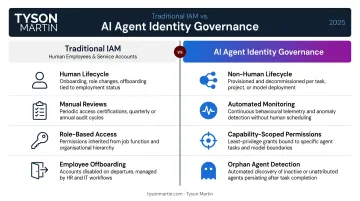
Why "Apply Existing Policy" Fails
Governance frameworks that rely on human judgment at each step — approvals, reviews, escalations — break down when the actor can complete hundreds of actions before a human reviewer sees the first one. An agent operating under a broad service account can take dozens of sensitive actions in the time it takes a security analyst to open a ticket.
Manual checkpoints aren't the answer. Automated guardrails are. But technical controls only hold when someone owns them.
The Organizational Accountability Gap
AI agent governance cuts across security, legal, compliance, cloud operations, and individual business units. Most organizations haven't answered the hard question underneath all of it: who actually owns it?
That means determining who approves a new agent deployment, who reviews permissions on a regular cadence, and who is accountable when an agent acts outside its defined boundaries. Without explicit decision rights, governance stays theoretical — and accountability gaps fill the space where policy should be.
A Board-Level Governance Framework for AI Agents
Every board and executive team should be able to answer four questions about their AI agents:
- What agents do we have?
- What can they access?
- Who owns them?
- What happens when one misbehaves?
If those questions produce confident answers, the governance framework is working. If they produce silence or uncertainty, that silence is the risk.
Inventory and Classification
Governance starts with discovery. Every deployed AI agent should be registered as a named identity with documented capabilities, data access scope, and a designated human owner. Without a complete, current inventory, every other control is built on a blind spot.
That inventory must span all channels: licensed vendor tools, internally built agents, and anything deployed through departmental initiatives without central review.
Decision Rights and Escalation Thresholds
Effective AI governance requires explicit decision rights: who can authorize a new agent deployment, who can approve expanded permissions, and what thresholds trigger human review or automatic shutdown.
The standard that matters here is governance you can inspect, not just governance you can describe. A tiered model works well:
- Low-impact agents (narrow scope, no access to regulated data): management approval within defined policy
- Medium-impact agents (access to core systems, customer data): executive approval with documented review
- High-impact agents (financial transactions, production infrastructure, regulated data): board or audit committee visibility, with human checkpoints built into the workflow
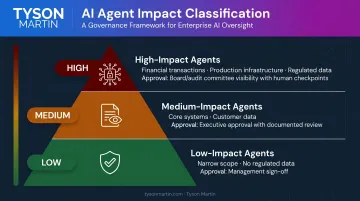
Organizations that define these tiers before an incident are the ones that respond to one coherently.
Least Privilege and Access Boundaries
Agents should receive only the permissions necessary for their specific task. Use short-lived credentials where possible, and review access on a defined cadence rather than letting permissions accumulate indefinitely.
AWS frames this directly: least-privilege access and permission boundaries for agentic workflows limit agent scope and prevent unauthorized or unintended actions. Google's guidance adds a complementary principle: single-purpose service accounts for each application, rather than shared accounts across workloads.
Human Oversight Checkpoints
Not every AI agent action should be fully autonomous. High-impact, sensitive, or irreversible actions need a human approval step:
- Financial transactions above a defined threshold
- Changes to production infrastructure
- Access to regulated or sensitive data classes
- Any action that would be difficult or impossible to reverse
The question isn't whether to include human checkpoints — it's identifying precisely where in each agentic workflow they belong.
Monitoring and Auditability
Continuous monitoring of agent activity isn't optional. At minimum, the audit record should capture:
- What the agent did and when
- What data or systems it accessed
- Whether its behavior matched its authorized scope
- Whether anomalies were detected and flagged
This is the inspectable execution layer — the difference between a governance framework that looks good on paper and one that holds up in an audit or incident response. AWS's agentic AI security guidance identifies action logging, reasoning-chain capture, and continuous behavioral logging as requirements for higher-autonomy systems. That standard should inform enterprise governance design.
From Compliance Burden to Competitive Advantage
Treating AI agent governance as a compliance tax slows everything down. Treating it as infrastructure for trustworthy deployment is what lets organizations scale faster, with fewer incidents, and with the board-level confidence that sustains investment rather than stalling it.
McKinsey's 2024 AI survey found that high performers — organizations attributing more than 11% of EBIT to generative AI — were nearly twice as likely to involve legal functions and embed risk reviews early in development. Governance and performance move together, not against each other.
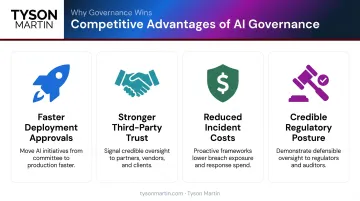
A well-governed AI agent program enables:
- Faster deployment approvals — when the risk framework exists, new agents move through a defined process rather than a case-by-case negotiation
- Stronger third-party trust — partners and vendors have greater confidence when they can see governance is real, not aspirational
- Reduced incident costs — governed agents with least-privilege access and monitoring have a smaller blast radius when something goes wrong
- Credible regulatory posture — when the SEC or an auditor asks, you have an answer
The cultural effect matters as well. Teams that know their AI tools are governed and auditable use them more confidently — and more responsibly. Visible guardrails don't constrain speed; they make speed defensible.
Where to Start: Three Moves This Quarter
Move 1: Conduct a Rapid AI Agent Inventory
Identify every agent currently running across the enterprise — licensed, internally built, or departmentally deployed. Document ownership, access scope, and business purpose for each. This single step converts unknown risk into managed risk — and it often surfaces agents leadership didn't know existed.
Move 2: Establish Governance Ownership
Assign a named executive or cross-functional team with explicit accountability for AI agent policy. Without a named owner, deployment approvals stall, permission reviews never happen, and no one leads the response when an agent acts outside its boundaries.
Move 3: Define Escalation Thresholds Before the Next Deployment
Before the next agent goes live, document:
- What it is and is not authorized to do
- Which actions require human approval before execution
- Under what conditions it should be automatically suspended
This is the minimum viable governance layer. The board or audit committee should review these thresholds at least quarterly — not as a one-time exercise, but as a standing agenda item.
Frequently Asked Questions
Frequently Asked Questions
What makes AI agents harder to govern than traditional software or service accounts?
AI agents act autonomously across multiple systems, chain actions without human intervention, and operate at a speed that makes manual review impractical. Unlike static software, agents make decisions — which means governance must address behavior, not just configuration.
Who should own AI agent governance in the enterprise?
Governance ownership should span security, legal, compliance, and business operations, but a named executive or governance committee must hold ultimate accountability. Without clear decision rights, governance stays theoretical — and no policy fills that gap on its own.
How should boards receive reporting on AI agent risk?
Boards need a plain-English view of what agents are deployed, what they can access, whether any incidents or policy violations occurred, and what the trend looks like over time — a risk posture summary tied to business impact, not a technical inventory.
What are the biggest compliance risks posed by ungoverned AI agents?
Regulatory exposure under data privacy laws, financial services regulations, and the EU AI Act's logging requirements. In regulated industries, the inability to produce an audit trail of agent actions is a compliance failure in its own right, separate from any governance shortfall.
Can strong AI governance actually accelerate AI adoption rather than slow it down?
Yes. Governance creates a repeatable approval pathway. Once the framework is in place, new agent deployments move through a defined process rather than a case-by-case negotiation — reducing friction and giving the board and legal team the confidence to sustain investment over time.
What is the first practical step for an organization with no current AI agent governance?
Start with inventory. Understand what's already deployed before writing a single policy. Then assign ownership and document access boundaries before the next deployment is approved. Visibility comes first. Documentation follows.