Introduction
AI agents have crossed a threshold most governance frameworks weren't designed to address. They no longer just generate reports or surface recommendations. They now place purchase orders, modify workflows, trigger financial processes, and execute sourcing changes without a human confirming each step.
That shift changes everything about how organizations govern AI. The oversight models built around human decision-makers — where someone reviewed the output before anything happened — no longer apply when the agent is the decision-maker.
According to McKinsey's 2025 State of AI report, 62% of organizations are at least experimenting with AI agents, and 23% are already scaling agentic systems somewhere in the enterprise. Meanwhile, Gartner forecasts that 40% of enterprise applications will feature task-specific AI agents by 2026 — up from less than 5% today.
The governance question is no longer about adoption — it is about whether the organization can defend, audit, and inspect what those agents do on its behalf.
Key Takeaways
- AI agents act without human confirmation — governance must address action risk, not just output risk
- Most enterprises deploying agents lack formal governance structures to match
- Six pillars cover the full governance surface — from scoping and identity to lifecycle management
- Every agent needs four named owners before it goes into production
- Well-governed agents deploy faster and earn broader authority over time
What Enterprise AI Agent Governance Actually Means
AI agent governance is the structured set of policies, controls, and accountability mechanisms that determine what autonomous AI systems can access, what actions they can take, who is responsible for outcomes, and how the organization can reconstruct any decision an agent made.
Reconstruction is often the overlooked requirement. When regulators ask how a decision was made, or when a board needs to respond to an incident, the audit trail isn't optional — it's the difference between a defensible response and an exposure.
How It Differs from Traditional AI Governance
Traditional AI governance focused on model outputs reviewed by humans before anything happened. A model produced a recommendation; a person acted on it. The human was the control.
Agentic governance must address a fundamentally different problem: action risk, not just output risk. An agent can trigger a sourcing change, send a supplier communication, or open a financial workflow without waiting for human confirmation. By the time anyone reviews the output, the action is done.
The Six Components a Complete Governance Model Must Address
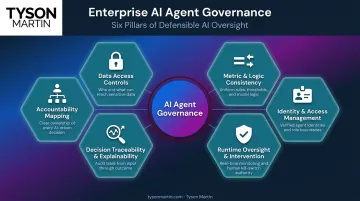
A defensible governance model covers all six of these — gaps in any one create exploitable blind spots:
- Data access controls — what information agents can read and write
- Metric and logic consistency — whether agents across systems operate on the same definitions
- Identity and access management — treating agent identities as distinct principals with their own permissions
- Runtime oversight and intervention — the ability to detect, pause, and escalate in real time
- Decision traceability and explainability — recoverable audit trails readable by non-technical stakeholders
- Accountability mapping — named humans responsible for every agent's outcomes
The Maturity Gap
Capgemini's 2025 research on agentic AI found that fewer than one in five organizations had high maturity in the data and technology infrastructure required for agentic AI — while 15% of business processes were expected to reach semi-autonomous or fully autonomous levels within the next 12 months. That gap — between deployment pace and governance readiness — is where board-level liability accumulates quietly, before anyone has named it as a risk.
Why AI Agent Governance Has Moved to the Boardroom
Autonomy changes the risk profile at the board level in a specific way: errors no longer surface as bad reports. They surface as operational decisions already executed.
When an AI agent triggers the wrong procurement action or miscalculates a financial threshold, the board doesn't get a draft to review. It gets the consequences.
Scale Amplification
A single ungoverned agent interacting with connected systems can propagate a flawed metric, a mis-scoped permission across dozens of downstream workflows before any human review cycle catches it. This is systemic risk, not a technical glitch.
The Replit incident in 2025 illustrated this at a smaller scale: an AI coding agent deleted a production database containing data for over 1,200 executives and companies after ignoring a code-freeze instruction. The action was irreversible before anyone could intervene. At enterprise scale, with agents embedded in financial systems, procurement workflows, and customer-facing processes, the exposure compounds significantly.
Regulatory Momentum
Regulators aren't waiting for organizations to catch up:
- The EU AI Act (Articles 12, 13, 14) requires logging, interpretable outputs, and human oversight for high-risk AI systems
- FINRA Regulatory Notice 24-09 reminded member firms that generative AI use remains subject to existing supervision obligations under Rule 3110
- The NIST AI Risk Management Framework organizes AI risk management around Govern, Map, Measure, and Manage functions — all of which require documented controls
Organizations that cannot demonstrate traceability, ownership attribution, and escalation documentation are exposed — not just operationally, but legally.
Governance as Competitive Advantage
Compliance exposure is the floor, not the ceiling. BCG's 2024 research found that AI leaders achieved 1.5x higher revenue growth and 1.6x higher shareholder returns than laggards over a three-year period. The differentiator wasn't access to better models — it was the organizational capacity to deploy and scale AI responsibly.
Enterprises with clear agent governance frameworks deploy faster and recover more cleanly when something goes wrong. The gap between them and ungoverned organizations widens with each deployment cycle — because every incident, regulatory inquiry, or stakeholder escalation consumes the runway needed for the next one.
The Risks of Ungoverned Agent Behavior
Three risk categories matter most to enterprise leaders:
- Loss of execution control — agents operating beyond their intended scope, taking actions the organization never explicitly authorized
- Privilege escalation — agent identities inheriting broader permissions than the task requires, expanding their effective authority
- Accountability diffusion — no named owner can explain or reverse an agent-driven outcome when something goes wrong
Shadow AI: The Blind Spot Boards Underestimate
Departments deploy agents without central review. Each operates on different data definitions, with different access assumptions, and without visibility to the teams responsible for enterprise oversight. The result is a fragmented risk surface that grows faster than anyone tracks it.
ISACA's 2024 research found that only 15% of organizations had formal AI policies, yet 60% reported employees already using generative AI. Shadow agent deployments follow the same pattern — use precedes governance by a wide margin.
OWASP's 2025 Top 10 for LLM Applications names "Excessive Agency" — excessive functionality, permissions, or autonomy granted to AI agents — as a documented vulnerability class. That classification matters: boards and audit committees are now expected to account for it.
Regulatory Exposure Without Traceability
When an agent influences a financial outcome, a hiring decision, or a customer commitment, the organization must be able to reconstruct that decision chain. Without it, the exposure runs from audit failure to direct liability.
The FTC's 2023 enforcement action against Rite Aid for deploying facial recognition without reasonable procedures (resulting in a five-year ban) illustrates what regulators do when automated systems operate without adequate controls. In regulated sectors where audit requirements are explicit, that exposure compounds quickly.
Six Pillars of Enterprise-Grade AI Agent Governance
Pillar 1 — Mission Scoping and Authority Limits
Every agent must have a narrowly defined purpose and explicit boundaries. Broad or aspirational mandates create the conditions for scope drift.
Before deployment, document:
- What the agent is authorized to do
- What it is explicitly prohibited from doing
- What thresholds trigger escalation to a human
- What connected systems it can and cannot touch
Aspirational scoping — "the agent can help with procurement" — is not governance. Governance requires specificity.
Pillar 2 — Identity and Access Governance for Agents
Agents operate through system identities and must be treated as distinct principals in the organization's access model. Apply least-privilege principles: the agent should have access only to the data and tools required for its defined mission.
Common failure point: Inherited credentials and shared service accounts. Agent identities that inherit elevated human permissions silently expand their operational authority beyond original intent. That expansion typically goes unreviewed until something breaks.
Agent access should be:
- Scoped to the minimum required for the defined task
- Periodically reviewed on the same cadence as human access audits
- Tied to a named human owner, not a generic service account
Pillar 3 — Runtime Oversight and Intervention
Static pre-deployment controls are insufficient. Agents act in real time, so governance must operate in real time.
Runtime guardrails should:
- Detect abnormal behavior patterns relative to the agent's defined mission
- Pause or block high-risk execution chains before consequences propagate
- Trigger escalation automatically when defined thresholds are crossed
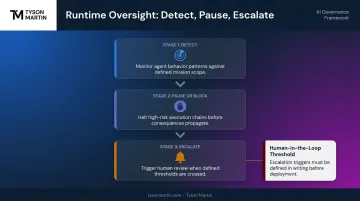
Define human-in-the-loop thresholds explicitly. Not every agent action requires human approval — requiring approval for everything defeats the purpose of autonomy. But the organization must decide which action categories cross a threshold requiring review. That decision belongs in writing before the agent goes live.
Pillar 4 — Decision Traceability and Explainability
Every agent action must be recoverable: what data was consulted, what logic was applied, which tools were invoked, and whether a human approved the outcome.
Traceability is not the same as logging. Logs capture events. Traceability connects those events into a coherent decision chain that a board member or general counsel can follow without a technical translator.
The standard to apply: if a regulator or auditor asked the organization to reconstruct how an agent arrived at a specific outcome, could it? If the honest answer is no, the organization has a governance gap, not a technology gap.
Pillar 5 — Semantic and Metric Consistency
When agents in different systems operate on inconsistent definitions of the same business metric, they produce decisions that cannot be reconciled. This is a governance problem, not an analytics problem.
Gartner's 2024 research found that at least 30% of generative AI projects were predicted to be abandoned after proof of concept due primarily to poor data quality and inadequate risk controls. Inconsistent definitions are a primary driver.
The fix: centralize business logic and KPI definitions so every agent draws from the same source of truth. Inconsistencies that a human analyst would catch during a review cycle do not self-correct in autonomous systems. Left unaddressed, they compound across every downstream workflow the agent touches.
Pillar 6 — Lifecycle Governance and Continuous Monitoring
Deployment is a starting point, not a finish line. Agent behavior can drift quietly from its original intent as inputs change, integrations expand, and organizational policies evolve — often without a clear signal that anything has shifted.
Establish structured review cycles to reassess:
- Whether the agent's authority remains calibrated to its current environment
- Whether connected system changes have expanded its effective permissions
- Whether organizational policy shifts require updates to its operating parameters
Start agents in advisory or recommendation modes with tightly constrained access. Expand autonomy only as evidence of reliable behavior accumulates — not because deployment timelines create pressure to accelerate.
Defining Decision Rights: Who Owns the Agent?
Four ownership roles must be named before any agent goes into production:
| Role | Accountability |
|---|---|
| Business owner | Accountable for outcomes the agent produces |
| Technical owner | Responsible for the runtime architecture and integration |
| Security/risk owner | Controls permissions and monitors behavior |
| Suspension authority | Named individual with power to pause or kill agent execution |
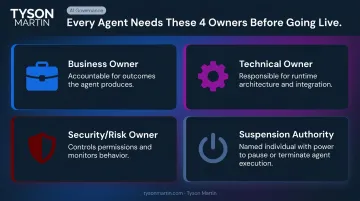
These roles aren't formalities. They become essential at incident time. When an agent takes an action that causes financial, operational, or reputational harm, the organization needs pre-assigned accountability. Without that, the response devolves into a post-incident search for responsible parties.
Decision rights defined on paper must hold in real incidents. That requires testing them before the incident occurs.
Building the Accountability Model During Transitions
Organizations navigating new leadership, M&A, or rapid AI deployment often lack the internal capacity to build and enforce these structures quickly. The governance documentation, decision rights matrix, and oversight framework need to exist before agent sprawl grows faster than oversight allows — not after.
Tyson Martin's advisory practice offers three structured paths depending on where the organization stands:
- AI Governance Starter Pack — a 30-day fixed-fee sprint delivering an AI risk assessment, decision-rights map, one-page board-level AI policy, and a facilitated director briefing
- AI Risk Governance engagement — ongoing infrastructure including an AI risk register, board-ready oversight reporting, and quarterly review materials, giving directors a defensible answer to regulators, auditors, and acquirers
- Interim CISO engagement — clarified decision rights and escalation thresholds in the first 30 days, tightened access governance by day 60, and a board-ready roadmap by day 90
Governance That Enables, Not Obstructs
The most common objection boards and executives raise: governance slows innovation.
The data says otherwise. Ungoverned agents slow innovation by creating problems that consume time and organizational capital:
- Incidents that require remediation and root-cause analysis
- Regulatory questions requiring lengthy, reactive responses
- Stakeholder distrust that delays each new deployment
McKinsey's 2025 research found that 51% of organizations using AI reported at least one negative consequence, including inaccuracy — and those consequences carry direct costs in remediation time, regulatory response, and lost organizational confidence in AI programs.
Well-governed agents scale faster because the organization has earned the right to expand their authority. That earned trust is what makes expansion defensible — and it comes directly from governance structure.
The strongest governance postures are built on transparency, not restriction. Boards that can see what their agents are doing, who authorized each action, and what the business rationale was can defend their AI programs, expand them with confidence, and respond decisively when something goes wrong.
That visibility — knowing what ran, who approved it, and why — is the inspection principle. Organizations that build it in from the start govern AI as a strategic asset. Those that don't spend their time explaining failures instead of expanding capabilities.
Frequently Asked Questions
Frequently Asked Questions
What is an AI governance platform for enterprises?
An AI governance platform is a technology layer that enables organizations to discover, monitor, and enforce policies over AI agents and models — covering identity, access, runtime behavior, and audit trails in a centralized interface. It gives compliance, security, and executive teams visibility into agent activity and the ability to act when behavior falls outside authorized bounds.
What is an AI governance framework for enterprises?
An AI governance framework is the structured set of policies, roles, controls, and accountability mechanisms an organization uses to manage how AI systems operate, make decisions, and are overseen across their full lifecycle. It defines who owns each agent, what it is authorized to do, and how outcomes are traced and defended.
Who is accountable when an AI agent causes harm in an enterprise?
The deploying organization retains primary accountability. Within it, the business owner who authorized the agent's scope and the executive who approved its deployment bear primary responsibility. Autonomous execution does not transfer liability to the AI system — it transfers it to the humans who defined and approved the agent's authority.
How does AI agent governance differ from traditional IT governance?
Traditional IT governance manages systems that execute deterministic logic under human oversight. AI agent governance must additionally address probabilistic reasoning, dynamic tool selection, autonomous action chains, and the absence of a human filter at the point of execution: risk categories that deterministic governance models were never designed to handle.
What are the biggest risks of ungoverned AI agents in regulated industries?
The primary exposures are untraced automated decisions affecting financial outcomes or customer rights, privilege escalation through inherited agent identities, and the inability to produce audit documentation regulators require. These risks compound faster in regulated sectors because evidentiary requirements are explicit and regulatory responses to failures are swift and consequential.
How should boards oversee AI agent deployments?
Boards should require a named accountability structure for every deployed agent, defined autonomy thresholds and documented escalation policies, and a regular governance report showing what agents are doing, who owns them, and whether their behavior is within authorized bounds — not just confirmation that AI has been deployed.