The problem is not that compliance requirements are unimportant. It is that compliance is a floor, not a ceiling. AI systems change between board meetings. Vendors update models without notice. Use cases expand gradually, and human reliance on AI outputs deepens in ways no single risk assessment can anticipate.
Adaptive AI governance is not about satisfying a checklist. It is about building oversight structures that evolve as fast as the technology they govern—and that give boards and executives defensible, inspectable control over decisions that increasingly carry real consequences.
Key Takeaways
- Compliance-first AI governance creates a false sense of security; static policies cannot govern dynamic systems.
- AI's core behaviors—model drift, silent vendor updates, expanding use cases—require continuous oversight, not periodic review.
- Adaptive governance requires five elements: living policies, continuous monitoring, impact assessments, clear decision rights, and defined ownership.
- Boards that treat AI risk with less rigor than financial or cyber risk are accumulating undisclosed liability.
The Compliance Checkbox Trap
Traditional governance was built for stable systems. You assessed a risk, documented a control, and moved on. That rhythm made sense when the underlying system did not change unless someone explicitly changed it.
AI does not operate that way. Models are retrained, data distributions shift, third-party vendors push silent updates, and human reliance on AI outputs deepens gradually. None of these changes require anyone to sign an approval form. None will appear in a risk assessment completed at deployment.
The Pattern and Its Costs
The "compliance theater" pattern is familiar: an organization documents AI risks at deployment, files the assessment, and treats the governance question as closed. Regulators and plaintiffs ask what the organization did after deployment, not just before it.
The regulatory surface area alone makes compliance-chasing unsustainable. According to the NCSL, at least 45 states, Puerto Rico, the Virgin Islands, and Washington, D.C. introduced AI bills in the 2024 legislative session, with 31 states and territories actually enacting legislation or resolutions. No compliance program can track that volume across jurisdictions while also keeping pace with internal AI deployments.
Governance Lag Is a Liability
ISACA's 2026 research puts the problem plainly: only 38% of organizations have a formal, comprehensive AI policy, and only 38% of digital trust professionals express confidence in their board's understanding of AI risks.
This gap—between when an AI system's behavior changes and when governance documentation reflects it—is what creates real exposure. In high-stakes use cases like credit decisions, hiring, or healthcare triage, governance lag is not just an audit finding. It is where actual harm and actual liability originate.
Compliance answers "are we meeting the current requirement?" Governance answers "are we making good decisions about AI over time, and can we prove it?" A board that conflates the two will satisfy auditors while missing the exposures that matter most.
Why AI Breaks Traditional Governance Models
Corporate governance evolved in environments where change was predictable and control cycles were periodic. Board reviews happened quarterly. Risk assessments were refreshed annually. That cadence worked because systems mostly behaved the way they behaved last year.
AI violates both assumptions.
Model Drift: The Silent Governance Failure
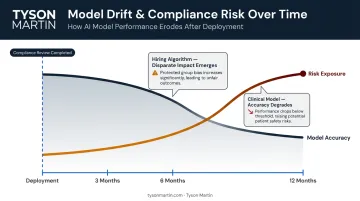
Model drift is the gradual erosion of AI performance as real-world data diverges from the data a model was trained on. The system does not announce the change. It simply starts producing outputs that are less accurate, more biased, or both—often in decisions that carry meaningful consequences.
The NIST AI Risk Management Framework explicitly identifies data, model, and concept drift as triggers for corrective maintenance, noting that AI systems may require more frequent review than traditional software for exactly this reason. A compliance review completed at deployment does not account for drift that develops six months later.
In practice, this means a hiring algorithm that passed a bias audit at launch may quietly develop disparate impact as labor market conditions change. A clinical recommendation model may degrade in accuracy as patient populations shift. Neither failure requires anyone to make a change—it happens on its own.
The Third-Party Visibility Problem
Internal drift is difficult enough to catch. Vendor-provided AI compounds the problem because organizations often have no visibility into when those models are updated, retrained, or materially changed.
Research published on arXiv found that GPT-4's behavior changed substantially between March and June 2023, with accuracy on one measured task shifting from 97.6% to 2.4%. OpenAI itself later rolled back a GPT-4o update it described as overly sycophantic.
These are not edge cases. They are the normal operating condition of vendor-provided AI. Governance structures that assume a vendor's compliance posture is sufficient are not closing a risk gap—they are creating one.
AI Governance Is Not Cybersecurity Governance
This distinction gets collapsed too often. The two disciplines cover different ground:
- Cybersecurity governance addresses confidentiality, integrity, and availability
- AI governance addresses fairness, transparency, accountability, and societal impact
The NIST AI RMF covers harmful bias, explainability, and effects on communities. None of those appear in a cybersecurity CIA triad. Organizations that adapt their information security policy and call it AI governance are not covering the problem. They are documenting a blind spot.
The Five Pillars of Adaptive AI Governance
Pillar 1 — Living Policies
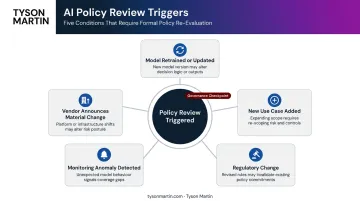
AI governance policies should be versioned, regularly reviewed documents—not static artifacts filed at deployment. The key word is triggers. A policy review cadence built on calendar intervals alone will miss the changes that matter most.
Effective policies define review triggers:
- Model retrained or significantly updated
- New use case added beyond original deployment scope
- Regulatory change affecting the AI application
- Monitoring surfaces anomalous performance or bias
- Vendor announces material changes to an underlying model
Quarterly reviews work for high-risk systems. Annual reviews may be adequate for low-risk, constrained applications. The trigger model ensures reviews happen when they are needed, not just when scheduled.
Pillar 2 — Continuous Monitoring and Feedback Loops
Real-time monitoring is not optional for high-risk AI systems. The EU AI Act requires providers of high-risk AI systems to establish and document post-market monitoring systems. NIST recommends that monitoring plans include user input, appeal and override mechanisms, and incident response protocols.
Two components matter here:
- Automated detection — mechanisms that flag performance degradation, output anomalies, or bias drift before they cause harm
- Human feedback channels — structured pathways for frontline teams and customers to report unexpected AI behavior, with those reports integrated into governance decisions rather than siloed in a help desk queue
Automated detection surfaces what metrics can quantify. Without structured feedback channels, the gaps users actually experience go unreported — and unaddressed.
Pillar 3 — Impact Assessments, Not Just Risk Assessments
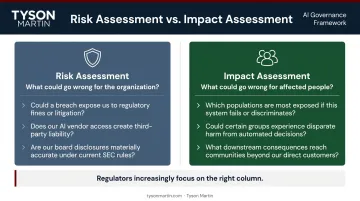
The distinction is consequential. A risk assessment asks what could go wrong for the organization. An impact assessment asks what could go wrong for the people affected by the AI's decisions.
Regulators increasingly care about the second question. EU AI Act Article 27 requires certain deployers of high-risk AI systems to conduct fundamental rights impact assessments. NIST calls for characterizing impacts on individuals, groups, communities, and society—not just organizational exposure.
Impact assessments force a different set of questions:
- Which populations are affected by this decision?
- Could this output create disparate harm for a protected class?
- What are the downstream consequences if the system produces a wrong result?
Organizations that skip this step don't just run a compliance risk. They miss the analysis that would have surfaced the problem before it triggered a regulatory finding or enforcement action.
Pillar 4 — Clear Decision Rights and Escalation Thresholds
That accountability gap doesn't stay in the impact assessment — it surfaces here, at the board level. Without documented decision rights, governance exists on paper but not in practice.
Organizations need to define in advance:
- Who has authority to approve a new AI use case
- What data sensitivity or decision consequence triggers escalation to the board or audit committee
- What constitutes an AI incident requiring internal escalation versus external disclosure
- Who can authorize exceptions, and for how long
This kind of clarity does not emerge from a policy document alone—it requires deliberate design. Tyson Martin's advisory work with boards and executive teams focuses specifically on this gap: clarifying who decides what, at what threshold, so that governance holds under the pressure of real incidents rather than just tabletop exercises.
Pillar 5 — Organizational Ownership
Effective AI governance requires a designated owner with executive accountability. Someone must own AI governance the way a CFO owns financial controls—not as a compliance burden, but as a strategic function where business enablement and risk management meet.
Without that ownership, governance becomes no one's job. Legal assumes technology is handling it; technology assumes compliance is. The result is documentation without accountability.
The ownership model should involve cross-functional stakeholders — legal, compliance, business owners, and executive leadership — but require a named executive who can commit resources, make tradeoffs, and report to the board on outcomes.
Risk Tiering: The Right Controls at the Right Level
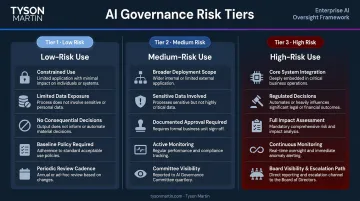
Not all AI systems carry equal risk. Treating them as if they do produces predictable failures: over-restricting low-risk tools and stalling productivity, or under-governing high-risk systems and creating real exposure.
A Practical Three-Tier Model
| Tier | Characteristics | Governance Requirements |
|---|---|---|
| Low-risk | Constrained use cases, limited data access, no consequential decisions | Baseline policy acknowledgment, periodic review |
| Medium-risk | Broader deployment, sensitive data, consequential actions | Documented approval, regular monitoring, designated owner |
| High-risk | Core business systems, regulated decisions, customer-facing outputs with significant impact | Full impact assessment, continuous monitoring, board-level visibility, defined escalation path |
Starting With Visibility
Organizations cannot tier what they cannot see. The starting point is always an inventory: what AI systems are in use, who owns them, and what decisions they influence.
OMB M-24-10 requires federal agencies to maintain AI use case inventories and designate Chief AI Officers. NIST recommends that inventory mechanisms be resourced according to organizational risk priorities. The same logic holds for private-sector organizations: visibility precedes tiering, and tiering precedes controls.
Tier assignment should not be a technology decision. It requires legal, compliance, business owners, and executive leadership. The core questions are:
- Does this system make or influence decisions affecting people's rights, finances, or health?
- Does it process sensitive data?
- What is the consequence of a wrong output?
What Board-Level Accountability for AI Actually Looks Like
Board accountability for AI is not about technical literacy. Directors do not need to understand how a model is trained. They need to understand what decisions the model influences, what oversight exists, and what the escalation path is when something goes wrong.
The questions boards should ask management mirror the questions they ask about cyber risk:
- What AI systems are currently in use, and how are they classified by risk?
- Who has authority to approve new AI use cases, and what does that approval process look like?
- How would we know if an AI system's performance degraded or introduced bias?
- What constitutes an AI incident requiring board notification?
- Have impact assessments been completed for high-risk systems?
What Good Governance Looks Like in Practice
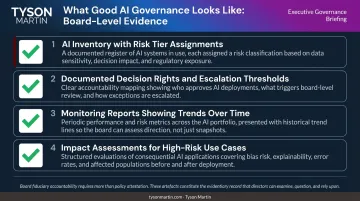
Management should be able to show:
- A defined AI inventory with risk tier assignments
- Documented decision rights and escalation thresholds
- Monitoring reports that show trends over time, not just current-state snapshots
- Evidence that impact assessments have been conducted for high-risk use cases
Watch for this: governance reviews that consistently find nothing to address are not a sign of a healthy program. They are a sign that the review process is not rigorous enough. Good governance leaves marks—documented decisions, accepted tradeoffs, identified issues and how they were resolved.
The Liability Dimension
As AI-related regulatory obligations expand across states and sectors, boards that cannot demonstrate active, structured oversight face genuine fiduciary exposure. Under Caremark oversight duties, directors and officers are expected to engage in algorithmic oversight as part of their fiduciary responsibilities. The SEC has already charged investment advisers for misleading statements about AI use, resulting in $400,000 in civil penalties.
No board has been held liable specifically for AI oversight failure—yet. But the absence of precedent is not the absence of risk. When that question does get tested, the boards with documented governance structures, clear escalation paths, and evidence of active review will have a defensible record. Those without one will not.
Frequently Asked Questions
What is adaptive AI governance and how is it different from compliance?
Adaptive AI governance is a continuous, living oversight model that evolves alongside AI systems and regulation. Unlike static compliance documentation that captures risk at a single point in time, adaptive governance accounts for model drift, regulatory changes, and expanding use cases as they occur.
Why is compliance alone not enough to govern AI systems?
AI systems change continuously—models retrain, data shifts, vendors update without notice. A compliance review conducted at deployment becomes outdated as soon as the system or its context changes. Compliance confirms whether a requirement is met today; governance ensures accountability over the system's full life.
What is model drift and why does it matter for AI governance?
Model drift is the gradual erosion of AI performance as real-world data diverges from training data. It matters most in consequential decisions—credit, hiring, clinical recommendations—where degraded accuracy or emerging bias can cause real harm well before any monitoring alert fires.
What role should the board play in AI governance?
The board's role is oversight, not operations. Directors should review AI risk tiering and escalation thresholds, confirm that management has documented decision rights and impact assessments for high-risk systems, and apply the same scrutiny to AI exposure that they bring to cyber and financial risk.
How often should an organization review and update its AI governance policies?
Policies should have defined triggers for review—model retraining, new use cases, regulatory changes, monitoring anomalies—rather than fixed calendar intervals alone. High-risk AI systems warrant more frequent review cycles, with trigger-based reviews supplementing your scheduled reviews.
What is the difference between an AI risk assessment and an AI impact assessment?
A risk assessment asks what could go wrong for the organization. An impact assessment asks what could go wrong for the people affected by the AI's decisions. Regulators and courts increasingly care about the second question—and organizations that only conduct the first are missing the analysis that matters most.