Introduction
AI tools are already running inside your organization. Procurement teams are summarizing contracts with ChatGPT. HR is drafting job descriptions with Copilot. Finance analysts are feeding spreadsheets into generative tools nobody approved.
The tools arrived before the rules did — and boards are now being asked to account for risks they cannot clearly see or measure.
Without a documented AI governance policy framework, that exposure compounds across multiple fronts:
- Data leaks to third-party model providers handling sensitive business information
- Regulatory penalties as the EU AI Act and US state AI laws take effect
- Reputational damage when an incident surfaces with no governance trail to show
This guide provides a practical, board-oriented template for building a framework that closes that gap — covering the components every policy must include, the governance structure required to make it work, and the reporting metrics that give boards real oversight rather than the illusion of it.
Key Takeaways
- 78% of AI users bring their own tools to work — shadow AI is already inside your organization accumulating risk leadership cannot see
- Every regulated enterprise needs a documented AI governance framework now — waiting for an incident to force one is the most expensive path forward
- A complete framework covers five layers: guiding principles, governance structure with decision rights, data protection rules, risk classification, and board-visible reporting metrics
- Aligning with NIST AI RMF and ISO 42001 builds a policy that adapts to new regulations without a full rebuild
- Governance breaks down when board oversight roles and management execution roles blur; keeping those lines clear is where most frameworks fall short
Why AI Governance Has Become a Board-Level Imperative
The Shadow AI Problem Is Already Inside Your Organization
According to Microsoft and LinkedIn's 2024 Work Trend Index, 75% of knowledge workers use AI at work — and 78% of AI users bring their own tools, sourced outside any IT approval process. That survey covered 31,000 people across 31 countries.
The implication for boards is direct: shadow AI is already operating inside your organization, processing data that may include customer records, financial information, or proprietary business logic — with no governance trail attached.
IBM's 2025 Cost of a Data Breach report puts a dollar figure on the problem:
- $4.44M — global average cost of a data breach
- 63% of organizations lack AI governance policies for unapproved AI tools
- $670,000 — the additional average breach cost attributed to high shadow AI environments
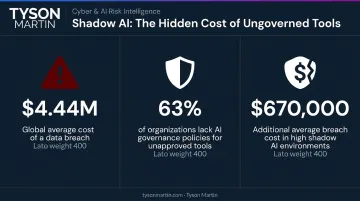
That $670,000 premium is the cost of not having a governance framework. It is not a compliance overhead; it is an unhedged risk.
Regulatory Convergence Is Accelerating
The EU AI Act entered into force on August 1, 2024. Prohibited practices applied from February 2, 2025. Most remaining obligations take effect from August 2, 2026. For global enterprises, enforcement is already underway.
US-side enforcement signals are equally clear:
- The SEC charged two investment advisers in 2024 for false and misleading statements about their AI use
- The FTC banned Rite Aid from using AI facial recognition for five years following deployment without reasonable safeguards
- State laws in Colorado, Texas, and Illinois are adding algorithmic accountability requirements that overlap with existing HIPAA, GLBA, and PCI DSS obligations
Boards Are Personally Accountable
SEC cybersecurity disclosure rules adopted in July 2023 require annual disclosure of board oversight of cybersecurity risk — including management's role and expertise. The "we didn't know" position is not a defense; it is the disclosure failure.
That liability exposure is the floor. The more compelling board-level case is strategic: organizations with clear AI governance structures adopt AI faster. When employees know the rules, escalation paths exist, and boards can approve new use cases with documented rationale, decision cycles compress. Governance is what makes confident, defensible adoption possible.
What an AI Governance Policy Framework Must Cover
Scope, Definitions, and AI Classification
Define "AI system" broadly. The most common governance gap is a narrow definition that excludes exactly the tools creating risk. A workable enterprise definition covers:
- Generative AI tools used for drafting, summarization, or analysis
- Predictive models used in operations, credit, or HR decisions
- Automated decision systems that affect employees or customers
- Third-party software with embedded AI features (CRM, ERP, HR platforms)
If the definition doesn't capture vendor-embedded AI, it creates an exemption wide enough to drive most of your risk through.
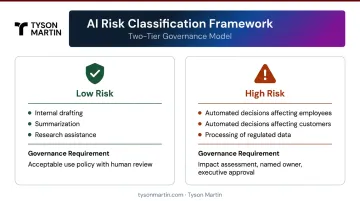
Establish a risk-tiered classification system. Two tiers cover most enterprise use cases:
| Risk Tier | Examples | Governance Requirement |
|---|---|---|
| Low | Internal drafting, summarization, research assistance | Acceptable use policy; human review of outputs |
| High | Automated decisions affecting employees, customers, regulated data | Impact assessment; named owner; executive approval |
The EU AI Act uses legally defined risk tiers (unacceptable, high, limited, minimal). NIST AI RMF uses a voluntary risk management approach without fixed tiers. Both are useful references — but your internal classification needs to be specific to your operations, not just a restatement of regulatory categories.
AI Principles and Acceptable Use Rules
Foundational principles — accountability, transparency, fairness, human oversight, privacy — must be anchored to regulatory requirements and business operations, not treated as aspirational language. They are the criteria against which every AI use case gets evaluated.
The difference between a governance policy and a policy that creates governance:
- ❌ "Use AI responsibly and in accordance with company values"
- ✅ "Generative AI tools are approved for internal draft creation. All outputs require human review and subject matter expert sign-off before external use or client delivery."
Define approved and prohibited use cases explicitly. Examples by sector:
- Healthcare: Prohibited — inputting patient records or PHI into any generative AI tool not covered by a BAA
- Financial services: Prohibited — using AI-generated credit or risk assessments without human review and documented sign-off
- Retail: Permitted — AI-assisted product description drafting with human review; Prohibited — automated pricing decisions without override controls
Data Governance and Protection Rules
Prohibit entry of these data categories into AI systems by default:
- Personally identifiable information (PII)
- Protected health information (PHI)
- Financial records and payment card data
- Proprietary intellectual property, source code, and trade secrets
- Any data class regulated by HIPAA, GLBA, PCI DSS, or state privacy laws
NIST AI 600-1 confirms a specific risk boards should understand: generative AI models can reveal sensitive information through data memorization and can correctly infer PII from disparate inputs. This is not just about what you intentionally share — it is about what the model reconstructs.
That exposure risk drives a single rule every employee needs to know: data entered into AI systems may be retained by third-party providers or used for model training. That statement belongs in the policy and in employee training.
Risk Assessment and Impact Documentation
Data exposure risk is also why impact assessments exist. Require a documented AI impact assessment before any high-risk AI system is deployed. The policy should define:
- What triggers assessment: any AI system classified as high-risk, any system touching regulated data, or any automated decision affecting employees or customers
- Who conducts it: the CISO or designated risk owner, with input from Legal and the relevant business unit
- What authority level signs off: executive committee approval for high-risk systems; board committee approval for any system with direct customer impact or regulatory reporting implications
This creates an auditable record of due diligence. In a regulatory inquiry or breach response, that record demonstrates you identified the risk, evaluated it deliberately, and assigned accountability before deployment.
Governance Structure: Decision Rights and Escalation Thresholds
The Decision Rights Hierarchy
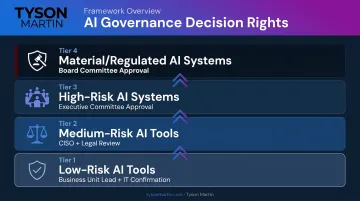
Unapproved tool adoption and unclear approval authority are the two most common structural failures in enterprise AI governance. The fix is a documented decision rights hierarchy:
| Risk Tier | Approval Authority |
|---|---|
| Low-risk AI tools | Business unit lead + IT confirmation |
| Medium-risk AI tools | CISO or equivalent + Legal review |
| High-risk AI systems | Executive committee approval |
| Material/regulated AI systems | Board committee approval |
AI Oversight Committee
Establish an AI Oversight Committee with a documented charter. Required elements:
- Membership: IT/security, Legal, Compliance, Finance, and rotating business unit representation
- Cadence: Monthly for operational decisions; quarterly for policy and risk tier reviews
- Decision authority: Approves new high-risk AI deployments, reviews policy exceptions, escalates material issues to the board
Escalation Thresholds
Vague escalation language fails during actual incidents. Define specific, testable triggers for mandatory board-level escalation:
- Confirmed data exposure involving an AI system and regulated data
- Regulatory inquiry about any AI use or AI-related disclosure
- AI model failure that produced material adverse outcomes for customers or employees
- Discovery of unauthorized AI tool use at scale (more than a defined number of users or data volume threshold)
- Ransom, extortion, or legal action involving an AI system
For each trigger: define who notifies, what information is required in the first update, and how quickly the board chair must be reached.
The Board's Role vs. Management's Role
These two roles are distinct — and keeping them that way is what makes governance defensible to regulators.
| The Board | Management |
|---|---|
| Sets risk appetite | Executes within board-approved parameters |
| Approves the governance framework | Manages day-to-day AI use and tool selection |
| Receives regular reporting against defined metrics | Reports up on performance and exceptions |
| Does not select tools or run operations | Does not set its own risk appetite unilaterally |
When those lines blur, oversight breaks down. The board loses independent judgment; management loses clear authority. Neither outcome serves the organization.
For organizations in leadership transition or scaling AI adoption without a dedicated CISO, an interim CISO or board advisor can establish and document these decision rights quickly. Tyson Martin's AI Governance Starter Pack is a 30-day engagement that delivers a working framework, decision-rights map, and board-ready policy — giving organizations a defensible governance posture before regulators or an incident demand one.
Aligning with NIST AI RMF and ISO 42001
NIST AI RMF: Four Functions in Practice
The NIST AI Risk Management Framework has four core functions:
| Function | What It Means in Practice |
|---|---|
| Govern | Establish governance structure, roles, policies, and oversight accountability |
| Map | Identify AI risks in context — what systems exist, what they touch, what could go wrong |
| Measure | Assess and monitor risk using defined methods and metrics |
| Manage | Prioritize and act on identified risks with documented controls |
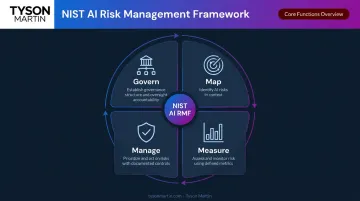
NIST AI RMF is voluntary — it does not prescribe fixed risk tiers or mandate specific tolerances. What it provides is a tested methodology for building a governance structure that is coherent, auditable, and adaptable.
ISO 42001: The Management System Standard
ISO/IEC 42001:2023 is the first international AI management system standard. It specifies requirements for establishing, implementing, maintaining, and improving an AI management system across industries and organization types.
For regulated industries and enterprise procurement, ISO 42001 alignment is increasingly a third-party requirement. Clients, auditors, and regulators have a recognized reference point for evaluating governance maturity when your framework maps to it.
Why Align with Both Now
NIST provides crosswalks that map AI RMF concepts to other standards and frameworks — including ISO 42001. That mapping means the two are designed to work together, not compete. When new regulations arrive — and they will — those crosswalks let you update specific controls within an existing structure rather than rebuilding policy from scratch. The governance investment you make today stays valid as the regulatory environment shifts around it.
Who Owns AI Governance — and What the Board Needs to See
Cross-Functional Ownership
AI governance ownership must be explicitly assigned. No owner means no accountability:
- CISO (or equivalent): Owns the overall AI risk posture, the governance policy, and incident response
- IT: Defines approved tools, manages the AI system inventory, and enforces technical controls
- Legal: Owns regulatory compliance, IP considerations, and contract review for AI vendor agreements
- Business unit leaders: Validate that policy works operationally and flag friction before it becomes shadow AI
Organizations without a dedicated CISO can assign this role to a fractional CISO to maintain board-level credibility and continuity. Leave it unassigned and the risk posture goes unmanaged.
What the Board Needs to See
The board needs a stable, plain-English AI governance dashboard — not a technical inventory. A quarterly briefing should cover:
- Active AI systems and their current risk classification
- Incidents or near-misses in the reporting period, with brief disposition
- Trend direction on key metrics (is the risk posture improving, stable, or deteriorating?)
- Open policy exceptions — what was approved outside the standard framework, who owns it, and when it expires
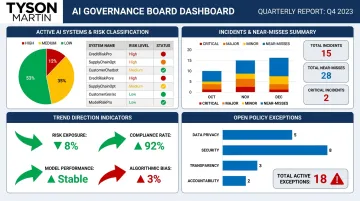
Trend matters more than point-in-time counts. A board that sees the same dashboard structure every quarter can track progress, ask better questions, and make faster decisions. Changing the format or the metric definitions destroys that continuity. Define the dashboard before the first briefing, then hold it stable.
More than 62% of public-company directors now set aside specific agenda time for full-board AI discussions, according to NACD's 2025 survey. The expectation of board-level AI oversight is no longer exceptional — it is becoming standard practice.
Frequently Asked Questions
What is an AI governance policy framework?
An AI governance policy framework is the structured set of principles, decision rights, and oversight processes that governs how an organization adopts, uses, monitors, and reports on AI systems. It goes beyond a simple acceptable use policy by establishing accountability structures, risk classification, escalation thresholds, and board-level reporting.
What are the core components every AI governance policy must include?
Every AI governance policy must include:
- Purpose and scope with a workable AI system definition
- Guiding principles and acceptable use rules (approved and prohibited cases)
- Data protection requirements and risk classification
- Governance structure with decision rights and escalation thresholds
- Board-level reporting metrics
How does an AI governance framework align with NIST AI RMF and ISO 42001?
NIST AI RMF provides the risk management methodology — Govern, Map, Measure, Manage — while ISO 42001 provides the management system structure and requirements. Together they give organizations a tested, internationally recognized foundation that can accommodate new regulations by updating specific controls rather than rebuilding the entire policy.
Who is responsible for AI governance in an enterprise organization?
AI governance is cross-functional by design:
- CISO owns risk posture and policy
- IT owns technical controls and the tool inventory
- Legal owns regulatory compliance and IP
- Board sets risk appetite and receives reporting
Each layer holds accountability for a defined portion of the governance lifecycle.
How often should an AI governance policy be reviewed and updated?
Quarterly reviews during the first year are the minimum, given the pace of AI regulatory and tool changes. Once the framework matures, semi-annual reviews are appropriate. Any significant breach, policy failure, or material regulatory change should trigger an out-of-cycle review regardless of the scheduled cadence.
What is the difference between AI governance policy and AI risk management?
AI governance policy defines the rules, roles, and decision rights for how AI is used across the organization. AI risk management is the ongoing operational process of identifying, assessing, and mitigating specific risks within that governance structure. Without a clear governance policy, risk management has no defined boundaries or escalation path to work within.