Key Takeaways
- Healthcare software vendors face compounding liability when AI governance gaps affect every customer on their platform simultaneously
- Three regulatory anchors every vendor needs: HIPAA Business Associate obligations, FDA SaMD classification, and NIST AI RMF alignment
- A governance policy without an AI system inventory is unenforceable — the inventory comes first
- Enterprise health system procurement teams evaluate specific documentation, not governance intentions
- Strong governance posture shortens deal cycles and removes contract friction — treat it as a sales asset, not an overhead line item
Introduction
Healthcare software vendors are embedding AI into their products faster than they're building the governance structures to support it. That gap is showing up in enterprise procurement reviews, contract negotiations, and regulatory scrutiny — and it's starting to cost deals.
According to Deloitte's 2024 Life Sciences and Health Care GenAI Outlook Survey, 75% of leading healthcare companies are experimenting with generative AI or scaling use cases. The governance infrastructure to match that adoption rate hasn't kept pace.
The risk profile for healthcare software vendors is categorically different from a health system deploying AI internally. A governance failure in a vendor's platform doesn't affect one organization — it replicates across every customer running that software simultaneously.
This guide breaks down the regulatory obligations that apply to vendors specifically, the core policy components every AI-enabled product needs, and why a defensible governance posture is increasingly the difference between winning and losing enterprise healthcare contracts.
What AI Governance Means for Healthcare Software Vendors (and Why It's Different)
AI governance, in the vendor context, is the structured set of policies, controls, accountability roles, and oversight mechanisms that govern how a company develops, deploys, monitors, and updates AI systems embedded in its healthcare software products.
That definition sounds similar to what a provider organization needs, but the directionality is different. Healthcare providers govern AI they deploy internally for their own patients. Software vendors govern AI they build and ship to others.
That distinction carries weight. Every governance decision a vendor makes — how the model was trained, what data it touched, how bias was tested, what PHI protections were applied — becomes part of their customers' risk exposure.
The Business Associate Problem Most Vendors Underestimate
HHS defines a Business Associate as any person or entity that performs functions involving PHI on behalf of a covered entity — including data analysis, data processing, quality assurance, and data aggregation. Most healthcare software vendors whose AI systems touch patient data meet this definition and underestimate what that classification requires.
Being a Business Associate means:
- Executing a BAA with every covered entity customer
- Applying the full HIPAA Security Rule safeguard framework to ePHI in AI systems
- Disclosing subcontractors (fourth parties) who also access PHI
- Notifying customers of breaches within required timelines
Enterprise customers now expect AI-specific BAA clauses covering model training data use, subprocessor access, and breach notification timelines that many vendors aren't prepared to negotiate.
What's at Stake Without Governance
The Practice Fusion case illustrates the scale of vendor-side liability. HHS OIG reported in 2020 that Practice Fusion paid $145 million to resolve criminal and civil investigations related to clinical decision support alerts manipulated to increase opioid prescriptions. Separately, a widely cited JAMA Internal Medicine external validation found that the Epic Sepsis Model — deployed across many health systems — performed poorly at predicting sepsis, raising concerns about the national impact of a single vendor's model.
When a vendor's model underperforms or its data handling fails, the exposure isn't contained to one customer — it propagates across every health system running that product.
The Regulatory Landscape Every Healthcare AI Vendor Must Understand
HIPAA Security Rule
The HIPAA Security Rule requires administrative, physical, and technical safeguards for all electronic PHI. For vendors, this applies directly to any AI system that processes, stores, or transmits ePHI.
Those three safeguard categories translate to specific AI governance requirements:
- Administrative: Policies and procedures for AI system selection, development, and maintenance
- Physical: Controls protecting the infrastructure running AI models
- Technical: Access controls, audit logs, and encryption protecting ePHI in AI pipelines
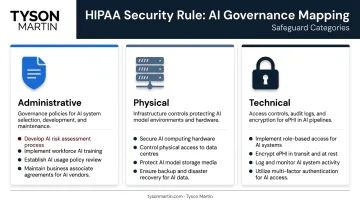
Encryption minimums that align with NIST standards include AES-256 at rest (NIST FIPS 197) and TLS 1.3 in transit (NIST SP 800-52 Rev. 2). HIPAA doesn't mandate those specific standards by name, but they represent the defensible floor enterprise customers expect.
FDA AI/ML Software as a Medical Device
FDA distinguishes between administrative AI (not regulated) and clinical decision support that qualifies as a Software as a Medical Device. The classification question hinges on whether the software's function is intended to diagnose, treat, prevent, or cure a disease.
Two recent guidance documents define the current compliance floor:
- CDS Software Guidance (January 2026): Clarifies which clinical decision support functions fall outside the device definition
- PCCP Guidance (August 2025): Applies to AI-enabled devices in 510(k), De Novo, and PMA pathways — requiring vendors to document planned model modifications, validation methodology, and impact assessments in advance
Vendors should conduct a classification analysis early in product development. Discovering your product is an unregistered SaMD during an enterprise procurement review is not a recoverable situation.
NIST AI RMF and the EU AI Act
The NIST AI Risk Management Framework (released January 2023) is organized around four core functions: Govern, Map, Measure, and Manage. While voluntary, enterprise health system security teams increasingly use it as their baseline for vendor assessments.
Vendors who can map their governance structure to the NIST AI RMF have a measurable advantage in security questionnaire responses — it signals maturity before procurement conversations get difficult.
For vendors with international customers, EU Regulation 2024/1689 (the EU AI Act) classifies most healthcare AI as high-risk under its medical device provisions. High-risk obligations include conformity assessments, technical documentation, transparency requirements, and human oversight mechanisms. Article 6(1) obligations apply from August 2, 2027.
State-Level Laws Require Ongoing Monitoring
The state legislative picture is active and moving quickly. Two enacted examples every healthcare AI vendor should know:
- California SB 1120 (Chapter 879, Statutes of 2024): Addresses AI use in utilization review, requiring physician decision-making safeguards
- Colorado SB24-205: Requires developers of high-risk AI systems to use reasonable care to protect consumers from algorithmic discrimination
New York has pending legislation (A11048) addressing AI in utilization review. New Jersey has bills in committee. Any vendor governance policy must include a formal process for tracking and responding to new state requirements — not just a one-time review.
Core Components of an AI Governance Policy for Healthcare Software Vendors
A governance policy without operational specificity is a document that exists to be attached to procurement questionnaires and ignored. The components below define what the policy must actually contain.
Acceptable Use and Prohibited Use
Define what AI the company is authorized to build into its products, what's explicitly off-limits (unsanctioned PHI training data, manipulative outputs, public AI tools accessing production data), and the intake process for evaluating new AI tools or models before deployment.
Data Privacy, PHI Controls, and BAA Standards
The policy must specify:
- Data minimization requirements before model training begins
- De-identification protocols and their technical standards
- Encryption minimums (AES-256 at rest, TLS 1.3 in transit)
- Subcontractor and fourth-party disclosure requirements
- Data retention limits for PHI used in AI systems
- The AI-specific BAA terms the vendor extends to every covered entity customer
AI Lifecycle Risk Management
Governance controls must attach to every stage of the AI development lifecycle, not just pre-deployment:
- Ideation: Use case risk assessment before development begins
- Pre-training: Data risk assessment covering PHI scope and de-identification
- Pre-deployment: Validation assessment and sign-off authority documentation
- In production: Mandatory periodic audit at defined intervals
- Upgrades: Triggered re-review when vendor-initiated changes materially alter AI functionality
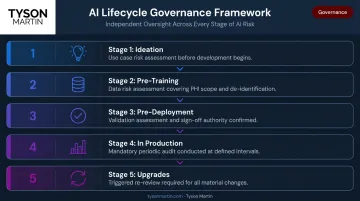
A risk-tiering model (low / medium / high / critical) based on PHI sensitivity and clinical impact determines the governance scrutiny level, approval authority, and monitoring intensity applied to each system.
Bias, Fairness, and Clinical Safety
Pre-deployment bias testing must include subgroup performance analysis stratified by race, ethnicity, sex, age, and insurance type. Required elements include:
- A defined performance disparity threshold that triggers remediation
- Bias audits conducted by parties independent of the development team
- Documented results retained as part of the model's governance record
For any AI output supporting a clinical decision, the policy must establish that a qualified human retains authority to review, verify, and override that output. Documentation of human review must be maintained in the audit trail, with records specifying who reviewed the output, when, and what action was taken.
Operationalizing AI Governance: From Policy to Practice
A governance policy with no operational backbone is just a document. Three foundations determine whether your AI governance actually functions under scrutiny — especially in healthcare, where the stakes are clinical and regulatory.
Build the Governance Structure Before the Policy
Identify who owns AI governance at the company — a dedicated AI Governance Committee, the CISO, a cross-functional steering group, or a fractional executive. Document decision rights, escalation paths, and accountability for AI-related incidents before deploying any policy.
Each AI risk or initiative needs one named, accountable leader — not a committee. Escalation thresholds should be defined in advance:
- Amber triggers: worsening trends, near misses — escalate to the AI risk owner within 48 hours
- Red triggers: threshold breaches, repeat violations — escalate to senior leadership with a defined response timeline
Maintain a Live AI System Inventory
Without an inventory, governance policies have nothing to act on. Every AI tool, model, and third-party AI integration — including tools used internally by employees, not just product-facing AI — should be cataloged with:
- Risk tier and approval status
- Data access level (does it touch PHI?)
- Owning team and review schedule
- Subprocessor dependencies
The AI Controls Matrix (AICM) offers a structured way to build and audit this inventory. It's a vendor-neutral framework covering 243 control objectives across 18 domains, aligned with NIST AI RMF, ISO 42001, and EU AI Act requirements.
Implement Monitoring with Inspectable Outputs
If your governance program can't produce evidence on demand, it won't hold up in a regulatory review or a board inquiry. Vendor-side AI monitoring should track, at minimum:
- Model accuracy and drift indicators
- Subgroup performance metrics (bias monitoring)
- PHI access logs
- Incident and near-miss reports
- Human override rates for clinical AI outputs
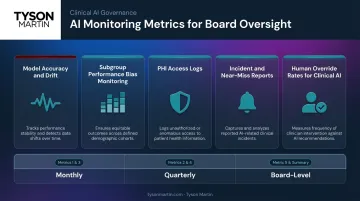
Cadence matters as much as content: monthly dashboards for the operational team, quarterly reviews for leadership, and a board-level summary that shows trend lines against agreed thresholds rather than raw technical data.
Using AI Governance as a Competitive Advantage in Enterprise Healthcare Sales
Enterprise health system procurement teams don't evaluate AI governance as a checkbox. Their security and compliance teams conduct structured assessments, and the Healthcare Sector Coordinating Council's 2026 Third-Party AI Risk Guide explicitly notes that standard vendor questionnaires and security certifications often miss AI-specific risks — including data provenance, model governance, and algorithmic accountability.
What Enterprise Buyers Are Actually Looking For
When a hospital CISO or general counsel evaluates a healthcare software vendor's AI governance posture, they want to see:
- A documented AI system inventory with risk scores
- Bias audit results from independent reviewers
- BAA with AI-specific terms (training data use, subprocessor access, breach timelines)
- Encryption and access control documentation
- FDA clearance status or a documented classification analysis
- Human oversight requirements for clinical AI outputs
- Incident response procedures specific to AI failures
The Communication Gap Most Vendors Get Wrong
Most vendors have some governance in place. What they can't do is communicate it clearly to a CISO, general counsel, or audit committee. Technical documentation that requires interpretation doesn't pass enterprise procurement scrutiny — it stalls it.
Presenting governance posture in plain-English terms with stable, trend-based metrics is what separates vendors who close from those who stall. A one-page dashboard showing top risks, what changed since last review, and decisions needed tells a procurement team more than a 40-page technical architecture document.
Governance Shortens Deal Cycles
Vendors who arrive at enterprise procurement reviews with documented governance — a current inventory, third-party bias audit results, clear BAA terms, and traceable approval history — remove the friction points that stall contract negotiations. Each of those artifacts answers a specific question procurement teams will ask; having them ready eliminates the back-and-forth that adds weeks to deal cycles.
Tyson Martin's AI Governance Starter Pack is a fixed-fee 30-day sprint that builds this foundation: an AI risk assessment, a decision-rights map, a one-page board-level AI policy, and a facilitated briefing that prepares leadership to present governance posture credibly under enterprise customer scrutiny.
Getting Board-Level AI Governance Right
AI systems embedded in healthcare software products create material risk — regulatory, financial, reputational, and clinical. Boards are responsible for overseeing that risk, and following the SEC's July 2023 cybersecurity disclosure rules requiring public companies to report on cybersecurity risk management and governance, the expectation for board-level oversight has formalized considerably.
What Board-Ready AI Governance Reporting Includes
A board-level AI governance report should answer four questions:
- What is our current AI risk posture?
- What changed since the last review?
- What open incidents or regulatory developments require board attention?
- What decisions does the board need to make?
What it should not be: a technical data dump that requires translation, a status report with no trend context, or a document that reassures rather than informs.
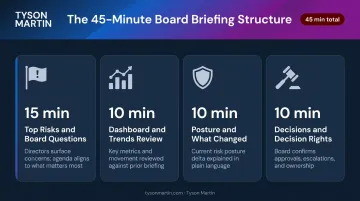
The 15-10-10-10 briefing structure — 15 minutes on top risks and board questions, 10 minutes reviewing the dashboard and trends, 10 minutes on posture and what changed, 10 minutes on decisions and decision rights — produces the right outcome: fewer surprises, faster escalation, and cleaner communication.
The Role of a Board Advisor or Fractional CISO
For healthcare software companies that need AI governance infrastructure built or stabilized without a full-time executive hire, an experienced board advisor or fractional CISO provides different value than an MSSP or internal team expansion.
Tyson Martin's engagement model is deliberately independent of the in-house security team, security vendors, and managed service providers. That independence keeps recommendations free from tool relationships or operational incentives, with the focus squarely on governance that produces inspectable evidence and prepares leadership for enterprise scrutiny.
For healthcare software vendors in transition, a 30-to-90-day fractional engagement typically delivers:
- A working governance structure with documented decision rights
- A complete AI system inventory with risk classifications
- Board-ready reporting with trend context, not just status
- Documented evidence ready for enterprise customer or acquirer review
Common triggers include a pending enterprise deal, an audit finding requiring remediation, a fundraise where acquirers will assess AI risk, or a new leadership team that inherited an undocumented program.
Frequently Asked Questions
What regulations apply to AI governance for healthcare software vendors?
The primary frameworks are the HIPAA Security Rule (for ePHI-handling AI), FDA's SaMD and Clinical Decision Support guidance (for AI that may meet the medical device definition), and the NIST AI RMF (the de facto enterprise baseline). State-level laws are also evolving — California, Colorado, and New York each have enacted or pending healthcare AI legislation — so compliance monitoring must be ongoing, not a one-time exercise.
Do healthcare software vendors need to sign a Business Associate Agreement?
Yes, if your AI systems access, process, or store PHI on behalf of a covered entity, you are a Business Associate under HIPAA and must execute a BAA. Enterprise customers increasingly require AI-specific BAA clauses covering model training data use, fourth-party subprocessor access, and breach notification timelines beyond standard HIPAA minimums.
What is the difference between AI governance for a healthcare provider vs. a healthcare software vendor?
Providers govern AI they deploy internally for their own patients. Vendors govern AI they build into products used by many provider organizations simultaneously — creating broader liability exposure and the additional obligation to satisfy each customer's own governance and contractual requirements.
When does a healthcare AI product require FDA clearance or approval?
FDA regulates AI/ML software that qualifies as a Software as a Medical Device, particularly clinical decision support intended to inform diagnoses or treatment decisions rather than perform administrative functions. Conduct a classification analysis early in development; the FDA's final CDS guidance (January 2026) and PCCP guidance (August 2025) are the primary references.
How often should a healthcare software vendor's AI governance policy be reviewed and updated?
Annual review is the minimum. Triggered reviews should occur after significant regulatory developments, product updates that change AI functionality, a material security or bias incident, or a major customer audit finding. The policy itself must include a documented version control and approval process — enterprise customers will ask to see it.
What should be in a vendor's AI governance policy to satisfy enterprise healthcare customer procurement reviews?
Enterprise procurement teams typically look for:
- A documented AI system inventory with risk scoring
- Bias and fairness audit results from independent reviewers
- A BAA with AI-specific terms (training data use, subprocessors, breach timelines)
- Encryption and access control standards
- FDA clearance status or a documented classification analysis
- Incident response procedures specific to AI failures
- Human oversight requirements for clinical AI outputs