Introduction
Boards are approving AI vendor contracts, greenlighting pilot programs, and accepting AI-powered tools across business functions — often with no visibility into how those systems are classified, monitored, or escalated when something goes wrong.
The numbers make the gap concrete. According to McKinsey's 2024 global survey, 65% of organizations were regularly using generative AI — yet only 18% had an enterprise-wide council or board with actual authority over responsible AI governance. Deloitte's 2025 boardroom survey found that 31% of respondents said AI still wasn't on the board agenda at all.
This is not a technology management problem. It is a fiduciary oversight problem.
Under the Caremark standard, directors have a duty to implement reasonable oversight systems for material risks and to respond in good faith when those systems surface problems. AI qualifies.
Boards that passively accept management updates, without defined escalation paths, risk tiering, or accountability structures, are carrying real liability exposure — regardless of whether a specific AI law has passed in their jurisdiction.
That exposure is what this guide addresses. It maps the structural, reporting, and behavioral red flags that indicate AI governance has no real home at the board level — and what functioning oversight requires in practice.
Key Takeaways
- Boards that cannot name who owns AI risk are already exposed — that vagueness is a governance failure, not a gap to resolve later.
- No AI inventory means no real oversight; management updates are not a substitute for knowing what systems are running and at what risk level.
- Opportunity-only AI reporting is itself a red flag — boards should be hearing about incidents, drift, and bias testing, not just deployments.
- The Caremark gap is the most legally significant failure pattern: adopting an oversight framework but never genuinely monitoring it.
- Director AI illiteracy is a structural vulnerability; boards that cannot ask informed questions cannot exercise meaningful oversight.
Why AI Governance Failures Often Start at the Board Level
The Intent-Action Gap
Most boards acknowledge AI as a strategic priority. Few have the governance infrastructure to back that acknowledgment up.
McKinsey's 2024 data captures the disconnect precisely: 65% of organizations using generative AI regularly, but only 18% with an enterprise-level body authorized to make responsible AI governance decisions. That gap is where fiduciary exposure lives.
Deloitte's 2024 boardroom research reinforced this: 46% of respondents were either unsatisfied with or concerned about the time devoted to AI discussions, and only 16% were satisfied with the current pace of governance progress — even as AI adoption accelerated inside their organizations.
Acknowledging AI risk without a defined escalation path, recurring reporting cadence, or accountable owner means a board has accepted the risk — not the oversight responsibility that comes with it.
Regulated Industries: The Compliance Clock Is Already Running
For boards in financial services, healthcare, and retail, AI governance isn't a future obligation — the regulatory clock is already running under existing frameworks:
- Financial services: CFPB Circular 2022-03 makes clear that adverse action requirements under ECOA apply to credit decisions based on complex algorithms. The CFPB's position: a creditor's lack of understanding of its own AI model is not a defense.
- Healthcare: HIPAA's Privacy and Security Rules apply to AI systems that touch protected health information, including vendor-embedded tools and tracking technologies.
- Retail/consumer: FTC Section 5 enforcement has extended to AI-related data practices, and CCPA covers AI systems that process California consumer data.
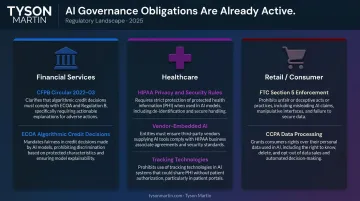
None of these regulations waited for an "AI law." Boards in regulated industries that treat AI governance as a future task are already out of step with current obligations.
What the Board Is Actually Responsible For
Directors are not expected to be machine learning engineers. They are expected to implement reasonable oversight systems and respond in good faith when risks surface.
The absence of that system — not imperfect execution of one — is where Caremark liability originates. Three omissions signal that absence clearly:
- No AI inventory has ever been requested
- No oversight owner has been designated
- No escalation threshold has been defined
Any one of these gaps, in a material and growing risk category, is enough to call the board's oversight posture into question.
Structural Red Flags: When AI Oversight Has No Real Home
No Accountable Executive Owner
When a board asks "who owns AI governance?" and the answer is vague, shared between departments, or defaults entirely to IT, that is a governance failure. It is not an organizational complexity to accommodate.
Effective AI oversight requires a designated cross-functional owner with written responsibilities, board-level reporting obligations, and authority that spans legal, compliance, security, and the relevant business lines. IT ownership alone is insufficient because most of the risk (regulatory, reputational, decision integrity) lives outside IT's mandate.
No Committee Mandate for AI Risk
If no committee charter has been updated to include AI risk oversight, boards are treating AI as a sub-bullet under digital transformation rather than as a discrete risk category.
Boards should be able to answer specifically: does AI oversight sit with the full board, the audit committee, the risk committee, or a dedicated technology committee? Any of those can work. The problem is when no one can answer the question.
No Enterprise-Wide AI Inventory
Without a current inventory of AI tools in use, the board has no foundation for risk oversight. That inventory needs to cover:
- Sanctioned internal tools
- Vendor-embedded AI (often invisible inside licensed software)
- Employee-initiated "shadow AI": consumer tools employees use on company data without IT approval
Without that inventory, there is no basis for risk tiering and no way to distinguish a grammar-checking tool from a model making credit or hiring decisions.
Shadow AI Is Unaddressed
Microsoft and LinkedIn's 2024 Work Trend Index found that 78% of AI users brought their own AI tools to work: tools not sanctioned by IT, without security controls or contractual data protections. IBM defines this as shadow AI: unsanctioned use of AI tools by employees without IT oversight.
The risks are direct: data exfiltration, IP leakage into third-party model training, contractual gaps with no vendor accountability, and no audit trail. If shadow AI has never appeared in a board briefing, it has not been governed.

No Defined Escalation Triggers
Boards need pre-established, written thresholds that define what constitutes an AI incident requiring board notification. At minimum, that document should address:
- Model failures producing material output errors
- Regulatory inquiries related to AI decisions
- Customer harm events linked to AI outputs
- Vendor AI failures affecting the organization's systems
- Significant model drift or bias testing failures
If those paths don't exist in writing before an incident, they won't hold during one. Structural governance gaps like these are what transform manageable AI failures into board-level crises.
Reporting Red Flags: When Boards Cannot See AI Risk Clearly
Opportunity-Only AI Updates
When every AI briefing covers productivity gains, pilot launches, and competitive positioning — with no mention of incidents, model drift, bias testing results, or compliance gaps — that is not balanced reporting. It is a filtered view that prevents meaningful oversight.
Boards should be receiving both sides: what AI is delivering, and where it is failing or creating exposure.
No Repeatable Reporting Cadence
One-off AI updates, delivered when management chooses, are structurally insufficient for mission-critical risks. The Delaware Court of Chancery's ruling in In re The Boeing Company Derivative Litigation is instructive: the court found that "discretionary management reports that mention safety as part of the Company's overall operations are insufficient to support the inference that the Board expected and received regular reports on product safety."
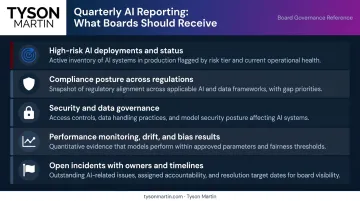
The same logic applies to AI. A defined quarterly reporting cadence should cover, at minimum:
- High-risk AI deployments and their current status
- Compliance posture across applicable regulations
- Security and data governance for AI systems
- Performance monitoring, drift, and bias testing results
- Open incidents with owners and resolution timelines
No Risk-Tiered View Presented to the Board
Not all AI carries the same risk. Boards receiving a flat list of AI tools — with no classification distinguishing between high-impact systems (underwriting models, clinical decision tools, fraud detection, regulatory reporting) and lower-risk operational tools — cannot allocate oversight attention appropriately.
Risk tiering is not a technical exercise. It tells the board where to direct scrutiny — and where it can reasonably defer to management.
Metrics That Measure Activity, Not Governance Health
NIST's AI Risk Management Framework calls for objective, repeatable measurement processes — and warns that risk metrics can be "oversimplified, gamed, or fail to account for differences in affected groups and contexts."
Those are activity metrics. For governance health, boards should be tracking trend-based indicators:
- Model performance drift over time (not just current-state snapshots)
- Bias testing frequency and results — not just "testing was done"
- Open incident count and age — how many are open, and for how long
- Vendor AI audit status — what third-party AI has been reviewed and when
Third-Party AI Treated as Management's Problem
Boards that accept "we reviewed our vendors" without pressing further are carrying undisclosed third-party AI risk. The right questions are specific:
- What AI are key vendors running, and how was it validated?
- Has independent bias testing been conducted — and by whom?
- What contractual rights does the organization hold if a vendor's model changes materially?
Vendor AI failures are the organization's liability. Regulators won't distinguish between internal models and contracted ones — the institution owns the outcome either way.
Behavioral Red Flags: Passive Oversight and the Caremark Gap
The Framework Adoption Trap
Creating an AI oversight structure and then passively accepting updates without challenge, follow-through, or genuine engagement is not governance — it is the appearance of governance. The Caremark duty requires not just implementing an oversight system, but actually using it.
A board that approves an AI governance policy, receives quarterly one-page updates, and never pushes back on what's missing has not closed its liability exposure. It has documented its passivity.
Deferring Entirely to Technical Leadership
Deloitte's 2024 survey found that 79% of boards had limited, minimal, or no AI knowledge or experience — with only 2% described as highly knowledgeable. By 2025, that number had improved but remained concerning: 66% still had limited to no AI knowledge.
Directors don't need to be AI engineers. They do need enough fluency to identify weak answers — and to tell the difference between a management team that has genuinely governed its AI systems and one that has assembled reassuring language.
Boards that cannot ask informed questions about data sourcing, model validation, incident history, or regulatory applicability are ratifying, not overseeing.
No AI-Specific Education Tied to the Organization's Actual Footprint
Generic AI literacy programs are not enough — and fluency gaps don't close themselves. The NACD has stated directly that board members must develop a solid understanding of AI to effectively oversee deployment, manage risks, and guide responsible use. That means training tied to the company's actual AI footprint, not general concepts.
Boards that have never received training tied to their company's specific AI use cases — the regulatory implications, IP and data risks, and incident scenarios that apply to their actual deployments — are not positioned to govern those deployments.
Tabletop exercises are a practical test of whether that preparation holds. Scenarios worth running include:
- Data leakage through shadow AI tools
- Harmful or biased model output affecting customers
- Vendor model failure with downstream business impact
- Regulatory inquiry triggered by undisclosed AI use
Board Minutes Don't Reflect AI Oversight Activity
Oversight liability often turns on what directors did when problems surfaced. If board minutes don't document that AI risk was discussed, that questions were asked, and that action was directed, the governance cannot be defended in a legal or regulatory challenge.
A clean paper trail isn't a formality — it's what separates defensible oversight from documented inaction.
What Strong AI Governance Looks Like From the Board's Chair
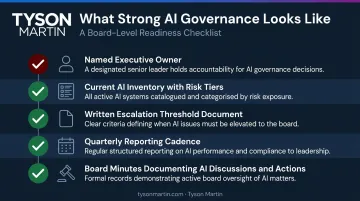
A functioning AI governance posture has identifiable components — not aspirational principles, but verifiable structural facts the board can confirm:
- A named executive owner with written AI governance responsibilities and board reporting obligations
- A current AI inventory with risk-tier classification distinguishing high-impact from lower-risk systems
- A written escalation threshold document defining what AI incidents require board notification and when
- A quarterly reporting cadence covering both performance and compliance , not just deployments
- Board minutes that document AI risk was discussed, questions were asked, and action was directed
, not just documented?
A board that asks these questions and demands specific answers — then follows up at the next meeting — is governing AI. A board that accepts "we have a framework" without verification is not.
Frequently Asked Questions
What does an AI governance board do?
A board exercising AI governance sets the organization's risk appetite for AI use, ensures accountable ownership and escalation structures are in place, and reviews regular reporting on AI performance and compliance. It holds management accountable for governing AI responsibly across both internal systems and vendor-provided AI tools.
What are the pillars of AI governance?
The core pillars of AI governance are:
- Accountability — defined ownership and named roles
- Transparency — explainable systems and documented decisions
- Risk management — inventory, classification, and monitoring
- Compliance — alignment with applicable regulations and frameworks
- Ongoing oversight — repeatable reporting cadence with genuine board engagement
What type of transaction is a red flag in AI detection models?
From a board oversight perspective, the real question is whether the detection model has been validated, bias-tested, and produces explainable outputs — and whether there is a documented process for handling disputed or erroneous results.
What is the board's fiduciary duty regarding AI oversight?
Under the Caremark standard, directors must implement reasonable oversight systems for material risks — including AI — and respond in good faith when those systems surface problems. Consciously disregarding risk signals, or failing to build the oversight structure at all, creates direct liability exposure.
How often should boards review AI risk?
At minimum, quarterly reporting on AI governance topics — with escalation-triggered updates for material incidents, new deployments, regulatory inquiries, or vendor failures. An annual review of the full AI inventory and risk classifications is baseline practice.