That gap isn't an IT configuration problem. It's a governance failure with direct board liability attached.
This article delivers a practical, enterprise-grade AI Acceptable Use Policy (AUP) template with the governance context that boards, CISOs, and General Counsel need to act. This is not a small business checklist. Enterprise AI governance requires different architecture—one that accounts for third-party vendors, automated systems, multinational data residency, and regulatory frameworks that don't forgive ad-hoc approaches.
Key Takeaways
- 58% of employees already use AI at work; only 41% have any organizational guidance — assume adoption is ahead of governance
- Enterprise AI AUPs require four elements SMB templates skip: vendor/third-party scope, automated system coverage, data classification tiers, and decision rights
- No single U.S. law mandates an AI AUP by name, but HIPAA, GDPR, CMMC, and SEC cyber disclosure rules all create obligations a documented AUP directly supports
- The template below includes scope, data tiers, tool registry, use case guardrails, accountability chain, and enforcement language
- Quarterly review is the minimum cadence; any significant tool adoption, regulatory change, or incident triggers an out-of-cycle review
Why Enterprise AI Governance Is a Board-Level Imperative
The Shadow AI Problem at Enterprise Scale
Large organizations face AI proliferation across hundreds of departments, vendors, and contractors simultaneously. Ad-hoc governance cannot keep pace with that volume.
Deloitte's 2024 board governance research found that nearly 45% of directors and executives said AI had not yet made it onto the board agenda, and 79% rated their boards as having limited, minimal, or no AI knowledge. Meanwhile, KPMG found 56% of employees used AI tools at work without knowing whether it was allowed, and 57% avoided revealing when they used AI to complete work.
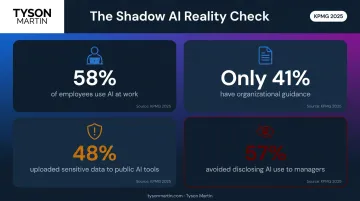
Widespread undisclosed use, sensitive data exposure, and board-level unawareness in the same organization is a reliable path to a material incident.
Why This Flows Directly to the Board
AI misuse isn't an abstract risk. It creates specific, board-level exposure:
- Data breach liability: Unsanctioned AI tools are a direct data exfiltration vector. Samsung's 2023 incident, where engineers uploaded proprietary source code to ChatGPT, shows how fast uncontrolled use escalates
- SEC cyber disclosure obligations: Public companies must disclose material cybersecurity incidents and governance processes; AI-related incidents can trigger these requirements
- Regulatory penalties: HIPAA, GDPR, CMMC/NIST SP 800-171, and the EU AI Act all create compliance obligations that unsanctioned AI use can violate
- Director liability: Without documented oversight, boards cannot demonstrate defensible duty-of-care under regulatory scrutiny or shareholder litigation
Regulated industries—financial services, healthcare, retail—face compounded exposure. AI use may trigger NIST AI RMF alignment expectations, CMMC rules of behavior requirements, or HIPAA risk analysis obligations. None of these frameworks accept "we didn't have a policy" as a defense.
What Separates an Enterprise AI AUP from a Basic Template
Most publicly available AI AUP templates are written for small businesses. They produce approved/prohibited tool lists, a handful of conduct rules, and a signature block. That structure is inadequate for enterprise environments.
Three Dimensions Basic Templates Ignore
Employees aren't the only AI users in your environment. Vendors, contractors, and third-party service providers may use AI tools that touch your data. An enterprise AUP must cover these actors explicitly—including contract language, data processing agreements, and approval requirements before a vendor uses AI to process your data. Three areas where basic templates fall short:
- Vendor and third-party AI scope — Contract requirements and approval gates before external parties deploy AI against your data
- AI agents and automated systems — Governance coverage for AI embedded in business processes (pricing logic, fraud detection, customer communication), not just tools employees choose to open
- Multinational data residency — Explicit jurisdiction mapping, because the same tool may be acceptable in one region and prohibited in another based on transfer restrictions or local AI regulation
Why a Simple Approved/Prohibited List Fails
Enterprise data environments include PII, PHI, financial records, CUI, trade secrets, and proprietary code—sometimes all in the same workflow. A binary tool list cannot capture the nuance that the same AI tool may be appropriate for marketing content generation and completely prohibited for processing regulated patient data.
Binary lists also drive shadow AI adoption. When employees can't get fast approval for legitimate use cases, they use tools without asking. High exception request volume signals a policy calibrated too restrictively—not a workforce acting in bad faith.
Decision Rights Are Not Optional
An enterprise AUP without clear decision rights is a suggestion document. The policy must answer three questions explicitly:
- Who approves new AI tools (and at what data sensitivity threshold)?
- Who owns AI-related incidents?
- How are exceptions granted, time-limited, and closed?
These aren't procedural details—they determine whether governance holds when an incident actually occurs.
Enterprise AI Acceptable Use Policy Template
Important: This template is a starting point. Organizations must adapt it based on industry, regulatory requirements, and AI maturity level. Legal review is required before deployment. This document does not constitute legal advice.
Scope and Purpose
Effective Date: [DATE] | Policy Owner: [CISO / CIO] | Review Cycle: Quarterly
Scope
This policy applies to:
- All employees, regardless of role or location
- Contractors, consultants, and temporary staff with access to company systems or data
- Third-party vendors and service providers whose work involves company data
- Automated AI systems and AI agents operating within or on behalf of the organization
Definition of AI Tools "AI tools" includes generative AI applications, large language models, machine learning platforms, AI-powered productivity tools, AI agents, and any automated system using AI/ML to process, generate, or analyze content or data.
Jurisdictional Scope This policy applies globally. Where local law imposes stricter requirements, local requirements govern. [Annex A lists jurisdiction-specific restrictions.]
Core Objectives
- Reduce risk of data exposure, regulatory violation, and reputational harm from unsanctioned AI use
- Establish a defensible governance record for regulatory and board oversight purposes
- Enable responsible AI adoption without blocking legitimate business use
Data Classification and AI Use Permissions
| Tier | Data Type | Examples | Permitted AI Tools |
|---|---|---|---|
| Tier 1 — Public | Publicly available information | Published content, marketing materials, public datasets | Any approved AI tool |
| Tier 2 — Internal/Operational | Non-sensitive internal data | Internal communications, operational reports, general business analysis | Enterprise-licensed tools only; vendor must not use inputs for model training |
| Tier 3 — Confidential/Regulated | PII, PHI, financial records, CUI, legal documents | Customer records, health data, financial statements, government contract data | Private-instance or on-premise tools only; data processing agreement required |
| Tier 4 — Prohibited | Credentials, encryption keys, attorney-client communications, board deliberations | Passwords, private keys, privileged legal communications | Must never enter any AI tool under any circumstances |
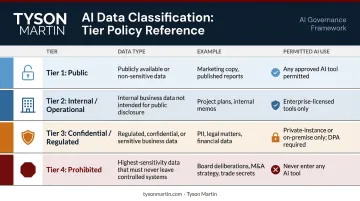
Any uncertainty about data classification defaults to the higher (more restrictive) tier pending review by [Data Governance Owner].
Approved, Conditionally Approved, and Prohibited AI Tools
Approved Tools [IT/Security maintains a current register of approved AI tools at: INTERNAL LINK]. Approved tools have completed vendor security review, have executed data processing agreements where required, and meet the organization's minimum security standards.
Conditionally Approved Tools Certain AI tools are approved for specific use cases only, with additional controls. Conditionally approved tools are listed in the register with explicit use-case restrictions. Using a conditionally approved tool outside its approved scope requires prior written approval from [AI Governance Lead].
Prohibited Tools The following categories of tools are prohibited without exception:
- Public AI tools used with Tier 3 or Tier 4 data
- Tools from vendors that have not completed the organization's security review
- Tools that store or use inputs for model training when processing Tier 2 or above data
Tool Approval Request Process Submit new tool approval requests to [IT/Security] with the following:
- Vendor privacy policy and terms of service
- Executed or draft data processing agreement
- Intended use case and data tier involved
- Business justification
Requests are reviewed within [X business days]. Employees must not use tools pending approval.
Acceptable and Prohibited Use Cases
Acceptable Uses with Required Guardrails
| Use Case | Required Controls |
|---|---|
| Content creation and drafting | Human review required before publication or external distribution |
| Code generation | Same review, testing, and approval cycle as human-written code |
| Customer-facing AI interactions | Human review required; disclosure obligations apply where required by law |
| Data analysis and reporting | Output must be validated against source data before informing decisions |
| HR and recruitment support | AI cannot be the sole decision-maker for hiring, promotion, or termination |
| Legal document drafting | Attorney review required; no Tier 3/4 data in unapproved tools |
Explicitly Prohibited Uses
- Automated decisions affecting individuals' employment, credit, or benefits without human review
- Reproducing copyrighted material without authorization or appropriate licensing
- Processing Tier 3 or Tier 4 data in tools not explicitly approved for that tier
- Using AI to bypass, circumvent, or test security controls
- Misrepresenting AI-generated content as entirely human-created in contexts where disclosure is required
Human Oversight, Accountability, and Incident Reporting
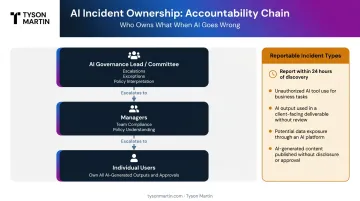
Accountability Chain
- Individual users own the outputs they generate or approve using AI tools. Delegating a task to an AI tool does not transfer accountability for the result
- Managers are responsible for ensuring their teams understand and comply with this policy
- [AI Governance Lead / Committee] handles escalations, exception requests, and policy interpretations
What Constitutes an AI-Related Incident Report the following to [Security/Compliance] within [X hours] of discovery:
- Tier 3 or Tier 4 data entered into an unapproved AI tool
- AI-generated output used for a decision that caused material harm
- Discovery of unauthorized AI tool use involving company data
- Any AI system behavior that is unexpected, harmful, or potentially discriminatory
Incident Documentation Reports must include: tool name, data involved and classification tier, estimated exposure scope, business context, and steps taken immediately. This documentation supports breach notification obligations where applicable.
Policy Review, Enforcement, and Compliance
Review Cadence This policy is reviewed quarterly at minimum. Out-of-cycle reviews are triggered by: significant new AI tool adoption, material regulatory changes, or any AI-related security or compliance incident.
Violations and Consequences Violations are addressed through the organization's existing disciplinary framework, with severity assessed based on data tier involved, intent, and harm caused:
- First-time violations from genuine misunderstanding are addressed through mandatory retraining
- Repeat violations carry escalated consequences through the standard disciplinary process
- Incidents involving Tier 3/4 data exposure may result in termination and legal action
Audit Rights The organization reserves the right to audit AI tool usage, review outputs, and assess compliance with this policy. Employees and contractors consent to such audits as a condition of system access.
Questions and Escalation Direct policy questions to [AI Governance Lead] at [CONTACT]. For urgent incidents, follow the incident reporting process above.
Acknowledgment By signing below, I confirm that I have read, understood, and agree to comply with this AI Acceptable Use Policy.
Name: _________________ Role: _________________ Date: _________________
Securing Executive and Board Sign-Off
Cross-Functional Drafting Is Not Optional
An AI AUP developed solely by IT will be under-enforced. Effective enterprise policies require Legal, HR, Compliance, Risk, and business unit leaders from the first draft. The policy needs a C-suite sponsor—CTO, CIO, or CISO—as the named executive owner with actual enforcement authority.
An independent board advisor or interim CISO can accelerate this process by:
- Translating technical requirements into board-ready business language
- Building the risk-framed business case that gets executive attention
- Preventing the common failure mode where Legal and IT produce a document that HR won't enforce
Framing the Policy for the Board
Don't present this as an IT policy. Present it as a risk management instrument. The board conversation should lead with:
- Regulatory exposure (HIPAA, GDPR, CMMC, SEC disclosure)
- Reputational risk scenarios (AI-generated content causing harm, data exposure via public tools)
- Liability scenarios that connect directly to director duty-of-care
A simple risk matrix showing likelihood and impact of AI misuse scenarios—calibrated to your industry—is more persuasive than policy text. Use ranges rather than false precision, and anchor the scenarios to outcomes the board already tracks: financial loss, operational disruption, legal exposure, and reputation harm.
Legal Review Requirements
Before board approval, the policy must be reviewed against:
- Applicable privacy law (HIPAA, GDPR, CCPA, state laws)
- Employment law obligations in all operating jurisdictions
- Industry-specific regulations relevant to the organization
- Existing IT security, data governance, and code of conduct policies
The goal is a policy that reinforces what already exists. Conflicts between AI policy and existing data governance create enforcement gaps that regulators and plaintiff attorneys find quickly — and that boards are then asked to explain.
Rolling Out and Enforcing the Policy at Scale
Phase 1 — Communicate (Weeks 1–2)
- Executive-sponsored all-hands announcement establishing policy as a governance priority
- Policy distribution with a plain-language one-page summary (not the full legal document)
- Posting to internal knowledge base with version history
- FAQ document addressing common employee questions about daily workflow changes
The plain-language summary matters. Employees don't read 15-page policy documents. They read one-pagers.
Phase 2 — Educate (Weeks 2–4)
- Mandatory training (30–45 minutes) covering practical scenarios, not policy text recitation
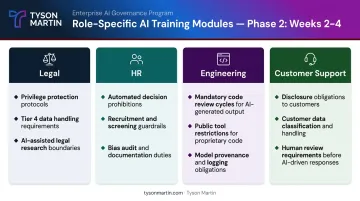
- Role-specific modules for high-risk teams:
- Legal: Privilege protection, attorney-client communications, Tier 4 data handling
- HR: Automated decision prohibitions, recruitment use case guardrails
- Engineering: Code generation review cycles, proprietary code in public tools
- Customer support: Disclosure obligations, customer data classification, human review requirements
- Scenario-based exercises showing what good and bad AI use looks like in context
KPMG's research found that 66% of employees relied on AI output without critically evaluating it—which means training must address complacency, not just rule recitation.
Phase 3 — Embed (Ongoing)
- Policy acknowledgment integrated into onboarding for all new employees and contractors
- AI tool usage added to vendor onboarding assessments
- Quarterly policy refreshes tied to review cycle, with change summaries distributed to all staff
Enforcement Without Surveillance
The goal is AI literacy, not monitoring. Most policy violations result from employees not understanding the risks—not intentional misconduct. Regular training and a straightforward tool request process prevent more violations than enforcement alone—make it easier for employees to ask questions than to work around the policy.
Track these indicators to gauge whether the policy is working:
- Policy acknowledgment rate (target: 100% of in-scope staff)
- Training completion rate (track by department and role)
- Shadow AI tool detection (unapproved tools identified on network)
- AI-related security or compliance incidents (volume and severity trend)
- Exception request volume (high volume signals overly restrictive policy calibration)
These metrics only mean something if you establish a baseline before rollout. No authoritative public benchmark currently quantifies incident reduction following AI AUP deployment—any vendor citing a specific percentage reduction should be pressed on methodology. Measure your own starting point and track progress against it.
Frequently Asked Questions
What is the difference between an AI acceptable use policy and an AI governance framework?
An AI AUP is a specific operational document governing how employees, vendors, and systems may use AI tools. An AI governance framework is the broader organizational structure—covering roles, risk processes, oversight mechanisms, and accountability—within which the AUP sits. The AUP is one component of that framework, not a substitute for it.
Who should own the AI acceptable use policy in an enterprise?
Ownership typically sits with the CISO or CIO, with Legal and Compliance as co-owners. An executive sponsor—CTO or COO—provides enforcement authority. The board's Audit or Risk Committee should have visibility into the policy as part of AI risk oversight.
How often should an enterprise AI acceptable use policy be reviewed?
Review quarterly at minimum — AI tool adoption moves fast enough that waiting longer creates real exposure. Any significant new tool adoption, material regulatory change, or AI-related incident should trigger an out-of-cycle review.
Does an enterprise AI acceptable use policy need board approval?
Operational policies typically don't require full board approval. The Audit or Risk Committee should be briefed on it, though — especially in regulated industries where AI misuse creates direct board liability and demonstrating defensible oversight is a regulatory expectation.
How do you handle employees who use AI tools not on the approved list?
The policy should include a clear tool request and approval process so employees have a sanctioned path to add new tools quickly. Unauthorized use runs through existing disciplinary procedures: first-time violations from misunderstanding go to mandatory retraining; repeat violations or Tier 3/4 data exposure carry escalated consequences.
What regulations require enterprises to have an AI acceptable use policy?
No single U.S. law currently mandates a document named "AI Acceptable Use Policy." Several frameworks do create obligations that a documented AUP directly supports, including:
- HIPAA — PHI safeguards and breach notification
- CMMC/NIST SP 800-171 — CUI rules of behavior and access controls
- GDPR — automated decision restrictions and processor controls
- SEC cyber disclosure rules — material incident and governance disclosure