Introduction
Right now, someone on your team is using ChatGPT to draft client proposals. Another employee is summarizing internal meeting notes through a free tool they found online. A third is using an AI feature baked into your CRM that nobody in IT formally reviewed.
This is not speculation. According to Deloitte, 65% of employees use free external generative AI tools for work tasks or pay for them personally — often before their organization has any policy in place. Meanwhile, ISACA reports that only 28% of organizations have a formal, comprehensive AI use policy.
The gap between those two numbers is where risk lives.
This article gives mid-sized organizations a practical framework for AI governance: what to assess before drafting a policy, how to structure it, and what separates a policy that holds from one that quietly fails.
Key Takeaways
- The real risk isn't AI adoption — it's adoption that leadership hasn't evaluated or governed
- Effective governance requires clear ownership, defined data boundaries, an acceptable use policy, and a vendor review process
- Plug AI governance into existing cybersecurity and risk frameworks — don't treat it as a separate project
- Without a CISO or CDO, assign governance accountability explicitly or bring in outside support to fill the gap
- A policy written in 2023 is likely already outdated; build in a review trigger from day one
Why Generative AI Governance Is a Different Challenge for Mid-Sized Companies
Mid-sized organizations occupy an uncomfortable middle ground. They're large enough to face enterprise-level regulatory exposure — HIPAA, SOC 2, financial services obligations, SEC cybersecurity disclosure requirements — but they typically lack the compliance infrastructure that large enterprises use to manage it.
That gap creates real exposure. The KPMG survey of senior leaders at companies with over $1B in revenue found that only 16% felt highly equipped for generative AI use, despite 69% actively training their workforce. If that's where large enterprises stand, mid-sized companies are starting from a harder position.
The Shadow AI Problem
Because procurement controls at mid-sized companies tend to be lighter, employees adopt AI tools before IT or leadership is involved. By the time a policy gets written, sensitive data may already have been entered into platforms the organization never reviewed.
This is not theoretical. In 2023, Samsung restricted generative AI tools across the company after employees uploaded sensitive internal source code and meeting content to ChatGPT. A separate analysis found that 4% of employees had pasted sensitive data into ChatGPT at least once. Samsung has a dedicated security team. Most mid-sized companies don't.
Generative AI doesn't introduce new risk categories so much as it exposes the ones already present. Where controls are thin, AI makes the consequences arrive faster and at greater scale:
- Unclassified data reaches external platforms before anyone notices
- Vendor relationships expand without review or contractual data protections
- Employees escalate nothing because no threshold tells them what warrants escalation
How to Build a Generative AI Governance Framework: Step by Step
Step 1: Audit What Is Already in Use
Governance cannot start with policy writing. It has to start with an honest inventory of what's already happening.
That means looking at three places most organizations miss:
- Embedded AI features in existing SaaS tools — Microsoft 365 Copilot, Salesforce Einstein, and similar platforms activate AI capabilities that IT may not have formally reviewed
- Standalone tools employees adopted independently, often using personal accounts or expense reimbursements
- AI-enabled workflows that have been built without IT involvement
A 2026 Cloud Security Alliance survey found that 82% of enterprises have unknown AI agents in their environments. Mid-sized companies have even fewer detection controls.
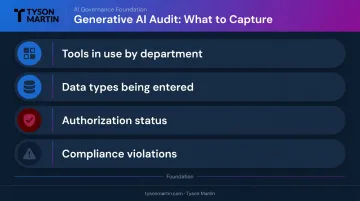
What to capture in the audit:
- Which tools are in use, and in which departments
- What data types are being entered (the answers here are often surprising)
- Who authorized use — and whether anyone actually did
- Whether current use violates existing data handling obligations
This audit is the foundation. Everything else builds on what it surfaces.
Step 2: Assign Governance Ownership and Clarify Decision Rights
Named ownership is what separates a governance structure from a policy document nobody enforces.
Someone at the executive level must own AI policy accountability — including specific decision rights: who approves new tools, who escalates concerns, and who has authority to restrict or revoke access when a tool fails evaluation.
The NIST AI Risk Management Framework is explicit on this: senior leadership and C-suite members are responsible for maintaining awareness of AI risks and affirming organizational risk appetite. Accountability structures should empower specific teams and individuals — with documented roles — to map, measure, and manage AI risks.
Many mid-sized organizations lack a CISO or CIO positioned to lead this work. When that's the case, accountability defaults to no one. Naming a cross-functional AI governance lead — or engaging a fractional CISO or independent board advisor — closes that gap.
The initial focus should be practical: establish a plain-English risk posture, define escalation thresholds, and build a board-ready reporting baseline.
Step 3: Define Data Boundaries
The core of any generative AI acceptable use policy is a clear, explicit list of data types that must never be entered into AI platforms.
Common prohibited categories:
- Protected health information (PHI)
- Non-public financial data
- Confidential client records
- Trade secrets and proprietary product information
- Employee personal information
- Any data subject to contractual confidentiality obligations
Data boundary definitions also need to account for how AI vendors actually handle inputs. The distinction between consumer and enterprise plans matters here.
OpenAI, Microsoft (Copilot), Google Workspace with Gemini, and Anthropic's commercial products all publish documentation indicating that enterprise accounts are not used to retrain models by default — but those protections are plan-dependent and not automatic for free or personal accounts.
Employees using personal accounts on company tasks do not get enterprise data protections. That distinction needs to be explicit in your policy.
Step 4: Draft and Publish an Acceptable Use Policy
A generative AI acceptable use policy does not need to be long. It needs to be clear. A policy no one reads will not change behavior.
Core components:
- Approved tools list (specific products, specific versions)
- Prohibited tools list — or a default-deny model where unlisted tools require review
- Prohibited data types (see Step 3)
- Use case approval process for tools not yet reviewed
- Accuracy verification expectations for AI-generated outputs
- Documentation or logging requirements where compliance obligations apply
Write it in plain language that employees can follow without legal or IT training. The measure of a good policy is whether it changes behavior before an incident, not whether it satisfies an auditor after one.
Step 5: Build a Vendor Evaluation and Review Cadence
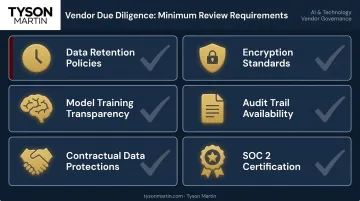
Every AI tool your organization standardizes on needs a minimum due diligence review before deployment. That review should cover:
- Data retention policies (and whether enterprise settings are active)
- Encryption standards in transit and at rest
- Model training transparency — are inputs used for retraining?
- Audit trail availability
- Contractual data protection terms
- SOC 2 or equivalent certification evidence
Beyond initial review, build a regular review schedule. The CSA recommends reviewing data security and privacy policies at least annually — but given how fast vendor practices are evolving, annual may not be sufficient. A policy written in early 2023 predates the NIST Generative AI Profile, FTC AI privacy guidance, and CSA's AI data security framework, all published in 2024 and 2025.
Review triggers (don't wait for the annual cycle):
- A significant new AI capability is released by a vendor you use
- A new vendor is adopted
- A relevant regulation changes
- A governance incident or near-miss occurs
Key Variables That Determine If Your Generative AI Policy Actually Works
A policy can be well-written and still fail. These four variables are what separates governance that holds from governance that looks good on paper.
Data Classification Maturity
An acceptable use policy is only as effective as your employees' ability to identify what data is sensitive. If that ability is inconsistent, the policy's data boundary rules cannot be followed consistently.
Before publishing your AI policy, run a brief data sensitivity mapping exercise: identify the five to eight data types your organization handles that carry the highest regulatory or contractual sensitivity, give each a plain-English label, and confirm that employees in high-risk roles can identify them correctly.
This doesn't need to be a formal classification program. It needs to be enough that employees can make sound judgment calls in edge cases — and that the calls are consistent across teams.
Governance Ownership Structure
Distributed AI governance — where each department informally manages its own AI use — produces inconsistent enforcement, duplicate vendor risk, and gaps that only become visible during an incident or audit.
The alternative is a named executive or governance body with visibility across all AI use and escalation authority when issues arise. A single owner with clear decision rights and a defined escalation path closes more gaps than a committee without one.
Policy Enforcement and Monitoring Mechanisms
Governance requires both technical controls and a reporting path — without them, a policy is just a document.
Technical controls to consider:
- Blocking unauthorized AI domains at the network level
- Logging AI tool usage through endpoint management
- Requiring IT pre-approval for new tool access requests
Monitoring mechanisms for lean teams:
- A small set of stable metrics that trigger decisions — not dashboards that generate noise
- Exception tracking with expiration dates (temporary exceptions should not become permanent policy)
- A visible, low-friction way for employees to flag potential misuse without fear of penalty
Common Mistakes Mid-Sized Companies Make Governing Generative AI
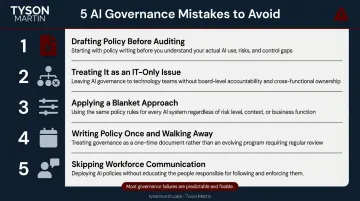
Most mid-sized companies don't fail at AI governance because they lack intent. They fail because of predictable, fixable missteps. Here are the five that come up most often:
- Drafting policy before auditing current use. Organizations that write an AI policy without knowing what tools employees already use create rules disconnected from reality. Those rules get ignored immediately.
- Treating AI governance as an IT issue. When policy ownership lives only in IT, the board and executive team lack visibility into AI risk exposure. Escalation thresholds never get defined at the decision-making level — and governance collapses when a real incident hits.
- Applying a blanket approach. A flat prohibition drives usage underground. A flat approval with no review creates compliance exposure. Effective governance uses a tiered model: low-risk use cases pre-approved, higher-risk cases requiring explicit review.
- Writing the policy once and walking away. Generative AI capabilities and vendor practices change faster than annual review cycles can track. Build in review triggers — new regulation, new capability, new vendor, incident — or the policy will be outdated within 12 months.
- Skipping workforce communication. Governance documents that are never actively communicated or trained against create the illusion of control while leaving actual behavior unchanged. Employees need to understand not just the rules but the reasoning behind data boundaries. That's what enables good judgment in situations the policy didn't anticipate.
Conclusion
Governing generative AI in a mid-sized company does not require bureaucracy. It requires clarity: clear ownership, clear data boundaries, an enforceable acceptable use policy, and a vendor review process that can be verified and inspected.
Most governance failures come from starting too late, assigning accountability to no one, or treating the policy as a document rather than an operational control. Organizations that establish governance before an incident, rather than in response to one, move faster on AI adoption — with a board that can actually verify what controls are in place.
Mid-sized organizations that lack the internal executive capacity to build and maintain this framework can engage a board advisor or fractional CISO to establish the decision rights, escalation thresholds, and inspectable execution structure that governance requires.
Tyson Martin works with boards and executive teams to build AI governance that integrates directly into existing cybersecurity and risk frameworks, rather than sitting beside them as a separate initiative with no operational teeth.
Frequently Asked Questions
What should a generative AI acceptable use policy include?
At minimum:
- An approved and prohibited tools list
- Prohibited data types (clearly defined)
- A use case approval process for unreviewed tools
- Accuracy verification expectations for AI-generated outputs
- Documentation requirements where compliance applies
Write it in plain language employees can follow without IT or legal training.
Who should own AI governance in a mid-sized organization?
Executive leadership must hold accountability — typically the CEO, COO, or a designated executive with cross-functional authority — with IT, legal, and compliance supporting implementation. In organizations without a CISO or CDO, a fractional executive or board advisor should establish the governance structure, define decision rights, and set the escalation framework before an incident forces the issue.
How is governing generative AI different from general cybersecurity governance?
Cybersecurity governance focuses on protecting systems and data from external threats. AI governance focuses on how decisions about AI are made internally — covering accountability, acceptable use, vendor oversight, and ethical guardrails. Both are necessary, and they should be integrated: AI governance plugs into your existing risk framework rather than operating as a separate discipline.
What data should employees never enter into generative AI tools?
Protected health information, non-public financial data, confidential client records, employee personal information, trade secrets, and anything under contractual confidentiality obligations. Your specific list depends on your regulatory environment and the industries you serve.
How often should a generative AI governance policy be updated?
At minimum, annually — but triggered reviews are equally important. Review the policy whenever a significant new AI capability is released, a new vendor is adopted, a relevant regulation changes, or a governance incident occurs. With new models and regulatory guidance appearing on a near-monthly basis, the annual cycle alone won't keep pace.