Introduction
Picture this: an authorized employee asks the company's AI assistant a routine question about a client account. The response is accurate and complete. It also contains financial details from documents the employee was never cleared to access. No breach alert fires. No DLP rule triggers. No SIEM event surfaces. The employee closes the window and moves on.
That is the defining characteristic of enterprise AI data leakage. It happens through normal operation, not an obvious attack.
Enterprises are deploying AI faster than their governance frameworks, access controls, and oversight structures can keep pace. According to IBM's 2025 Cost of a Data Breach analysis, 20% of studied organizations experienced breaches linked to shadow AI — unsanctioned tools adopted without IT or security review.
ISACA found that only 15% of organizations had formal AI policies while 70% of staff were already using AI tools regularly. That gap is where most enterprise AI exposure originates — and this guide walks through exactly where it shows up and what boards and executives can do about it.
Key Takeaways
- Enterprise AI data leakage happens through normal tool operation — prompt retention, retrieval systems surfacing unauthorized content, and agent actions — not traditional attacks.
- Existing DLP, network segmentation, and access controls were not designed for how data moves inside AI systems.
- AI agents now book meetings, send emails, and trigger payments autonomously — the risk has expanded well beyond data exposure.
- Boards need clear decision rights, assigned ownership, and measurable controls in place before the next AI deployment.
What Enterprise AI Data Leakage Really Looks Like
Enterprise AI data leakage is the exit of sensitive business information through an AI tool's prompt, model response, retrieval system, or API connection — without triggering existing security controls, and often through authorized employees using sanctioned tools.
Most exposure is operational, not adversarial. Data moves continuously through orchestration layers, logging pipelines, retrieval systems, plugins, memory stores, and external integrations during normal use.
NIST AI 600-1 identifies this as a core generative AI risk category: data provenance, data privacy, harmful outputs, and third-party component exposure all occur as a function of how these systems work, not just how they can be attacked.
The Five Primary Leakage Vectors
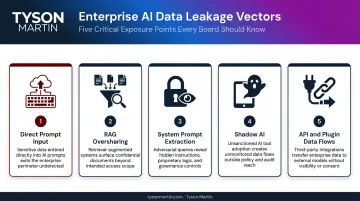
- Direct prompt input: Employees paste customer data, financial records, or patient information into a public AI tool that lacks a proper data processing agreement.
- RAG oversharing: Retrieval-augmented systems surface documents a querying user was never authorized to see, because the retrieval layer applies no access controls before passing content to the model.
- System prompt extraction: Users query an AI application to reveal its internal instructions, exposing pricing logic, API credentials, M&A context, or business process details embedded by the developer.
- Shadow AI: Employees use browser extensions or personal AI accounts outside the approved vendor list, creating data flows IT and security teams cannot see or govern.
- API and plugin data flows: OAuth tokens granted to AI tools during onboarding retain permissions far broader than the original use case — and those tokens are rarely reviewed.
The Agentic Escalation
The exposure profile changes fundamentally when AI moves from answering questions to taking action. An agent embedded in enterprise workflows books meetings, sends communications, modifies records, triggers payments, and calls external APIs — all without a human in the loop for each step. Gartner projects that 40% of enterprise applications will be integrated with task-specific AI agents by the end of 2026, up from less than 5% in 2025.
Regulated industries face compounded exposure. In financial services, healthcare, and retail, the data flowing through AI tools includes precisely the categories that attract the most severe regulatory penalties:
- Financial services: Client account data, transaction records, and trading strategies
- Healthcare: Protected health information and clinical decision data
- Retail: Competitive pricing logic, supplier contracts, and consumer behavioral data
Why Your Existing Security Stack Wasn't Built for This
The honest answer is that most security tools were designed for a world where humans move data and machines move it only when instructed. AI broke that assumption.
DLP Fails at the Prompt Layer
As Gartner's research confirms, conventional DLP cannot effectively manage generative AI data loss risks, including exposure via encrypted traffic, intent blindness, and shadow AI. DLP scans outbound files and emails for structured data patterns. It cannot:
- Classify a client contract pasted as plain text into an AI prompt
- Detect when a RAG system surfaces unauthorized content in a response
- Flag an agent-generated summary that captures the same sensitive information a raw export would have triggered
The data never looked like data leaving the building. So no rule fired.
Access Controls and Network Segmentation Fall Short
Traditional access controls assume data flows through predictable paths and that human operators are accountable for each action. AI agents route data through multiple hops and transformations at machine speed. A misconfigured agent can interact with records, generate outputs, and trigger downstream actions faster than a security team can respond.
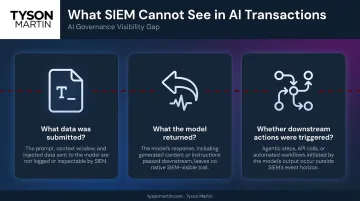
Standard SIEM logs record that an HTTPS request was made to an AI provider endpoint. They don't capture what was in the request, what was returned, or whether sensitive data changed hands. That gap is precisely what NIST AI RMF 1.0 targets — it calls for monitoring, documentation, and incident processes rather than relying on perimeter controls alone.
Three things most SIEM environments cannot answer about an AI transaction:
- What data was submitted in the prompt or context window
- What the model returned and whether it included sensitive content
- Whether downstream actions were triggered based on that output
Regulators are now examining this visibility gap directly. Organizations that can't reconstruct what their AI systems submitted and received are not in a defensible position.
The Governance Gap: What Boards and Executives Must Own
Here is the problem in plain numbers. Deloitte's 2024 board survey found 79% of respondents said their boards had limited, minimal, or no AI knowledge or experience — and only 2% described their boards as highly knowledgeable. At the same time, 45% said AI had not yet made it onto the board agenda. McKinsey found that 65% of organizations were already regularly using generative AI.
That gap — between deployment pace and governance maturity — is where most enterprise AI risk lives.
Questions Every Board Must Be Able to Answer
When Tyson Martin opens AI risk conversations with audit and risk committees, the diagnostic starts with accountability. Boards should be able to answer:
- What AI tools are in active use across the enterprise, including tools employees installed independently?
- What data can each tool access, and under what authorization?
- When security conflicts with speed, who breaks the tie?
- How do you approve and monitor AI tools that touch company data?
- What are the escalation thresholds if an AI system behaves unexpectedly?
Organizations that cannot answer these questions don't have a governance posture. They have an assumption.
Decision Rights in the AI Context
For each AI deployment, governance requires clearly defined boundaries: what the system can do autonomously versus what requires human review, what data it is permitted to access, and which actions are irreversible.
Any irreversible action — sending an external communication, modifying a financial record, triggering a downstream payment — requires a human confirmation gate hardcoded into the architecture. Leaving that assessment to the agent itself is not a control.
What Meaningful Board Reporting Looks Like
Meaningful AI risk reporting is a stable dashboard showing trend data across AI tool inventory, access controls, data classification status, and incident history — not a point-in-time compliance certification. Every metric needs a clear owner, a target, a time window, and a decision it drives.
Where in-house security leadership is absent or in transition, boards should ensure someone with AI risk fluency owns this reporting function and can translate findings into decisions. The question is not "Is our AI compliant?" — it's "What can our AI agents do on a bad day, and does anyone in this room know the answer?"
A Prevention Framework for Enterprise AI Deployments
Controls applied after a problem surfaces are incident response, not prevention. The following framework addresses the structural checkpoints that should exist before any AI deployment expands.
Data Classification First
An organization cannot detect or prevent leakage of data it hasn't classified. Before deploying AI tools, every data category the tool will access must be classified by sensitivity level, with documented authorization defining which agents and users can access each level. This baseline is also what audit and compliance reviews will examine first.
The Cloud Security Alliance's AI Controls Matrix — which aligns with NIST AI RMF, ISO 42001, and the EU AI Act — treats data governance as a foundational domain, not an optional layer.
Access Controls at the Right Layer
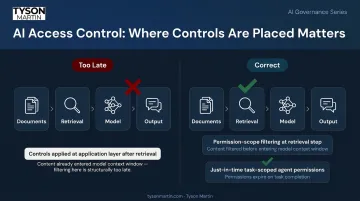
Controls applied at the application layer after retrieval has already occurred are too late. In RAG systems, permission-scope filtering must happen at the retrieval step — before any document enters the model's context window. In agentic workflows, permissions should be granted per task and expire when that task completes (just-in-time access for non-human identities), not granted permanently to the agent as an entity.
Prompt-Level Enforcement and Output Scanning
An acceptable use policy is not a technical control. Preventing prompt-level leakage requires a system that inspects submissions to AI tools in real time — before the data reaches the model — and scans model outputs for sensitive data before it is rendered to the user.
Organizations deploying AI across regulated data categories should assess whether their current tooling provides this capability or whether a structured security assessment is needed to identify the gap.
Immutable Audit Logging and Adversarial Testing
Two disciplines that most organizations haven't formalized yet:
- Require tamper-evident prompt logs: HIPAA's Security Rule and emerging AI governance frameworks require a record of what was submitted to AI systems, what those systems returned, and what enforcement actions were taken — in a form an auditor can reconstruct. Network-level telemetry doesn't meet this bar.
- Require ongoing adversarial validation, not just annual testing: AI models can behave differently based on phrasing, context, and user intent — making point-in-time assessments insufficient. Boards and executives should require evidence that AI deployments are tested regularly with realistic adversarial scenarios, using the actual permissions the agent holds in production. Ask when the last test occurred and what changed as a result.
Regulatory and Compliance Exposure You Cannot Ignore
A single AI data leakage incident can trigger multiple regulatory frameworks at once. Boards in regulated industries need to understand how these penalties compound.
The Penalty Stack
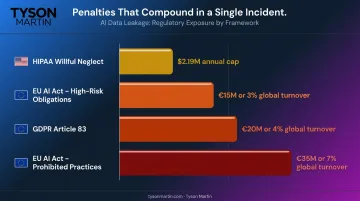
| Framework | Jurisdiction | Maximum Penalty |
|---|---|---|
| GDPR Article 83 (higher-tier) | EU | €20,000,000 or 4% of worldwide annual turnover |
| EU AI Act (prohibited practices) | EU | €35,000,000 or 7% of worldwide annual turnover |
| EU AI Act (high-risk system obligations) | EU | €15,000,000 or 3% of worldwide annual turnover |
| HIPAA (willful neglect, uncorrected) | US | $73,011 minimum per violation, $2,190,294 annual cap |
Consider how quickly exposure accumulates. An employee submitting personal data to a third-party AI tool without a valid Data Processing Agreement is a potential unauthorized processing event under GDPR, with notification obligations. Two related gaps that boards often overlook:
- A RAG system surfacing unauthorized content in a regulated environment creates audit trail obligations
- An AI tool operating as a high-risk system without documented input/output logging is non-compliant with EU AI Act obligations taking full effect August 2026
A single leakage incident can fail a SOC 2 audit, trigger a HIPAA breach notification, create GDPR Article 28 exposure, and generate board-level liability — all at once.
For organizations in financial services, healthcare, and retail, that combination makes AI governance an enterprise risk management issue — not an IT issue.
What Auditors Will Ask
Boards should assume auditors will present four questions:
- Do you have controls to prevent unauthorized data access?
- Do you monitor for data exfiltration?
- Do you have an incident response plan — with evidence it was followed?
- Were your controls tested?
Organizations that cannot produce evidence for each question are exposed. Those that can are defensible. Building that evidence posture is a governance and reporting function — one that belongs on the board agenda, not just the security team's checklist.
Frequently Asked Questions
What is enterprise AI data leakage?
Enterprise AI data leakage is the exit of sensitive business information through an AI tool's prompt, model response, retrieval system, or API connection without triggering existing security controls. Unlike a traditional breach, it happens through authorized employees using sanctioned tools — not unauthorized access.
How is AI data leakage different from a traditional data breach?
Traditional breaches involve unauthorized access by external or internal attackers. AI data leakage happens through normal, authorized operation. No file transfer event occurs, no SIEM alert fires, and the employee may be entirely unaware that sensitive data traveled beyond its intended boundary.
Can existing DLP tools prevent AI data leakage?
No. DLP tools scan outbound files and emails for structured data patterns. They cannot inspect natural language prompts, detect RAG oversharing, or flag agent-generated summaries that capture sensitive information without triggering a signature-based rule. Industry analysts have confirmed this limitation explicitly.
What questions should boards ask about AI data leakage risks?
Three questions every board should ask:
- What AI tools are in active use, including those employees installed without IT approval?
- What data can each tool access, and under what authorization?
- What can our AI agents do autonomously, and what requires human approval before execution?
What are the regulatory consequences of an AI data leakage incident?
A single incident can simultaneously trigger GDPR notification obligations, HIPAA breach reporting requirements, SOC 2 audit findings, and EU AI Act violations with financial penalties that compound across frameworks for organizations in regulated industries.
How do you prevent employees from leaking data through AI tools without blocking productivity?
Policy alone cannot be technically enforced, and access restriction pushes employees to personal devices and shadow AI. Effective prevention requires prompt-level enforcement that classifies submissions in real time and applies the correct policy response without interrupting legitimate workflows.