Introduction: The AI Privacy Trap Boards Walk Into Without Realizing It
AI adoption is accelerating faster than the governance structures meant to contain it. According to McKinsey's 2024 survey, 72% of organizations had adopted AI in at least one business function, yet only 18% had an enterprise-wide council with actual authority over responsible AI governance. That gap is a liability, not a compliance footnote.
The pressure is real on both sides. Business teams want AI deployed yesterday. Meanwhile, data exposure compounds with each new use case — often without anyone formally tracking what data the model touched, how it was used, or whether existing consent actually covers it.
This piece is about what governance needs to look like to hold up under regulatory scrutiny, board questions, and real incidents — before those situations force the answer. What follows covers how AI reshapes privacy risk, what the regulatory landscape actually requires, and what executives and boards should have in place now.
Key Takeaways
- 72% of organizations use AI but only 18% have formal governance authority in place — the gap creates direct liability
- AI infers sensitive information from non-sensitive data — exposure that doesn't require a breach to trigger regulatory scrutiny
- The EU AI Act carries fines up to €35 million or 7% of global revenue for prohibited AI practices
- Governance built at deployment is 10x harder to retrofit than governance built at design
- Boards need documented decision rights and escalation thresholds before an AI incident forces the question
How AI Fundamentally Changes Enterprise Data Privacy Risk
Traditional security controls were designed to protect data at rest and in transit. AI does something different: it interprets, synthesizes, and acts on data continuously, across multiple systems, at machine speed. The risk surface that creates is genuinely new.
The Data Intensity Problem
AI systems get more capable with more context. That appetite is by design. A customer service AI pulling from CRM records, call transcripts, behavioral signals, and third-party data sources isn't doing anything unusual — it's doing exactly what it was built to do. The privacy question is whether each of those data layers was collected for this purpose, and whether existing consent actually covers the use.
Most organizations can't answer that cleanly when pressed. The data was collected under one set of terms, the AI use case emerged later, and nobody formally connected the two.
Inference Risk Without a Breach
One of the less-discussed AI privacy risks doesn't require a breach to materialize. ICO guidance makes clear that AI systems can infer special-category data — health status, ethnicity, financial vulnerability — from inputs that never explicitly contained those categories. A 2022 Lancet Digital Health study found deep learning models could predict self-reported race from medical images with AUC scores reaching 0.99 for chest X-rays. The model was trained on images. Nobody disclosed race.
That pattern translates directly to enterprise AI: behavioral signals, browsing patterns, and transaction data can generate inferences about protected characteristics even when users never provided them. Regulatory exposure follows the inference, not just the breach.

The Governing-Late Trap
The costliest AI governance failure is structural: organizations deploy use cases quickly, then discover months later that controls were never built in. Retrofitting governance after a model is trained and decisions have been made is expensive, disruptive, and sometimes forces the product to be pulled entirely.
Governance has to be built at the point of entry — before the model trains on the data, before the use case scales. The organizations that wait find out that window closes well before anyone notices it's gone.
The failure points that keep appearing in late-governance scenarios:
- Consent scope wasn't validated before data entered the training pipeline
- No documented data lineage connecting source collection terms to AI use
- Accountability for the decision to deploy sat with no single owner
- Risk reviews happened after the model was in production, not before
The Black-Box Problem
Many enterprise AI systems cannot explain what data shaped a given output, who had access, or how that data moved through a workflow. Regulators increasingly require that explanation. Boards ask for it after incidents. Organizations that can't produce it face mandatory rework, not just reputational risk.
The Regulatory Landscape Every Board Should Understand
This is not one unified law. It's a layered, evolving set of obligations that differ by geography, sector, and AI risk classification. Boards that treat AI compliance as a single checkbox are looking at the wrong map.
Key Frameworks
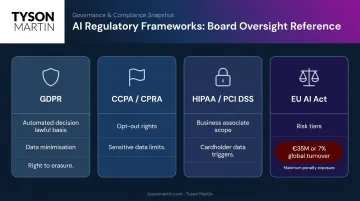
| Framework | Core AI Obligation |
|---|---|
| GDPR | Lawful basis for automated decisions (Article 22), data minimization (Article 5), right to erasure (Article 17) |
| CCPA/CPRA | Opt-out rights for automated decision-making in significant decisions; limits on sensitive personal information use |
| HIPAA/PCI DSS | AI vendors handling PHI may qualify as business associates; AI payment workflows touching cardholder data trigger full PCI scope |
| EU AI Act | Risk-based tiers (prohibited, high, limited, minimal); high-risk systems require documentation, human oversight, and audit logs |
The EU AI Act penalties set the ceiling: €35 million or 7% of worldwide annual turnover for prohibited AI practices, €15 million or 3% for other specified violations. Both figures are codified in Article 99 of the enacted regulation.
The U.S. Patchwork Is Moving Fast
The EU framework is only part of the picture. NCSL reported that in 2025, all 50 states introduced AI legislation, with 38 states adopting or enacting roughly 100 measures. IAPP confirmed 19 U.S. states had passed comprehensive privacy laws as of mid-2025. For organizations operating across state lines, this is no longer a watch-and-wait situation.
Sector Context Matters
Regulated industries — financial services, healthcare, retail — face AI-specific scrutiny layered on top of existing compliance requirements. The FTC's 2023 Rite Aid enforcement action is instructive: the retailer was banned from using facial recognition for five years after deploying the technology without reasonable safeguards.
No data exfiltration occurred. The enforcement came from the AI deployment itself.
Regulations now require organizations to demonstrate that automated decisions are lawful, proportionate, and explainable. If you can't trace how an AI-driven outcome reached its conclusion, you may face mandatory rework regardless of whether anything was stolen.
Why Governance Is the Missing Piece — Not a Brake on Innovation
The assumption that governance slows AI down gets things backwards. Organizations with strong data governance frameworks typically move from pilot to production faster — because they spend less time renegotiating trust, backtracking on data issues, or rebuilding controls after an incident.
IBM's 2025 Cost of a Data Breach report found the global average breach cost at $4.44 million, with U.S. averages reaching $10.22 million. Organizations with high levels of shadow AI had breach costs $670,000 higher than those with low or no shadow AI. That's the cost of ungoverned AI use — not hypothetical risk.
What Enterprise AI Data Governance Actually Includes
- Clear data ownership and stewardship by named roles
- Role-based access controls tied to least-privilege principles
- Retention and deletion rules with enforcement mechanisms
- Consent management that updates across systems in real time
- Version-controlled knowledge sources for AI systems
- Audit trails that can answer "what happened and why"
Data Governance vs. Privacy Governance
These are related but distinct. Data governance keeps data usable and consistent. Privacy governance keeps data use legitimate and defensible. You can have clean, well-organized data and still use it in ways that create regulatory exposure. You can have good privacy intentions sitting on top of a disorganized data environment. Both layers are required.
The Accountability Gap
A common failure pattern: senior leaders assume AI risk "belongs" to a specialist team or a single executive. It doesn't work that way. AI systems train on opaque datasets, their behavior can drift after deployment, and their outputs carry organizational liability.
Governance must include visible senior ownership. Delegating it to a data science function and waiting for it to surface after something goes wrong is not a strategy — it's a liability.
Building an AI Governance Framework That Actually Works
Start With Privacy by Design
Before any AI use case deploys, define what data is actually required. Strip unnecessary identifiers before data reaches models. Set retention limits upfront. Run privacy impact assessments on new AI workflows.
AI tools are context-hungry by design. That appetite has to be managed deliberately — not assumed away.
Build Cross-Functional Governance
Governance policy that lives only in the legal team or only in IT creates structural blind spots. Effective AI governance includes:
- Legal — consent validity, regulatory mapping, disclosure obligations
- Security — access controls, logging, incident response
- CIO/CTO — architecture decisions, vendor selection, technical standards
- CX/Operations — customer-facing use case review, escalation design
- Data and AI teams — model behavior, training data sourcing, output monitoring
- Procurement/Vendor Risk — third-party AI tools and data processors
For organizations in transition or without a seated security executive, an interim CISO can build this structure quickly — getting decision rights in place before risk compounds. Tyson Martin's practice does exactly this: stepping in to clarify ownership, establish governance cadence, and hand off a structure the organization can run independently.
Risk-Tier AI Use Cases Before Scaling
Not all automation carries the same exposure. A practical tiering:
| Risk Level | Use Case Examples | Controls Required |
|---|---|---|
| Lower | Conversational summaries, internal drafting | Standard access controls, logging |
| Mid | Customer-facing answers, complaint triage, personalization | Human review checkpoints, consent validation |
| High | Account changes, identity recovery, payment actions, entitlement decisions | Human-in-the-loop, step-up verification, full audit trail |
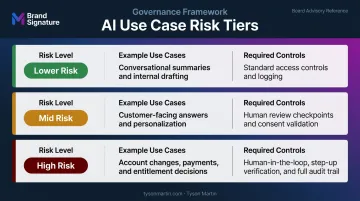
Use cases should be tiered before they scale, not after.
Guardrails Around Identity, Access, and Workflow Execution
Define explicit escalation thresholds — when the AI stops and hands off to a human — before the use case goes live. This includes:
- Least-privilege access across all AI-connected systems
- Clear separation between assistive AI and autonomous AI
- Logging for every data access and workflow action
- Defined handoff protocols with documented ownership
Monitor AI Behavior After Deployment
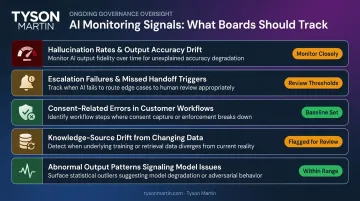
Governance doesn't end at launch — it shifts from setup to monitoring. Mature organizations track these signals on an ongoing basis:
- Hallucination rates and output accuracy drift
- Escalation failures and missed handoff triggers
- Consent-related errors in customer-facing workflows
- Knowledge-source drift as underlying data changes
- Abnormal output patterns that signal model or data issues
A governance policy that sits untouched until an incident forces a review has become a liability, not a safeguard.
The Board's Role: Oversight Without Assumption
Boards don't manage AI directly. Their responsibility is ensuring the right people have the right authority, that risk posture is visible and reportable, and that escalation paths exist before an incident forces the question.
Spencer Stuart's 2024 Board Index found only 29% of new S&P 500 directors had a technology background. NACD found 33.5% of private-company directors cited lack of technology expertise as a major barrier to effective oversight. Those gaps don't fix themselves — they require deliberate structural choices.
Those structural choices typically take the same form across well-governed organizations.
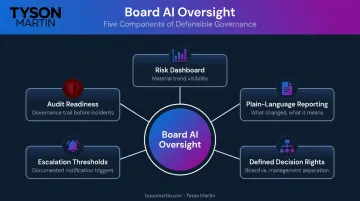
What Good Board-Level AI Oversight Looks Like
- A stable dashboard showing trend, not trivia — movement on material risk scenarios, not blocked-attack counts
- Plain-language reporting that answers: what changed, what it means, what management is doing, and what support is needed
- Defined decision rights that separate board oversight from management execution
- Documented escalation thresholds — what requires board notification, and who triggers it
- Maintains audit-readiness so that if something goes wrong, the governance trail already exists
Board advisors or independent directors with technology and security backgrounds can translate AI risk into defensible governance without requiring the full board to become technical experts.
Tyson Martin's board advisory practice — drawing on experience with Fortune 100 retailers and AWS — offers independent, plain-language oversight that gives boards a clear line of sight into AI risk posture and decision rights, separate from in-house CISO reporting.
Governance as a Competitive Signal
Organizations that can demonstrate responsible AI use — to regulators, customers, procurement teams, and insurers — move faster in the market than those that can't. Governance is protection, but it also functions as institutional credibility. The organizations that scale AI most effectively are the ones that can show regulators and partners, specifically, how their systems are controlled — not just assert that they are.
Frequently Asked Questions
Frequently Asked Questions
What is enterprise AI data governance and why does it matter for boards?
Enterprise AI data governance covers the policies, controls, and ownership structures that determine how data is collected, used, stored, and deleted across AI systems. Without it, boards have no defensible line of sight into what AI decisions are based on or who is accountable when something goes wrong.
How does AI change data privacy risks compared to traditional systems?
AI expands both the volume and velocity of data use, can infer sensitive information from non-sensitive inputs, and makes it harder to trace exactly what data shaped a given outcome. That creates privacy exposure — regulatory and reputational — that doesn't require a breach to trigger consequences.
What regulations should enterprises monitor when deploying AI?
The primary frameworks are GDPR, CCPA/CPRA, HIPAA and PCI DSS for regulated sectors, and the EU AI Act. Obligations vary by geography, industry, and AI risk classification, and U.S. state-level activity is accelerating — treat it as a layered, evolving landscape rather than a single compliance checklist.
How can organizations build a data governance framework without slowing AI innovation?
Strong governance accelerates AI deployment by reducing rework, renegotiation, and cleanup costs. The practical path: build governance in at the point of data entry, risk-tier use cases before scaling, and treat governance as a shared cross-functional responsibility rather than a compliance afterthought assigned to one team.
Who should own AI data governance within an enterprise?
Ownership must be distributed across legal, security, technology, and operations leadership, with clear decision rights defining who approves new AI use cases, who sets escalation thresholds, and who is accountable when something goes wrong. Concentrating that responsibility in one team creates gaps that only surface after an incident.
What should boards ask about AI data privacy at their next meeting?
Start with these:
- Can we explain how our AI systems make decisions and what data they rely on?
- Do our governance controls hold up under regulatory scrutiny?
- Are our escalation thresholds and decision rights documented before an incident forces us to find them?