
Introduction
AI adoption has outpaced governance — and the gap creates real liability for boards.
According to McKinsey's 2024 State of AI report, 72% of organizations had adopted AI and 65% were using generative AI regularly — yet only 18% had an enterprise-wide responsible AI governance council with actual decision authority. Meanwhile, 44% reported at least one negative consequence from AI use.
That gap is a governance problem, not a technology problem. Organizations are making consequential AI-driven decisions — in hiring, lending, healthcare, and operations — without clear accountability structures, defined decision rights, or oversight mechanisms that hold under pressure.
This post draws on current research and leading frameworks to clarify what responsible AI governance actually requires — and what boards and senior executives specifically need to own:
- The structural components most governance programs are missing
- How leading frameworks translate into board-level decision rights
- What inspectable AI oversight looks like in practice
Key Takeaways
- Responsible AI governance is not AI ethics. Ethics sets the principles; governance is the institutional machinery that enforces them.
- Research consistently identifies three practice types that matter: structural (roles, committees, decision rights), procedural (assessments, audits, monitoring), and relational (training, escalation, transparency).
- The persistent failure is the "principles-to-practices gap": organizations have policies but lack enforceable controls.
- Boards govern AI governance — not AI systems directly — and that requires the right reporting lines, escalation thresholds, and decision rights.
- The biggest unaddressed gap in research and practice is not how to govern AI systems, but who governs, at what level, and when.
What Is Responsible AI Governance — And Why the Distinction Matters
Three terms dominate board-level AI discussions, and executives routinely conflate them. Getting the distinctions right determines whether your governance program is functional or decorative.
- AI Ethics — the moral philosophy layer. What values should guide AI development and use? Fairness, transparency, accountability, non-maleficence. This is the what.
- Responsible AI — the operationalized principles layer. How do you build those values into actual products, models, and decisions? This sits between philosophy and process.
- AI Governance — the institutional machinery layer. The committees, decision rights, audit workflows, escalation paths, and reporting structures that make principles enforceable. This is the how.
Governance is where most programs fail — not because organizations lack principles, but because they lack the infrastructure to enforce them.
Trustworthiness Is Institutional, Not Technical
Trustworthiness is an institutional property — not a testing outcome. It emerges from governance mechanisms applied rigorously enough that boards, regulators, and affected stakeholders can have justified confidence in AI-driven decisions.
That means named accountability for AI systems, documented audit trails, human oversight requirements, and escalation paths that actually get used. In practice, this requires embedding governance across the full AI lifecycle: policy design, risk classification, accountability assignment, and post-deployment monitoring.
Why This Is Acute in Regulated Industries
In financial services, healthcare, and retail, AI systems increasingly inform decisions about credit access, clinical care, employment, and pricing. Without governance, those systems operate in an accountability vacuum: no one owns the outcome, no one monitors for drift, and decisions can't be explained when a regulator or plaintiff asks.
The CFPB made this concrete. Creditors using complex algorithms must still provide specific adverse-action reasons under ECOA and Regulation B. Black-box complexity is not a legal defense.
What the Research Reveals About AI Governance Frameworks
The Academic Gap
A 2025 systematic literature review found that AI governance research can be organized around four questions: WHO is accountable, WHAT is governed, WHEN governance occurs in the lifecycle, and HOW governance is implemented. Only 3 of 28 reviewed studies addressed all four dimensions comprehensively — which means the research itself reflects the fragmentation that practitioners experience on the ground.
Organizational-level governance has the most developed solutions. Team-level and national-level governance remain comparatively underdeveloped.
The Four Major Frameworks
| Framework | Type | Best For |
|---|---|---|
| NIST AI RMF | Voluntary, risk-based | Most US organizations — practical starting point with four functions: Govern, Map, Measure, Manage |
| ISO/IEC 42001 | Management system standard | Organizations seeking certification or operating across jurisdictions |
| EU AI Act | Mandatory law | Any company with EU operations or EU-headquartered clients; risk-based classification with binding obligations |
| OECD AI Principles | International ethical foundation | 47 adherent countries; emphasizes human-centered values and transparency |
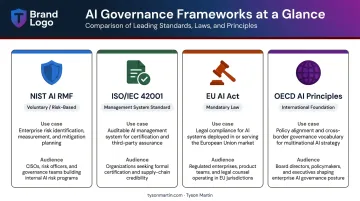
For most US-based mid-market or enterprise organizations, NIST AI RMF is the most practical entry point — it is voluntary, well-documented, and maps cleanly onto existing risk management structures.
Risk-Tiered Logic and High-Risk Classification
Choosing NIST as a starting point does not mean ignoring the broader landscape. All major frameworks apply risk-tiered governance: higher-stakes systems require more rigorous oversight. The EU AI Act's Annex III defines high-risk categories that boards in regulated sectors should recognize:
- Biometric identification systems
- Credit scoring and creditworthiness assessments
- Employment screening and worker management
- Emergency healthcare dispatch and prioritization
- Law enforcement decision support
For these systems, the EU AI Act's Articles 9, 12, and 14 require documented risk management systems, automatic event logging, and human oversight by design — not as optional features.
The Principles-to-Practices Gap
Convergence on ethics principles has not produced convergence on implementation. Jobin et al.'s review of 84 AI ethics guideline documents found broad agreement on values — transparency, fairness, accountability — but substantive divergence on what those values require in practice. AlgorithmWatch has tracked over 160 such principle sets from governments and industry bodies, and notes that most remain voluntary declarations with no operational mechanism behind them.
The gap is not a shortage of principles. It is the absence of governance infrastructure to act on them — the policies, decision rights, audit trails, and accountability structures that turn stated values into inspectable behavior.
The Four Governance Dimensions Boards and Executives Must Own
Boards do not govern AI systems technically. They govern the governance of AI systems — ensuring the organization has the right structures, processes, accountability, and measurement in place. Four dimensions define this.
Structural Governance
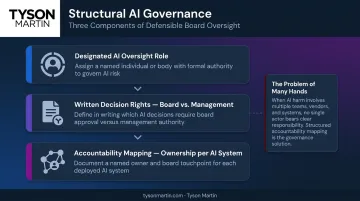
Boards should ensure the organization has:
- A designated AI oversight role (Chief AI Ethics Officer or equivalent cross-functional committee with actual authority — not advisory-only)
- Written decision rights that distinguish what the board approves versus what management delegates
- Accountability mapping that answers, for each AI system: who owns it, who approved deployment, and who is responsible when something goes wrong
The "problem of many hands" — where responsibility diffuses across developers, deployers, and vendors — is not an organizational inevitability. It is a structural design choice that boards can and should correct.
Procedural Governance
The process layer is where governance becomes inspectable. Boards should require:
- AI impact assessments before deployment for any high-risk system
- Risk-tiered review gates that mandate board or committee sign-off for high-risk AI deployments
- Audit trail requirements that answer: what decision did the AI make, what data informed it, and who approved the deployment
- Model monitoring protocols that detect drift and bias before they produce harm or regulatory exposure
The EU AI Act's Article 9 (risk management), Article 12 (automatic logging), and Article 14 (human oversight by design) function as board-level procedural checkpoints for any organization operating under or preparing for that regulation.
Relational Governance
When AI governance is confined to legal or compliance, it tends to arrive late, lack authority, and miss the operational context where most risk actually lives. Effective relational governance requires:
- AI literacy training across both technical and business teams — not fluency, but enough literacy to recognize when escalation is needed
- Defined escalation paths with specific triggers: which AI concerns surface to management, which reach the board, and what timeline applies
- External transparency mechanisms — how the organization communicates its AI governance posture to regulators, auditors, and customers
Accountability and Measurement
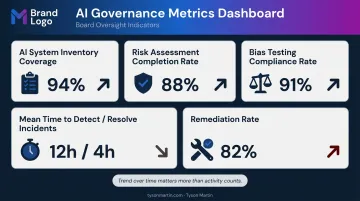
Boards cannot oversee what they cannot measure. Key governance metrics include:
- AI system inventory coverage — you cannot govern what you have not cataloged
- Risk assessment completion rates for high-risk deployments
- Bias testing compliance rates across in-scope models
- Mean time to detect and resolve AI governance incidents
- Remediation rates — are governance findings producing actual change?
Board dashboards should show trend over time and residual risk posture, not just activity counts. Metrics that cannot trigger a decision or shift resource allocation are activity reporting — not oversight.
Regulatory expectations are hardening. The OCC's updated 2026 model risk management guidance explicitly addresses generative AI and agentic AI. The SEC's 2025 examination priorities list AI use in portfolio management, trading, marketing, and compliance as areas of focus. For boards in regulated industries, AI governance oversight is an emerging regulatory expectation — not just a best practice.
Why Most AI Governance Programs Stall
The Principles-to-Practices Gap in Practice
Organizations mistake having an AI policy for having AI governance. Common signs that a program is activity-based rather than enforceable:
- Ethics guidelines exist but have no enforcement mechanism
- Governance committees meet but hold no decision authority
- Audit documentation exists but does not change behavior
- Metrics change every reporting cycle so trends never form
- Risk exceptions get approved by email with no expiry date or named owner
The diagnostic question boards should ask is not "do we have an AI governance program?" It is: "Can we show evidence that our controls are functioning?"
Talent Scarcity
Effective AI governance requires people who can bridge AI technical knowledge, risk and compliance expertise, legal requirements, and policy translation simultaneously. That combination is rare. The World Economic Forum's Future of Jobs Report 2025 identified skills gaps as the single largest barrier to business transformation — and AI governance sits at the intersection of multiple skills disciplines that most hiring pipelines treat separately.
This scarcity is one reason interim and fractional executive models have become a practical solution for organizations that cannot wait to build a full-time AI governance function. Tyson Martin's board advisory practice addresses exactly this gap — delivering AI governance diagnostics, board reporting frameworks, and structured oversight for boards that need a functioning program without a 12-month hiring timeline.
Regulatory Fragmentation
Talent scarcity becomes harder to manage when the regulatory landscape keeps shifting underneath it. US federal agencies introduced 59 AI-related regulations in 2024 — more than double the prior year, issued by twice as many agencies. Organizations operating across jurisdictions face the EU AI Act, NIST AI RMF, ISO/IEC 42001, and sector-specific rules simultaneously, often with inconsistent requirements and no clear hierarchy.
Picking one framework does not resolve this. It requires active management and a governance architecture designed to satisfy multiple overlapping obligations at once.
Building Inspectable AI Governance: A Practical Starting Point
Minimum Viable Governance
Rather than waiting for a complete governance solution, boards should establish basic accountability structures immediately. The goal is governance that is real enough to inspect within 90 days, then iterate.
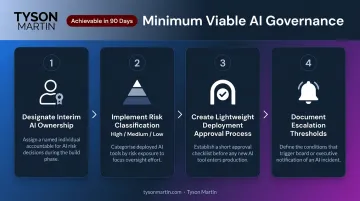
Minimum viable governance includes:
- Designate interim ownership for AI oversight — a named person, not a shared responsibility
- Implement a simple risk classification for all existing AI systems — at minimum, high/medium/low based on decision impact
- Create a lightweight approval process for new AI deployments before they go live
- Document escalation thresholds — which AI decisions require board notification versus management handling
What Inspectable Governance Looks Like
Inspectable governance has specific, testable artifacts:
- Decision rights are written down and tested, not assumed
- An AI system inventory is live and classified by risk level
- Board reporting shows a stable trend dashboard — what changed since last quarter and why
- Escalation thresholds specify exact triggers for board notification
- Governance findings produce documented remediation actions with named owners and deadlines
Boards managing leadership transitions or accelerating AI adoption often benefit from a structured 90-day plan that sequences these artifacts in the right order — decision rights first, inventory second, escalation architecture third, reporting cadence last. That sequence matters because each layer depends on the one before it.
The Maturity Progression
AI governance maturity moves through recognizable stages:
| Stage | Characteristics | Board Priority |
|---|---|---|
| Ad-hoc | Reactive, inconsistent, no documentation | Establish any accountability structure |
| Defined | Documented processes, assigned roles | Enforce the processes that exist |
| Managed | Metrics-driven, cross-functional | Improve signal quality in reporting |
| Optimized | Automated controls, continuous improvement | Reduce residual risk, demonstrate to regulators |
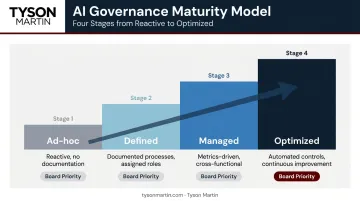
Boards should know which stage their organization occupies — not to pursue perfection, but to understand the governance liability they are currently carrying.
Frequently Asked Questions
What is a responsible AI governance framework?
A responsible AI governance framework is the structured set of policies, roles, processes, and oversight mechanisms an organization uses to ensure AI systems are developed and deployed ethically, safely, and in compliance with applicable law. Unlike general ethics guidelines, it emphasizes enforceability and operational specificity — designed to produce inspectable evidence, not aspirational statements.
What are the key pillars of a responsible AI governance framework?
Research identifies three primary practice dimensions: structural (roles, committees, decision rights), procedural (risk assessments, audit workflows, model monitoring), and relational (training, stakeholder engagement, escalation paths). Effective frameworks combine all three — organizations that invest in only one dimension consistently underperform on governance outcomes.
How does responsible AI governance differ from AI ethics?
AI ethics defines the what — the values and principles that should guide AI, including fairness, transparency, and accountability. Governance defines the how: the institutional mechanisms that put those principles into practice through enforceable controls. Having principles without that infrastructure is precisely where most organizations stall.
Who is responsible for AI governance in an organization?
Accountability operates at multiple levels. Boards set strategic expectations; the C-suite (CEO, CRO, General Counsel, and increasingly a Chief AI Ethics Officer) owns operational governance; coordinating committees bridge legal, technical, and business functions. The critical requirement: accountability must be clearly assigned — shared accountability is functional anonymity.
What are the biggest challenges in implementing responsible AI governance?
Research consistently identifies three barriers: the principles-to-practices gap (policies that do not translate into enforceable controls), talent scarcity (difficulty finding people who bridge AI, risk, legal, and governance expertise simultaneously), and regulatory fragmentation (navigating multiple overlapping frameworks with inconsistent requirements).
How should a board oversee AI governance?
Boards should focus on governance of governance — confirming the organization has the right structures, decision rights, escalation mechanisms, and measurement systems in place. Regular reporting should cover AI risk posture trends, not activity counts, so directors can ask informed questions and make defensible decisions when regulators or incidents demand it.