The accountability gap is not hypothetical. It shows up in congressional inquiries, agency audits, and real decisions that affect citizens' legally protected rights. The challenge is not whether to adopt AI — that decision is largely settled. The challenge is ensuring that when an AI system makes a consequential decision, leadership can reconstruct it, defend it, and assign ownership for it.
This article covers the unique governance pressures federal agencies face, the oversight fallacy that traps many programs, current regulatory requirements, and a four-pillar accountability framework that leaders can actually implement.
Key Takeaways
- Federal AI decisions affect legally protected rights — the accountability standard is higher than in most private-sector deployments
- OMB M-25-21 (April 2025) replaced M-24-10, requiring agencies to designate a Chief AI Officer, stand up AI Governance Boards, and document risk practices for high-impact systems
- The NIST AI RMF's four functions — Govern, Map, Measure, Manage — set the operational standard for federal AI governance
- Placing a human reviewer at the end of an AI decision chain is not an accountability framework
- Effective governance requires four pillars: decision rights, transparency, deployment guardrails, and auditable monitoring
Why Federal AI Governance Is Different
Federal agencies operate under an accountability standard that most private-sector organizations never face. When an agency denies a benefit, flags someone for enforcement, or makes a hiring decision using AI, that outcome must be defensible under administrative law — not just explainable in a post-incident review.
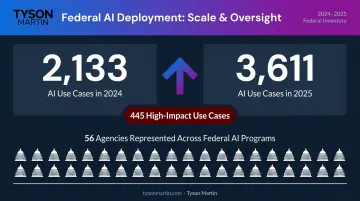
The scale of the challenge is significant. The 2025 federal AI use case inventory reported 3,611 individually reported AI use cases across 56 agencies, up from 2,133 in 2024. Of those, 445 are classified as high-impact.
Agencies rarely operate a single AI tool. They run overlapping systems for fraud detection, document review, workforce scheduling, and infrastructure management — often procured from different vendors with minimal interoperability in audit logging. That fragmentation creates a diffuse accountability problem unique to government. Without explicit, documented decision rights, responsibility after an incident disperses across:
- Program offices
- Contracting officers
- Chief Information Officers
- Political appointees
None of them hold the full picture, which makes post-incident accountability nearly impossible to trace.
The Public Trust Dimension
Accountability failures in federal AI carry consequences well beyond the immediate case. Research by Stanford using IRS data found that Black taxpayers were 3 to 5 times more likely to receive audit notices — with Black taxpayers representing 21% of EITC claims but 43% of EITC audits. The IRS confirmed the study's findings.
The disparity was not the product of staff behavior. When AI systems operate without governance infrastructure, bias accumulates in the design layer — invisible to the humans reviewing outputs downstream.
That design-layer risk is compounded by a velocity mismatch. Agencies face pressure to modernize quickly, while procurement cycles, FedRAMP authorization requirements, FISMA security controls, and workforce training consistently lag behind deployment timelines. AI can go live before governance structures exist to oversee it.
The Oversight Fallacy
Many agencies treat a human reviewer at the end of an AI decision chain as sufficient accountability. It isn't.
In integrated or agentic AI systems, the operative judgments are made upstream — during design, procurement, and configuration. What the system is permitted to optimize, which variables are weighted, which tradeoffs are embedded: all of that is fixed before any caseworker sees a result.
Consider a benefits screening system that presents a ranked list to a caseworker. The caseworker approves or denies. That review feels authoritative. But the system's internal weightings, proxy variable choices, and optimization logic were determined during procurement — typically without meaningful agency input into those design decisions.
The human review addresses effects. It does not govern causes.
GAO testimony on forensic algorithms reinforced this directly: human reviewers can misinterpret probabilistic outputs, and users often perceive algorithmic results as more certain than warranted. Human review introduces its own failure modes when reviewers don't understand what the system actually did.
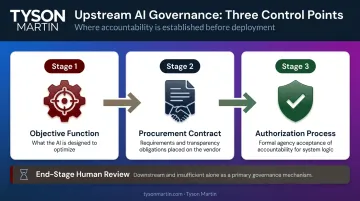
Meaningful accountability requires governance to move upstream. The specific points of control are:
- The system's objective function — what the AI is designed to optimize and which tradeoffs are embedded at build time
- The procurement contract — the requirements, constraints, and transparency obligations placed on the vendor before deployment
- The authorization process — the agency sign-off that formally accepts accountability for the system's logic, not just its outputs
Without upstream controls at each of these points, end-stage human review is accountability theater: visible, documented, and structurally insufficient.
What Federal Law and Policy Now Require
OMB M-24-10 (March 2024) set the prior governance baseline. It required designated Chief AI Officers, AI Governance Boards for CFO Act agencies, annual AI use case inventories, and human oversight requirements for covered AI systems — including rights-impacting and safety-impacting assessments.
OMB M-25-21, issued April 3, 2025, rescinds and replaces M-24-10. It requires:
- Agency heads to designate a CAIO within 60 days
- CFO Act agencies to convene AI Governance Boards within 90 days
- Minimum risk-management practices for high-impact AI systems
- Continued AI use case inventory requirements
These are binding requirements — not voluntary guidelines.
The NIST AI RMF as Operational Standard
OMB guidance points agencies toward a specific operational standard for meeting these requirements. The NIST AI Risk Management Framework (AI RMF 1.0), published January 2023, organizes AI risk management around four core functions:
| Function | What It Does |
|---|---|
| Govern | Establishes policies, roles, accountability structures |
| Map | Identifies AI context, risks, and affected stakeholders |
| Measure | Analyzes and quantifies risk using defined metrics |
| Manage | Prioritizes and implements risk responses |
OMB guidance designates the NIST AI RMF as the preferred federal approach. It carries no statutory force — agencies that ignore it, however, face a harder time demonstrating defensible governance when questions arise.
Additional Compliance Layers
- FedRAMP: Cloud-based AI tools require FedRAMP authorization. FedRAMP has explicitly prioritized AI-based cloud services providing conversational AI access.
- FISMA / NIST SP 800-53: AI systems processing federal data fall within existing federal information security controls. NIST is developing SP 800-53 overlays specifically for generative, predictive, and agentic AI.
- Sector-specific requirements: DoD agencies operate under five adopted AI ethics principles (Responsible, Equitable, Traceable, Reliable, Governable); HHS has published sector-specific M-25-21 compliance guidance — check directly with your agency's CAIO for the current version.
This regulatory landscape changes rapidly. Verify current requirements directly with OMB, NIST, and your agency's CAIO before finalizing your governance program.
A Four-Pillar AI Accountability Framework
Effective AI accountability is not a policy document. It is an operational infrastructure that can be inspected, tested, and reported on. Each pillar addresses a specific failure mode common in federal AI deployments.
Pillar 1: Decision Rights and Ownership
For every AI system an agency operates or procures, three things must be documented before deployment:
- A named owner responsible for the system's behavior
- A defined scope of authority specifying what the system is permitted to do
- Explicit escalation thresholds that require human review before action
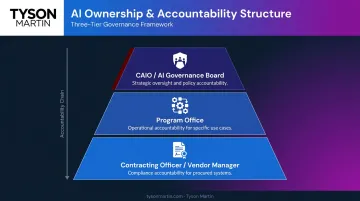
Structure ownership at three levels:
- CAIO / AI Governance Board — strategic oversight and policy accountability
- Program office — operational accountability for specific use cases
- Contracting officer / vendor manager — compliance accountability for procured systems
These assignments belong in a registry, reviewed at least annually. When an incident occurs, accountability should be traceable to a name. A committee or a vendor is not an accountable party.
This is where governance typically fails first. Without documented decision rights, a new CIO or program director inherits a deployed AI system with no ownership history and no escalation protocol. Decision rights frameworks — with tested escalation thresholds that hold under real incident pressure — must be in place before a system goes live.
Pillar 2: Transparency and Documentation
Every AI system in the agency inventory should have documentation that answers four questions:
- What is this system authorized to do?
- What data does it use, and where does it originate?
- What outputs does it produce, and what actions can those outputs trigger?
- Who approved its deployment, and under what framework?
For vendor-supplied or procured AI, agencies must require this documentation as a contract condition, not a after-the-fact request. Procurement contracts should require:
- Training data sources and provenance documentation
- Model validation methodology and test results
- Known limitations and failure modes
- Performance benchmarks against defined metrics
Procurement is a governance mechanism. Accountability cannot be established after deployment if the documentation was never required during acquisition.
Pillar 3: Guardrails and Deployment Constraints
Four categories of guardrails must be defined by agency leadership (not delegated to IT or vendors) before a system goes live:
- Objective-function guardrails: What the system is permitted to optimize, including explicit equity constraints
- Data governance guardrails: What data sources are authorized, how provenance is documented, how data drift is detected
- Deployment guardrails: Thresholds requiring human review before consequential action, particularly for rights-impacting decisions
- Retraining guardrails: Conditions under which a system must be reviewed, paused, or retrained based on performance deviation or adverse outcome patterns
These are institutional policy choices, not technical configurations. Agency leadership must define acceptable tradeoffs and performance thresholds. Outsourcing those decisions to developers or vendors embeds unauthorized policy into system architecture — and accountability for those choices belongs to the agency regardless of who made them.
Pillar 4: Audit Trails and Continuous Monitoring
Accountability without evidence is unenforceable. AI systems must log:
- Every automated decision or recommendation
- The input data state at the time of decision
- The model version in use
- Any human review action taken
These records must be retained in accordance with federal records management requirements and accessible for internal audit, IG review, or legal discovery.
Beyond logging, agencies need a continuous monitoring posture:
- Standing dashboards tracking performance against defined fairness, accuracy, and compliance metrics
- Automatic escalation thresholds when outputs deviate from expected parameters
- A named official responsible for responding within a defined timeframe
An audit that surfaces a governance failure is already too late. Continuous monitoring exists to catch deviation before it becomes a finding.
Turning Policy Into Inspectable Execution
The most common failure in federal AI governance: a well-written policy exists in SharePoint and nowhere else. Inspectable execution means an IG investigator or oversight committee can ask "show me how this system is governed" and receive evidence — not a document reference.
What inspectable execution looks like:
- A live AI use case registry with current ownership assignments
- Risk classifications for each system aligned to NIST AI RMF tiers
- A standing reporting cadence to the AI Governance Board with trend metrics
- A tested incident response protocol for AI failures — exercised, not just written
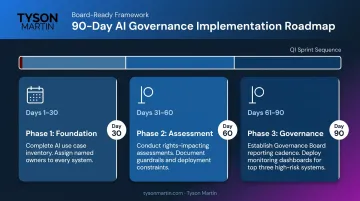
A practical 90-day sequence for agency leaders:
- Days 1–30: Complete or validate the AI use case inventory. Assign named owners to every system.
- Days 31–60: Conduct rights-impacting assessments for the highest-risk systems. Document guardrails and deployment constraints for each.
- Days 61–90: Establish the Governance Board reporting cadence. Deploy monitoring dashboards for at least the three highest-risk systems.
Governance frameworks fail most often during leadership transitions. A new CIO or program director who inherits systems with no documented decision rights or oversight history has no baseline to manage from — and no defensible record when oversight questions arrive.
Start narrow, document everything, and expand from there. Three systems with active monitoring and clear ownership outperform a comprehensive policy no one is accountable to enforce.
Frequently Asked Questions
What federal requirements currently govern AI use in executive branch agencies?
OMB M-25-21 (April 2025) is the current binding memorandum, replacing M-24-10. It requires agencies to designate a Chief AI Officer, convene AI Governance Boards, maintain AI use case inventories, and implement minimum risk-management practices for high-impact AI systems.
What is the role of a Chief AI Officer in a federal agency?
The CAIO coordinates agency-wide AI governance, ensures compliance with OMB requirements, oversees the AI use case inventory, and serves as the accountable executive for AI risk management. This is a distinct role from the CIO or CISO, with specific authority over AI policy and oversight.
How does the NIST AI Risk Management Framework apply to federal agencies?
The AI RMF's four functions (Govern, Map, Measure, Manage) provide the operational structure for federal AI governance programs. OMB guidance references it as the preferred approach, making it practically expected even though it carries no standalone legal mandate.
Does having a human review AI decisions satisfy federal accountability requirements?
Human review is necessary but not sufficient. Accountability requires that the system's objective function, data sources, and deployment guardrails were authorized by appropriate officials before deployment, and that audit trails exist to reconstruct how any specific decision was reached.
How should federal agencies govern AI systems provided by outside vendors?
Contract awards should require training data documentation, model validation methodology, known limitations, and performance benchmarks. Accountability cannot be delegated to a vendor: the agency retains legal and oversight responsibility regardless of who built or operates the system.