Introduction
AI is already making consequential decisions inside your organization. Credit approvals, candidate screening, fraud flags, inventory routing — these aren't future scenarios. They're happening now, often embedded in vendor software that leadership never formally approved as an AI system.
The governance problem is that most board frameworks were built before any of this existed. Boards receive cybersecurity risk reports, financial risk reports, and audit committee findings — but ask most directors what AI systems are currently operating inside their organization, and the honest answer is: they don't fully know.
That gap between AI capability and board-level oversight is where liability lives. Human oversight in AI governance isn't a technical detail to hand off to the IT team. It's a board-level obligation — and this article breaks down what that oversight actually requires, where most governance frameworks fall short, and what directors can do about it.
Key Takeaways
- AI systems have no capacity for ethical reasoning or self-correction — human judgment is the essential check
- Oversight operates at three layers: governance (board), operational (management), and technical (implementation)
- Meaningful oversight requires decision rights, escalation thresholds, and inspectable execution — not passive monitoring
- Regulators — from the EU AI Act to U.S. sector agencies — are converting oversight from best practice to legal requirement
Why AI Cannot Govern Itself
AI systems detect statistical patterns in historical data. That's the whole mechanism. They have no capacity for ethical reasoning, no awareness of organizational context, and no ability to recognize when their training data no longer reflects current reality. When context shifts, they don't adapt — they extrapolate from the past.
Bias Gets Encoded and Scaled
The most documented failure mode is bias amplification. A 2019 study published in Science by Obermeyer et al. found racial bias in a widely used population-health algorithm because healthcare cost was used as a proxy for health need — a proxy that systematically underrepresented illness in Black patients.
At the same risk score, Black patients were measurably sicker than White patients. Correcting the bias would have increased the share of Black patients receiving additional care from 17.7% to 46.5% — a gap that persisted at scale, invisibly, until researchers examined it.
Hiring systems show the same pattern. The EEOC alleged that iTutorGroup's application software automatically rejected female applicants aged 55 or older and male applicants aged 60 or older, resulting in a $365,000 settlement — the EEOC's first AI discrimination lawsuit.
NIST's AI Risk Management Framework puts the scale problem plainly: AI systems can "increase the speed and scale of biases" and "amplify, perpetuate, or exacerbate inequitable outcomes." A miscalibrated model doesn't make one bad decision — it makes thousands before anyone notices.
The Accountability Gap
Many AI systems cannot explain their own outputs in terms a human reviewer can audit. When a recommendation leads to harm, the inability to reconstruct the decision logic creates immediate legal and reputational exposure.
The FTC demonstrated this clearly when it banned Rite Aid from using AI facial recognition for five years after finding the system generated thousands of false-positive matches — disproportionately affecting women and people of color — with no adequate safeguards in place to catch or correct errors.
AI systems have no awareness of your regulatory environment, your organization's risk appetite, or the reputational stakes of a given decision. Those judgments require human input — and the governance structure that enables them must be defined before deployment. Boards and executives who wait for an incident to clarify accountability will find they have neither the time nor the clean record to do it well.
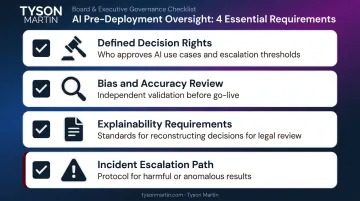
What effective pre-deployment oversight looks like in practice:
- Defined decision rights: Who approves AI use cases, and at what risk threshold does escalation to the board occur?
- Bias and accuracy review: Independent validation of model outputs before the system goes live, not after complaints surface
- Explainability requirements: A standard for how decisions can be reconstructed and documented for legal or regulatory review
- Incident escalation path: A clear protocol for what happens when the model produces a harmful or anomalous result
The Three Layers of Human Oversight in AI Governance
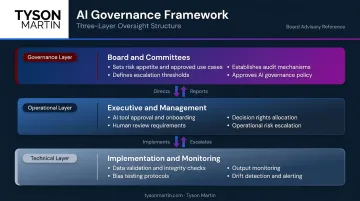
Effective AI governance isn't a single policy or a single role. It requires three connected layers, each with distinct responsibilities. Gaps between layers are where accountability collapses.
Governance Layer: Board and Committees
The board's job is not to understand every algorithm. It's to set the conditions under which AI operates:
- Approved use cases — which decisions AI is authorized to influence
- Risk appetite — how much AI-driven decision-making the organization will tolerate in consequential domains
- Escalation thresholds — at what point AI incidents require board-level attention
- Audit mechanisms — how the board receives ongoing assurance that controls are working
Boards should receive AI risk reporting on the same cadence and with the same rigor as cybersecurity or financial risk reporting — trend data, not just incident alerts.
The NACD's 2023 guidance on AI as an emerging audit committee responsibility recommends that audit committees assess AI risk tolerance, determine whether high-risk systems have appropriate controls, and consider the NIST AI RMF as an implementation foundation. The same guidance cited a survey finding that only 13% of organizations had a formalized AI oversight framework — and just 36% were even considering one.
Operational Layer: Executive and Management
Management translates board-level risk appetite into operational policy. This layer owns:
- Which AI tools are approved for use, and under what conditions
- Human review requirements before consequential outputs are acted upon
- Decision rights — who can authorize deployment of a new AI system, who approves exceptions, and who is accountable when an AI-assisted decision causes harm
Without written decision rights, accountability dissolves at exactly the moment it's most needed. "The AI recommended it" is not a defensible answer when a regulator or plaintiff asks who authorized the action.
Technical Layer: Implementation and Monitoring
Closing that accountability gap requires controls at the implementation level. Technical oversight covers the full AI lifecycle:
- Data quality validation before training
- Bias testing prior to deployment
- Output monitoring once systems go live
- Model drift detection over time
Without governance-layer direction, technical teams tend to optimize for accuracy metrics while missing ethical and legal risk signals entirely. That's why technical teams must produce oversight artifacts — audit logs, performance dashboards, bias assessments — that non-technical reviewers at the operational and governance layers can actually act on. Those artifacts are what turn board accountability from an intention into a defensible record.
What Meaningful Human Oversight Actually Looks Like
There's a meaningful difference between a human being technically "in the loop" and a human actually exercising oversight. Nominal oversight means a reviewer exists on paper. Meaningful oversight means that reviewer has the right information, understands what they're evaluating, holds clear authority to intervene, and is accountable for that decision.
The Structural Requirements
Inspectable AI governance has specific characteristics:
- Documented AI use case inventory: a complete list of AI systems in use, what decisions they influence, and their assigned risk classification
- Defined intervention points in each AI workflow, with named human reviewers who have appropriate expertise for that decision type
- Escalation thresholds by category: which AI outputs require mandatory human review before action, which require periodic sampling, and which can run with post-hoc monitoring
- Audit trails on demand — the ability to produce a complete governance record when a regulator or incident requires it
The NIST AI Risk Management Framework provides the practical architecture for this. Its GOVERN, MAP, and MEASURE functions require organizations to define human-AI oversight roles, document system knowledge limits, monitor production behavior, and use explainability to support audit and governance.
The NIST AI Risk Management Framework provides the practical architecture for this. Its GOVERN, MAP, and MEASURE functions require organizations to define human-AI oversight roles, document system knowledge limits, monitor production behavior, and use explainability to support audit and governance.
EU AI Act Article 14 goes further, requiring that overseers be able to interpret outputs, recognize automation bias, and intervene or stop systems entirely — not merely observe them.
The Culture Problem
Structure alone doesn't produce oversight. Most organizations end up with nominal review processes where AI outputs are treated as authoritative rather than advisory. Reviewers rubber-stamp recommendations because questioning them feels like challenging a technical process they don't fully understand.
Leaders must actively establish the norm that human reviewers are expected to question, override, and escalate AI recommendations. That expectation needs to be stated explicitly, reinforced in training, and demonstrated when it matters. Leaders who treat reviewer skepticism as a defect — rather than a design feature — are the ones who end up with rubber-stamp processes when incidents occur.
The Regulatory Stakes: AI Oversight Is No Longer Optional
The compliance landscape has shifted from guidance to enforcement.
What the Major Frameworks Require
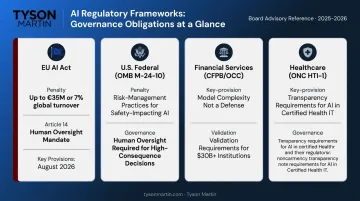
EU AI Act — Regulation (EU) 2024/1689 mandates human oversight for high-risk AI systems. Article 14 requires overseers to understand system capabilities and limitations, monitor operation, detect failures, and override outputs. Penalties reach €35 million or 7% of global annual turnover for prohibited-practice violations; general requirements violations reach €15 million or 3%. Key provisions apply from August 2026.
U.S. Federal — OMB Memorandum M-24-10 (March 2024) requires federal agencies to implement minimum risk-management practices for safety-impacting and rights-impacting AI, with specific human oversight and accountability requirements for high-consequence decisions.
Financial Services — CFPB Circular 2022-03 makes clear that creditors using complex algorithms cannot hide behind model complexity to avoid adverse-action explanation requirements. The OCC and Federal Reserve issued revised model risk management guidance in 2026 covering organizations with more than $30 billion in assets, requiring effective challenge and rigorous validation.
Healthcare — ONC's HTI-1 Final Rule (effective March 2024) establishes transparency requirements for AI and predictive algorithms in certified health IT, including source-attribute requirements so clinical users can assess fairness, validity, and safety.
The liability calculus is direct: when an AI system causes harm and the organization cannot demonstrate meaningful human oversight was in place, regulators and plaintiffs name board members and executives — not just the technology team. A documented governance record is what separates a defensible response from personal exposure.
The same governance record that protects against liability also signals trustworthiness to the market. PwC's 2025 Responsible AI survey found that 58% of business leaders said responsible AI initiatives improve ROI and organizational efficiency, and 55% said they enhance customer experience and innovation. Auditable AI governance is now a procurement criterion, not just a compliance obligation.
How Boards Should Structure AI Governance Oversight
Most boards are surprised when they first inventory the AI already operating inside their organization. It's not just internally built systems — it's the AI embedded in HR platforms, financial software, customer service tools, and vendor products that touch consequential decisions daily.
Start With the Inventory
Before designing oversight, leadership needs to know what's actually running:
- What AI systems are in use across the organization?
- What decisions do they influence or make?
- What is the risk profile of each system — low, medium, or high?
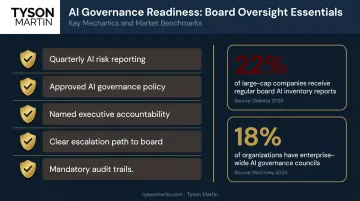
Deloitte's 2025 board survey found that only 22% of large-cap companies receive regular board reports on their current AI inventory. That figure alone defines the governance gap most organizations need to close first.
The Governance Mechanics
Once the inventory exists, boards need a functioning governance structure:
- Report on high-risk AI systems quarterly — the same cadence boards use for cybersecurity
- Approve an AI governance policy that sets risk appetite and defines acceptable use cases
- Assign a named executive with explicit accountability for operational AI oversight (typically the CISO, CIO, or Chief Digital Officer, depending on where AI risk concentrates)
- Establish a clear escalation path from management to the board when AI incidents occur
- Require audit trails so the board can demonstrate meaningful oversight to regulators on demand
Those mechanics are rarer than they should be. McKinsey's 2024 State of AI research found that only 18% of organizations had enterprise-wide councils or boards to oversee responsible AI governance. The same research found that companies attributing more than 10% of EBIT to generative AI were substantially more likely to follow risk-related best practices — including involving legal functions early in AI decisions.
For boards in transition, under new leadership, or operating across regulated industries, building this structure from scratch is genuinely hard. The practical challenge is creating reporting mechanisms that give the board real oversight without pulling directors into operational management.
That's the work Tyson Martin does with boards and executive teams — building AI governance frameworks, establishing decision rights, and creating the escalation paths needed to exercise credible oversight.
Frequently Asked Questions
Frequently Asked Questions
What is the role of human oversight in responsible AI?
Human oversight ensures AI systems operate within ethical boundaries, legal requirements, and the organization's risk appetite. It means humans retain the authority and practical ability to intervene, correct, or override AI decisions — and are accountable when they don't.
What are the biggest risks of AI systems without human oversight?
The primary risks are bias amplification at scale, accountability gaps when AI outputs cause harm, regulatory non-compliance, and consequential errors propagating organization-wide before anyone detects them. Each has appeared in real enforcement actions and board-level post-mortems.
How should a board of directors oversee AI governance?
The board's role is to set risk appetite, approve AI governance policy, receive regular AI risk reporting, and ensure a named executive owns operational oversight. Boards should ask whether high-risk systems are classified, controlled, and auditable — not manage the systems directly.
What is the difference between human oversight and human control in AI?
Oversight refers to ongoing monitoring, review, and audit of AI systems. Control refers to the authority to modify, stop, or override AI decisions. Both are necessary — oversight without control authority is insufficient and creates nominal rather than meaningful governance.
What regulations require human oversight of AI systems?
The EU AI Act's Article 14 mandates explicit human oversight mechanisms for high-risk AI systems, with penalties reaching 7% of global turnover. In the U.S., the CFPB, OCC, and Federal Reserve have each issued sector-specific guidance requiring documented oversight mechanisms for AI-driven decisions in financial services.
How do you build an AI governance framework with meaningful human oversight?
Start by inventorying AI use cases and classifying each by risk level. Then assign decision rights, set human review requirements and escalation thresholds, and create auditable artifacts — audit logs, bias assessments, performance dashboards — that boards and regulators can inspect on demand.