Introduction
Most enterprise organizations now have an AI policy. Far fewer can prove their AI risk posture is actually working.
That gap matters. According to ISACA's 2026 research, only 38% of organizations have a formal, comprehensive AI policy — and even among those, 56% of digital trust professionals didn't know how quickly their organization could halt an AI system after a security incident.
That disconnect is the core problem. Evaluating AI risk posture is an active governance discipline — one that asks whether controls are actually operating, whether accountability is clear, and whether the organization can produce defensible decisions rather than just point to a written standard.
This post covers the four dimensions every evaluation should address, how established frameworks structure the assessment, what credible board-level reporting looks like, and the three gaps that most commonly undermine evaluations before they start.
Key Takeaways
- AI risk posture is the aggregate, measurable state of your AI risk management program, covering security, operations, compliance, and data governance
- Evaluation must cover all four dimensions; a gap in one undermines the others
- Shadow AI is the most common blind spot; evaluations that miss unauthorized tools are incomplete by definition
- Board reporting should show trend data and clear decision items, not technical inventories
- Frameworks like NIST AI RMF, ISO 42001, and the EU AI Act provide defensible structure for your evaluation
What Enterprise AI Risk Posture Actually Means
AI risk posture is the aggregate, measurable state of an organization's ability to identify, manage, and communicate AI-related risk across its operations — covering security controls, governance structures, accountability, and oversight practices. Unlike conventional cybersecurity posture, it extends well beyond infrastructure vulnerabilities into territory most security frameworks don't address.
Why AI Introduces Different Risk Categories
Traditional security frameworks evaluate infrastructure vulnerabilities, access controls, and incident response. AI introduces categories those frameworks don't address:
- Non-deterministic behavior — AI systems can produce different outputs from identical inputs, making behavioral drift harder to detect than a misconfigured firewall
- Training data vulnerabilities — the integrity of a model depends on the integrity of the data it learned from, which is a governance question, not just a technical one
- Model drift — performance degrades over time as real-world data diverges from training conditions
- Ethical and explainability risk — biased outputs and opaque decision logic create regulatory and reputational exposure that has no direct cybersecurity analog
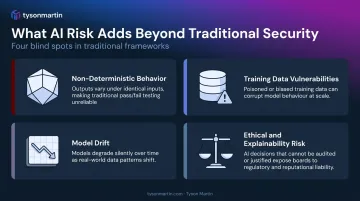
In practice, AI risk stems from opaque model logic, data integrity threats, adversarial inputs, biased algorithms, and evolving regulatory expectations — not only from code vulnerabilities or cloud misconfigurations.
Evaluation Is a Governance Function, Not an Audit Event
Evaluating AI risk posture is a recurring function, not a point-in-time audit. The questions that matter aren't "do we have a policy?" — they're operational: Is the risk management program inspectable? Are findings tracked with trend data? Can the organization produce decisions a board can defend under scrutiny?
The Four Dimensions Every Enterprise AI Risk Posture Evaluation Should Cover
A credible evaluation addresses four interconnected dimensions. Weakness in any one creates exposure across the others.
Dimension 1: Security Risk
Evaluate whether AI systems are protected against the adversarial attack types that specifically target AI pipelines — not just conventional infrastructure threats.
NIST's adversarial machine learning taxonomy defines the key categories:
- Data poisoning — an adversary inserts or modifies training samples to corrupt model behavior
- Model extraction — an adversary reverse-engineers model architecture or parameters
- Prompt injection — direct attacks alter LLM behavior through user input; indirect attacks arrive through third-party sources like documents or web pages
The operational stakes are significant. Gartner predicts that by 2028, 50% of enterprise cybersecurity incident response efforts will focus on incidents involving custom-built AI-driven applications. Incident response plans that don't extend to AI pipelines are already behind.
Dimension 2: Operational Risk
Assess whether the organization has active controls — with defined ownership and escalation paths — for detecting and responding to model drift, performance degradation, and AI system failures.
McKinsey's 2025 State of AI survey found that 51% of organizations using AI reported at least one negative consequence, with nearly a third experiencing issues specifically from AI inaccuracy. Organizations were managing an average of four AI-related risks in 2025, up from two in 2022.
Post-deployment monitoring is where many organizations fail. Deploying a model and declaring success is not a risk management posture. The evaluation question is whether someone is actively watching performance metrics, with defined thresholds for escalation.
Dimension 3: Compliance and Ethical Risk
Evaluate whether AI systems are inventoried against applicable regulatory requirements and whether bias, fairness, and explainability are assessed on a defined schedule — not just at initial deployment.
Relevant frameworks include:
| Framework | Primary Focus |
|---|---|
| NIST AI RMF | Govern, Map, Measure, Manage functions across the AI lifecycle |
| EU AI Act (2024/1689) | Risk classification; continuous requirements for high-risk systems |
| ISO 42001 | AI management system requirements including monitoring and improvement |
| OCC Model Risk Guidance | Model validation and governance for banking organizations |
| FDA AI Device Guidance | Risk management files and change control for AI-enabled medical devices |
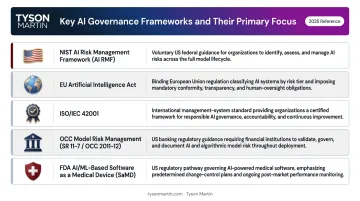
The EU AI Act is particularly consequential for organizations with European exposure: high-risk AI providers must establish a continuous, iterative risk management system, not a one-time assessment.
Dimension 4: Data Risk
Determine whether training data lineage is tracked, access controls on AI-relevant data are enforced, and whether governance exists over sensitive data flowing into third-party AI systems.
The exposure here is substantial. A 2024 Cisco study found that 48% of businesses admitted entering non-public company information into generative AI tools, while 27% had temporarily banned GenAI use due to privacy and data security concerns. Those numbers reflect a governance gap that most organizations haven't formally closed.
Key Evaluation Questions That Reveal Whether Your AI Risk Posture Is Real
Most organizations have documentation. The harder task is proving execution. The evaluation must move from "do we have a policy?" to "can we demonstrate it's working?"
Visibility: Can You Inventory What You Have?
The foundational question: can the organization produce a current, complete inventory of all AI systems in use — including third-party integrations and employee-adopted tools?
If the answer is no, or slow, the evaluation is working from an incomplete picture. Any posture conclusions drawn will be unreliable.
One signal Tyson Martin uses in governance-gap diagnostics: asking "How do you approve and monitor AI tools that touch company data?" A strong answer describes an approval path, data rules, and access controls. A red flag sounds like "Teams use what they want."
Decision Rights: Who Owns What?
- Does each AI system have an identified owner accountable for security, performance, and compliance?
- Are escalation thresholds documented and tested, or just assumed?
- When something goes wrong, is there a named person — not a committee — responsible for the response?
Tyson Martin's advisory approach frames this clearly: decision rights require knowing who can accept risk, who can force a fix, and who can approve downtime for a security change. The same logic applies directly to AI systems.
Governance: Is Reporting Trend-Based or Episodic?
Are AI risk findings reported on a defined cadence with trend data, or only when something breaks? Effective governance reporting distinguishes what changed, why it matters, and what action is required — rather than producing a point-in-time summary that the next reporting cycle will contradict.
That same discipline extends to vendor relationships, where AI-specific questions are often absent entirely.
Third-Party Risk: Are Vendors Evaluated Against AI-Specific Criteria?
Standard vendor security reviews often miss the AI-specific questions:
- Does the contract specify how training data is handled and who retains ownership?
- Are incident notification timelines tied to the organization's own obligations?
- Is model integrity addressed — including what happens if upstream components change?
Organizations that can't answer these questions quickly have a posture gap, not a documentation gap. An independent advisor — one without vendor relationships to protect — can surface these exposures before a regulator or an incident does it for them.
How Governance Frameworks Structure AI Risk Posture Evaluations
Established frameworks give evaluations consistency and credibility. The three most relevant:
NIST AI RMF is the most useful evaluation scaffold for US organizations. Its four core functions map directly to evaluation questions:
- Govern — does the organization have the culture, policies, and accountability structures to manage AI risk?
- Map — are AI risks identified across the full lifecycle, including deployment and monitoring?
- Measure — are quantitative and qualitative tools in place to analyze and track risk?
- Manage — are resources allocated to mapped risks on a regular basis, with documented responses?
ISO 42001 establishes requirements for an AI management system — covering policy and objectives, risk management, data governance, lifecycle controls, transparency, and continual improvement. It's the certification path for organizations that need to demonstrate governance maturity to customers or regulators.
EU AI Act risk classification determines which organizations face mandatory continuous risk management requirements versus lighter disclosure obligations. Even US-headquartered enterprises with European customers, employees, or data flows need to understand where their AI systems land on the risk classification scale.
Framework Alignment Is Evidence, Not the Goal
Checking boxes against a framework does not constitute a sound AI risk posture. Frameworks are evaluation scaffolds — they help identify where gaps exist. The goal is using those findings to prioritize remediation based on actual risk to operations and regulatory exposure.
Once gaps are identified, sequencing matters. Effective remediation moves through four stages:
- Quick wins — fast exposure reduction with minimal resource commitment
- Risk reducers — targeted fixes to the highest-probability failure points
- Foundational capabilities — controls that enable sustained risk management
- Structural changes — longer-term governance and accountability reforms
Framework findings are the input. Business risk — not compliance optics — drives the order.
What Credible AI Risk Reporting Looks Like to a Board
Boards cannot oversee what they cannot understand. The common failure is risk reporting dense with technical findings, lacking trend data, and forcing directors to either rubber-stamp management's assessment or escalate without real information.
NACD's 2025 survey found that over 62% of directors set aside agenda time for full-board AI discussions. Yet ISACA's 2026 research found only 38% of practitioners were confident in their board's understanding of AI risks. The meeting time is happening. The signal quality often isn't.
What Effective AI Risk Reports Include
A board-level AI risk report should answer four questions clearly:
- What is our current AI risk posture? — Plain-English summary, not a technical inventory
- What changed since the last reporting period? — Movement matters more than status
- Which risks are above the agreed threshold? — Named, with accountability attached
- What decisions are required? — Explicit distinction between board action, management delegation, and informational items
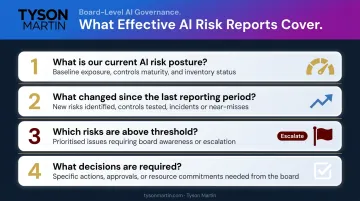
Trend Visibility vs. Technical Noise
Tyson Martin's board reporting methodology is built around a stable set of 8–12 metrics that map to approved thresholds. The discipline is in separating signal from noise: a single month is rarely conclusive, but a three-month trend clearly shows whether risk is improving, holding, or getting worse.
Relevant AI-specific key risk indicators (KRIs) drawn from ISACA's research include:
- Time to halt an AI system following a security incident
- Existence and testing status of a documented AI shutdown or override process
- Confidence level in incident explanation — can the organization explain a serious AI incident to leadership or regulators?
- Shadow AI exposure — percentage of AI systems in use that are formally inventoried and governed
Clear Decision Rights in Every Report
Every board-level AI risk report should make explicit which items require board action, which are delegated to management with defined escalation triggers, and which are informational. Without that structure, oversight responsibility defaults to whoever raises their hand — which means it often defaults to no one.
Common Gaps That Undermine Enterprise AI Risk Posture Evaluations
Gap 1: Shadow AI Blindness
Many evaluations assess only formally approved AI systems. That's an incomplete picture by definition.
Microsoft's 2024 Work Trend Index found that 78% of AI users were bringing their own AI tools to work. Salesforce research found that more than half of generative AI adopters used unapproved tools. Gartner predicts that by 2030, more than 40% of enterprises will experience security or compliance incidents linked to unauthorized shadow AI.
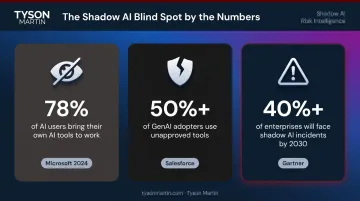
Any posture evaluation that skips a shadow AI discovery phase is assessing the organization's formal program, not its actual AI footprint.
Gap 2: Third-Party AI Risk Underestimation
Enterprises often apply rigorous controls to internally built AI systems while assuming vendor-provided AI tools carry sufficient safeguards. That assumption is wrong.
Third-party AI supply chain risk requires its own evaluation layer, covering three dimensions:
- Model integrity: Does the vendor's model behave as described?
- Data handling: Where does your data go, and who can access it?
- Incident response alignment: Will you receive timely notification if the vendor's system is compromised?
The 2023 OpenAI incident — where a bug in a third-party library exposed payment information for approximately 1.2% of active ChatGPT Plus subscribers — shows how upstream component risk becomes downstream enterprise exposure. Vendor AI security questionnaires that don't address these dimensions are not adequate.
Gap 3: Treating Evaluation as a One-Time Event
AI risk posture degrades between assessments. Models drift. Regulations change. Employees adopt new tools. The competitive pressure to deploy AI faster than governance can keep pace is constant.
Gartner research found that organizations performing regular AI system audits and assessments were more than three times more likely to achieve high generative AI value than those that did not. The EU AI Act mandates a continuous, iterative risk management system for high-risk AI providers — not a certification event followed by periodic reviews.
Tying evaluation to both the AI lifecycle and the board reporting cadence is what separates a program that holds under scrutiny from one that degrades between reviews.
Frequently Asked Questions
What is an AI risk posture and how is it different from AI security?
AI risk posture is the governance-level state of an organization's AI risk management maturity — spanning security controls, accountability structures, oversight practices, and compliance coverage. AI security refers specifically to the technical protections applied to AI systems. Posture addresses whether those protections are functioning, governed, and producing defensible outcomes.
How often should enterprises evaluate their AI risk posture?
Monitoring should be continuous, with formal structured assessments conducted at least annually — and additionally following significant AI system changes, new deployments, material regulatory updates, or security incidents. Annual-only evaluations miss the drift that occurs between assessments.
What frameworks should enterprises use to evaluate AI risk?
The NIST AI Risk Management Framework (Govern, Map, Measure, Manage), ISO 42001, and EU AI Act risk classification are the most widely adopted evaluation frameworks. The right starting point depends on the organization's industry, geographic exposure, and regulatory requirements — US-focused organizations typically start with NIST AI RMF.
How should boards receive and act on AI risk reporting?
Boards should receive plain-English summaries showing trend data across key risk indicators, flagged risks above threshold, and explicit decision items. Each report should clearly separate what requires board action, what is delegated to management with escalation triggers, and what is informational only.
What is the biggest gap most enterprises have in their AI risk posture?
Shadow AI — employee-adopted tools operating outside formal IT oversight — is consistently the largest blind spot. Posture evaluations built on an incomplete AI inventory measure only the officially sanctioned footprint, leaving actual risk exposure unexamined.
How is evaluating AI risk posture different from a standard cybersecurity audit?
AI risk posture evaluation extends beyond infrastructure and data security to include non-deterministic model behavior, training data integrity, algorithmic bias, and accountability for AI-driven decisions. These dimensions don't appear in conventional security audit frameworks, which means organizations that rely solely on standard cybersecurity audits will have material blind spots in their AI risk coverage.