Introduction
Most boards believe they have a reasonable handle on their organization's cyber risk. That assumption often holds right up until it doesn't—when an incident surfaces, a regulator asks uncomfortable questions, or a new executive inherits a program that turns out to be far weaker than documented.
A cybersecurity posture assessment replaces that assumption with evidence. It's the structured process that measures what your organization can actually defend, detect, and recover from — closing the gap between what your policies claim and what your controls deliver.
The stakes are real. According to IBM's 2024 Cost of a Data Breach Report, the average global breach cost reached $4.88 million, with financial services organizations absorbing $6.08 million on average. And detection remains a persistent problem: only one-third of breaches are caught by the organization's own security team—the rest are disclosed by attackers or discovered by third parties, at nearly $1 million more per incident.
This guide covers what a posture assessment includes, how to run one step by step, which frameworks apply, and most importantly, how to turn findings into board-level decisions rather than an unread technical document.
Key Takeaways
- A cybersecurity posture assessment evaluates how effectively people, processes, and technology defend against threats—across assets, controls, compliance, and incident readiness.
- Run it as a repeatable governance mechanism, not a one-time audit — each cycle produces a measurable baseline and a prioritized roadmap.
- Core components include asset inventory, vulnerability analysis, access controls, incident response readiness, and human/third-party risk.
- Translate findings into board language: risk trends, material exposures, and clear decisions — not raw vulnerability lists.
- Organizations that assess regularly and act on findings contain incidents faster and hold up under regulatory scrutiny.
What Is a Cybersecurity Posture Assessment?
Per NIST's security posture definition, an organization's security posture is "the security status of an enterprise's networks, information, and systems based on resources such as people, hardware, software, policies, and capabilities to manage defense and react as situations change."
A posture assessment takes that definition and turns it into a structured evaluation. It asks: are those defenses actually working, and would they hold under real pressure?
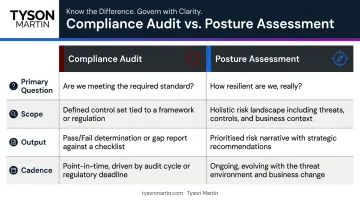
Posture Assessment vs. Compliance Audit
These two are not the same thing, and conflating them is one of the most common board-level mistakes.
| Compliance Audit | Posture Assessment | |
|---|---|---|
| Primary question | Do controls exist? | Do controls work? |
| Scope | Specific regulatory requirements | Organization-wide defensive architecture |
| Output | Pass/fail against a standard | Prioritized risk and maturity picture |
| Cadence | Often annual/event-driven | Continuous + periodic deep reviews |
Posture Assessment vs. Risk Assessment
These are complementary but distinct. A risk assessment identifies and scores individual threats and vulnerabilities. A posture assessment evaluates the overall defensive architecture that's supposed to manage those risks. Put simply: the risk assessment tells you what could go wrong; the posture assessment tells you whether you're actually set up to prevent or recover from it.
Boards and audit committees need both — but the posture assessment is what supports defensible decisions on risk appetite, security investment, and SEC disclosure obligations.
Key Components of a Cybersecurity Posture Assessment
Asset Inventory and Classification
You can't protect what you don't know exists. This component builds a complete inventory of hardware, software, data stores, cloud environments, and network resources—and classifies each by criticality and sensitivity.
Organizations routinely discover undocumented systems, forgotten cloud accounts, or shadow IT at this stage. Each discovery immediately changes the risk picture because unmanaged assets represent unmanaged exposure.
Vulnerability and Threat Exposure Analysis
This component maps known weaknesses across infrastructure, applications, and configurations. Two distinct activities are involved:
- Vulnerability scanning identifies known technical flaws through automated testing across systems and configurations
- Threat analysis maps likely adversary motivations based on your industry, size, and data holdings
Financial services, healthcare, and retail organizations face distinct threat profiles. A retailer processing payment card data faces different adversary motivations than a healthcare system protecting patient records—both analyses must reflect that reality.
Identity, Access, and Data Controls
Over-privileged accounts and weak access hygiene are among the most consistently exploited entry points in enterprise breaches. This component evaluates:
- MFA enforcement across critical systems and user populations
- Privileged account controls and just-in-time access practices
- Data encryption and access logging
- Data loss prevention coverage
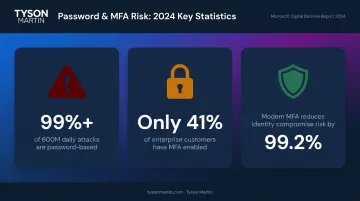
The Microsoft Digital Defense Report 2024 found that over 99% of more than 600 million daily identity attacks are password-based, yet MFA adoption among enterprise customers stood at only 41%. Modern MFA reduces identity compromise risk by 99.2%. That gap is a board-level issue, not a technical footnote.
Incident Response and Governance Readiness
Having a plan on paper is not the same as being prepared. This component evaluates whether:
- The incident response plan has been tested under realistic conditions
- Escalation thresholds and decision rights are pre-defined
- The right people know their roles before something happens
CISA's Cybersecurity Performance Goals require organizations to review and drill IR plans at least annually with realistic scenarios and relevant stakeholders. Organizations with tested IR programs save an average of $248,000 per incident compared to those without.
Human Risk and Third-Party Exposure
The human element appears in approximately 60% of breaches, according to the Verizon 2025 Data Breach Investigations Report. Third-party involvement doubled from 15% to 30% year-over-year in the same report. Both dimensions require direct assessment.
On the human side, assessment covers phishing susceptibility, employee awareness levels, insider risk indicators, and security behavior patterns. On the third-party side, it examines vendor access to systems or sensitive data, contract security requirements, and evidence of control effectiveness across your supply chain.
Neither dimension manages itself—and boards that haven't asked for a consolidated view of both are operating with an incomplete risk picture.
How to Conduct a Cybersecurity Posture Assessment: Key Steps
The most common failure modes aren't technical. They're organizational: treating the assessment as an IT-only project, skipping alignment with business context, and producing findings that no one acts on. The steps below are structured to avoid those traps.
Step 1: Define Scope, Goals, and Business Context
Start with what the organization is trying to protect and what constitutes unacceptable risk. Goals should connect directly to business objectives — regulatory compliance deadlines, M&A readiness, incident recovery speed targets — not generic technical benchmarks.
Skipping this step produces findings that leadership can't act on. A security finding without a business consequence attached to it won't drive a decision.
Step 2: Inventory Assets and Map the Attack Surface
Document all digital assets: on-premises infrastructure, cloud environments, third-party integrations, and remote endpoints. Categorize by criticality. Pay particular attention to:
- External-facing systems and APIs
- Systems with access to sensitive or regulated data
- Third-party connections with elevated privileges
Organizations routinely underestimate their external attack surface until this mapping is complete.
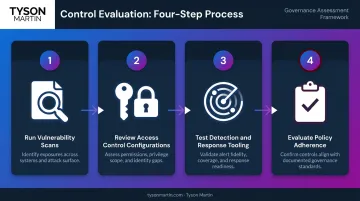
Step 3: Evaluate Controls, Vulnerabilities, and Gaps
Assess control effectiveness — not just whether controls are present. This means:
- Run vulnerability scans across infrastructure and applications
- Review access control configurations against least-privilege principles
- Test detection and response tooling to confirm it actually fires
- Evaluate policy adherence through sampling and interviews
This is where experienced judgment matters most. Knowing which gaps are genuinely material versus which create noise is the difference between an actionable roadmap and a 200-item remediation backlog that paralyzes the team.
Step 4: Assess Compliance Alignment and Regulatory Exposure
Map existing controls against applicable frameworks and regulations. Identify gaps that carry direct legal or financial consequence, and note upcoming regulatory changes that affect the posture picture.
For public companies, this step carries additional weight. SEC cybersecurity disclosure rules now require a defined process for identifying and managing material cyber risks — and annual disclosures must address it explicitly, not in passing.
Step 5: Analyze Findings and Prioritize by Business Impact
Not all vulnerabilities are equal. A critical-severity finding on a low-value test system matters far less than a medium-severity access control gap on a system processing customer financial data.
Score and prioritize findings by potential business impact:
- Likelihood of exploitation given current threat environment
- Magnitude of business disruption if exploited
- Regulatory or legal exposure associated with the gap
- Cost and complexity of remediation
Without this lens, the CISO walks into a board meeting with a severity list. With it, they walk in with a decision brief.
Step 6: Report, Communicate, and Build an Actionable Roadmap
Findings need to serve two audiences simultaneously:
Board and audit committee:
- Plain-English risk summary with trend (not just point-in-time status)
- What changed since the last review and why it matters
- Material exposures requiring a board decision or formal delegation
- Clear separation between what the board decides and what management executes
Management:
- Detailed remediation roadmap with named owners and sequenced priorities
- Timelines tied to business risk, not technical convenience
- Measurable outcomes so progress can be reported up
The reporting step is where most assessments fail. Findings land in a technical document, the security team has a checklist, and the board receives nothing it can act on. If the board can't ask a specific question after reading the report, the report hasn't done its job.
Frameworks That Guide Cybersecurity Posture Assessments
Frameworks provide a structured, accepted language for measuring and communicating security maturity. The right choice depends on industry, regulatory requirements, and current maturity level. Many mature programs align to two or more simultaneously.
| Framework | Best For |
|---|---|
| NIST CSF 2.0 | Flexible, risk-based baseline for US enterprises across sectors; supports current and target state profiling |
| ISO/IEC 27001:2022 | Organizations needing internationally recognized ISMS certification; strong for global operations and third-party assurance |
| PCI DSS v4.0.1 | Mandatory for organizations handling payment card data |
| HIPAA Security Rule | Required for healthcare covered entities and business associates |
| COBIT 2019 | IT governance alignment; useful when bridging security posture to broader enterprise governance structures |
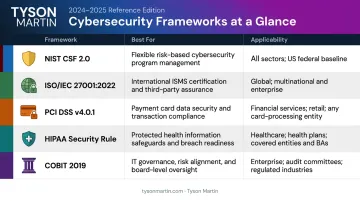
Framework selection matters less than commitment to one. The real value is a consistent, inspectable baseline the organization can measure against over time. A board dashboard anchored to a stable framework shows whether posture is improving, holding, or deteriorating — cycle over cycle, not just the latest standalone snapshot.
Turning Assessment Findings into Board-Level Action
Technically complete findings that don't drive decisions are organizationally inert. The security team has a vulnerability list. The board has no idea what to prioritize. That gap is where most assessments die.
What Board-Ready Output Looks Like
An effective posture assessment output for boards and audit committees includes:
- Plain-English risk summary — where the organization stands, what has changed since the last review
- Material exposures in business terms — regulatory exposure, operational impact, reputational consequence
- Trend indicators — is posture improving, stable, or deteriorating?
- Decisions requested — one to three specific items with options, cost ranges, and a recommended path
The format should stay consistent meeting to meeting. Stability in the dashboard is what allows boards to spot drift and track genuine progress rather than comparing incomparable snapshots.
The Posture Score: What It Does and Doesn't Tell You
A cybersecurity posture score translates assessment findings into a quantified benchmark, derived from control coverage, risk severity of identified gaps, and compliance alignment. The absolute number matters less than its direction. A score moving from 62 to 71 over three quarters tells a governance story. A static score tells the board nothing useful.
Metrics should include targets (what's acceptable), trends (whether you're improving), and time-to-fix (how long risk stays open). Boards don't need 20 metrics; they need 8 to 12 stable ones tied to business outcomes.
Governance Actions That Follow an Assessment
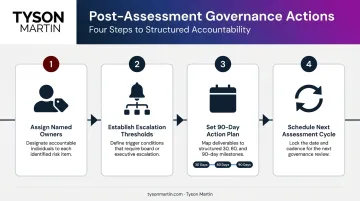
An assessment without follow-through is an expensive document. The governance actions that should follow:
- Assign owners to every remediation priority—not a team, a named individual
- Establish escalation thresholds — what triggers board notification vs. management response
- Set a 90-day action plan with measurable outcomes at 30, 60, and 90 days
- Schedule the next assessment cycle as a routine governance rhythm, not a one-time project
Regulated industries face growing pressure to demonstrate this oversight formally. Three rules now make posture assessment a compliance requirement, not just good governance:
- SEC cybersecurity disclosure rules — annual reporting on board oversight processes
- NYDFS Part 500 — at minimum an annual written report to the senior governing body
- FTC Safeguards Rule — regular board reporting on the overall security program
Organizations that can't show a consistent assessment record have no evidence to produce when regulators or plaintiffs ask for it.
How Tyson Martin Can Help
Tyson Martin works with boards and executive teams to reduce technology and cyber risk without slowing the business — by clarifying decision rights, tightening governance, and building execution frameworks that can be inspected.
His background includes leading security and technology transformation at AWS, Home Depot, and Best Buy. He holds CISSP certification and contributes actively to NACD, the NRF CISO Executive Committee, and the World Economic Forum's Centre for Cybersecurity.
In the context of a posture assessment, Tyson steps in as an interim or fractional CISO to scope the engagement around what matters most to the business—not a comprehensive checklist—and facilitates discovery, control evaluation, and findings translation. The output is built for action:
- A plain-English risk view tied to business priorities
- A prioritized roadmap with named owners and 30/60/90-day milestones
- A board-ready dashboard showing posture trend over time
For boards and audit committees, that translates into a consistent briefing structure each quarter:
- Top risks in plain language
- What changed since the last meeting
- Decisions needed from the board
- Progress against outcomes, with evidence rather than stories
The dashboard stays stable quarter to quarter so directors can track whether posture is improving — rather than receiving a new, incomparable snapshot each cycle.
Organizations in transition — new leadership, approaching M&A, a recent incident, or regulatory pressure — often need someone who can establish a credible baseline quickly and translate it into defensible decisions.
If that describes your situation, connect with Tyson on LinkedIn to discuss your posture assessment needs.
Frequently Asked Questions
What is a cybersecurity posture assessment?
A cybersecurity posture assessment is a structured, organization-wide evaluation of how effectively people, processes, and technology defend against cyber threats—covering assets, controls, compliance alignment, and incident readiness. It produces a prioritized improvement roadmap and a measurable baseline for governance tracking.
What is a cybersecurity posture score?
A posture score is a quantified measure of security maturity, typically derived from control coverage, risk severity of identified gaps, and compliance alignment. Its value lies in trend direction over time—showing whether posture is improving or deteriorating—rather than its absolute number.
What frameworks are used for cybersecurity posture assessments?
The most widely used frameworks are NIST CSF, ISO 27001, PCI DSS, HIPAA Security Rule, and COBIT. The right choice depends on industry, regulatory requirements, and maturity level. Many organizations align to more than one simultaneously.
How often should a cybersecurity posture assessment be conducted?
At minimum, a full assessment annually—with continuous or quarterly monitoring of key metrics. Assessments should also be triggered by major events: leadership changes, M&A activity, significant incidents, or new regulatory requirements.
What is the difference between a cybersecurity posture assessment and a risk assessment?
A risk assessment identifies and scores specific threats and vulnerabilities. A posture assessment evaluates the overall defensive architecture designed to manage those risks. Both are complementary, but distinct: posture assessment provides the broader governance view boards need to oversee risk strategy, not just individual exposures.
How should cybersecurity posture assessment findings be presented to a board?
Findings should be translated from technical vulnerability lists into business-risk terms. Effective board presentations cover:
- Overall posture status and what changed since the last review
- The most material risks and their potential business impact
- Specific decisions the board needs to make or delegate to management